

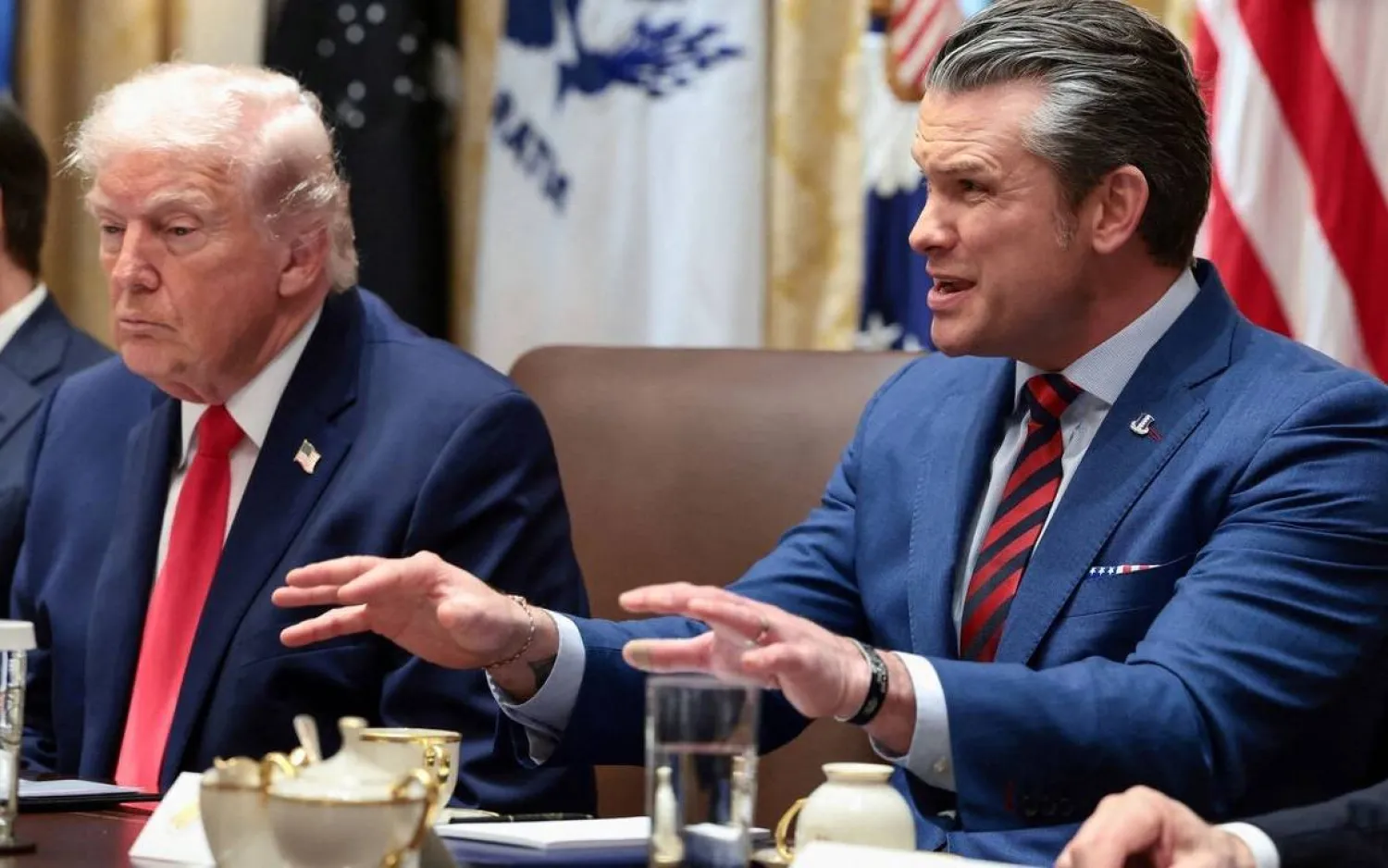

Trump Orders Pentagon to Cut Back Military Exercises with South Korea

US President Donald Trump listens as Secretary of War Pete Hegseth speaks (Reuters)
TT

Trump Orders Pentagon to Cut Back Military Exercises with South Korea

US President Donald Trump listens as Secretary of War Pete Hegseth speaks (Reuters)

US President Donald Trump on Sunday instructed the Pentagon to “substantially reduce” 10 days of joint military exercises with South Korea as they were about to get underway, citing the cost of the drills and Seoul's refusal to take part in actions against Iran.

Hours before exercises were scheduled to begin, Trump said on his Truth Social site that although it was too late to cancel the drills entirely, he was “not happy” that the US had previously agreed to participate and highlighted his “very good relationship” with North Korean leader Kim Jong Un, according to Reuters.

“These exercises are not only costly... but send a signal that is totally inappropriate and hostile, to a Country that, as long as Donald J Trump has been President, has been unthreatening and respectful,” Trump wrote.

South Korea's Joint Chiefs of Staff told Reuters that the drills started on Monday as scheduled, but declined comment on Trump's comments. The country's presidential office and defense and foreign ministries did not immediately respond on a public holiday in Seoul.

The annual Ulchi Freedom Shield joint military exercises are scheduled to run from August 17 to 27, with about 18,000 South Korean military ⁠personnel participating. The drills are expected to include operations to counter drones, disrupt GPS signals and cyberattacks to adapt to North Korea's evolving capabilities, officials said last week.

Trump also pointed to South Korea's stance on the US-Israeli conflict with Iran.

“While somewhat unrelated (?), I recently asked the President of South Korea if they would like to join us in the Denuclearization of the Islamic Republic of Iran, and they said, 'No thanks!’” Trump wrote.

A Pentagon spokesperson referred questions on the matter to the White House, which did not immediately respond to a request for more information on next steps for the drills.

Pyongyang routinely denounces the US-South Korean exercises as preparations for an invasion. North Korea last Wednesday fired a ballistic missile from its eastern coast towards the Sea of Japan, the South Korean and Japanese militaries said, six days after a similar North Korean short-range ballistic missile launch on August 6.

US military officials have said that North Korean troops, who have fought alongside Russia in its invasion of Ukraine, have gained experience from the conflict, including the growing use of unmanned systems, electronic warfare and cyber operations.

Ukraine said last week that North Korean-made missiles were used in a Russian ballistic missile attack on a steel plant in ⁠Zaporizhzhia that killed seven workers and forced a production halt, with Russia's Zircon hypersonic missiles also used in the attack.

A high-ranking US Northern Command official, Lieutenant General Joseph Jarrard, last week warned that North Korea had successfully tested intercontinental ballistic missiles with “enough boost to deliver a nuclear payload anywhere in North America,” complicating US homeland defense efforts.



Report: Nechirvan Barzani Secretly Mediated Between Washington and Iran’s Revolutionary Guards

Iraqi Kurdish leader Nechirvan Barzani and Iranian Parliament Speaker Mohammad Bagher Ghalibaf at the funeral of former Supreme Leader Ali Khamenei in Tehran on July 3. (Iranian Ministry of Foreign Affairs)
TT

Report: Nechirvan Barzani Secretly Mediated Between Washington and Iran’s Revolutionary Guards

Iraqi Kurdish leader Nechirvan Barzani and Iranian Parliament Speaker Mohammad Bagher Ghalibaf at the funeral of former Supreme Leader Ali Khamenei in Tehran on July 3. (Iranian Ministry of Foreign Affairs)

The administration of US President Donald Trump tapped Iraqi Kurdish leader Nechirvan Barzani as a secret backchannel to get in direct touch with Iranian Revolutionary Guard Corps (IRGC) commanders after Washington doubted Iranian negotiators were empowered to reach a deal to end the war, Axios reported on Sunday.

Citing three sources with direct knowledge of the contacts, Axios said that in May, White House negotiators started to think that Iranian negotiators — Parliament Speaker Mohammad Bagher Ghalibaf and Foreign Minister Abbas Araghchi — were not empowered to cut a deal and were being overruled by the IRGC.

The doubts emerged when the White House felt it was closing in on a deal, but Iran delayed its response for more than 10 days.

The White House realized it needed a backchannel to IRGC leadership. Around May 10, then-Director of National Intelligence Tulsi Gabbard called Barzani.

According to two sources with direct knowledge of the call, Gabbard told Barzani that the administration thought he could help get in touch with the commander of the IRGC, General Ahmad Vahidi.

One of the sources said Gabbard made clear to Barzani that she was making the call with the approval of Trump and Vice President JD Vance.

Gabbard also told Barzani the White House wanted to know if Vahidi and the IRGC leadership were on board with what Ghalibaf and Araghchi had been negotiating or whether they had other ideas or demands, the source told Axios.

Washington contacted Barzani because during the Iran-Iraq, he lived in Iran and studied at the University of Tehran. He is fluent in Farsi and has personal relationships with many senior members of the Iranian regime, including top members of the IRGC, according to one of the sources.

“Nechirvan Barzani is a pragmatic problem solver. He's respected across the region. He knows nearly everyone in Tehran, as well as Washington. That's who you call in a pinch,” Brett McGurk, who has served as a Middle East adviser to four presidents, said in an interview.

Talks with Vahidi

Barzani agreed to Gabbard's request, Axios wrote. He reached out to his contacts at the IRGC and said he had a message from the Trump administration.

“But I want to talk directly to General Vahidi,” Barzani stressed, according to one of the sources.

The Iranians agreed. On May 14, an IRGC official arrived in Barzani's office in Erbil, the capital of Iraqi Kurdistan, carrying an encrypted phone to conduct a secure call.

Barzani asked Vahidi if he was aligned with the Iranian negotiators. The Iranian general said he was. “I fully support them and this is also the position of the IRGC. We prefer to solve this crisis through negotiations,” Vahidi said, according to a source with direct knowledge.

Three sources, including a White House official, told Axios that Barzani called Gabbard right after his conversation with Vahidi and briefed her on the Iranian response. Gabbard then briefed the White House.

After receiving the Iranian response, the Trump administration came back with another proposal, according to one of the sources with knowledge of the backchannel talks. The US wanted Barzani to host secret talks between senior US and Iranian negotiators in Erbil.

Barzani spoke to the Iranians again and passed on the message. The Iranians didn't rule it out, but were concerned about their security, the source said.

They believed Israeli intelligence had many assets in Iraqi Kurdistan and were concerned the Israelis would try to assassinate them in Erbil or while they traveled there and back. The Erbil meeting never materialized.

The episode shows how tricky it's been for the US to negotiate with a country where Washington isn't sure who exactly is in charge. The US and Iran did reach a memorandum of understanding, but it quickly collapsed.

The Trump administration's key problem today and in any future negotiation will be to make sure it is talking to the people who are actually calling the shots. That also means finding mediators who are trusted by both the White House and the Iranian regime, said Axios.

It added that the Pakistani and Qatari mediators continue to exchange messages between the US and Iran but without any significant progress, regional sources with knowledge of the matter said.

Some of those sources believe the Pakistanis are giving more optimistic readouts than the talks justify in an effort to create a sense of momentum that could break the stalemate.

Barzani has recently sent messages to the White House offering to help restart US-Iran negotiations, according to a source with knowledge of the matter.

McGurk said the issue is not the mediator. “It's Iran's policy on the Hormuz Strait,” he said, “and that's unlikely to change anytime soon.”


India Temple Stampede Kills Seven

Artists wait to participate in the annual Athachamayam procession that marks the beginning of the 10-day Onam festival in Tripunithura, Kerala, India, Sunday, Aug.16, 2026. (AP Photo/ R S Iyer)
TT

India Temple Stampede Kills Seven

Artists wait to participate in the annual Athachamayam procession that marks the beginning of the 10-day Onam festival in Tripunithura, Kerala, India, Sunday, Aug.16, 2026. (AP Photo/ R S Iyer)

A stampede at a Hindu temple in India's eastern Bihar state killed at least seven people and injured 19 others on Monday, officials said.

Deadly stampedes are a common occurrence at big Indian gatherings and religious festivals, mainly due to poor crowd management.

The incident occurred at the Ashok Dham temple in Bihar state's Lakhisarai district, where a massive crowd had gathered to pay homage to the Hindu deity Shiva.

The stampede was triggered after rumours spread that an electric pole had fallen on devotees inside the temple premises, district magistrate Shailendra Kumar told AFP.

"The situation is under control now," Kumar said, confirming the casualties.

Around 19 others were undergoing hospital treatment, he added.

Bihar's Chief Minister Samrat Choudhary called the incident "heart-wrenching" and announced compensation of 400,000 rupees ($4,180) to the family of each victim.

The tragedy is the latest in a series of fatal stampedes in India.

In November last year, nine people were killed in a crush at a temple in the southern state of Andhra Pradesh.

Another stampede at a political rally in Tamil Nadu last year left 36 people dead.

One of the country's worst recent crowd disasters occurred in 2024 in Uttar Pradesh, where 120 people were killed during a religious sermon attended by thousands of devotees.


Ebola Outbreak in DR Congo Now Deadliest in Country's History

People in protective gear lower into a grave the coffin containing the remains of Jacques Lobo Dhena, who died of Ebola, during a burial service in Bunia, Ituri province, eastern Congo, Wednesday, Aug. 12, 2026. (AP Photo/Dieudonne Dirole)
TT

Ebola Outbreak in DR Congo Now Deadliest in Country's History

People in protective gear lower into a grave the coffin containing the remains of Jacques Lobo Dhena, who died of Ebola, during a burial service in Bunia, Ituri province, eastern Congo, Wednesday, Aug. 12, 2026. (AP Photo/Dieudonne Dirole)

The Ebola outbreak in Democratic Republic of Congo has killed 2,325 people, government data showed on Sunday, surpassing the toll from the 2018-2020 outbreak to become the deadliest in the country's history.

Congo's public health institute said in its latest report that confirmed cases had risen to 4,945, including 101 new cases detected in the previous 24 hours, according to Reuters.

The outbreak, Congo's 17th, was already the biggest in the country's history in terms of number of cases - a milestone reached in late July.

The latest government data shows that the total number of deaths has surpassed the 2,299 deaths recorded in Congo's 2018-2020 outbreak, which was previously the country's worst on record.

There are now 4,945 confirmed cases, the data showed.

Three months after it was formally announced, the outbreak is now dwarfed only by ⁠West Africa's 2014-2016 Ebola outbreak in which 28,616 cases and 11,310 deaths were recorded across Guinea, Liberia and Sierra Leone, according to the World Health Organization.

It took nearly five months from the declaration of that outbreak to hit 1,000 deaths, whereas Congo's current outbreak hit 2,000 deaths in less than three months.

No Treatments Available for Rare Ebola Species

The current outbreak is caused by the Bundibugyo species of Ebola, which has no approved vaccines or treatments. The outbreak has gained momentum since it was declared on May 15, as weak health infrastructure, community resistance and instability hinder the effort to identify and respond to cases.

The proportion of people dying from the outbreak after a confirmed infection, known as the case fatality ratio, has risen from about 20% in ⁠early June to 46%, according to government data, meaning nearly one in every two confirmed cases is now fatal.

Experts say the trend does not indicate the virus has become more lethal. Instead, it points to persistent shortcomings in surveillance, case detection and access to care.

“Normally, as an outbreak progresses, the case fatality ratio should fall as contact tracing improves and patients are identified and treated earlier,” said Thomas Parisch, a ⁠public health specialist recently deployed to Democratic Republic of Congo with Medecins Sans Frontieres.

“Instead, we're still seeing many cases detected very late, when treatment is less likely to succeed, with many identified only after they die in the community,” he added.

A small number of experimental vaccines and therapies are ⁠being evaluated, while global health authorities assess whether existing Ebola treatments could offer protection. Evidence so far is limited to animal studies.

The outbreak earlier spread to neighboring Uganda, but authorities there managed to limit deaths to two and confirmed cases to ⁠20 before declaring an end to the outbreak in that country last month. Ebola spreads through direct contact with the bodily fluids of infected people, living or dead. It can cause fever, vomiting, diarrhea and, in severe cases, internal and external bleeding.