


Ebola Outbreak in DR Congo Now Deadliest in Country's History

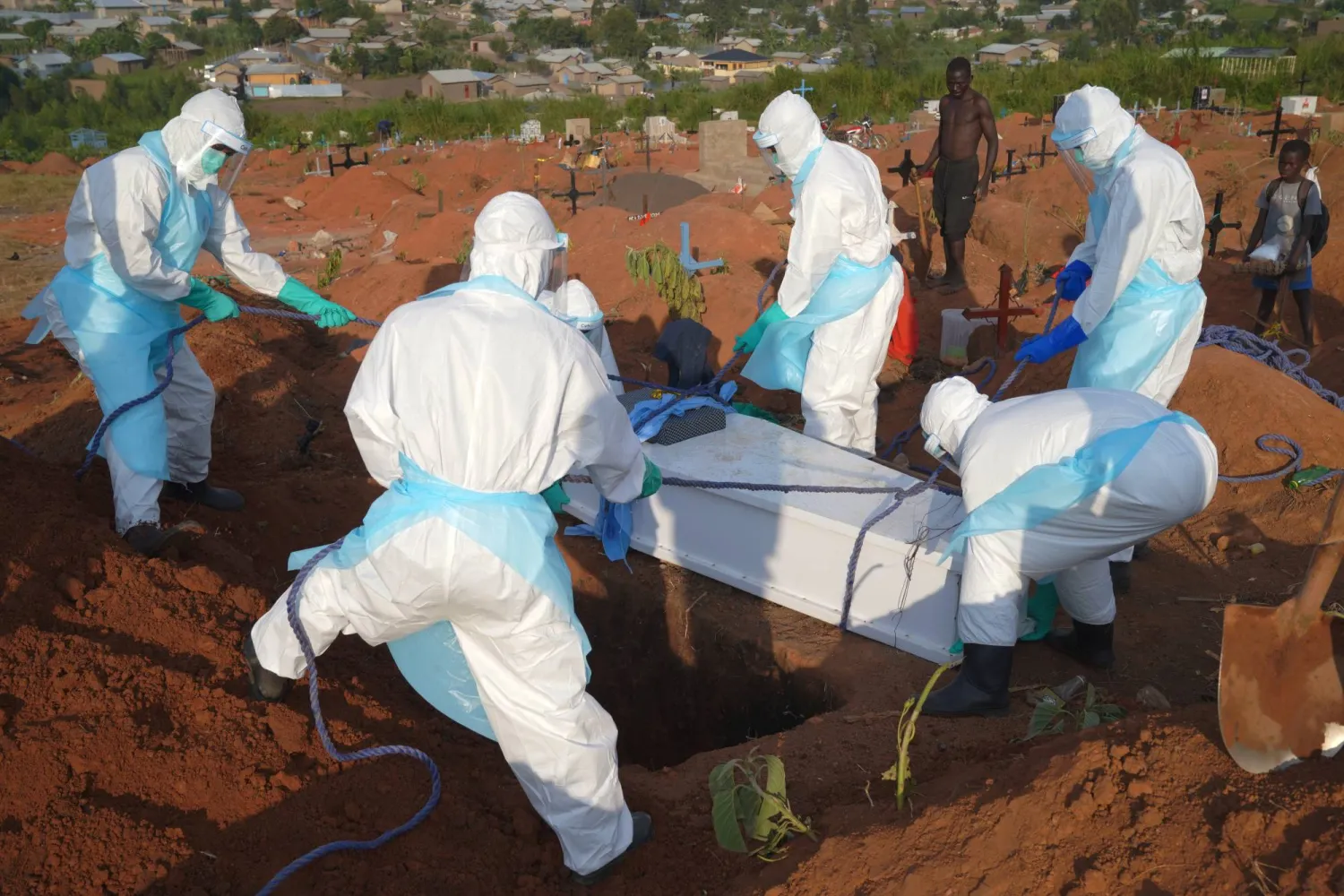
People in protective gear lower into a grave the coffin containing the remains of Jacques Lobo Dhena, who died of Ebola, during a burial service in Bunia, Ituri province, eastern Congo, Wednesday, Aug. 12, 2026. (AP Photo/Dieudonne Dirole)
TT

Ebola Outbreak in DR Congo Now Deadliest in Country's History

People in protective gear lower into a grave the coffin containing the remains of Jacques Lobo Dhena, who died of Ebola, during a burial service in Bunia, Ituri province, eastern Congo, Wednesday, Aug. 12, 2026. (AP Photo/Dieudonne Dirole)

The Ebola outbreak in Democratic Republic of Congo has killed 2,325 people, government data showed on Sunday, surpassing the toll from the 2018-2020 outbreak to become the deadliest in the country's history.

Congo's public health institute said in its latest report that confirmed cases had risen to 4,945, including 101 new cases detected in the previous 24 hours, according to Reuters.

The outbreak, Congo's 17th, was already the biggest in the country's history in terms of number of cases - a milestone reached in late July.

The latest government data shows that the total number of deaths has surpassed the 2,299 deaths recorded in Congo's 2018-2020 outbreak, which was previously the country's worst on record.

There are now 4,945 confirmed cases, the data showed.

Three months after it was formally announced, the outbreak is now dwarfed only by ⁠West Africa's 2014-2016 Ebola outbreak in which 28,616 cases and 11,310 deaths were recorded across Guinea, Liberia and Sierra Leone, according to the World Health Organization.

It took nearly five months from the declaration of that outbreak to hit 1,000 deaths, whereas Congo's current outbreak hit 2,000 deaths in less than three months.

No Treatments Available for Rare Ebola Species

The current outbreak is caused by the Bundibugyo species of Ebola, which has no approved vaccines or treatments. The outbreak has gained momentum since it was declared on May 15, as weak health infrastructure, community resistance and instability hinder the effort to identify and respond to cases.

The proportion of people dying from the outbreak after a confirmed infection, known as the case fatality ratio, has risen from about 20% in ⁠early June to 46%, according to government data, meaning nearly one in every two confirmed cases is now fatal.

Experts say the trend does not indicate the virus has become more lethal. Instead, it points to persistent shortcomings in surveillance, case detection and access to care.

“Normally, as an outbreak progresses, the case fatality ratio should fall as contact tracing improves and patients are identified and treated earlier,” said Thomas Parisch, a ⁠public health specialist recently deployed to Democratic Republic of Congo with Medecins Sans Frontieres.

“Instead, we're still seeing many cases detected very late, when treatment is less likely to succeed, with many identified only after they die in the community,” he added.

A small number of experimental vaccines and therapies are ⁠being evaluated, while global health authorities assess whether existing Ebola treatments could offer protection. Evidence so far is limited to animal studies.

The outbreak earlier spread to neighboring Uganda, but authorities there managed to limit deaths to two and confirmed cases to ⁠20 before declaring an end to the outbreak in that country last month. Ebola spreads through direct contact with the bodily fluids of infected people, living or dead. It can cause fever, vomiting, diarrhea and, in severe cases, internal and external bleeding.


Two Dead, Hundreds Evacuated from Fires on Island near Athens

TOPSHOT - Firefighters work to extinguish a wildfire raging since four days in the Megara Region, west of Athens on August 3, 2026. (Photo by Aris Oikonomou / AFP)
TT

Two Dead, Hundreds Evacuated from Fires on Island near Athens

TOPSHOT - Firefighters work to extinguish a wildfire raging since four days in the Megara Region, west of Athens on August 3, 2026. (Photo by Aris Oikonomou / AFP)

Two people died and hundreds of weekend bathers were hurriedly evacuated Sunday after two fires broke out on the Greek island of Salamis near Athens in less than half an hour, the fire department said.

While another fire on the Aegean island of Skyros was brought under control, a fire department spokesman told AFP that "two bodies were recovered" from the Peristeria beach area in the south of Salamis.

"Over 570 people were evacuated on coast guard patrol boats and other vessels," a coastguard spokeswoman told AFP.

Fire department communications director Vassilis Vathrakogiannis said the separate fires had broken out in Peristeria and near Selinia, two popular beaches in the island's south and east, within 20 minutes of each other.

With hundreds enjoying a sunny Sunday at the beach a short boat ride from Athens, the civil protection ministry issued four evacuation orders in quick succession.

The Greek blazes come as Europe battles a succession of wildfires breaking out in tinderbox-like conditions, driven by widespread droughts and high temperatures that scientists have linked to climate change.

- 'Spread in seven minutes' -

But two people, reportedly an elderly couple, died before firefighters could get to them, Vathrakogiannis said in a televised address.

With the wind reaching up to 61 kilometers (38 miles) per hour, the fire "spread rapidly in seven minutes", he said.

Nine people required medical care for burns, state agency ANA said.

Greek TV stations showed footage of several homes gutted by the flames.

Salamis, just west of Athens, has some 37,000 residents, many of them elderly, and the beaches were full of people on Sunday, including day travelers, officials said.

Battling through rocky terrain, firefighters managed to keep the blaze in Selinia from scaling a mountain and linking up with the other fire, Salamis's deputy mayor Thodoris Zannis told the ERT TV station.

A fire department spokesman told AFP that the Selinia blaze had been put out by the evening, while scattered pockets of fire remained at Peristeria.

The fire service mobilized a large force of some 260 firefighters, nearly 60 engines, 10 aircraft and seven helicopters, rushing in reinforcements from the mainland.

- Skyros blaze contained -

After largely escaping the heatwave temperatures that blanketed much of Europe earlier this summer, Greece has been hit with several major wildfires since late July, fueled by unusually strong winds.

Firefighters had largely contained a blaze on the island of Skyros earlier, an AFP reporter said.

A local forestry official said the fire, which started Saturday, had burned some 1,300 hectares of forest.

The same northwestern part of the island had been struck by fires in 2008 and 2014.

Thirty-six blazes have broken out over the past 24 hours around the country, according to the fire department.

Five firefighters have died so far, including a Danish pilot killed in a mid-air collision between two helicopters while battling a blaze near Athens earlier this month.

Winds were expected to ease later Sunday. According to the civil protection ministry, no area will be above 3 out of 5 on the national fire risk scale on Monday for the first time in 10 days.

Greece is hit by wildfires every year.

Experts say the risk is growing because of human-fueled climate change, which has made droughts and other extreme weather events more severe, frequent and longer-lasting.


Ukrainian Missile Strikes Kill 6 in Russia’s Belgorod

People clean up debris outside a building damaged during a Ukrainian overnight drone attack, according to local authorities, in the course of Russia-Ukraine conflict, in central Belgorod, Russia August 9, 2026. (Reuters)
TT

Ukrainian Missile Strikes Kill 6 in Russia’s Belgorod

People clean up debris outside a building damaged during a Ukrainian overnight drone attack, according to local authorities, in the course of Russia-Ukraine conflict, in central Belgorod, Russia August 9, 2026. (Reuters)

Ukrainian missile strikes killed six people and wounded four others, including a child, in Russia's Belgorod region, the acting governor said Monday.

With frontline fighting at a near standstill and talks frozen, the warring countries have significantly stepped up missile attacks, pushing the civilian death toll to its highest levels since the war's first months in 2022.

"Ukrainian terrorists attacked the village of Koloskovo, Valuysky district, with missiles," Belgorod acting governor Alexander Shuvaev said on the state-backed MAX platform. Koloskovo is about 15 kilometers (10 miles) from the Ukraine border.

The attack, which Shuvaev said burned a "structure" and damaged a vehicle, came a day after Russia and Ukraine carried out missile and drone strikes deep inside each other's territory that killed 19 people on both sides.

Moscow has carried out near-daily missile and drone strikes across Ukraine since launching its full-scale invasion in early 2022.

It has recently intensified attacks using hard-to-intercept ballistic missiles, exploiting Ukraine's air-defense shortages after the US-Israeli war against Iran diverted supplies.

Ukraine has increasingly targeted warehouses belonging to Russia's biggest online retailer Wildberries, saying the company supplies components for Russian drones.

Ukrainian President Volodymyr Zelensky says those strikes, along with attacks on oil refineries, are aimed at undermining Russia's war economy.

In July alone, 437 civilians were killed in Ukraine, the highest monthly toll since May 2022, according to a United Nations tally.

Russian authorities have reported 79 civilians killed on their side in July, up from the previous month.


Thousands in Indonesia Await Aid After Quake Kills 54, Overshadowing Independence Day

 Soldiers work to move medical supplies out of a damaged hospital in the aftermath of an earthquake in Nagekeo, East Nusa Tenggara, Indonesia, August 17, 2026. (Reuters)
Soldiers work to move medical supplies out of a damaged hospital in the aftermath of an earthquake in Nagekeo, East Nusa Tenggara, Indonesia, August 17, 2026. (Reuters)
TT

Thousands in Indonesia Await Aid After Quake Kills 54, Overshadowing Independence Day

 Soldiers work to move medical supplies out of a damaged hospital in the aftermath of an earthquake in Nagekeo, East Nusa Tenggara, Indonesia, August 17, 2026. (Reuters)
Soldiers work to move medical supplies out of a damaged hospital in the aftermath of an earthquake in Nagekeo, East Nusa Tenggara, Indonesia, August 17, 2026. (Reuters)

Thousands of people were still waiting for aid on the Indonesian island of Flores as the country celebrated its 81st Independence Day on Monday, days after a powerful earthquake killed at least 54 people, injured dozens and damaged hundreds of homes and other buildings.

Many residents spent the day mourning victims, searching for loved ones and waiting for aid to arrive to communities still cut off by the deadly quake.

More than 1,300 homes were damaged when the quake struck East Nusa Tenggara province on Saturday, with nearly 250 were destroyed on Flores alone. Some 5,000 people were forced into temporary shelters and 135 people were injured, according to the National Disaster Management Agency.

The province's governor declared a 14-day state of emergency on Sunday.

The quake occurred at a depth of 10 kilometers (6 miles) shortly before 6 a.m. Saturday, according to the US Geological Survey, and residents fled in panic as tsunami warnings were issued and later lifted. Authorities have since recorded at least 995 aftershocks, but only 46 were felt by residents.

Thousands of people on Flores camped outside collapsed homes under tarpaulin tents overnight into Monday, sleeping outside because of the danger of more aftershocks.

An Associated Press photojournalist saw widespread devastation across the island, with fallen trees blocking roads, giant boulders hurled downslope by landslides, and homes left shattered or heavily damaged. Parked cars were crushed when buildings collapsed during the quake.

For many residents, the disaster revived painful memories of a powerful earthquake and tsunami that struck Flores in 1992, killing about 2,500 people.

"My house is just rubble now,” said Rasyid Jafar, a clothing trader in the village of Reo, the hardest-hit area in Manggarai regency. “We need food, medicine and clean water urgently.”

More than 3,500 military and police personnel have been deployed across the disaster zone and 275 tons of aid have been to the area, though logistical challenges have slowed deliveries to some hard-hit communities.

While some relief has trickled in, survivors say they still need equipment to cook food.

“We have nothing left ... Why isn’t there a public kitchen?" said Mariana Tewu, another villager in Reo.

Indonesia, an archipelago of more than 17,000 islands, is prone to earthquakes and volcanic eruptions because of its location on the Pacific “Ring of Fire,” a horseshoe-shaped arc of seismic faults and volcanoes.

In 2018, a magnitude 7.5 earthquake triggered a tsunami on the island of Sulawesi that killed more than 4,400 people. In 2004, a magnitude 9.1 quake off Sumatra unleashed a tsunami that killed about 230,000 people in a dozen countries, nearly 170,000 in Aceh province alone.