


Report: Nechirvan Barzani Secretly Mediated Between Washington and Iran’s Revolutionary Guards

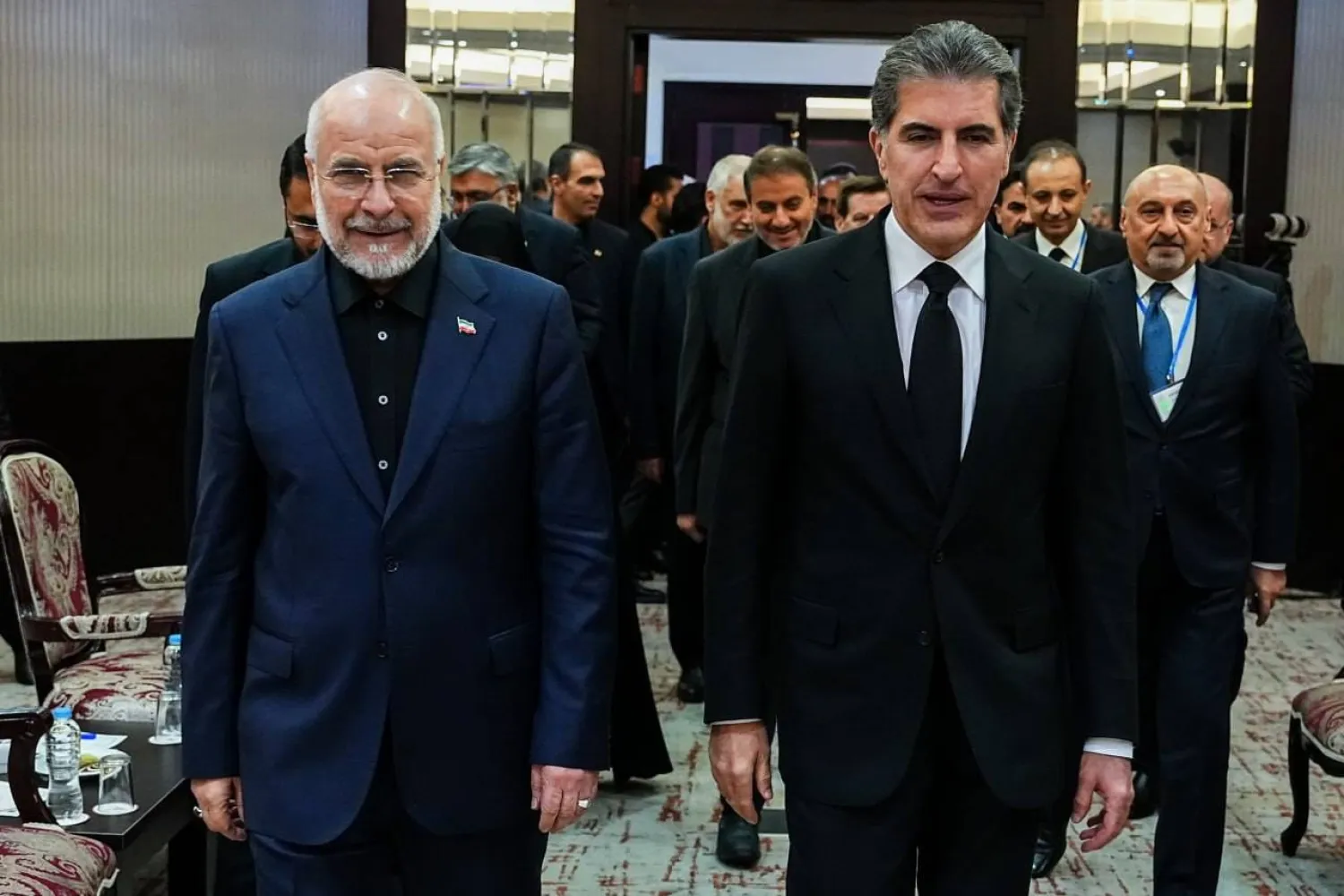
Iraqi Kurdish leader Nechirvan Barzani and Iranian Parliament Speaker Mohammad Bagher Ghalibaf at the funeral of former Supreme Leader Ali Khamenei in Tehran on July 3. (Iranian Ministry of Foreign Affairs)
TT

Report: Nechirvan Barzani Secretly Mediated Between Washington and Iran’s Revolutionary Guards

Iraqi Kurdish leader Nechirvan Barzani and Iranian Parliament Speaker Mohammad Bagher Ghalibaf at the funeral of former Supreme Leader Ali Khamenei in Tehran on July 3. (Iranian Ministry of Foreign Affairs)

The administration of US President Donald Trump tapped Iraqi Kurdish leader Nechirvan Barzani as a secret backchannel to get in direct touch with Iranian Revolutionary Guard Corps (IRGC) commanders after Washington doubted Iranian negotiators were empowered to reach a deal to end the war, Axios reported on Sunday.

Citing three sources with direct knowledge of the contacts, Axios said that in May, White House negotiators started to think that Iranian negotiators — Parliament Speaker Mohammad Bagher Ghalibaf and Foreign Minister Abbas Araghchi — were not empowered to cut a deal and were being overruled by the IRGC.

The doubts emerged when the White House felt it was closing in on a deal, but Iran delayed its response for more than 10 days.

The White House realized it needed a backchannel to IRGC leadership. Around May 10, then-Director of National Intelligence Tulsi Gabbard called Barzani.

According to two sources with direct knowledge of the call, Gabbard told Barzani that the administration thought he could help get in touch with the commander of the IRGC, General Ahmad Vahidi.

One of the sources said Gabbard made clear to Barzani that she was making the call with the approval of Trump and Vice President JD Vance.

Gabbard also told Barzani the White House wanted to know if Vahidi and the IRGC leadership were on board with what Ghalibaf and Araghchi had been negotiating or whether they had other ideas or demands, the source told Axios.

Washington contacted Barzani because during the Iran-Iraq, he lived in Iran and studied at the University of Tehran. He is fluent in Farsi and has personal relationships with many senior members of the Iranian regime, including top members of the IRGC, according to one of the sources.

“Nechirvan Barzani is a pragmatic problem solver. He's respected across the region. He knows nearly everyone in Tehran, as well as Washington. That's who you call in a pinch,” Brett McGurk, who has served as a Middle East adviser to four presidents, said in an interview.

Talks with Vahidi

Barzani agreed to Gabbard's request, Axios wrote. He reached out to his contacts at the IRGC and said he had a message from the Trump administration.

“But I want to talk directly to General Vahidi,” Barzani stressed, according to one of the sources.

The Iranians agreed. On May 14, an IRGC official arrived in Barzani's office in Erbil, the capital of Iraqi Kurdistan, carrying an encrypted phone to conduct a secure call.

Barzani asked Vahidi if he was aligned with the Iranian negotiators. The Iranian general said he was. “I fully support them and this is also the position of the IRGC. We prefer to solve this crisis through negotiations,” Vahidi said, according to a source with direct knowledge.

Three sources, including a White House official, told Axios that Barzani called Gabbard right after his conversation with Vahidi and briefed her on the Iranian response. Gabbard then briefed the White House.

After receiving the Iranian response, the Trump administration came back with another proposal, according to one of the sources with knowledge of the backchannel talks. The US wanted Barzani to host secret talks between senior US and Iranian negotiators in Erbil.

Barzani spoke to the Iranians again and passed on the message. The Iranians didn't rule it out, but were concerned about their security, the source said.

They believed Israeli intelligence had many assets in Iraqi Kurdistan and were concerned the Israelis would try to assassinate them in Erbil or while they traveled there and back. The Erbil meeting never materialized.

The episode shows how tricky it's been for the US to negotiate with a country where Washington isn't sure who exactly is in charge. The US and Iran did reach a memorandum of understanding, but it quickly collapsed.

The Trump administration's key problem today and in any future negotiation will be to make sure it is talking to the people who are actually calling the shots. That also means finding mediators who are trusted by both the White House and the Iranian regime, said Axios.

It added that the Pakistani and Qatari mediators continue to exchange messages between the US and Iran but without any significant progress, regional sources with knowledge of the matter said.

Some of those sources believe the Pakistanis are giving more optimistic readouts than the talks justify in an effort to create a sense of momentum that could break the stalemate.

Barzani has recently sent messages to the White House offering to help restart US-Iran negotiations, according to a source with knowledge of the matter.

McGurk said the issue is not the mediator. “It's Iran's policy on the Hormuz Strait,” he said, “and that's unlikely to change anytime soon.”



In Spain's Ceuta, Hundreds of Migrants Stage Protest and Demand Asylum

TOPSHOT - Migrants pose for a picture while being escorted to the Ceuta-Morocco border in the Spanish North African enclave of Ceuta on August 1, 2026. (Photo by Henry NICHOLLS / AFP)
TT

In Spain's Ceuta, Hundreds of Migrants Stage Protest and Demand Asylum

TOPSHOT - Migrants pose for a picture while being escorted to the Ceuta-Morocco border in the Spanish North African enclave of Ceuta on August 1, 2026. (Photo by Henry NICHOLLS / AFP)

Hundreds of migrants ‌who recently entered Spain's North African enclave of Ceuta staged a protest on a popular urban beach on Sunday, urging Spanish authorities to grant them asylum instead of sending them back to Morocco.

They were among the estimated 5,000 to 8,000 who remain in Ceuta after the mass border crossing two weeks ago that saw over 72,000 people surge into the tiny territory of about 80,000. The vast majority returned voluntarily in the following days.

With the city's resources overstretched, most migrants were living in precarious conditions on El Trampolin beach or the city's outskirts while awaiting a chance to journey on to continental Europe.

"We're sleeping next to the sea, with cold and bad smells. We're suffering a lot," said Ayoub Elarroud from Morocco's Tetouan, adding that police were blocking migrants from going to the city center.

The protesters held up ‌Spanish flags and ‌banners reading "We don't want to go back to Morocco" and "We are also ‌human", ⁠while chanting slogans such ⁠as "We're tired" or "We need a solution". On the rocky shores behind them, some migrants washed their clothes while others fished with makeshift bamboo rods.

Earlier this week, Interior Minister Fernando Grande-Marlaska said migrants who had entered irregularly would not be allowed to stay in the enclave, travel to mainland Spain or obtain legal status, except in rare cases involving extreme vulnerability.

HEALTH SERVICES UNDER PRESSURE

The head of Ceuta's medical board, Enrique Roviralta, told Onda Cero radio that the city's limited healthcare workers were exhausted and criticized what he described as ⁠a slow response by the central government.

Roviralta added that diseases such as ‌infectious diarrhea and scabies were breaking out, and violence-related injuries such ‌as broken noses or stab wounds were rising.

On Sunday, Health Minister Monica Garcia rejected suggestions that local health ‌services had "collapsed", but acknowledged they were under pressure.

"To associate migration with illness is unjust and xenophobic," ‌she told reporters in Ceuta, adding there was a moderate risk of epidemic outbreaks for migrants and a low one for residents.

Most of the Moroccan migrants interviewed by Reuters said they were driven by poor working conditions in their country, despite many holding higher qualifications.

Mohammed Ouanzar, a 39-year-old automation specialist from Fez, said average monthly salaries of ‌3,000 dirham ($324) made it impossible for him to buy a home or start a family.

"Once I reached Spanish soil, I felt like I ⁠was born again," he ⁠said. "I'd rather die than return."

Hicham Chikir, 25, said most people were eager to work in Europe. "If anyone is bad, the police can send them back," he added.

REFUGEES EXHAUSTED

Emmanuel, a 30-year-old electrician who fled conflict-ridden northeastern Nigeria, said he decided to embark on a perilous four-month journey across Niger, Algeria and Morocco because his children had stopped going to school over fears of being kidnapped.

"I'm fighting for a better life for them," he said, adding that he would take any job he was offered.

Mohammad Ismail Hossain, 34, left Bangladesh over two years ago following the 2024 mass uprising. He traversed India, Pakistan, Iraq, Syria, Egypt, Libya and Algeria - mostly on foot - and saw many companions die of thirst in the desert.

Ousmane from southern Senegal said he was seeking asylum because he suffered persecution over his sexual orientation but had yet to obtain a reply from the local NGOs he had contacted.

"The worst thing is waiting all day with nothing to do, checking my emails constantly" he said.


Two Dead, Hundreds Evacuated from Fires on Island near Athens

TOPSHOT - Firefighters work to extinguish a wildfire raging since four days in the Megara Region, west of Athens on August 3, 2026. (Photo by Aris Oikonomou / AFP)
TT

Two Dead, Hundreds Evacuated from Fires on Island near Athens

TOPSHOT - Firefighters work to extinguish a wildfire raging since four days in the Megara Region, west of Athens on August 3, 2026. (Photo by Aris Oikonomou / AFP)

Two people died and hundreds of weekend bathers were hurriedly evacuated Sunday after two fires broke out on the Greek island of Salamis near Athens in less than half an hour, the fire department said.

While another fire on the Aegean island of Skyros was brought under control, a fire department spokesman told AFP that "two bodies were recovered" from the Peristeria beach area in the south of Salamis.

"Over 570 people were evacuated on coast guard patrol boats and other vessels," a coastguard spokeswoman told AFP.

Fire department communications director Vassilis Vathrakogiannis said the separate fires had broken out in Peristeria and near Selinia, two popular beaches in the island's south and east, within 20 minutes of each other.

With hundreds enjoying a sunny Sunday at the beach a short boat ride from Athens, the civil protection ministry issued four evacuation orders in quick succession.

The Greek blazes come as Europe battles a succession of wildfires breaking out in tinderbox-like conditions, driven by widespread droughts and high temperatures that scientists have linked to climate change.

- 'Spread in seven minutes' -

But two people, reportedly an elderly couple, died before firefighters could get to them, Vathrakogiannis said in a televised address.

With the wind reaching up to 61 kilometers (38 miles) per hour, the fire "spread rapidly in seven minutes", he said.

Nine people required medical care for burns, state agency ANA said.

Greek TV stations showed footage of several homes gutted by the flames.

Salamis, just west of Athens, has some 37,000 residents, many of them elderly, and the beaches were full of people on Sunday, including day travelers, officials said.

Battling through rocky terrain, firefighters managed to keep the blaze in Selinia from scaling a mountain and linking up with the other fire, Salamis's deputy mayor Thodoris Zannis told the ERT TV station.

A fire department spokesman told AFP that the Selinia blaze had been put out by the evening, while scattered pockets of fire remained at Peristeria.

The fire service mobilized a large force of some 260 firefighters, nearly 60 engines, 10 aircraft and seven helicopters, rushing in reinforcements from the mainland.

- Skyros blaze contained -

After largely escaping the heatwave temperatures that blanketed much of Europe earlier this summer, Greece has been hit with several major wildfires since late July, fueled by unusually strong winds.

Firefighters had largely contained a blaze on the island of Skyros earlier, an AFP reporter said.

A local forestry official said the fire, which started Saturday, had burned some 1,300 hectares of forest.

The same northwestern part of the island had been struck by fires in 2008 and 2014.

Thirty-six blazes have broken out over the past 24 hours around the country, according to the fire department.

Five firefighters have died so far, including a Danish pilot killed in a mid-air collision between two helicopters while battling a blaze near Athens earlier this month.

Winds were expected to ease later Sunday. According to the civil protection ministry, no area will be above 3 out of 5 on the national fire risk scale on Monday for the first time in 10 days.

Greece is hit by wildfires every year.

Experts say the risk is growing because of human-fueled climate change, which has made droughts and other extreme weather events more severe, frequent and longer-lasting.


Ukrainian Missile Strikes Kill 6 in Russia’s Belgorod

People clean up debris outside a building damaged during a Ukrainian overnight drone attack, according to local authorities, in the course of Russia-Ukraine conflict, in central Belgorod, Russia August 9, 2026. (Reuters)
TT

Ukrainian Missile Strikes Kill 6 in Russia’s Belgorod

People clean up debris outside a building damaged during a Ukrainian overnight drone attack, according to local authorities, in the course of Russia-Ukraine conflict, in central Belgorod, Russia August 9, 2026. (Reuters)

Ukrainian missile strikes killed six people and wounded four others, including a child, in Russia's Belgorod region, the acting governor said Monday.

With frontline fighting at a near standstill and talks frozen, the warring countries have significantly stepped up missile attacks, pushing the civilian death toll to its highest levels since the war's first months in 2022.

"Ukrainian terrorists attacked the village of Koloskovo, Valuysky district, with missiles," Belgorod acting governor Alexander Shuvaev said on the state-backed MAX platform. Koloskovo is about 15 kilometers (10 miles) from the Ukraine border.

The attack, which Shuvaev said burned a "structure" and damaged a vehicle, came a day after Russia and Ukraine carried out missile and drone strikes deep inside each other's territory that killed 19 people on both sides.

Moscow has carried out near-daily missile and drone strikes across Ukraine since launching its full-scale invasion in early 2022.

It has recently intensified attacks using hard-to-intercept ballistic missiles, exploiting Ukraine's air-defense shortages after the US-Israeli war against Iran diverted supplies.

Ukraine has increasingly targeted warehouses belonging to Russia's biggest online retailer Wildberries, saying the company supplies components for Russian drones.

Ukrainian President Volodymyr Zelensky says those strikes, along with attacks on oil refineries, are aimed at undermining Russia's war economy.

In July alone, 437 civilians were killed in Ukraine, the highest monthly toll since May 2022, according to a United Nations tally.

Russian authorities have reported 79 civilians killed on their side in July, up from the previous month.
