

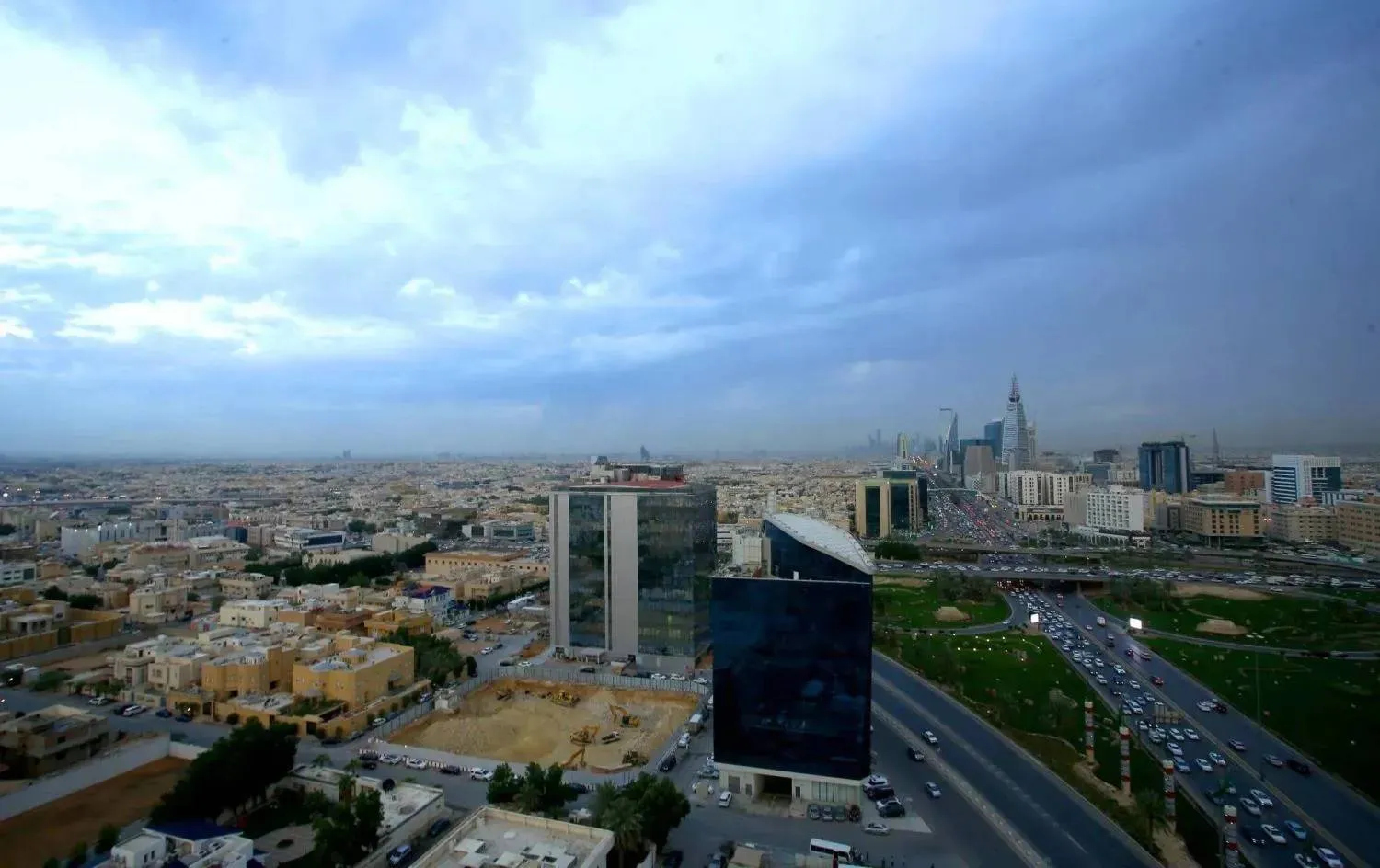

Riyadh Opens Second Real Estate Balance Program With Land Price Cap

Residential neighborhoods in the Saudi capital, Riyadh (SPA) 
TT

Riyadh Opens Second Real Estate Balance Program With Land Price Cap

Residential neighborhoods in the Saudi capital, Riyadh (SPA) 

Riyadh’s real estate market entered a new phase Sunday with applications opening for the second round of the Real Estate Balance Program.

Overseen by the Royal Commission for Riyadh City (RCRC), the program aims to provide between 10,000 and 40,000 developed and planned residential plots annually over the next five years, at prices not exceeding SR1,500 per square meter.

The Real Estate Balance Platform aims to help balance the real estate market and increase homeownership among eligible beneficiaries in Riyadh.

It also seeks to ensure fair distribution and maintain a balance between supply and demand in the city's residential real estate market.

The Royal Commission for Riyadh City announced last week that applications for the program’s second year would be accepted from Aug. 16 through Sept. 15 via its online platform. The initiative follows directives from Saudi Crown Prince and Prime Minister Mohammed bin Salman to take measures to restore balance to the capital’s real estate sector.

As the program expands, its potential to influence the broader market is growing. Prices set for land offered through the initiative provide a new benchmark for homebuyers and an alternative to conventional market listings, increasing competition and potentially prompting landowners and real estate agencies to reassess asking prices.

The program is part of broader government efforts to increase Riyadh’s real estate supply and develop unused land, helping bring supply and demand into better balance as the capital experiences rapid population and economic growth.

Real estate specialists say the second round could help narrow the gap between asking prices and what buyers can afford. Its impact could extend beyond direct beneficiaries because increasing the supply of land at predetermined prices puts competitive pressure on other sellers, particularly in areas where comparable alternatives are available.

Khalid Al-Jasser, a real estate specialist and chairman of Amaken International Group, previously told Asharq Al-Awsat that the program’s impact extends beyond the land market to financing, construction, building materials and housing-related services.

Its strength, he argued, lies not only in offering land at set prices but in addressing the underlying problem by increasing supply. A larger, more orderly supply of residential land gives citizens more choices and reduces the ability of scarcity to drive prices higher.

Real estate developer Ahmed Omar Basodan described the program’s continuation for a second year as an important signal that tackling high housing costs requires a sustained approach rather than a temporary measure.

As Riyadh grows rapidly, residential supply must continually keep pace with demographic and economic expansion, he noted. The program’s most significant effect could ultimately be a shift in market behavior by reducing expectations that land scarcity will continue indefinitely to support higher prices.


Oil Prices Fall on Easing Fears Over Saudi Supply Disruption

FILE PHOTO: Vessels near the Strait of Hormuz, as seen from Musandam, Oman, September 2, 2026. REUTERS/Stringer/File Photo
TT

Oil Prices Fall on Easing Fears Over Saudi Supply Disruption

FILE PHOTO: Vessels near the Strait of Hormuz, as seen from Musandam, Oman, September 2, 2026. REUTERS/Stringer/File Photo

Oil prices fell 2% on Friday, extending losses for a third straight session as easing concerns over Saudi supply disruptions outweighed anxiety about a widening of conflict across the Middle East.

Brent crude futures fell by $2.14, or 2%, to $102.68 a barrel by 0806 GMT. US West Texas Intermediate futures fell $1.83, or 1.8%, to $100.08, Reuters reported.

Benchmark Brent prices are on track for their first weekly loss in three.

Prices climbed to close to four-month highs earlier in the week after sources said crude loadings ⁠at Saudi Arabia's Red Sea export hub of Yanbu had been suspended and Riyadh cancelled some deliveries to Europe after its East-West pipeline was damaged in an attack last week.

However, prices have cooled since on reports that Saudi Arabia was seeking to restore about half the capacity of its East-West oil pipeline within days.

Saudi Arabia has sold about 60 million barrels of crude from its Gulf port of Ras Tanura inside the Strait of Hormuz for loading via ship-to-ship transfer at the Omani port of Sohar this month and next, multiple trade sources said on Friday.

The rebound in Saudi Aramco's exports from inside the Gulf to between 1 million to 1.5 million barrels per day on average, similar to or slightly higher than August's levels, has cooled global oil prices as it could make up for some of the ⁠volume lost at its port of Yanbu.

Chinese and South Korean refiners are among the top buyers of the spot supplies, while some volumes will be going to India and Japan, said the sources, who spoke on condition of anonymity.

"Recent efforts ‌to restore Saudi export capacity have reduced some of the immediate supply ‌anxiety," said Priyanka Sachdeva, head of market insights at Phillip Nova.


ECB's Lagarde Keeps Door Open to Early Exit

European Central Bank (ECB) President Christine Lagarde addresses a press conference after a meeting of the Governing Council of the European Central Bank (ECB) in Berlin on September 10, 2026. (Photo by John MACDOUGALL / AFP)
TT

ECB's Lagarde Keeps Door Open to Early Exit

European Central Bank (ECB) President Christine Lagarde addresses a press conference after a meeting of the Governing Council of the European Central Bank (ECB) in Berlin on September 10, 2026. (Photo by John MACDOUGALL / AFP)

European Central Bank President Christine Lagarde on Friday kept the door open to leaving her post early, replying "we'll see" when asked if she would remain in the position until her term ends ‌in October 2027.

"I ‌leave in ‌2027," ⁠Lagarde told Irish ⁠national broadcaster RTE in response to a question on rumors of her early resignation that have persisted for most ⁠of this year.

When asked ‌if ‌that meant October 2027, ‌Lagarde replied: "We'll see."

"What I ‌can tell you at this point is that whatever the time, it will be ‌handled in the most professional way as ⁠it should ⁠be," she added.

Sources told Reuters this week that France would back Dutchman Klaas Knot to succeed Lagarde as part of a bargain in which a French candidate would be picked for chief economist.


5 Countries Want Smaller Growth of Next EU Budget, Spain Offers Ideas

FILE PHOTO: European Union flags flutter outside the European Commission headquarters in Brussels, Belgium April 29, 2026. REUTERS/Yves Herman/File Photo
TT

5 Countries Want Smaller Growth of Next EU Budget, Spain Offers Ideas

FILE PHOTO: European Union flags flutter outside the European Commission headquarters in Brussels, Belgium April 29, 2026. REUTERS/Yves Herman/File Photo

Germany, Denmark, Finland, the Netherlands and Austria said on Friday the European Union's budget for 2028-2034 must be "several hundred billion euros" smaller than the €2 trillion proposed by the European Commission, drawing battle lines before EU budget talks come to a head in the next three months.

The leaders of the five countries, among the biggest net contributors to the budget, wrote in a joint op-ed in Politico that EU taxpayers ⁠cannot keep paying ⁠more to pay for both old and new priorities.

"It (the budget) is too focused on subsidies and transfers allocated largely in advance, leaving too little room for what Europe urgently needs: common investment in security and defense, competitiveness, innovation, and the fight against irregular migration," the five leaders said.

Net beneficiaries of the EU budget are concerned that ⁠would reduce EU funds for farmers and for equalizing standards of living between the poorer and richer regions of Europe -- a major political concern before parliamentary elections next year in France, Italy, Spain, Poland, Greece, Finland, Slovakia and Estonia.

The European Commission has proposed the budget should amount to €2 trillion or 1.26% of EU Gross National Income (GNI), of which some 168 billion, or 0.11% of GNI, is to service the EU's borrowing for the post-pandemic recovery fund. The five leaders called the proposed nominal increase of around 60% over the 2021-2027 budget "simply not ⁠realistic."

"This is ⁠why we call for a balanced cut to the Commission’s proposal of several hundred billion euros," Reuters quoted them as saying.

To help find a solution, Spain proposed to change the repayment schedule of part of the EU post-pandemic borrowing, linking it to economic growth and spreading it out over a longer period. This, according to Spanish Economy Minister Carlos Cuerpo, would free up some €70 billion.

"An annual payment of about 0.06% of EU GDP would retire the debt by 2058, the deadline agreed by member states," Cuerpo said.

EU governments will discuss the next EU budget at summits in October, November and December in an effort to get a deal before the end of the year.
