German Regulator: Apple to Change App Data Consent Rules

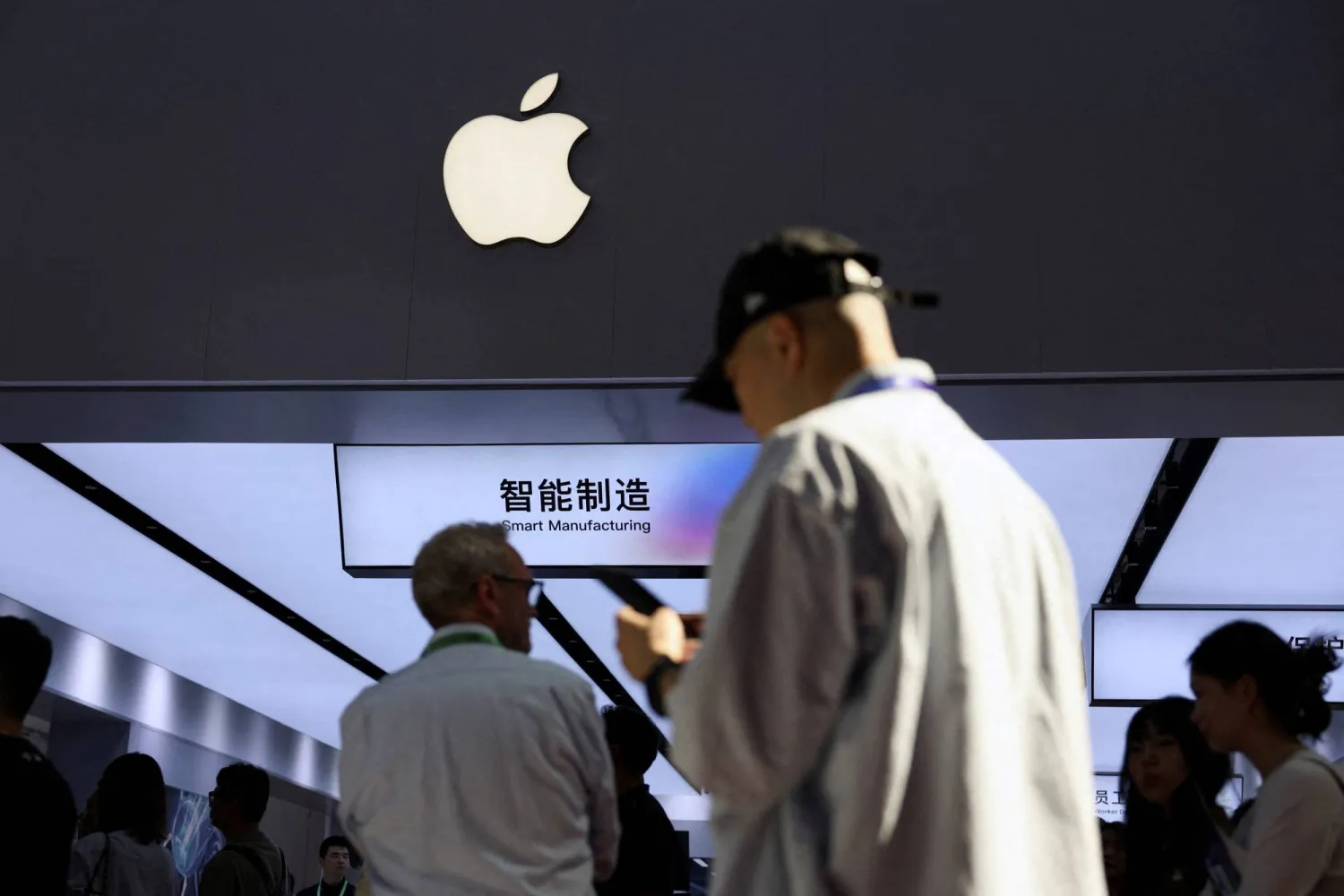
FILE PHOTO: People walk past a booth showcasing Apple's suppliers during the China International Supply Chain Expo (CISCE) in Beijing, China June 22, 2026. REUTERS/Florence Lo/File Photo
TT

German Regulator: Apple to Change App Data Consent Rules

FILE PHOTO: People walk past a booth showcasing Apple's suppliers during the China International Supply Chain Expo (CISCE) in Beijing, China June 22, 2026. REUTERS/Florence Lo/File Photo

Apple will change rules governing how app developers can use personal data for targeted advertising on iPhones and iPads, Germany's competition authority said on Monday, closing a years-long investigation.

The Federal Cartel Office found that Apple's App Tracking Transparency framework gave its own apps more favorable consent prompts than those of third-party developers, potentially breaching competition rules.

Apple has four ⁠months to implement ⁠the changes after the decision is served. Commitments run for seven years and will be monitored by a trustee.

Under the commitments, consent pop-ups for third-party apps must be redesigned ⁠to remove discouraging language and symbols, and made visually and linguistically neutral.

Third-party app publishers will also gain more flexibility to combine Apple's required consent request with separate data-protection consent prompts.

According to Reuters, Apple said the changes would apply in almost all European Union countries and that it had adapted the text and design of the ⁠consent ⁠prompt at the authority's request.

Developers of third-party apps, including Facebook parent Meta Platforms, aim for accurate user data so that targeted adverts can be displayed on devices. These generate more revenue than broader campaigns.

France and Italy have already fined Apple €150 million and €98.6 million, respectively, over the ATT framework.


AI Market Correction is Coming, ECB Blog Predicts

FILE PHOTO: European Union flags flutter outside the European Central Bank (ECB) headquarters in Frankfurt, Germany, March 19, 2026. REUTERS/Jana Rodenbusch/File Photo
TT

AI Market Correction is Coming, ECB Blog Predicts

FILE PHOTO: European Union flags flutter outside the European Central Bank (ECB) headquarters in Frankfurt, Germany, March 19, 2026. REUTERS/Jana Rodenbusch/File Photo

A market correction to tech stock exuberance in the US is likely and could have far-reaching consequences due to limits in fiscal and monetary policy buffers to blunt the potential economic hit, a European Central Bank blog post said on Monday.

Investors have been piling into technology stocks on bets that AI will fundamentally alter the global economy, and valuations for top tech companies are now far above historic averages.

"Economic research on past technological revolutions points to a worrisome conclusion: a correction of current stock market valuations is likely," said ⁠the blog post, ⁠which does not necessarily reflect the ECB's opinion.

Even if the technology succeeds and profits rise, stocks may still fall because it is hard to fulfil markets' excessively optimistic profit growth bets, the post added.

Psychological trends also point to a correction, ⁠the blog argued. Overly optimistic investors tend to bid up prices beyond fundamentals. Then when optimism fades, prices tend to fall even more sharply than in the rational scenario, the post said.

For Europe, a US market correction would be a question of financial stability since households have a €440 billion exposure to so-called Magnificent Seven stocks - Alphabet, Amazon, Apple, Meta Platforms, Microsoft, Nvidia and Tesla -while pension and insurance firms' exposure is about the same.

"The more severe ⁠scenario is ⁠not the equity correction on its own but a correction that coincides with broader market instability that policymakers cannot easily calm: unlike in the dot-com episode, today's starting point leaves markedly less room to cut interest rates or use fiscal policy to cushion the fallout," Reuters quoted the blog as saying.

While European stock valuations appear more rational, market moves closely correlate with the US, so local equities will also take a hit, the blog said, adding that the exact timing of the correction "is unknowable in advance".

"These boom-bust patterns are only identifiable with hindsight," it said.


France's Top Court Blocks Social Media Ban for under-15s

(FILES) This photograph shows a set up smart-phone screen displaying the logo of main social media platforms including Instagram, Facebook, LinkedIn, Reddit, Telegram, X, Bluesky, Tiktok and Whatsapp in Saint-Mande, east of Paris, on April 29, 2026. On August 14, 2026, the French Constitutional Council struck down the ban on social media for under-15s, ruling that this measure constitutes "a disproportionate infringement" of their freedom of expression. (Photo by Martin LELIEVRE / AFP)
TT

France's Top Court Blocks Social Media Ban for under-15s

(FILES) This photograph shows a set up smart-phone screen displaying the logo of main social media platforms including Instagram, Facebook, LinkedIn, Reddit, Telegram, X, Bluesky, Tiktok and Whatsapp in Saint-Mande, east of Paris, on April 29, 2026. On August 14, 2026, the French Constitutional Council struck down the ban on social media for under-15s, ruling that this measure constitutes "a disproportionate infringement" of their freedom of expression. (Photo by Martin LELIEVRE / AFP)

France's top court on Friday blocked a bill banning social media access for under-15s, saying it infringed upon freedom of expression, a setback for President Emmanuel Macron who asked his government to rewrite the legislation.

"By prohibiting minors under the age of fifteen from accessing certain online services, the law inherently requires every person, even an adult, to prove their age before accessing them," the Constitutional Council said in its decision.

"However, by failing to specify the conditions and limits under which such proof must be provided, the legislature has not established the legal safeguards necessary to ensure compliance with these requirements," it added. French lawmakers had approved a ban on social media access for children under age 15, becoming the first in Europe to follow Australia, whose world-first ban barred access to platforms including Facebook, TikTok and YouTube for under-16s in December.

Macron has ordered Prime Minister Sebastien Lecornu to re-work the draft legislation to take the Constitutional Council's concerns into account, the Elysee said in a statement.

The Elysee said Macron was determined the reform take effect before spring 2027, when France holds a presidential election. Macron cannot run for a third term.


China’s Lenovo Posts 43% Jump in Q1 Revenue, Highest in Five Years

The Lenovo logo is seen in this illustration photo January 22, 2018. (Reuters)
TT

China’s Lenovo Posts 43% Jump in Q1 Revenue, Highest in Five Years

The Lenovo logo is seen in this illustration photo January 22, 2018. (Reuters)

China's Lenovo Group reported a 43% jump in quarterly revenue on Thursday, beating forecasts and sending shares of the world's largest computer maker surging, as it rides an AI hardware boom and reaps the benefits of a global memory chip shortage.

Lenovo's revenue rose to $26.94 billion in the three months ended June 30, beating analyst expectations of $22.3 billion, as the consumer electronics hardware giant benefited from artificial intelligence-driven demand and solid PC sales.

It was ‌the group's highest ‌quarterly revenue growth in the last five years, as ‌AI-related ⁠revenue grew 60% ⁠year-on-year to $9.3 billion, accounting for 35% of total revenue in its fiscal first quarter.

The company swung to a net loss attributable to shareholders of $609 million from a profit of $505 million last year, compared to the average analyst estimate of $589 million profit, according to data compiled by LSEG.

The company said the loss was primarily due to a non-cash fair value loss of US$1.7 billion arising ⁠from the revaluation of warrants issued in 2025.

Lenovo's shares hit ‌an all-time high on Thursday before ‌the results announcement, bringing its year-to-date gains to 225%. The shares surged as much as ‌17% after the results announcement.

Its US competitors Dell, Hewlett Packard and Super ‌Micro have been some of Wall Street's best performers this year but have raised prices by 10% to 30% due to soaring NAND and DRAM memory chip costs.

Lenovo's PC, tablet and smartphone division, which accounted for about 64% of total revenue, ‌reported a 27% year-on-year increase in revenue during the period. Adjusted net income, which excludes one-off items and non-cash charges, ⁠more than doubled ⁠to $1.075 billion.

R&D expenses jumped 30% year-on-year, the company said.

Global PC shipments declined by 2% year-on-year in the second quarter of 2026 to 16.6 million units for the first time since Q1 2025 due to memory-driven cost pressures, according to Counterpoint Research.

Lenovo retained its market lead in the second quarter, giving it a market share of 25.6%. Its AI server pipeline reached $54.0 billion, up 157% quarter-over-quarter, reflecting demand from hyperscalers, AI cloud and enterprise AI clients, its earnings report said.

Lenovo's strong performance comes after the company warned earlier this year of pressure on PC shipments as the industry grapples with a memory chip shortage that is getting more severe.

It has also raised PC prices to mitigate the impact of soaring memory costs.