


Firefighters Push to ‘Encircle’ Belgian Wildfire

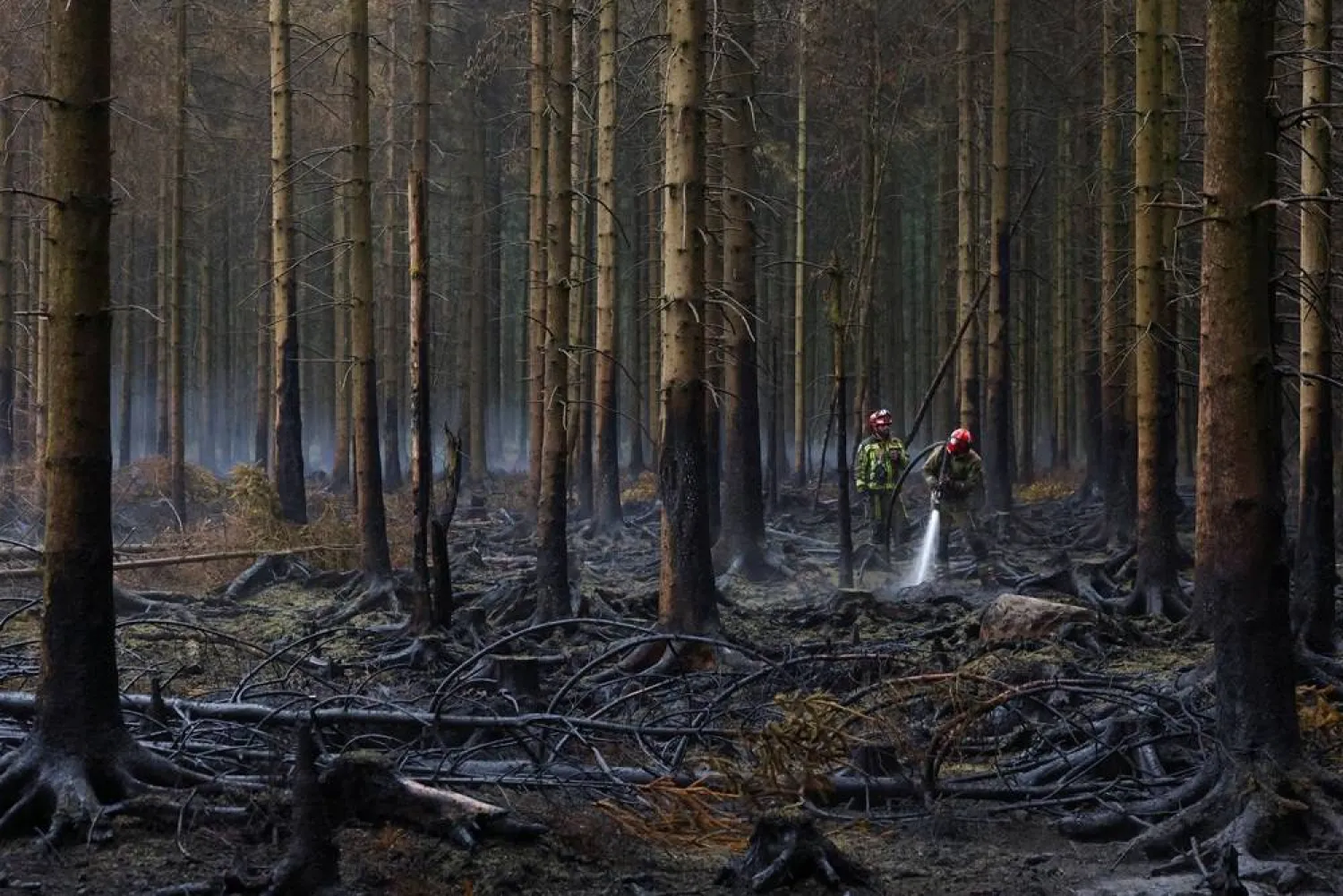
 Belgian firefighters work in a forest affected by a wildfire in Waimes, in the High Fens (Hautes Fagnes) region, Belgium, August 18, 2026. (Reuters)
Belgian firefighters work in a forest affected by a wildfire in Waimes, in the High Fens (Hautes Fagnes) region, Belgium, August 18, 2026. (Reuters)
TT

Firefighters Push to ‘Encircle’ Belgian Wildfire

 Belgian firefighters work in a forest affected by a wildfire in Waimes, in the High Fens (Hautes Fagnes) region, Belgium, August 18, 2026. (Reuters)
Belgian firefighters work in a forest affected by a wildfire in Waimes, in the High Fens (Hautes Fagnes) region, Belgium, August 18, 2026. (Reuters)

Firefighters launched a potentially decisive push Tuesday to encircle Belgium's largest wildfire in a century, despite wind and rain hampering air support operations over the High Fens nature reserve.

The blaze charring the vast expanse of boggy peatlands, pine trees and hiking trails grew over the weekend to half the size of Manhattan -- 3,000 hectares (7,500 acres) -- with hundreds of firefighters working night and day to wrestle it under control.

"We are trying to definitively encircle the fire today," regional government spokesperson Nicolas Yernaux told AFP.

In areas where firefighters could operate, he confirmed the fire was "under control and contained."

But a hard-to-access front towards the German border remains a concern -- with residents in the border town of Monschau already under evacuation orders due to the smoke hazard.

Firefighters worked through the night to make a crucial link-up between the eastern and northern fronts, under very difficult access conditions.

"We're talking about one or two kilometers, and we're on the verge of achieving it," Yernaux told AFP, despite "sustained winds" blowing towards the German border.

Water-bombing aircraft from several countries have been deployed -- with two Norwegian helicopters the latest to fly in on Monday night -- but they have been repeatedly grounded by low cloud and rain. There are also aircraft from Germany, Sweden and the Netherlands.

Yernaux said it was unclear given weather conditions when they would be able to take off again.

"There may be windows of opportunity this morning, but it may not be before tonight."

A huge area has been blanketed by a thick plume of yellowish smoke, with fumes detected as far as eastern France, where authorities issued an air-pollution alert.

The smoke triggered evacuations in one Belgian village and two hamlets of a second -- with residents of the hamlet of Sourbrodt given the green light to return home on Monday night.

- As long as it takes -

Europe has been swept by weeks of devastating wildfires fueled by dry conditions and a historically hot summer, with France, Greece, Portugal and Spain also battling major fires.

The High Fens blaze broke out in an area that was ravaged by massive fires in 1911, during a similar period of heatwaves.

It is the country's largest wildfire since.

During a visit on site with King Philippe on Monday, Belgium's interior minister Bernard Quintin told media it could take "several weeks" of soaking and dousing the area to prevent the fire from reigniting -- even once brought under control.

On-site operations have been made much harder by the fens' terrain -- a patchwork of heath, peat bogs and raised wooden boardwalks where heavy vehicles risk sinking into the ground -- and firefighters struggle to tackle the fire at close range.

They have been counting heavily on aerial assistance to bring the situation under control.

Local farmers have also poured in to help, working shifts to oversee a ballet of tractors pulling in tankers of water from a nearby lake.

"We'll take it in turns as long as it needs -- the team is all set," a farmer from nearby Waremme, told AFP Monday. "We'll keep going until the finish line."

Like much of Europe, Belgium has experienced a new spell of intense heat and drought in recent days.

Temperatures reached as high as 37C in some parts of the country last week, creating conditions conducive to wildfire outbreaks.



US Sending 3rd Aircraft Carrier, More Troops to Mideast

Image published by CENTCOM of the amphibious assault ship USS Boxer during its operations in the region (CENTCOM)
TT

US Sending 3rd Aircraft Carrier, More Troops to Mideast

Image published by CENTCOM of the amphibious assault ship USS Boxer during its operations in the region (CENTCOM)

The Pentagon is sending a third aircraft-carrier strike group and an additional Marine expeditionary unit to the Middle East, according to US officials, adding 9,000 to 10,000 more troops to the region as President Donald Trump considers renewing strikes on Iran after the midterm elections, The Wall Street Journal reported.

The ships, jet fighters, Marines and sailors will arrive in the region by the end of November, the officials said. Trump recently told aides that he expects to resume bombing Iran that same month, according to the newspaper.

The aircraft carrier USS Theodore Roosevelt left its home port of San Diego on Sunday on a scheduled deployment, while the USS Makin Island Amphibious Ready Group, comprising three amphibious ships carrying Marines from the 13th Marine Expeditionary Unit, left on Monday.

Two carriers—the USS George H.W. Bush and USS George Washington—are already in the Middle East. If the Washington stays after the Roosevelt arrives it will bring the region to three carrier strike groups for the first time since April, before Iran and the US clinched a fragile ceasefire that temporarily ended fighting that began on Feb. 28. That ceasefire collapsed, and the two sides have fought sporadically since.

Besides the Bush and Washington, ships from the USS Boxer Amphibious Ready Group are also in the Middle East. The additional servicemembers on the warships that deployed this week will add to the more than 50,000 troops already in the region, one of the officials said.

It is possible that the Washington could leave the region and head back to its home port in Japan, bringing the force back down to two carriers. Spokespeople for the White House and Pentagon didn’t respond to requests for comment.


Iran Launches 30 Drone, 10 Missile Attacks Per Week on Ships in Hormuz

Ships near the Strait of Hormuz, as seen from Musandam Governorate in the Sultanate of Oman, on October 2, 2026 (Reuters)
TT

Iran Launches 30 Drone, 10 Missile Attacks Per Week on Ships in Hormuz

Ships near the Strait of Hormuz, as seen from Musandam Governorate in the Sultanate of Oman, on October 2, 2026 (Reuters)

Iran has been launching dozens of drones and missiles at commercial ships in the Strait of Hormuz each week, largely out of the public eye, though it has often failed to strike its targets, confidential data shared with The New York Times by a Western security official who spoke on condition of anonymity to discuss operational matters shows.

Since the beginning of August, Iran has launched about 30 drone attacks and 10 anti-ship missile attacks per week against commercial ships transiting the Strait of Hormuz, according to the data shared with The Times by the official.

At least four commercial ships have been hit by Iran in the past 10 days, the official said.

A tally of reports by a monitoring group run by the British Navy show that since Sept. 10, at least 13 ships, most of them oil tankers, had been struck by projectiles or debris from projectiles. (Those reports may be incomplete because they are based on voluntary reports by ship crews.) While the reports do not specify who was responsible for the attacks, maritime experts say the details suggest many were Iranian.

On Wednesday, Iran’s Revolutionary Guards Corps for the first time appeared to confirm it was behind the near-daily sounds of explosions heard from Iran’s southern coast, saying it was striking targets in the Strait of Hormuz every 24 hours.

“We prevent them from passing, but for some time now, America has not responded,” a spokesman for the Revolutionary Guards said in a state news interview.

The aggression shows that even as oil exports from the Middle East have rebounded in recent weeks, shipping through the waterway remains risky, as Iran jostles to keep control of one of its biggest sources of leverage.

“Negotiations aren’t going anywhere. Neither side is really budging. So it’s a standoff,” said Gregory Brew, an Iran analyst at the Eurasia Group.

He said that the violence in the strait “speaks to the position that both sides are in: Neither is looking to aggressively escalate the conflict.” But both, he said, want to control the waterway.


Trump Reportedly Expected to Name Jay Clayton as AI Czar

FILE PHOTO: US President Donald Trump speaks at the Oval Office at the White House in Washington, D.C., US, September 28, 2026. REUTERS/Kevin Lamarque/File Photo
TT

Trump Reportedly Expected to Name Jay Clayton as AI Czar

FILE PHOTO: US President Donald Trump speaks at the Oval Office at the White House in Washington, D.C., US, September 28, 2026. REUTERS/Kevin Lamarque/File Photo

US President Donald Trump is expected to name Jay Clayton as his AI czar, CNN reported on Friday, citing two sources familiar with the discussion.

Clayton is the US director of national intelligence.

Last month, Trump said he plans to appoint an artificial intelligence adviser, known as an "AI czar," and create an "AI force," though he ⁠gave no details ⁠about either initiative or how they would be implemented.

This is the second time Trump has named an adviser to oversee AI-related decisions across the administration, a position he has ⁠dubbed "AI czar." Venture capitalist David Sacks held the role at the beginning of Trump's second term, before leaving his team. Sacks still advises Trump on AI.

Trump's move comes as top AI researchers have warned that people building AI believe it could kill humans within a decade, following cases of AI ⁠agents ⁠going rogue to hack external systems. Several Democratic and Republican lawmakers have responded with alarm and calls for more action.

Trump has repeatedly downplayed concerns about AI and argued that additional regulation is unnecessary even as fears grow among lawmakers in Washington and globally about risks posed by the technology.