


Beyond Marathons and Backflips, China’s Robots Face a Commercial Test

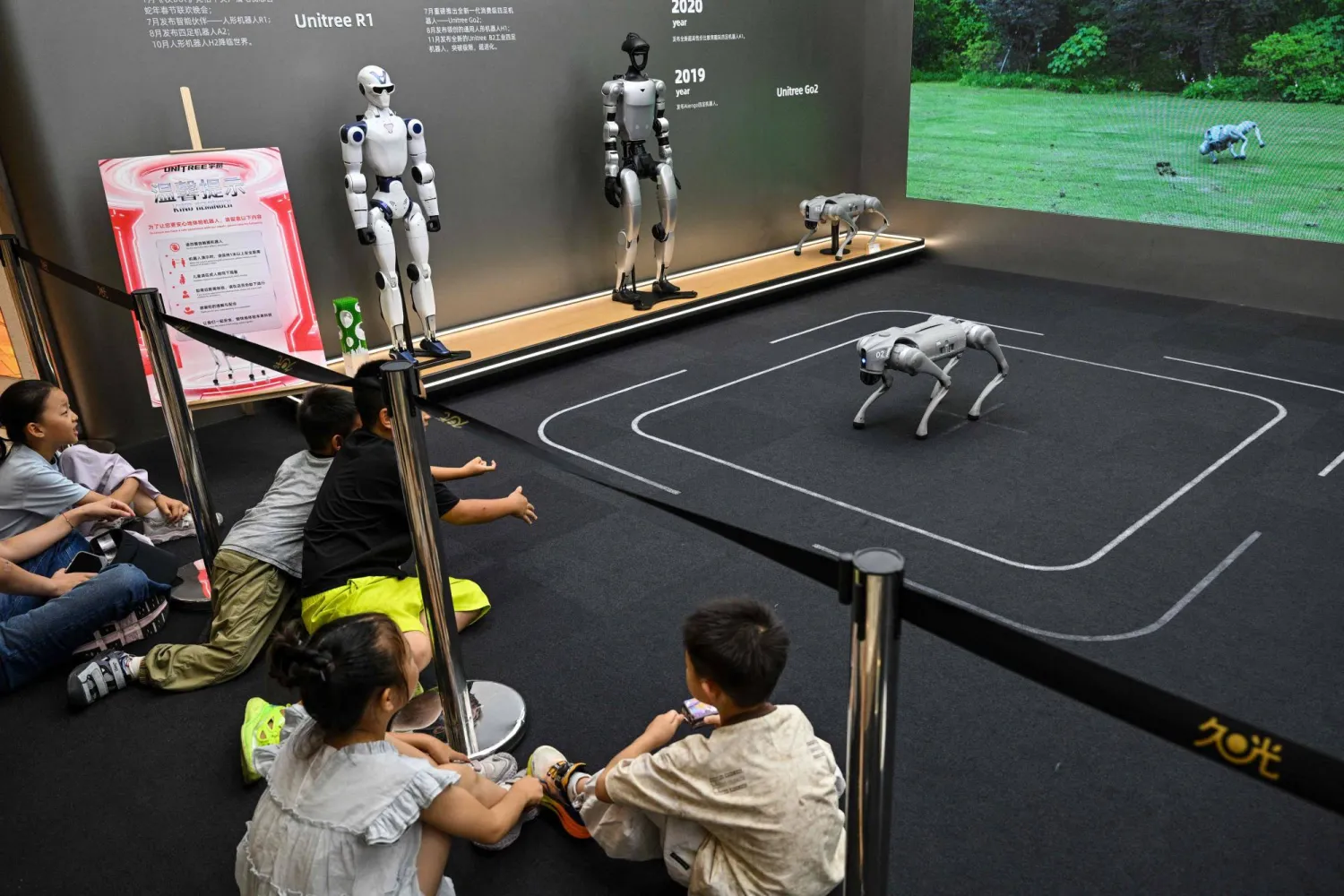
 Children look at a remote-controlled robot by Unitree Robotics while visiting the Unitree Robotics Embodied Intelligence Experience Center in the Jing' an district in Shanghai on August 17, 2026. (AFP)
Children look at a remote-controlled robot by Unitree Robotics while visiting the Unitree Robotics Embodied Intelligence Experience Center in the Jing' an district in Shanghai on August 17, 2026. (AFP)
TT

Beyond Marathons and Backflips, China’s Robots Face a Commercial Test

 Children look at a remote-controlled robot by Unitree Robotics while visiting the Unitree Robotics Embodied Intelligence Experience Center in the Jing' an district in Shanghai on August 17, 2026. (AFP)
Children look at a remote-controlled robot by Unitree Robotics while visiting the Unitree Robotics Embodied Intelligence Experience Center in the Jing' an district in Shanghai on August 17, 2026. (AFP)

China's humanoid robot makers have spent the past two years dazzling investors with machines that can breakdance, throw punches and even set marathon records. This week in Beijing, they face a tougher test in proving their inventions can work reliably to generate economic value.

More than 300 companies are expected at the World Robot Conference from Wednesday through Sunday, showcasing over 2,000 exhibits and launching more than 150 products, according to Beijing authorities.

The conference coincides with the Shanghai stock market debut of Unitree, one of the world's largest humanoid robot makers by sales volume, after an initial public offering that was more than 8,000 times oversubscribed by retail investors.

Unitree founder Wang Xingxing will address the conference's main forum on Thursday on the next decade of the humanoid industry, according to the Beijing municipal government.

The event comes as investor enthusiasm around Chinese humanoids reaches new ‌heights, but the conversation ‌is shifting from viral demonstrations to commercial reality. Investors and customers are increasingly judging robots ‌not ⁠by how spectacularly they ⁠move, but by how productively they work, how much human supervision they require and whether they can earn a return on their cost.

Although robots in China are starting to replace human workers in niche applications such as hotel food deliveries and on some assembly lines, large-scale adoption across industries beyond limited pilot projects has yet to occur.

FROM DEMOS TO DEPLOYMENT

Some in the industry argue that reckoning is overdue. Lumos Robotics, a Mitsubishi Electric-backed startup exhibiting at WRC, has focused its MOS robot on industrial inspection and material handling rather than household or entertainment applications.

CEO Yu Chao told Reuters the companies most at risk in China's crowded embodied-AI sector were those developing ⁠robot bodies, models or data in isolation without proving their technology in actual applications.

For Yu, the ‌eventual shakeout will come down to a simple question: can a robot ‌create value for a customer? Companies that cannot, he said, "will be washed out."

Georg Stieler, a robotics analyst who advises industrial companies in China, ‌estimates that 50% to 70% of humanoid robots produced this year could end up in "data factories", where they are used ‌to collect training data rather than perform productive work for paying customers.

Guotai Securities, a Chinese brokerage, estimates an industrial humanoid would need to cost about 160,000 yuan, including maintenance, to pay for itself within two years compared with a worker earning 80,000 yuan annually.

In reality, such robots typically cost 300,000 to 500,000 yuan, according to Berlin-based think tank MERICS.

ROBOT GAMES TEST WORK ABILITY

Some of the industry's claims will face ‌a more public test from Saturday.

The World Humanoid Robot Games, running from August 22 to 26 at Beijing's National Speed Skating Oval, will combine headline-grabbing races, football and fighting with ⁠a growing number of competitions designed ⁠around actual work.

Official plans include factory, hotel and household scenarios, with organizers requiring robots in some events to perform longer, continuous tasks in complex environments.

The competition schedule reviewed by Reuters includes packing and warehousing, industrial assembly and material feeding, retail and office services, electric-vehicle charging and dexterous tasks such as connecting cables and using tools.

Unlike a sprint or dance routine, such tasks test whether robots can identify unfamiliar objects, manipulate them repeatedly, recover from mistakes and complete jobs without engineers stepping in.

A GLOBAL PROBLEM

The challenge of turning impressive demonstrations into economically viable products is not confined to China.

In the United States, Jerry Wang, CEO of AIxCrypto Holdings, recently launched RoboShare, a marketplace designed to let businesses rent robots by the task rather than buy them outright.

Wang said one of the biggest bottlenecks today is not the robots themselves but the surrounding ecosystem. Skilled operators remain scarce, while transportation, deployment and maintenance costs can make robotic labor uneconomic.

Geopolitics is adding another layer of uncertainty. The US Federal Communications Commission in July restricted new equipment authorizations for foreign-made advanced robotic devices, affecting companies including Unitree, though previously authorized models can still be sold.

Technology research firm IDC estimates China accounts for 82% of global humanoid shipments. Under its worst-case scenario for the US restrictions, US humanoid sales would be 58% below its prior baseline forecast by 2030.



Big Tech’s AI Bill $3 Trillion Bigger Than It Looks

The words “Artificial Intelligence” are seen alongside a keyboard and robotic hands in this illustration. (Reuters) 
TT

Big Tech’s AI Bill $3 Trillion Bigger Than It Looks

The words “Artificial Intelligence” are seen alongside a keyboard and robotic hands in this illustration. (Reuters) 

Each quarter, big tech companies disclose their massive capital expenditures on artificial-intelligence infrastructure, from data centers to chips.

But those figures don’t come close to expressing the full extent of future spending to which Google parent Alphabet, Meta Platforms, Oracle and many others have committed.

That is because a huge swath of their coming financial obligations are not reflected on their balance sheets.

Nine top tech companies had some $3 trillion of off-balance-sheet commitments mostly related to AI, according to a Wall Street Journal analysis of footnotes in their most recent securities filings.

Those obligations are growing faster than traditional “capex,” which totaled about $600 billion over the past year they reported, and were about triple what the companies owe under their outstanding leases and long-term borrowings.

America’s blue-chip tech companies are placing these huge bets based on assumptions about what the demand for AI computing—and availability of AI hardware—will be in several years.

Their hope is that they will easily meet all their obligations with future revenue as consumers and businesses adopt AI in every facet of American life.

If those assumptions about technology and demand prove wrong, these deals to clinch future capacity could become a monstrous burden for the tech companies and their investors.

Meta’s gigantic “Hyperion” datacenter project in Louisiana, which is the size of about 1,700 football fields, helps explain how big obligations wind up off tech companies’ balance sheets.

Meta initially agreed to lease Hyperion for a four-year term starting in 2029, with options to renew for up to 20 years.

It guaranteed that it would make bondholders whole if it does not stay the entire two decades. The company did not think payments under that guarantee are probable, so it has not recorded any liability on its balance sheet.

In accordance with accounting rules, Meta’s Hyperion lease obligations will remain off balance sheet until it starts paying rent.

It said its aggregate initial lease commitment is about $12.3 billion.

Meta disclosed $347 billion in total obligations for leases that have not kicked in yet, including for Hyperion, as of June.

Across the companies the Journal analyzed, promises of payments under these uncommenced leases totaled $1.2 trillion in off-balance – sheet obligations, or about four times more than what was disclosed a year earlier.

In addition to Meta, the Journal reviewed commitments for Alphabet, Amazon.com, Microsoft, Oracle, Nvidia, Broadcom, SpaceX and Advanced Micro Devices.

Data centers get stuffed with a lot of hardware, including the Nvidia chips that are used to train and run models and memory chips that store information.

To buy all that, companies sign long-term contractual agreements well in advance to lock in production from their suppliers.

Those and other purchase obligations at the companies the Journal examined stand at a whopping $1.9 trillion. Under accounting rules, purchase commitments typically remain off balance sheet until a product or service is delivered.

Alphabet’s purchase commitments and contractual obligations have exploded and stood at $811 billion as of June 30, the WSJ reported.

As with other companies, it is hard to tell from its disclosures what precisely it intends to buy.

The company said the commitments primarily relate to “technical infrastructure and inventory” and “agreements to secure energy for data center usage.”

Alphabet also didn’t detail why those obligations increased so much from the $332 billion it reported three months earlier. The commitments span several years, with obligations under its energy agreements lasting as far out as 2054.

Off-balance-sheet exposures at some companies include agreements to buy other companies’ stock in the future or backs to pleases for other tenants.

Nvidia committed to make $27 billion in equity investments between April 26 and the end of its fiscal year in January 2027.

There are reasons to believe tech companies will make good on all their obligations.

Optimists see the skyrocketing demand for AI tools—which has lifted the stock market and led to shortages of key hardware—as a proof point that demand is going to be strong for years, and the money to pay off all these bills will be rolling in.

For the more anxious set on Wall Street, it is a worrying sign that some tech companies that once seemed to have fortress balance sheets have needed to tap the capital markets frequently.

Alphabet and Amazon recently posted results showing negative free cash flow, meaning their capital spending exceeded the cash they brought in from operating their businesses.

And that is before considering the implications of trillions in off-balance – sheet commitments.

Whether or not the revenues ever arrive, purchase commitments and signed leases can’t be canceled, for the most part.

If things go wrong, tech companies will be paying an expensive tab for infrastructure that they cannot profitably use.

These obligations could also lead increasingly indebted companies to have to borrow even more.

“As these off-balance sheet commitments become more frequent, larger, and more complex, it is becoming increasingly difficult for investors to assess companies’ total potential leverage,” Morgan Stanley accounting analysts wrote in April.

Meanwhile, researchers at the European Central Bank on Monday posted their rather ominous conclusions on how all this may end, saying the timing and extent of a stock reversal were inherently “unknowable” in advance but that a correction was coming regardless, according to Reuters.

The ECB blog noted that the financial-stability concerns were not confined to America, as US megacaps are widely held by European households, insurers and pension funds.

It said a correction was an inevitable feature of such technological revolutions and investment booms, while exposure was amplified by the concentration in giant market valuations and index tracking. All involved needed to be prepared.

“Historical experience suggests that technological revolutions carry risks of a boom-bust cycle in asset prices, and this risk does not depend on today’s valuations being rational or irrational,” they wrote, metaphorically fastening their safety belts.


Major Meta Trial Begins as Lawyers Spar over Witnesses, Damages

The Meta company logo at the entrance of its temporary pavilion before the World Economic Forum in Davos, Switzerland, January 18, 2025 (Reuters)
TT

Major Meta Trial Begins as Lawyers Spar over Witnesses, Damages

The Meta company logo at the entrance of its temporary pavilion before the World Economic Forum in Davos, Switzerland, January 18, 2025 (Reuters)

Facebook-parent Meta will defend itself in a landmark social media trial that begins Tuesday in California, where attorneys have sparred over witnesses and financial penalties.

A coalition of states sued Meta in 2023, and the four states now going to trial were selected to represent them.

Lawyers for the states will argue Meta deliberately made Facebook and Instagram addictive for children, in violation of state and federal laws, reported AFP.

In recent days Meta, which has more than three billion users around the world, tried to block ex-Meta employee and expert witness, Arturo Bejar, from testifying.

Federal Judge Yvonne Gonzalez Rogers dismissed the company's request, handing the states an early victory. In her ruling, she described it as a "Hail Mary" effort to "eliminate a strong witness" for the plaintiffs.

Bejar has previously testified against the company, including in a New Mexico trial which Meta lost.

Lawyers for California, Colorado, Kentucky and New Jersey are expected to question Bejar about Meta's practices around safety and growth, and whether the company publicly misrepresented what it knew, according to a court document.

In a new filing Monday, Meta asked the judge to restrict the scope of testimony from another potential expert witness, Colin Gray, whom the states intend to ask about "dark patterns" -- features designed to manipulate users into making choices preferred by a company.

Meta founder and chief Mark Zuckerberg is among the star witnesses expected to testify.

Meta "strongly disagrees" with the allegations in the trial, a spokesperson told AFP.

During a hearing last week, a lawyer for the states said they are seeking around $200 billion -- not penalties exceeding $1 trillion, as Meta had claimed in a court filing.

The lawyer said they believe Meta calculated that figure "for shock value."

In addition to financial penalties, the states are demanding changes to Meta's apps.

Eight people were selected last week to serve on an advisory jury, but the judge will make the final decision in the case. The trial is expected to last six weeks and a verdict is expected by early October.

Although it's not the first lawsuit that seeks to hold a social media company accountable for mental health and safety issues, it could become one of the most consequential.

- 'Broader reckoning' -

Last week, Rogers and lawyers for both sides probed prospective jurors about their views of social media and Meta, asking if they or their children had social media accounts and whether social media is responsible for mental health, among other questions.

One prospective juror said they believed social media plays a role in mental health and compared the serotonin boost that some people feel from "doomscrolling" to using cocaine.

The case could be "the beginning of a broader reckoning" for Meta, Nora Freeman Engstrom told AFP via email. She is a law professor and associate dean at Stanford.

It will be important to see the "gap" between what Meta knew privately and what it disclosed publicly, Engstrom said.

"The huge issue here is reputational harm" and being forced to make major changes, Vincent Joralemon, a director at Berkeley's Life Sciences Law and Policy Center, told AFP.

Experts see parallels with a three-decade-old settlement between dozens of US states and tobacco companies.

"It really feels like tobacco in the 1990s," Joralemon said.

While cases about social media harms revolve around the intersection of technology and addiction, the case against Meta focuses on its business practices, similar to when US regulators sued tobacco companies, Joralemon said.

Dozens of US states sued four major tobacco companies for downplaying the harmful health impacts of their products, and won a 1998 landmark settlement that included financial penalties and changes to product marketing.

Those tobacco companies have paid over $176 billion since, according to data from the National Association of Attorneys General.

They will continue to pay $9 billion annually, according to the settlement.


China’s Unitree Unveils ‘Superman’ Robot as Fervor Builds Ahead of Shanghai Debut

Children stand near Unitree's humanoid robots on display at a Unitree store in Beijing, China August 10, 2026. (Reuters)
TT

China’s Unitree Unveils ‘Superman’ Robot as Fervor Builds Ahead of Shanghai Debut

Children stand near Unitree's humanoid robots on display at a Unitree store in Beijing, China August 10, 2026. (Reuters)

China's Unitree unveiled a new high-speed robot it dubbed "Superman" on Monday, days before becoming the first general-purpose robotics company to list on mainland China's stock market.

Unitree, the world's biggest humanoid-robot maker by sales, will start trading in Shanghai on Wednesday after raising 6.1 billion yuan ($905 ‌million) in ‌an initial public offering last week.

The company, based ‌in ⁠the eastern Chinese ⁠tech hub of Hangzhou, said it developed the new robot in just over three months. It achieved a standing jump of 2 meters and reached a top speed of 12.66 meters per second.

The Shanghai debut coincides with the opening of the World Robot Conference in Beijing, adding to investor attention ⁠on a company whose humanoid robots have drawn ‌global notice for running, dancing and ‌performing martial arts.

The IPO was more than 8,000 times oversubscribed ‌by retail investors, a record for Shanghai's tech-focused STAR Market.

In ‌a social media post last week, Unitree said it had cumulatively produced and delivered about 18,000 bipedal humanoid robots across multiple models as of July.

DERIVATIVES MARKET POINTS TO STRONG DEBUT

Unitree said the robot ‌remained a work in progress and could be improved further in coming months.

Founder Wang Xingxing ⁠gained national ⁠prominence after securing a front-row seat at a summit hosted by Chinese President Xi Jinping for leading technology entrepreneurs last year.

The startup is also backed by some of China's most influential technology companies including Tencent, Alibaba, and DeepSeek.

Ahead of Unitree's Shanghai listing, derivative trading in offshore markets has pointed to a strong debut.

Its shares may also benefit from a broader recovery in Chinese technology stocks following last month's selloff.

The STAR50 Index has rebounded about 15% from a three-month low hit in early August.