West Bank Siege Exposes Israel Army Inaction on Settler Violence

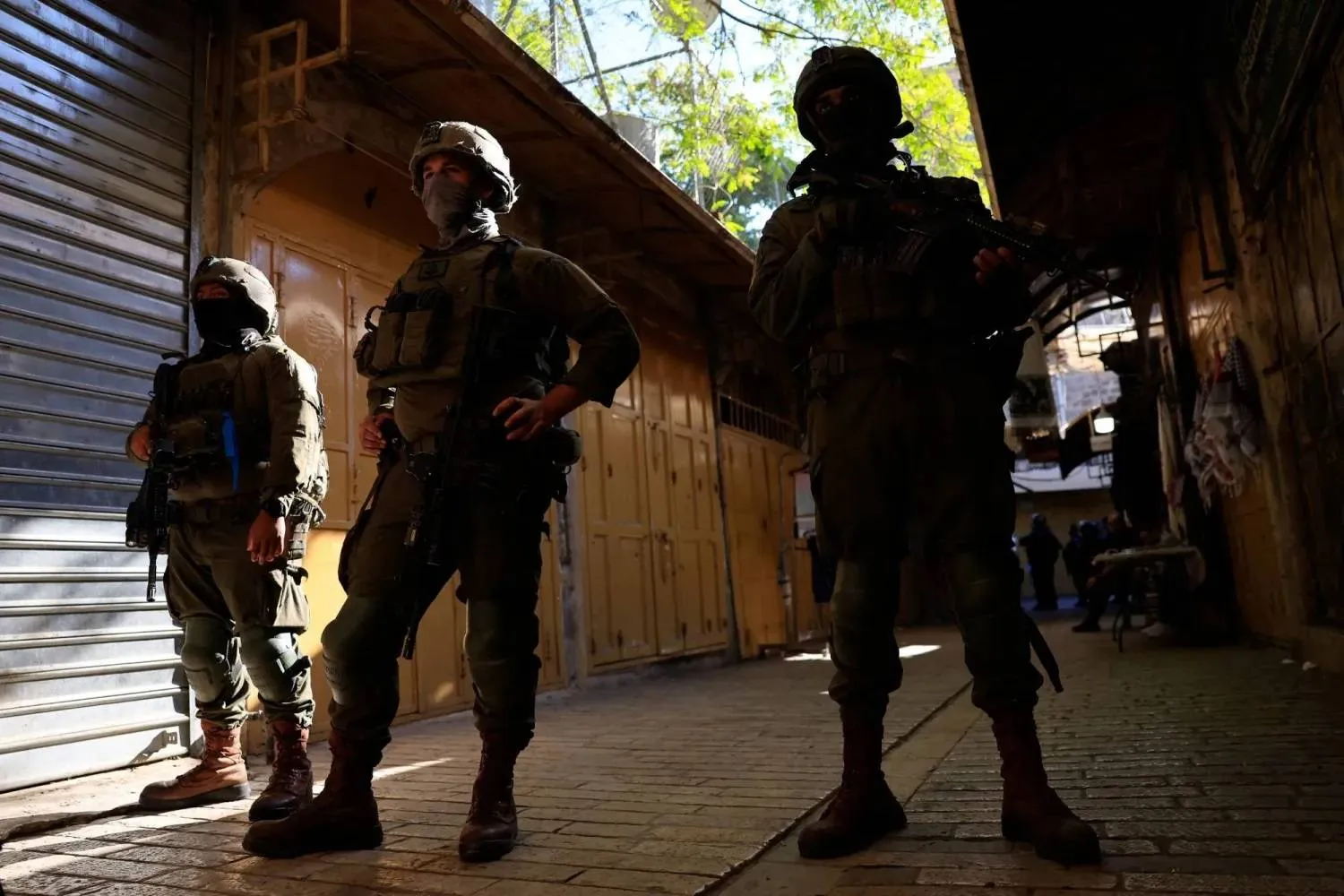
Israeli soldiers secure the weekly tour of settlers in the streets of Hebron in the occupied West Bank (Reuters)
TT

West Bank Siege Exposes Israel Army Inaction on Settler Violence

Israeli soldiers secure the weekly tour of settlers in the streets of Hebron in the occupied West Bank (Reuters)

The Israeli military is touted as the most powerful in the Middle East, striking targets deep into enemy territory. But for more than a week, Israeli troops have somehow failed to evict a small group of settlers sitting on rocks in the occupied West Bank.

Experts says the military has long shown inertia when its task is stopping surging violence against Palestinians, due to government backing for the settlement movement and the increasing influence of settler ideology within the army's ranks.

More than a week ago, a handful of settlers at Qusra near Nablus began besieging Palestinians inside their homes, blocking supplies and drawing international and even domestic condemnation.

The Israeli military repeatedly deployed troops, with the United States saying it had requested action by its ally as one of the besieged Palestinians is a US citizen.

But beyond condemnatory statements, the detention of one Israeli, and the dismantling of settlers' tents, little was done to force them out.

Some of the first soldiers to arrive at the scene were even filmed praying with the settlers. The military later vowed disciplinary action.

By Monday, settlers on quadbikes were back at the site shaking hands and chatting with Israeli forces, according to videos shared with AFP by a besieged resident.

The government's support for extremist settlers puts the military in an "impossible situation," said Nimrod Novik, a senior advisor and special envoy to former Israeli prime minister Shimon Peres.

The military is "forced to choose between operating on the basis of its professional judgement and duty, which calls for applying harsh measures against violent settlers, or... adhere to government policy, which provides those terrorists with political backwind as well as resources," he told AFP.

"The result is paralysis with rare exceptions due either to the severity of the crimes or US intervention," Novik added.

Israel has since 1967 occupied the West Bank, where more than 500,000 Israelis now live in settlements which are illegal under international law. The territory is home to some three million Palestinians.

Construction of settlements has reached historic highs under Prime Minister Benjamin Netanyahu's right-wing government, with several ministers cheering the establishment of outposts deemed illegal even under Israeli law and openly calling for the territory's annexation.

Settler violence against Palestinians has persisted for years, with perpetrators in most cases facing no repercussions, but recent months have seen a dramatic surge in attacks.

"The infrastructure of the occupation is built in a way that for a soldier, for us, it's almost impossible to enforce the law on violent settlers and very easy to do whatever we want on Palestinians," said Nadav Weiman, a former sniper who now heads Breaking the Silence, an advocacy group for Israeli veterans.

Weiman told AFP that the rules of engagement for dealing with settlers were rarely explained, with soldiers told to refer to police due to their status as Israeli citizens.

"In 22 years of collecting testimonies from soldiers in the West Bank, I can tell you that in the majority of the units, nothing is being told to the soldier on what they can do with settlers," he added.

The reluctance to act also comes from increasingly blurred lines between settlers and soldiers in the West Bank, Weiman said, with a growing number of settlers becoming officers after attending hardline ideological pre-military academies.

The military's commander for the West Bank, Major General Avi Bluth, himself attended the Bnei David pre-military academy in the settlement of Eli.

A further blurring happened following Hamas's October 7, 2023 attack on Israel.

With most soldiers sent to fight in Gaza or Lebanon, the military drafted thousands of settler reservists into regional defense units, tasked with securing their own communities in the West Bank.

According to rights group Yesh Din, around 7,000 settlers were armed and mobilized into these units during the first months of the war, with such reservists more likely to do nothing to stop settler attacks or to participate themselves.

While many are no longer on active reserve duty, the military has allowed them to keep their firearms and uniforms, according to Yesh Din, enabling soaring violence by settlers posing as soldiers.

When contacted by AFP, the military said the main body responsible for handling violations by Israeli citizens in the West Bank is the police, with soldiers instructed to "act to stop the violation and to delay or detain the suspects until the police arrive at the scene".

"In situations where soldiers fail to adhere to army orders, the incidents are thoroughly reviewed, and disciplinary actions are implemented accordingly", it added.

In the wake of the Qusra siege, Israel's Defense Minister Israel Katz has called for the police to take over West Bank law enforcement, saying it is not soldiers' responsibility to "chase" violent settlers.

The measure, while unlikely to be implemented soon, would be a step towards Israeli annexation of the territory.

Observers doubt the political will to crack down on violent settlers ahead of October 27 elections, but say the issue should be treated with urgency.

"Should settler violence continue, it will be astonishing if a major bloody conflagration doesn't ensue," Novik said.


Lebanon Army Arrests 3 Accused of Smuggling 264 Kg of Explosives

The explosives that were seized by the Lebanese army. (Lebanese Army)
TT

Lebanon Army Arrests 3 Accused of Smuggling 264 Kg of Explosives

The explosives that were seized by the Lebanese army. (Lebanese Army)

Lebanon's army on Sunday announced the arrest of three people accused of smuggling more than 260 kilograms (573 pounds) of explosives from Syria, after a separate shipment belonging to Hezbollah was seized last month.

"As a result of surveillance and monitoring operations along the northern and eastern borders, an army unit seized approximately 264 kilograms of explosives... smuggled from Syrian territory," the army said in a statement.

It said three suspects had been arrested and an investigation launched.

A Lebanese security source also told AFP the explosives entered Lebanon from Syria via rugged terrain and an "illegal crossing point", adding the three arrested men were "civilian smugglers with no party affiliation".

While the army's statement did not mention Hezbollah, pressure has been mounting on the Iran-backed group, and a judicial source told AFP on Wednesday that five Hezbollah members had been charged with recruiting and arming others.

The five were arrested earlier this month in northern Lebanon, a region far from Hezbollah's main strongholds, the source said.

They were charged with "forming an armed group, recruiting members, equipping them and supplying them with weapons", it added.

A Hezbollah MP on Friday slammed the decision, saying the individuals had been "arbitrarily detained".

"This unacceptable and condemnable prosecution... constitutes a dangerous course of action," said lawmaker Hussein al-Hajj Hassan.

"It raises serious questions about the motives and objectives behind these practices," he added.

Hezbollah media officer Youssef al-Zein said last week only one of the five was a member of the group and had not been carrying out a "party-related mission at the time of their arrest".

Last month, a Lebanese court charged 13 people for their alleged involvement in shipping explosives to Hezbollah, after authorities seized the half-ton cargo.

In a rare acknowledgement, the group said the vehicle and its load "belong to the resistance" against Israel and demanded that the shipment be returned.


Yemeni Foreign Ministry Welcomes Joint Qatari-German Condemnation of Houthi Attacks

11 March 2025, Yemen, Sanaa: An Armed Houthi carries a gun during a pro-Palestine rally in Sanaa. (dpa)
TT

Yemeni Foreign Ministry Welcomes Joint Qatari-German Condemnation of Houthi Attacks

11 March 2025, Yemen, Sanaa: An Armed Houthi carries a gun during a pro-Palestine rally in Sanaa. (dpa)

Yemen’s Ministry of Foreign Affairs and Expatriates welcomed on Sunday the joint statement by Qatar and Germany, which strongly condemned in the ongoing attacks carried out by Houthi militias in Yemen and against Saudi Arabia.

In a statement, the ministry commended both countries for expressing full solidarity with the Yemeni government and Saudi Arabia, and for reaffirming their firm commitment to Yemen's unity, sovereignty, independence, and territorial integrity.

The ministry praised the two nations' call on Iran to cease arming and supporting the militias, as well as their emphasis on the need for the Houthis to immediately halt all military actions and stop threatening and targeting civilian maritime navigation.

The ministry stressed that the threat posed by the Iranian-backed Houthi militias is no longer confined to Yemen and the region, but has become a direct threat to international peace and security.

It urged Yemen’s partners and the international community to translate these stances into practical, decisive measures, foremost among them enforcing the arms embargo against the militias, drying up their sources of funding, and holding them accountable for their crimes, adding that the security of Yemen, the region, and the world is indivisible


Yemen Army Neutralizes 86 Houthis, Destroys 64 Military Vehicles

Government forces are pressing ahead with counterattacks in Marib and Al-Jawf. (Military media)
TT

Yemen Army Neutralizes 86 Houthis, Destroys 64 Military Vehicles

Government forces are pressing ahead with counterattacks in Marib and Al-Jawf. (Military media)

Yemeni government forces announced on Sunday that 86 Houthi fighters and commanders were neutralized, and 64 military vehicles and pieces of equipment were destroyed or damaged, during 639 strike operations carried out across multiple fronts in recent hours.

In a statement, Yemeni Armed Forces spokesperson Majid Al-Nuzaili said the operations were conducted with air support from the Saudi-led coalition, targeting Houthi militia positions, gatherings, fortifications, and weapon caches.

The operations consisted of 24 airstrikes and 560 field artillery, 27 drone, and 28 rocket launcher strikes.

Al-Nuzaili added that government troops, backed by the Popular Resistance, are continuing offensive operations and counterattacks on the Marib, Al-Jawf, Taiz, and Lahij fronts as part of Operation Dawn of Yemen.

Forces are pressing ahead with counterattacks in Marib and Al-Jawf while clearing liberated areas of landmines and explosive devices, he said.

Meanwhile, in southwestern Taiz, troops are fighting to break the siege on the city, repel Houthi attacks and infiltration attempts, and recapture several areas.

Al-Nuzaili also confirmed that army forces repelled a Houthi assault and foiled an infiltration attempt on the Lahij fronts in southern Yemen.