NASA Images Show Crater Carved by SpaceX Rocket that Slammed Into the Moon

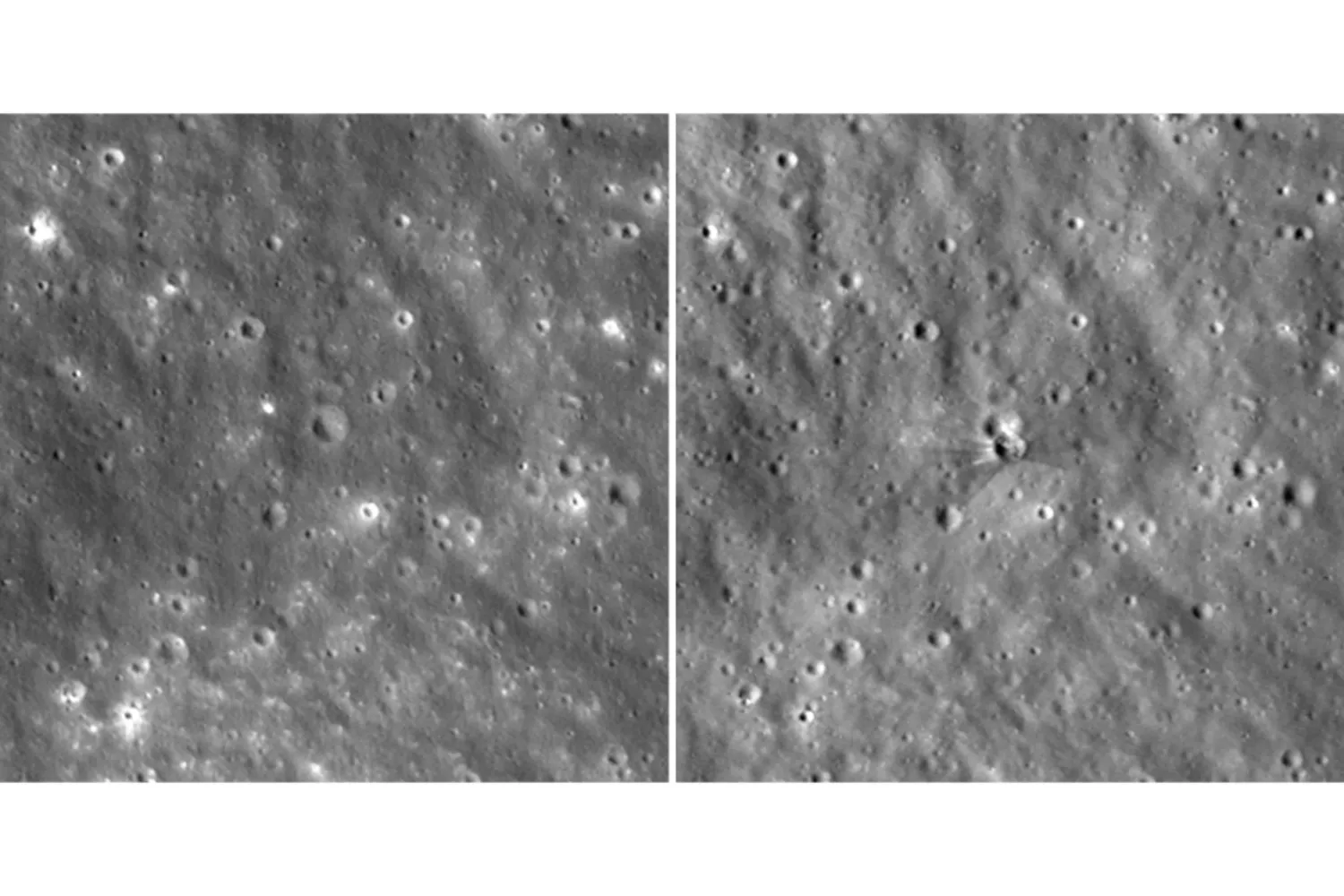
This combo made with photos provided by NASA on Tuesday, Aug. 18, 2026, taken by the Lunar Reconnaissance Orbiter, shows before, left, and after images of a fresh crater on the moon created by a collision with a SpaceX rocket. (NASA via AP)
TT

NASA Images Show Crater Carved by SpaceX Rocket that Slammed Into the Moon

This combo made with photos provided by NASA on Tuesday, Aug. 18, 2026, taken by the Lunar Reconnaissance Orbiter, shows before, left, and after images of a fresh crater on the moon created by a collision with a SpaceX rocket. (NASA via AP)

A NASA spacecraft circling the moon is providing the sharpest views yet of the crater carved by a crashing SpaceX rocket.

The space agency released before-and-after photos of the impact area on Tuesday.

The Falcon rocket’s upper stage plowed into the moon at 5,400 mph (8,700 kph) on Aug. 5 after drifting through space for more than a year. It launched a pair of private moon landers with experiments and even a tiny rover in 2025 as part of NASA’s push to commercialize lunar exploration.

Based on these new photos by NASA’s Lunar Reconnaissance Orbiter, the fresh crater appears to be 60 feet (18 meters) across and less than 10 feet (3 meters) deep, according to scientists.

Dark and bright streaks are clearly visible emanating like butterfly wings from the crater, The Associated Press reported.

The darker lines represent excavated material that was close to the surface and shaped by eons of solar wind, cosmic rays and micrometeorite strikes. The brighter rays indicate fresh rocks and dirt that were hurled from farther down.

The spacecraft photographed the crater a week after the collision from 60 miles (96 kilometers) up, while zooming along at one mile per second. Flight controllers had to tilt the spacecraft so its cameras pointed toward the impact scene.

The orbiter completes a lunar polar orbit every two hours, as the moon rotates beneath. It took six days before the crash scene came into view.

South Korea’s Danuri spacecraft was first on the scene to beam back photos.

The Lunar Reconnaissance Orbiter has been orbiting the moon since 2009, serving as NASA's up-close eyes as the space agency works to return astronauts to the lunar surface.


Italian Scientists Bet on Octopus to Fight Crab Invasion

Live blue crabs harvested by local fishermen in the Po river are seen in a waste bucket at Scardovari, Italy, northeast Italy, on June 26, 2026. (AFP)
TT

Italian Scientists Bet on Octopus to Fight Crab Invasion

Live blue crabs harvested by local fishermen in the Po river are seen in a waste bucket at Scardovari, Italy, northeast Italy, on June 26, 2026. (AFP)

From a fishing trawler in the Adriatic, Italian scientists gently release thousands of tiny octopuses in the hope of fighting an invasive crab species that has devastated local fisheries.

A team from the University of Bologna is betting that the common octopus can help contain the burgeoning population of blue crab -- a voracious crustacean that has ravaged shellfish production in the Adriatic.

"We chose the octopus because, in the wild, it is a formidable predator of crustaceans," Antonio Casalini, one of the researchers, told AFP.

Native to the North American Atlantic coast, blue crabs arrived in the Mediterranean decades ago, likely transported via ballast water from ships.

But their numbers have ballooned in recent years, with the government and fishing groups linking the boom to warming waters and climate change.

With sharp, blue-tinted claws that are particularly apt at prying open shells, they have wreaked havoc in Italy's northeast -- one of Europe's top clam producing regions.

Authorities in Bologna's Emilia-Romagna region said last year the species has caused almost 17 million euros ($20 million) in damages there since 2022.

Farming and fishing group Coldiretti has put the figure at about 200 million for the whole of Italy, with the northern Veneto region also badly affected.

"It eats everything including young clams lying on the seabed," said Davide Sanulli a fishermen and mussels farmer with thick eyebrows and grizzled hair, said of the crab.

In lagoon-like areas off the Po River delta "it has caused a massacre", added the 64-year-old, who is helping the university project.

Excellent swimmers and weighing up to one kilogram (2.2 pounds), the crabs have few natural predators -- something the researchers are hoping to change.

- Crab-eaters -

Launched last year and funded by the Emilia-Romagna region, the "Octo-Blu" project seeks to increase octopus numbers as a counterweight to the hard-shelled invaders.

The team breeds octopus hatchlings in white water tanks at a lab in the port town of Cesenatico.

When ready, the tiny invertebrates are scooped out by the thousands into a large plastic bag and taken out to sea, sometimes using Sanulli's rugged blue fishing boat.

The hatchlings are then released near underwater reefs where the group has laid cement-and-clay artificial dens to help the octopuses thrive.

Some 80,000 have been let out since June, an amount the research team is seeking to double by the end of August, hoping to see a few grow into fully developed octopuses.

"The idea is to establish a small community close to shore so that it can better combat the spread of the blue crab," said Casalini, an aquaculture technician.

The project has some clear drawbacks.

The common octopus is not prone to live in the sandy, warm waters typical of the lagoon areas where the blue crab is making the most damage, making its potential impact there negligible -- something the researchers are well aware of.

Other experts have suggested that seabass could be more effective at crab-fighting and the Bologna University team is also looking at eels, which are avid eaters of crustacean eggs, to complement the octopus's efforts.

Yet, if replicated, the pilot could still help limit blue crab numbers and the related impact on the Adriatic coast's marine environment, Casalini said.

"Blue crabs have an incredible reproductive potential and fertility rate," said Pietro Emmanuele, another University of Bologna researcher, noting a single crab lays millions of eggs, most of which hatch.

Although only some hatchlings reach adulthood, were an octopus to catch even a single female, it would make a difference, he said.


Mesmerizing Jellyfish Take Center Stage at 1st US Museum Dedicated Solely to the Floating Predators

A Japanese sea nettle is displayed at the Jellyfish Museum, a facility that is home to about 20 unique species of jellyfish found in Florida and other parts of the world, Friday, Aug. 14, 2026, in Pompano Beach, Fla. (AP)
TT

Mesmerizing Jellyfish Take Center Stage at 1st US Museum Dedicated Solely to the Floating Predators

A Japanese sea nettle is displayed at the Jellyfish Museum, a facility that is home to about 20 unique species of jellyfish found in Florida and other parts of the world, Friday, Aug. 14, 2026, in Pompano Beach, Fla. (AP)

The floating tentacled predators pulse and swirl in hypnotic patterns in the dark museum space, lit primarily by images projected on the walls and the glowing light from the saltwater tanks.

The private Jellyfish Museum in Pompano Beach, Florida, just north of Fort Lauderdale, is believed to be the first museum in the United States dedicated solely to the translucent invertebrates, and one of the few such spaces in the world, according to the city and the museum’s founders.

It was created by Alex and Yana Yanovsky, who previously developed successful aquariums in Ukraine, including their first jellyfish museum in Kyiv. The couple left those facilities behind when they fled Ukraine following the 2022 Russian invasion, operations manager Jessica Eisenbarth said.

The museum, which opened this past spring, is the couple's first aquatic attraction since immigrating to the US, but they'd like to expand.

“When they left Ukraine, they moved to Florida, and then they immediately wanted to share their passion here,” Eisenbarth said.

Jellyfish have survived for over 500 million years, making them older than dinosaurs and even trees. Their ancient origins are part of their allure, along with their hypnotic, pulsing movements. They have no heart or brain, and are made up primarily of water, giving them a translucent look.

Yana Yanovsky came up with the idea for the jellyfish museum after noticing how popular the jellyfish were at their other aquariums.

“Jellyfish are some of the most resilient creatures on Earth. While they lack a brain, they maintain a simple nerve net that allows them to respond to their environment,” Yana said in a statement provided by the city. “Their movement is mesmerizing, almost meditative, and they play an important role in marine ecosystems.”

Monty Graham, director of the Smithsonian Environmental Research Center, said he’s not surprised someone made an aquarium dedicated specifically to jellyfish. He credits the Monterey Bay Aquarium in California with kicking off the popularity of jellyfish exhibits at aquariums all over the world. Monterey Bay Aquarium began displaying jellyfish in temporary exhibits in 1985 and opened a permanent gallery in 1996.

“Jellyfish are cool, they’re things that people don’t get to see up close unless they’re scuba diving,” Graham said. “So here was this opportunity, in a controlled environment, very beautiful settings. It clicked all the buttons and checked all the boxes, and it was a very good, positive thing.”

The nearly 10,000-square-foot (900 square meters) Jellyfish Museum houses roughly 20 unique species of jellyfish found in Florida waters and other parts of the world. Different species can be rotated through the museum's 21 tanks. Some current occupants include Japanese sea nettles, moon jellyfish, spotted jellies and upside-down jellyfish, the last of which can be found among Florida's mangrove swamps.

The jellyfish are acquired through licensed aquaculture partners, according to the city.

The space is designed to exude calm and tranquility, general manager Iryna Pelypkanych said. It was converted from a former Wells Fargo bank branch with about $100,000 in community redevelopment grants from the city of Pompano Beach. Guides teach people about the role jellyfish play in marine ecosystems and the importance of protecting them.

“The biggest idea here is to leave people with the feeling that they know something more about the population of jellyfish,” Pelypkanych said. “Because so far, we know around 4,000 different species that can be called jellyfish.”


'How Many Will Die?': The Mysterious Ailment Killing Kenyan Elephants

Veterinary officers from the Sheldrick Wildlife Trust and Kenya Wildlife Service (KWS) attend to a male elephant lying on the ground after falling ill at Kitenden B Community Conservancy in Amboseli, Kajiado County, on August 12, 2026. (Photo by SIMON MAINA / AFP)
TT

'How Many Will Die?': The Mysterious Ailment Killing Kenyan Elephants

Veterinary officers from the Sheldrick Wildlife Trust and Kenya Wildlife Service (KWS) attend to a male elephant lying on the ground after falling ill at Kitenden B Community Conservancy in Amboseli, Kajiado County, on August 12, 2026. (Photo by SIMON MAINA / AFP)

Lying on the ground and kicking up a cloud of dust, the elephant slowly exhausted himself in futile attempts to stand, the latest victim of a mysterious ailment in southern Kenya.

Distressed vets administered a glucose injection -- the only option, given that the cause of the ailment remains unknown -- to the 11-year-old male, known as Genghis Khan, who was struggling to breathe and died on Tuesday.

The mystery affliction has killed at least 20 pachyderms, mostly females or young males, since June in Kenya. All of the animals have identical symptoms, including partial paralysis.

Elephant herds have made Amboseli -- overlooked by Africa's highest peak, Mount Kilimanjaro in Tanzania -- a lucrative tourist hotspot and the mysterious deaths in the region are a sensitive issue in a country where tourism is a huge source of revenue.

"You would find one struggling for a day, struggling for two or even three days. Until they completely die," said Patrick Papatiti, head of operations for Olgulului communal lands, which includes the Kitenden B reserve where Genghis Khan was found.

In late July, the Kenya Wildlife Service (KWS) said toxicology reports found high concentrations of cyanide in the animals' carcasses, suggesting possible pesticide poisoning from nearby farms' crops.

While observers still question the possible cause of death, several specialists interviewed by AFP dismiss poisoning.

"It's a disease," said Papatiti, who was born and raised in the local Maasai community, insisting there was "no way" cyanide was involved.

He is one of the very few local voices publicly rejecting the KWS preliminary findings, pointing out that no other animals have died.

Notably, neither scavengers nor flies that fed on the supposedly poisoned carcasses have perished -- creatures that typically succumb after consuming poisoned animals.

"If another animal feeds on that carcass and it is not dying, then definitely it is not a chemical," Joel Nyika, the Amboseli ecosystem manager for the Kajiado County authorities, told AFP.

He dismisses the theory, also put forward by the KWS, that the cyanide might have come from a type of foliage, noting local livestock would have died as well.

"As wildlife managers, we believe it could be a disease that is only affecting these elephants."

On August 7, the KWS said their "findings to date do not indicate an infectious or transmissible disease", assuring tourists that they could continue to visit.

But in the Kimana reserve, AFP journalists saw six carcasses on one day -- some fresh, others older -- with rangers also observing partial paralysis, preventing the animals from standing.

Maasai farmers, like 52-year-old Noah Saatia, rejected the possibility of poison -- pointing out to AFP they eat the same things -- and expressed anger over the animals' deaths.

"When they die, it hurts us," he told AFP, standing in his crop of maize, protected from animals by fences.

"We don't know the cause of the elephant deaths... But they are not dying because of food -- that's for sure."

Some of the deaths occurred only days earlier.

The carcass of a four-month-old calf, swarming with flies, lay half-devoured by hyenas.

About a dozen vultures were feeding on the remains of a pregnant female elephant, who had died near full term, and her unborn calf.

Paula Kahumbu, conservationist and head of Wildlife Direct, highlighted the "lack of evidence" supporting the pesticide theory.

In an interview with AFP, she noted that few adult male elephants had died, even though they are the ones most likely to raid crops.

Olgulului's Papatiti also dismissed the theory of deliberate poisoning. He said the emphasis should not be on pinning blame on individuals but finding the cause: "We need to know what is killing our elephants."

The sensitivity of the deaths has spooked the wildlife community, with several environmental organizations declining to comment to AFP beyond calling for a full investigation, while rangers at the Kimana reserve said they were not authorized to speak.

Papatiti fears that the death toll is being underestimated and that the affliction may also be affecting elephants in neighboring Tanzania.

"How many elephants will die before we can stop this?"