


Italian Scientists Bet on Octopus to Fight Crab Invasion

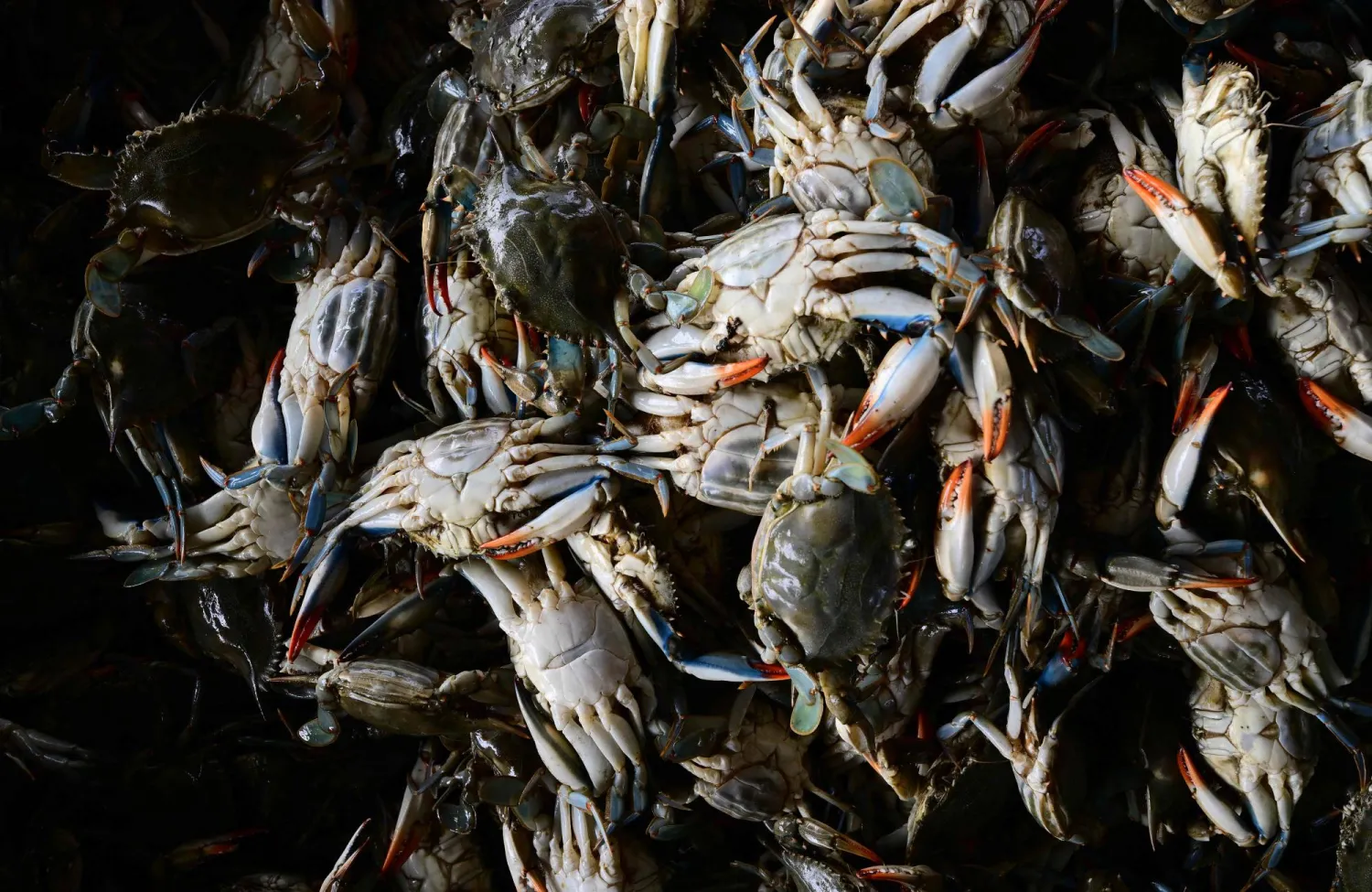
Live blue crabs harvested by local fishermen in the Po river are seen in a waste bucket at Scardovari, Italy, northeast Italy, on June 26, 2026. (AFP)
TT

Italian Scientists Bet on Octopus to Fight Crab Invasion

Live blue crabs harvested by local fishermen in the Po river are seen in a waste bucket at Scardovari, Italy, northeast Italy, on June 26, 2026. (AFP)

From a fishing trawler in the Adriatic, Italian scientists gently release thousands of tiny octopuses in the hope of fighting an invasive crab species that has devastated local fisheries.

A team from the University of Bologna is betting that the common octopus can help contain the burgeoning population of blue crab -- a voracious crustacean that has ravaged shellfish production in the Adriatic.

"We chose the octopus because, in the wild, it is a formidable predator of crustaceans," Antonio Casalini, one of the researchers, told AFP.

Native to the North American Atlantic coast, blue crabs arrived in the Mediterranean decades ago, likely transported via ballast water from ships.

But their numbers have ballooned in recent years, with the government and fishing groups linking the boom to warming waters and climate change.

With sharp, blue-tinted claws that are particularly apt at prying open shells, they have wreaked havoc in Italy's northeast -- one of Europe's top clam producing regions.

Authorities in Bologna's Emilia-Romagna region said last year the species has caused almost 17 million euros ($20 million) in damages there since 2022.

Farming and fishing group Coldiretti has put the figure at about 200 million for the whole of Italy, with the northern Veneto region also badly affected.

"It eats everything including young clams lying on the seabed," said Davide Sanulli a fishermen and mussels farmer with thick eyebrows and grizzled hair, said of the crab.

In lagoon-like areas off the Po River delta "it has caused a massacre", added the 64-year-old, who is helping the university project.

Excellent swimmers and weighing up to one kilogram (2.2 pounds), the crabs have few natural predators -- something the researchers are hoping to change.

- Crab-eaters -

Launched last year and funded by the Emilia-Romagna region, the "Octo-Blu" project seeks to increase octopus numbers as a counterweight to the hard-shelled invaders.

The team breeds octopus hatchlings in white water tanks at a lab in the port town of Cesenatico.

When ready, the tiny invertebrates are scooped out by the thousands into a large plastic bag and taken out to sea, sometimes using Sanulli's rugged blue fishing boat.

The hatchlings are then released near underwater reefs where the group has laid cement-and-clay artificial dens to help the octopuses thrive.

Some 80,000 have been let out since June, an amount the research team is seeking to double by the end of August, hoping to see a few grow into fully developed octopuses.

"The idea is to establish a small community close to shore so that it can better combat the spread of the blue crab," said Casalini, an aquaculture technician.

The project has some clear drawbacks.

The common octopus is not prone to live in the sandy, warm waters typical of the lagoon areas where the blue crab is making the most damage, making its potential impact there negligible -- something the researchers are well aware of.

Other experts have suggested that seabass could be more effective at crab-fighting and the Bologna University team is also looking at eels, which are avid eaters of crustacean eggs, to complement the octopus's efforts.

Yet, if replicated, the pilot could still help limit blue crab numbers and the related impact on the Adriatic coast's marine environment, Casalini said.

"Blue crabs have an incredible reproductive potential and fertility rate," said Pietro Emmanuele, another University of Bologna researcher, noting a single crab lays millions of eggs, most of which hatch.

Although only some hatchlings reach adulthood, were an octopus to catch even a single female, it would make a difference, he said.



Green Riyadh Launches Tree-Planting and Cleanup Campaign

File photo of the Saudi capital Riyadh - File/AAWSAT
TT

Green Riyadh Launches Tree-Planting and Cleanup Campaign

File photo of the Saudi capital Riyadh - File/AAWSAT

Green Riyadh, one of the programs overseen by the Royal Commission for Riyadh City, has launched a tree-planting and cleanup campaign at Shuaib Umm Qasr to coincide with Saudi National Day celebrations, the Saudi Press Agency said Sunday.

The campaign will be held on September 23 from 1:00 p.m. to 5:00 p.m. and is open to male and female volunteers from all segments of society. Participants will receive volunteer certificates in recognition of their active contributions to environmental service.

The initiative aims to attract volunteers to participate in tree planting and cleanup activities, thereby promoting community engagement and a culture of volunteerism while supporting national efforts to protect the environment and achieve sustainability.


82-year-old Dies after Beach Fight in Greece over Sun Lounger

Tourists from a nearby hotel watch military helicopters fly overhead during Medusa 15, a joint military exercise led by Greece and Egypt, at Maleme on the Greek island of Crete, Friday, Sept. 18, 2026. (AP Photo/Thanassis Stavrakis)
TT

82-year-old Dies after Beach Fight in Greece over Sun Lounger

Tourists from a nearby hotel watch military helicopters fly overhead during Medusa 15, a joint military exercise led by Greece and Egypt, at Maleme on the Greek island of Crete, Friday, Sept. 18, 2026. (AP Photo/Thanassis Stavrakis)

An 82-year-old man died Sunday after he got into a fight over a sun lounger on a beach in Greece near Athens, local media reported.

The octogenarian had a dispute with a 76-year-old man and a 21-year-old woman over the sun lounger, with the argument degenerating into a scuffle between the two men, according to police, the ANA news agency and ERT state television channel reported.

The 82-year-old, badly hurt, was transported to hospital from the Vouliagmeni beach resort area where the argument broke out. He was later declared dead at the hospital, AFP said.

Both the 76-year-old man and the 21-year-old woman were arrested, ANA said, with police investigating what happened.


10 Lions Die in Suspected Poisoning at Tanzania Wildlife Reserve

Lions are seen in their counpound at the Artis Amsterdam Royal Zoo in Amsterdam, Netherlands in this handout photo released to media on January 28, 2021. Artis Amsterdam Royal Zoo/Handout via REUTERS
TT

10 Lions Die in Suspected Poisoning at Tanzania Wildlife Reserve

Lions are seen in their counpound at the Artis Amsterdam Royal Zoo in Amsterdam, Netherlands in this handout photo released to media on January 28, 2021. Artis Amsterdam Royal Zoo/Handout via REUTERS

Ten lions were found dead in Tanzania's Ngorongoro wildlife reserve this week and preliminary findings suggest they may have been poisoned, the area's management authority said.

The deaths raise concerns over the conservation of lions in one of Africa's most renowned wildlife ecosystems. Poisoning has been a recurring threat to large ⁠carnivores across parts ⁠of East Africa, often linked to conflicts between predators and livestock owners.

The lions were discovered on September 18 in the Ndutu area of Endulen Ward in Arusha ⁠region, Reuters quoted the Ngorongoro Conservation Area Authority as saying in a statement released late on Saturday.

"Preliminary findings suggest the animals may have died after ingesting poison," the authority said, adding that it had launched an investigation to determine the cause and identify those responsible.

The Ngorongoro Conservation Area, a UNESCO ⁠World ⁠Heritage Site in northern Tanzania, is one of the country's leading tourism attractions. It is home to a wide range of wildlife, including lions, elephants, buffaloes and endangered black rhinos.

Last month, police arrested four suspects in an investigation into the deaths of 18 elephants across the border in Kenya.