


China Robot Makers Flock to Beijing Show, Seek Path to Mass Adoption

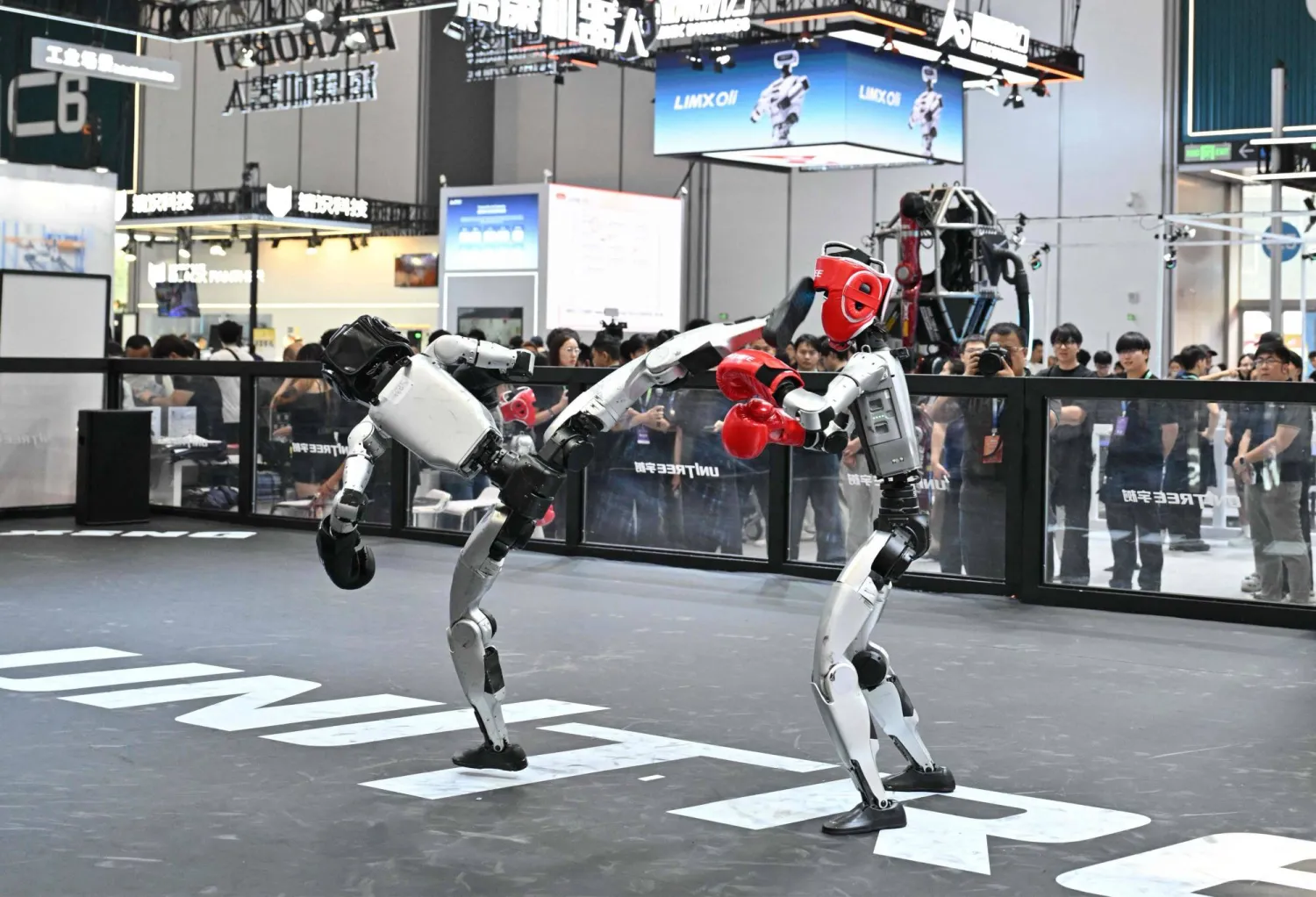
 Two robots produced by Unitree take part in a fighting demonstration during the 2026 World Robot Conference in Beijing on August 19, 2026. (AFP)
Two robots produced by Unitree take part in a fighting demonstration during the 2026 World Robot Conference in Beijing on August 19, 2026. (AFP)
TT

China Robot Makers Flock to Beijing Show, Seek Path to Mass Adoption

 Two robots produced by Unitree take part in a fighting demonstration during the 2026 World Robot Conference in Beijing on August 19, 2026. (AFP)
Two robots produced by Unitree take part in a fighting demonstration during the 2026 World Robot Conference in Beijing on August 19, 2026. (AFP)

China's robot makers showcased their latest machines at a Beijing conference on Wednesday, seeking to convince investors and customers that the technology is moving forward for broader commercial adoption.

More than 300 companies are attending the World Robot Conference which runs through Sunday, displaying over 2,000 exhibits and launching more than 150 products, according to Beijing authorities.

The conference comes as robotics emerges as a new front in the US-China rivalry and as investor enthusiasm for the sector hits fresh highs in China.

Shares in Unitree, China's best-known humanoid robot ‌maker, soared ‌nearly six-fold in their Shanghai trading debut on Wednesday.

ROBOTICS AN 'IMPORTANT FORCE' ‌IN ⁠CHINA'S DEVELOPMENT

Following its ⁠successful IPO, which was more than 8,000 times oversubscribed by retail investors, startup Lumos Robotics and the robotics division of China's largest auto exporter Chery Automobile told Reuters they were also considering stock market listings.

At the conference's opening ceremony, Xin Guobin, vice minister of the Ministry of Industry and Information Technology, pledged support for the sector's development, saying robotics had already become "an important force" in China's economic and social development, state-backed financial news outlet Cailianshe reported.

While robots in ⁠China are increasingly being deployed for tasks, such as hotel food ‌deliveries and on some assembly lines, large-scale adoption beyond ‌pilot projects remains limited.

Startup Robotera displayed a slick demonstration of a parcel-sorting humanoid robot torso ‌on a wheeled tripod base at the show. The robots have a continuous running ‌time of 900 to 1,000 hours, and are 85% as effective as a human worker, a sales representative told Reuters.

COMPETITION HELPS INDUSTRY'S GROWTH

The industry's rapid expansion mirrors China's electric vehicle sector a few years ago, when scores of companies emerged rapidly and competed aggressively.

"A large number of (robot) companies appeared ‌almost overnight," Zhang Guibing, head of AiMOGA Robotics, Chery's robotics division, told Reuters on the sidelines of the conference.

"But from the perspective ⁠of industry development, ⁠there is a positive side to this. It allows everyone to compete fully," he said. "In the end, this will help deepen the industry's technology and capabilities. From that perspective, I think this is a good thing."

Global humanoid robot shipments nearly quadrupled in the first half of this year to 19,100 units, with Chinese manufacturers dominating the market, according to data from Smart Analytics Global.

Still, Georg Stieler, a robotics analyst who advises industrial companies in China, estimates that between 50% and 70% of humanoid robots produced this year could end up in "data factories", where they are used to collect training data rather than perform productive work for paying customers.

"Competition in the Chinese market could become extremely intense in the future, especially when it comes to costs," Zhang said, adding humanoid robots could take about a decade to mature before seeing rapid adoption.



Musk Says Google Is Interested in Renting More Computing Capacity from SpaceX

The SpaceX logo in this illustration taken June 11, 2026. (Reuters)
TT

Musk Says Google Is Interested in Renting More Computing Capacity from SpaceX

The SpaceX logo in this illustration taken June 11, 2026. (Reuters)

Elon Musk said on Saturday in a post on X that Google was interested in renting more computing capacity from SpaceX, without providing further details.

Musk, SpaceX and Google did not immediately respond to Reuters requests for comment.

SpaceX already has a multi-year cloud services agreement with Google, signed ‌before its ‌blockbuster IPO. Google will ‌pay SpaceX $920 ⁠million monthly from ⁠October this year to June 2029, as per the terms of the deal announced in June.

The compute capacity includes about 110,000 Nvidia GPUs, CPUs, memory and other related components.

Demand for computing ⁠infrastructure has surged since generative AI ‌services were ‌introduced, prompting technology companies to invest heavily in ‌data centers equipped with advanced chips from ‌Nvidia and other manufacturers.

In May, rival Anthropic said that it had reached a deal to tap SpaceX's computing resources.

In a ‌regulatory filing in June, SpaceX disclosed compute-capacity agreements with Anthropic and ⁠Google ⁠worth more than $70 billion on aggregate.

SpaceX is also increasing its computing capacity beyond its existing Memphis-area hub. It said this month it would spend more than $74 billion in a planned investment at a new supercomputer facility at Starbase in the Rio Grande Valley in Texas, and a second campus in Cochise County, Arizona.


OpenAI Countersues Apple in Row Over Trade Secrets, Suppliers

An OpenAI advertisement is displayed on the Sphere in Las Vegas, Nevada, US, November 20, 2026. (Reuters)
TT

OpenAI Countersues Apple in Row Over Trade Secrets, Suppliers

An OpenAI advertisement is displayed on the Sphere in Las Vegas, Nevada, US, November 20, 2026. (Reuters)

OpenAI countersued Apple on Friday, alleging that the iPhone maker committed similar trade secret theft that it had accused the ChatGPT provider of this summer.

OpenAI alleged that Apple was stealing trade secrets through a former employee and pressuring shared suppliers to hamper its entry into the connected devices market.

An Apple spokesperson denounced the filing as "a transparent attempt to distract from the substance" of its own lawsuit.

The countersuit came in a filing Friday in federal court in San Jose, California, as part of the lawsuit filed by Apple in July against OpenAI and two of its employees who previously worked for Apple.

The two companies, partners since ChatGPT was integrated into Apple products in 2024, are poised to become rivals: OpenAI is developing its first connected devices designed for artificial intelligence with the studio of Jony Ive, Apple's renowned former design chief.

Apple is seeking "to compete unfairly by any means available," OpenAI's lawyers wrote.

According to the filing, Apple is demanding that suppliers identify their projects for OpenAI and the employees assigned to them.

"Suppliers have expressed fear of losing Apple business and have moved or rescheduled meetings with OpenAI to avoid Apple seeing them," the filing says.

One supplier moved OpenAI's production to a night shift, while another dropped planned work "because of threats from Apple," according to the filing, which does not name any of the firms.

OpenAI also accused a former Apple employee, who spent six months at OpenAI before leaving in June and returning to the iPhone maker, of sending "dozens of OpenAI documents" about a prototype to his personal phone numbers, then presenting OpenAI's plans to senior Apple staff in July "at Apple's request."

The lawyers also challenged a clause barring former Apple employees who joined OpenAI from trying to poach their former colleagues for one year.

They also challenged a practice that allegedly encourages Apple employees to mix work files with their personal iCloud accounts so that, according to the lawyers, the company can later accuse those who leave of theft.

"This case is about OpenAI employees deliberately stealing, accessing, and using Apple's secret and confidential information regarding our unreleased technologies, processes, and products - not about inadvertent retention of Apple information," the Apple spokesperson said, on the condition AFP did not attribute the quote to a specific name.

OpenAI on Friday also withdrew its motion to dismiss the case, without giving a reason.

In October, OpenAI pledged not to use the information Apple claims as trade secrets, after the judge said he was "highly likely" to issue an order barring OpenAI from using it until trial.


Tech Stocks Under Pressure as AI Jitters Persist

An electronic billboard displays messages supporting Nvidia CEO Jensen Huang in Taipei, Taiwan, November 25, 2026. REUTERS/Ann Wang
TT

Tech Stocks Under Pressure as AI Jitters Persist

An electronic billboard displays messages supporting Nvidia CEO Jensen Huang in Taipei, Taiwan, November 25, 2026. REUTERS/Ann Wang

Global technology stocks tumbled Wednesday as renewed concerns over the AI boom washed away the euphoria that greeted the return of Jensen Huang to the scandal-hit chip giant Nvidia.

News that Huang, one of the most prominent proponents of the artificial intelligence explosion, had returned as CEO less than two weeks after resigning over extramarital affairs -- including with an alleged Chinese spy -- had sent markets soaring after weeks of heavy selling.

But sentiment soured on renewed fears about the colossal sums pumped into the AI build-out and when investors would see returns.

The prospect of higher US interest rates amid high inflation has also sparked fears about the infrastructure investment costs.

"The sell-off in tech stocks continues, as market skepticism is driving price action," said Kathleen Brooks, research director at the trading group XTB.

Taipei, Tokyo and Seoul -- home of most of Asia's key AI-linked firms -- sank 4.8 percent, 2.8 percent and 6.2 percent, respectively.

Losses were led by Taiwan's TSMC and MediaTek, Japanese chip giants Kioxia and Advantest, and South Korean titans SK hynix and Samsung.

Hong Kong and Shanghai stock markets also fell.

"The continued slump in the AI trade in Asia and the US is helping the rotation into European indices," Brooks said.

London, Paris and Frankfurt were all higher in morning deals, with carmakers and the luxury sector leading the way.

The tech rout followed a return to selling on Wall Street on Tuesday after Monday's surge, with Nvidia shedding almost six percent.

Nvidia remains under scrutiny from investigators including the FBI and on Capitol Hill for allegedly helping Chinese firms gain access to the firm's most advanced chips.

And Anthropic, maker of the AI chatbot Claude, slumped 6.5 percent to fall below the $83 price for its massive IPO last week, the largest ever.

Investors will be keeping an eye on the release of the US Federal Reserve's preferred gauge of inflation later in the day, which could play a role in its interest rate decisions.

Due to stubbornly high inflation, Fed officials are widely expected to raise rates next month.

In company news, Chinese electronics giant Xiaomi rose in Hong Kong on optimism for the performance of the company's higher-end smartphones, even as an AI-driven memory chip supply crunch hits profits.