

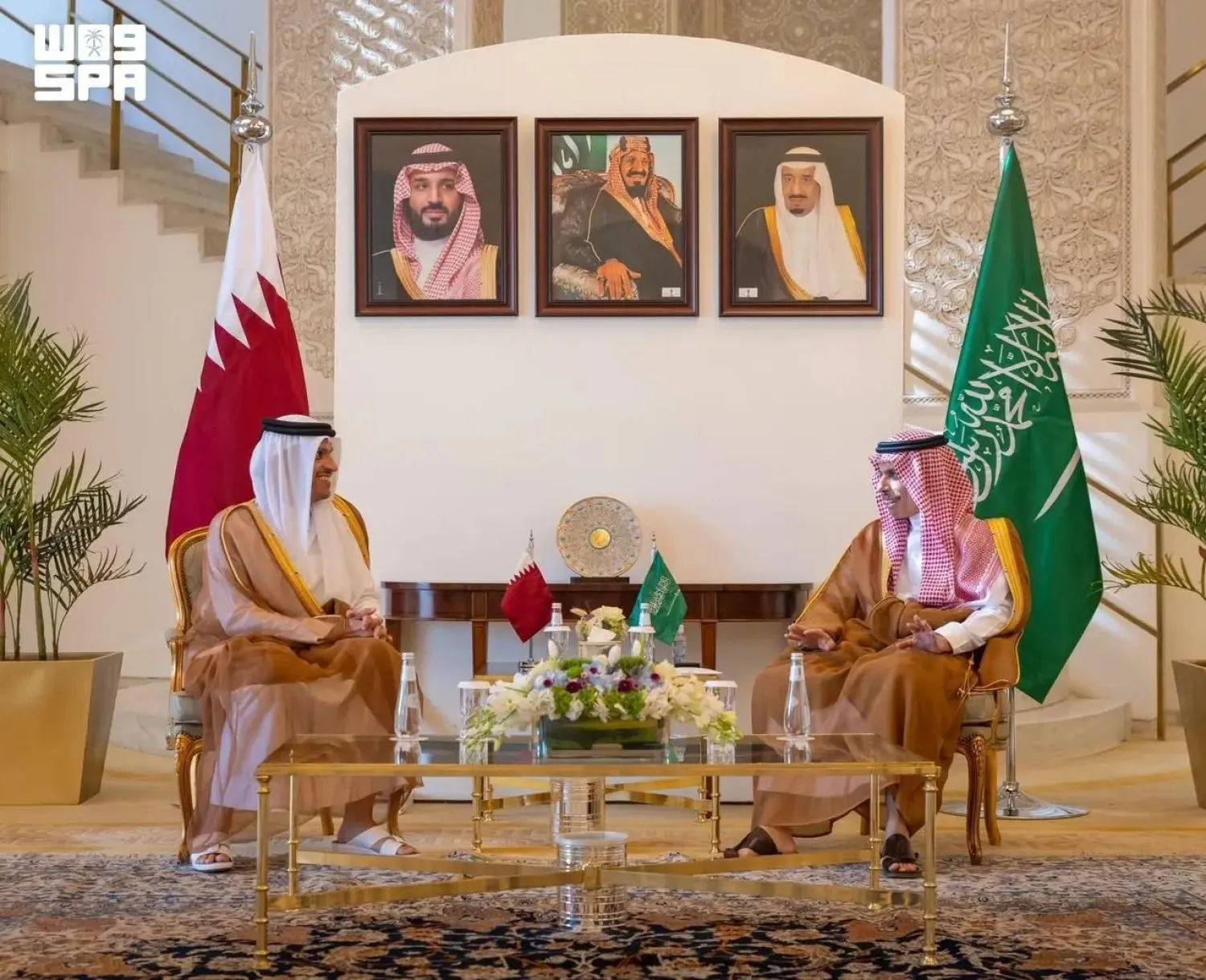

Saudi Foreign Minister Discusses Regional Developments with Qatari Counterpart

Saudi Minister of Foreign Affairs Prince Faisal bin Farhan bin Abdullah met with his Qatari counterpart, Sheikh Mohammed bin Abdulrahman bin Jassim Al Thani. (SPA)
TT

Saudi Foreign Minister Discusses Regional Developments with Qatari Counterpart

Saudi Minister of Foreign Affairs Prince Faisal bin Farhan bin Abdullah met with his Qatari counterpart, Sheikh Mohammed bin Abdulrahman bin Jassim Al Thani. (SPA)

Saudi Minister of Foreign Affairs Prince Faisal bin Farhan bin Abdullah received his Qatari counterpart, Sheikh Mohammed bin Abdulrahman bin Jassim Al Thani, in Riyadh on Wednesday, the Saudi Press Agency reported.

During the meeting, the two ministers reviewed bilateral relations, areas of cooperation and ways to strengthen and develop them in line with the aspirations of the two countries’ leaderships and peoples.

The two ministers discussed the latest regional developments and diplomatic efforts to de-escalate tensions, contain their repercussions and safeguard regional security and stability. They underscored the importance of continued coordination and consultation, as well as aligning positions on current developments to bolster efforts to promote security and stability across the region.

They affirmed their support for Qatari and Pakistani mediation efforts and the role they play in advancing dispute settlement through diplomatic means. They also stressed the need to continue joint efforts to ensure security, safety, and freedom of navigation in the region's vital maritime corridors.



Faisal bin Farhan Stresses Diplomacy to Ease Regional Tensions

Prince Faisal bin Farhan receives Japanese Foreign Minister Toshimitsu Motegi in Riyadh on Wednesday (Saudi Foreign Ministry)
TT

Faisal bin Farhan Stresses Diplomacy to Ease Regional Tensions

Prince Faisal bin Farhan receives Japanese Foreign Minister Toshimitsu Motegi in Riyadh on Wednesday (Saudi Foreign Ministry)

Saudi Foreign Minister Prince Faisal bin Farhan on Wednesday reaffirmed the Kingdom’s commitment to reducing regional tensions and preventing renewed conflict through comprehensive, sustainable diplomatic solutions addressing the sources of instability in the Middle East.

“Diplomacy, dialogue and peaceful means remain our priorities,” Prince Faisal declared during the third Saudi-Japanese Strategic Dialogue with Japanese Foreign Minister Toshimitsu Motegi in Riyadh.

Prince Faisal highlighted the decades-long relationship between Saudi Arabia and Japan, built on mutual trust and respect, and identified maritime security as a key shared priority.

He stressed the importance of safeguarding freedom of navigation in international waterways in accordance with international law, emphasizing that the Strait of Hormuz, Bab al-Mandab and other maritime passages must remain open, secure and free from threats.

The Saudi minister described Japan as an important economic partner and noted that Riyadh sought to expand cooperation in investment, energy, resources, supply chains, defense and technology, as well as the exchange of expertise and capabilities.

He reaffirmed that Saudi Arabia would remain a reliable partner for Japan, including in energy, while praising Tokyo’s efforts to strengthen economic resilience and stabilize global energy markets and trade.

Ahead of his visit to Riyadh and Muscat, Motegi noted that Saudi Arabia was playing a mediating role in talks between the United States and Iran and had seen its international influence expand significantly in recent years.

He pledged to deepen cooperation with the Kingdom as a strategic partner, particularly in ensuring stable energy supplies.

Toshihiro Kitamura, Japan’s assistant foreign minister and ministry spokesman, told Asharq Al-Awsat that cooperation between Riyadh and Tokyo was “strategic and encompasses all fields,” adding that future defense cooperation was possible.

Speaking at a news conference in Riyadh, Kitamura explained that Japan wanted to hear Saudi Arabia’s assessment of regional developments and strengthen coordination with Riyadh and Oman in support of peace and stability, particularly regarding Iran.

He noted that more than 95% of Japan’s crude oil imports passed through the Strait of Hormuz, underscoring its importance to global trade and the world economy.

Kitamura also expressed serious concern over Houthi attacks in Bab al-Mandab and indicated that Japan aimed to broaden bilateral cooperation beyond oil under the Saudi-Japan Vision 2030 framework, in line with Saudi Vision 2030.


Qatari Prime Minister Arrives in Riyadh

Qatar’s Prime Minister and Minister of Foreign Affairs Sheikh Mohammed bin Abdulrahman bin Jassim Al Thani is welcomed upon his arrival in Riyadh. (SPA)
TT

Qatari Prime Minister Arrives in Riyadh

Qatar’s Prime Minister and Minister of Foreign Affairs Sheikh Mohammed bin Abdulrahman bin Jassim Al Thani is welcomed upon his arrival in Riyadh. (SPA)

Qatar’s Prime Minister and Minister of Foreign Affairs Sheikh Mohammed bin Abdulrahman bin Jassim Al Thani arrived in Riyadh on Wednesday.

He was received by Vice Minister of Foreign Affairs Waleed Elkhereiji at King Khalid International Airport.


UAE Halts All Trade, Financial Dealings with Iran after Attack

Tuesday's announcement is the latest measure against Iran by the UAE after it recalled its ambassador early in the conflict. (Asharq Al-Awsat)
TT

UAE Halts All Trade, Financial Dealings with Iran after Attack

Tuesday's announcement is the latest measure against Iran by the UAE after it recalled its ambassador early in the conflict. (Asharq Al-Awsat)

The United Arab Emirates has said it is suspending all trade and financial dealings with Iran after reporting an Iranian missile attack directed at its ships.

The announcement comes after a period of relative calm in the UAE, with no Iranian missiles aimed at the country since May after it bore the brunt of attacks in the early weeks of the Middle East war.

Abu Dhabi has however accused Tehran of repeatedly targeting its tankers at sea in recent weeks.

"In light of regional escalations... all trade, commercial exchanges, and financial transactions with Iran have been halted until further notice," said UAE foreign ministry communications director Afra Al Hameli.

The UAE is home to a sizeable Iranian community and has been a major trading partner for US-sanctioned Iran, at least before the war.

Tuesday's announcement is the latest measure against Iran by the UAE after it recalled its ambassador early in the conflict.

- Navigation -

Abu Dhabi on Tuesday accused Iran of firing two ballistic missiles towards the country, the first such attack since May.

It later said the salvo was directed at shipping, but Tehran denied firing missiles at the UAE.

"UAE air defenses detected two ballistic missiles launched from Iran towards the country, with the first falling outside the country's territorial waters, while the second fell within the territorial waters," the UAE ministry said in a statement posted to social media.

A second statement released later said the missiles "were targeting maritime navigation and fell into the sea".

Iranian foreign ministry spokesman Esmaeil Baqaei "categorically rejected the United Arab Emirates' claim that Iran had launched a missile towards that country", calling it harmful to regional trust and security efforts.

The first UAE statement came nearly two hours after a phone alert that warned residents of a "potential missile threat".

It was the first such alert since a false alarm in June and an alert in July for an attack that ultimately did not enter UAE territory.

Before that, the last missile warning came in early May.

However, tankers belonging to the UAE's state-owned oil company ADNOC have been repeatedly targeted in the past few weeks.

When the Middle East war began on February 28, the UAE bore the brunt of Iran's attacks, with nearly 3,000 missiles and drones directed at the country -- more than anywhere else in the region.

After a memorandum of understanding between Iran and the United States came into effect in June, which has since collapsed, the UAE reported no attacks, unlike other Gulf states.