


Sudan: More Than 200,000 People Displaced Since Eruption of Blue Nile Fighting

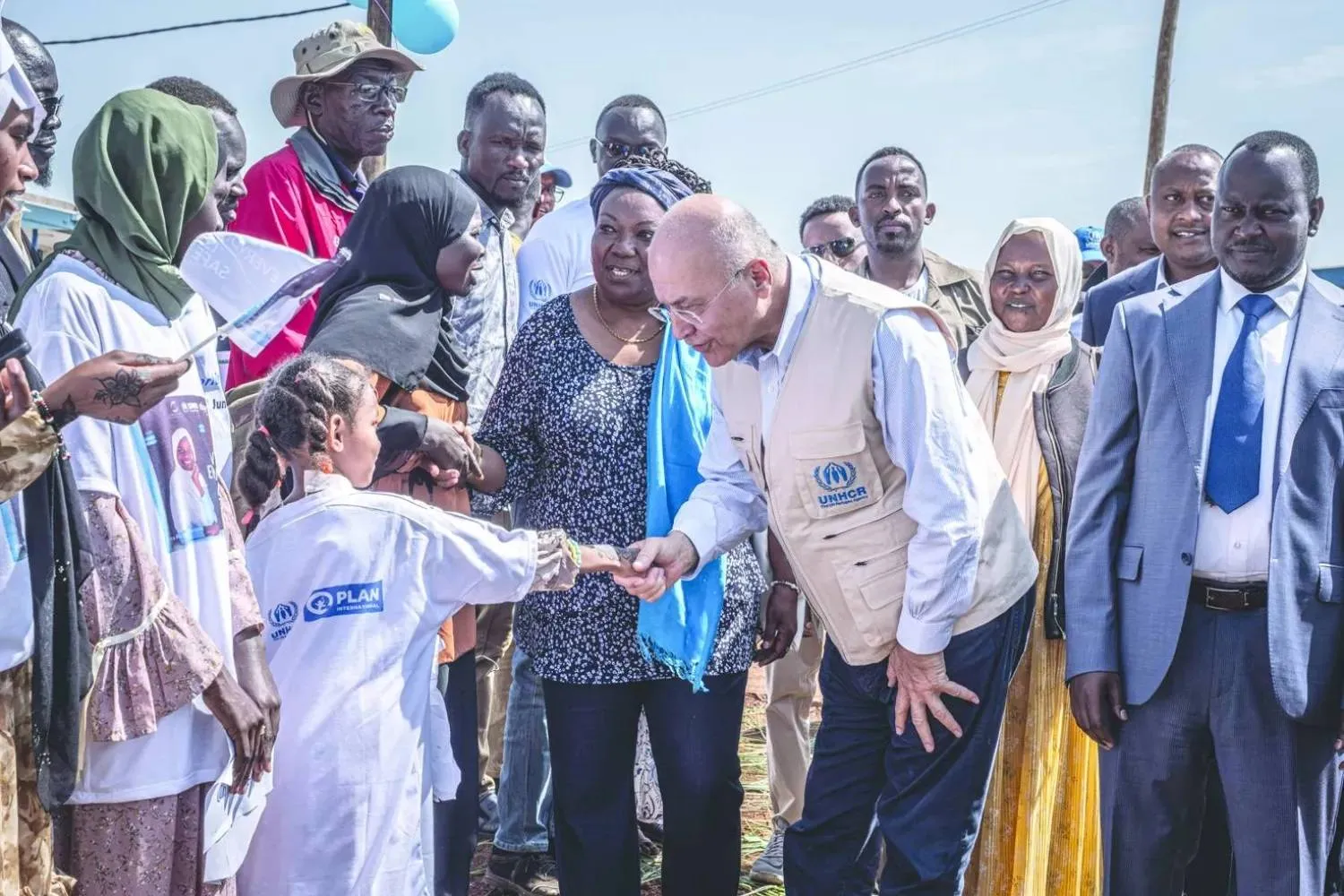
UN High Commissioner for Refugees Barham Salih meets Sudanese refugees in Ethiopia's Ura camp. AFP
TT

Sudan: More Than 200,000 People Displaced Since Eruption of Blue Nile Fighting

UN High Commissioner for Refugees Barham Salih meets Sudanese refugees in Ethiopia's Ura camp. AFP

A Sudanese government official has confirmed that more than 200,000 people have been displaced from the cities of Kurmuk and Qeisan, as well as other areas in the Blue Nile state in southeastern Sudan, as a result of fighting between the Sudanese army and the Rapid Support Forces (RSF).

Warnings have been issued about the worsening humanitarian and health conditions facing the displaced, amid heavy rainfall, shortages of food and shelter materials, and difficulties in delivering aid.

Last week, forces belonging to the Tasis (Foundation) alliance, led by the RSF, announced that they had taken control of the strategic cities of Kurmuk and Qeisan, located near the Ethiopian border.

This development triggered a large wave of displacement toward safer areas, particularly the cities of Damazin, the regional capital, and Roseires, the state's largest city.

Hashim Orta, Commissioner of Voluntary Return and Displaced Persons in the Blue Nile region, told Asharq Al-Awsat that the number of people displaced from Kurmuk, Qeisan, and other towns had exceeded 200,000 since the outbreak of hostilities.

He stressed that they are living under “extremely difficult humanitarian conditions.”

The Commission of Voluntary Return and Displaced Persons in the Blue Nile is a local government body responsible for monitoring the conditions of displaced persons and refugees, coordinating their return, and supporting their reintegration.

The origins of Sudan’s voluntary return mechanism date back to 2003, when a displacement and voluntary return unit was established under the Humanitarian Aid Commission.

Orta added that pregnant women and elderly men and women died while attempting to flee the fighting, enduring arduous displacement journeys that lasted several days. Many were forced to walk long distances through heavy rain and over difficult terrain.

According to Orta, displacement camps and reception centers around Damazin have received tens of thousands of civilians in recent days, most of them women and children. Their needs for food, drinking water, healthcare, and shelter materials continue to grow.

The total figure provided by the local official could not be independently verified.

The Commission of Voluntary Return and Displaced Persons is not affiliated with the United Nations, but it works in cooperation with UN agencies and international organizations, including the UN Refugee Agency (UNHCR) and the International Organization for Migration (IOM), on issues related to displacement, return, and humanitarian assistance.

Fears of Disease Outbreaks

The local government official warned of increasing health risks within displacement sites, particularly during the rainy season. He expressed concern about the potential spread of malaria, dengue fever, and other seasonal diseases, amid overcrowded shelters and weak healthcare services.

He said local authorities were making efforts to provide food, water, and shelter materials, but the available resources were far from sufficient to meet the scale of needs and the growing numbers of people arriving each day.

“The need is immense compared to the numbers flowing into the camps,” he said, calling on local, regional, and international organizations to intervene urgently and provide humanitarian assistance to those affected.

The continuing fighting has further complicated the humanitarian response, as insecurity in several areas is preventing aid organizations and supplies from reaching residents and displaced people. At the same time, local authorities are facing mounting pressure to provide basic necessities for the large numbers of people fleeing the violence.

Displacement Journey Amid Heavy Rains

Eyewitnesses described harsh conditions faced by civilians traveling from conflict areas toward Damazin and Roseires. They said heavy rainfall had severely damaged dirt roads and made them difficult to cross, forcing some families to walk long distances under extremely challenging conditions.

The crisis is compounded by the geography of the Blue Nile region, where seasonal rains cause rivers and streams to swell and cut off a number of roads, making civilian movement and the delivery of humanitarian aid even more difficult.



UK Summons Israeli Envoy over West Bank Settlement Project

An Israeli military vehicle patrols near to the settlers in front of the Palestinian houses in the village of Qusra, south of Nablus, in the occupied West Bank, on August 13, 2026. (Photo by Zain JAAFAR / AFP)
TT

UK Summons Israeli Envoy over West Bank Settlement Project

An Israeli military vehicle patrols near to the settlers in front of the Palestinian houses in the village of Qusra, south of Nablus, in the occupied West Bank, on August 13, 2026. (Photo by Zain JAAFAR / AFP)

Britain said on Wednesday it had summoned Israel's charge d'affaires and demanded a halt to a major West Bank settlement project after Israeli authorities opened bidding for more than 1,200 homes in the area.

The E1 plan, green-lit by Israel last year, has drawn international condemnation, with the UN secretary general saying at the time that it posed an "existential threat" to a contiguous Palestinian state.

The project would further separate east Jerusalem, occupied and annexed by Israel and predominantly inhabited by Palestinians, from the West Bank, said AFP.

British foreign minister Ed Miliband called the move "an unacceptable and destructive act" and said it would "endanger the viability of a two-state solution".

"The Israeli Government must halt E1 plans immediately, retract the tender and stop all settlement expansion," Miliband said in a statement.

Miliband said he delivered the message directly to his Israeli counterpart Gideon Saar and that Israel's charge d'affaires was summoned to the foreign ministry.

The British government also pledged to unveil "a comprehensive set of measures" in the coming weeks, including sanctions targeting people involved in the "illegal settlement expansion".

"Britain will not stand back and accept the destruction of the two state solution," Miliband said.

Israel approved the plans for the roughly 12-square-kilometer (five-square-mile) parcel of land known as E1 just east of Jerusalem, in August last year.

The plan seeks to build around 3,400 homes on the ultra-sensitive tract of land, which lies between Jerusalem and the Israeli settlement of Maale Adumim.

The latest tender covers more than 1,200 housing units, according to Israeli NGO Peace Now.

Peace Now said Israel's housing ministry published the tender on August 18 and immediately opened it for bids.

Submissions are due by October 19, one week before Israeli elections scheduled for October 27.

The group said the homes accounted for about one-third of the planned E1 development and accused the government of trying to advance construction commitments before the vote.

Israel heavily restricts the movement of West Bank Palestinians, who must obtain permits from authorities to travel through checkpoints to cross into east Jerusalem or Israel.

Last year, Britain and France were among 21 countries who condemned Israeli approval of the E1 project, calling it a violation of international law and urging Israel to reverse the decision.

Excluding east Jerusalem, the West Bank is home to around three million Palestinians, as well as about 500,000 Israeli settlers.


'Ray of Hope': Gaza Seed Bank Rebuilds after Wartime Destruction

Salem Muhanna, who manages the Al Qarara Seed Bank with support from the International Committee of the Red Cross (ICRC), prepares to stack a container with seeds at the bank, in Deir el-Balah, central Gaza Strip on August 11, 2026. (Photo by Bashar Taleb / AFP)
TT

'Ray of Hope': Gaza Seed Bank Rebuilds after Wartime Destruction

Salem Muhanna, who manages the Al Qarara Seed Bank with support from the International Committee of the Red Cross (ICRC), prepares to stack a container with seeds at the bank, in Deir el-Balah, central Gaza Strip on August 11, 2026. (Photo by Bashar Taleb / AFP)

From a small makeshift tent in the central Gaza Strip, a dedicated team works to carefully store and document some of the war-shattered territory's most precious commodities: local seeds.

Shelves of unassuming plastic tubs line the walls of the Al Qarara Seed Bank, each holding indigenous seeds seen as a way of reviving Gaza's devastated farming sector and preserving its agricultural heritage.

The seed bank in Deir el-Balah is rebuilding its stocks of Gaza's heirloom seeds that were destroyed during the Israel-Hamas war which erupted in October 2023, said AFP.

Unlike hybrid varieties often sold commercially, heirloom seeds can be saved and used year after year and are often better adapted to their local environment.

"During the war, they were what helped us survive," said Salem Muhanna, who manages the project which was founded in 2017 with support from the International Committee of the Red Cross (ICRC).

"Heirloom seeds give continuity. They provide 80 to 90 percent of the same yield repeatedly. That is why we relied on heirloom seeds," he told AFP.

The bank holds seeds for wheat and barley; leafy crops such as Swiss chard, spinach and parsley, as well as some vegetables like courgette and okra.

The war that erupted following Hamas's attack on Israel in October 2023 took an immensely heavy toll.

The fighting "completely destroyed the bank and led to the loss of many seed varieties," explained 27-year-old Hanadi Muhanna, Salem Muhanna's daughter who also manages the project.

"In addition, because we were repeatedly displaced, it was difficult to start over again," she added.

"Eventually we settled in Deir el-Balah and managed, thankfully, to establish a small tent. We created something simple using basic means".

A collection of large hessian sacks, plastic barrels, and smaller mismatched tubs now hold what remain of the stocks, each carefully labelled and protected from pests with plastic sheets.

- 'Safety valve' -

Like the rest of life in the coastal Palestinian territory, Gaza's agricultural sector was shattered by the conflict.

Despite a US-backed ceasefire since October 2025, bloodshed has continued, with the Israeli military continuing to target Palestinians it says are militants.

Israel says it now controls more than 60 percent of the Gaza Strip, up from about half when the ceasefire took effect, and has refused to start withdrawing until Hamas fully disarms.

Before the war, agriculture including crop production, herding and fishing, accounted for approximately 10 percent of Gaza's economy, according to the United Nations' Food and Agricultural Organization (FAO).

Just three percent of the cropland in Gaza remains accessible and undamaged, the FAO said Tuesday.

Tight Israeli controls on the entry of all goods into the territory has also compounded the woes of Gaza's farmers.

"There is no water, no fertilizer, no agricultural chemicals," Salem Muhanna told AFP. "Nothing is available".

Before the war, Gaza was self-sufficient in fresh vegetables and used to export one-third of its production to external markets, according to Osama Al-Mukhalalati, an economic security officer with the ICRC.

Now, at best, the agricultural output cannot provide more than 10 percent of Gaza's vegetable needs, he added.

The Al Qarara Seed Bank works on a lending system, with trusted farmers receiving seed and then returning it at the end of the season.

"During the war, we considered this project our main safeguard," said Suleiman Abu Shamas, a farmer from Deir el-Balah who was out inspecting a crop of waist-high chilli peppers.

"With agricultural supplies cut off and prevented from entering through the crossings, the only safeguard we had was to build a food basket based on heirloom seeds that already existed within Gaza."

For Al-Mukhalalati, the bank is not only a way of continuing food production on what agricultural land remains, but is a means of preserving Gaza's agricultural heritage for the future.

"We consider this project a ray of hope amid the complete darkness hanging over the agricultural sector," he said.


Türkiye Rejects Israeli Claims Used to Justify Strike on Syria’s Abu al-Duhur Air Base

Out-of-service Syrian Air Force aircraft at the Abu al-Duhur military air base, east of Idlib, after Syrian opposition fighters seized the area on Dec. 7, 2024 (EPA) 
TT

Türkiye Rejects Israeli Claims Used to Justify Strike on Syria’s Abu al-Duhur Air Base

Out-of-service Syrian Air Force aircraft at the Abu al-Duhur military air base, east of Idlib, after Syrian opposition fighters seized the area on Dec. 7, 2024 (EPA) 

Türkiye has rejected Israeli claims about its military posture in Syria and Israel’s justification for strikes on the Abu al-Duhur military air base in Idlib, which Israel said were prompted by plans to deploy Turkish forces there.

The Turkish presidency said Wednesday that Israeli allegations that Syria had allowed Turkish forces to deploy at Abu al-Duhur were “baseless.”

Israel carried out eight airstrikes Tuesday on the base in southeastern Idlib province near the Turkish border.

Israeli Prime Minister Benjamin Netanyahu’s office accused Syria of accepting a Turkish troop deployment, saying Israel had repeatedly warned Damascus that such a move would threaten its security but that those warnings had been ignored. Israel “will not tolerate any threats to its security,” the statement said, adding that it would welcome a return to the status quo.

Türkiye’s Directorate of Communications said the allegations were intended to legitimize what it called Israel’s illegal strikes against Syria’s sovereignty and territorial integrity.

It noted that the accusations reflected Netanyahu’s intention to pursue expansionist and destabilizing policies in the region ahead of Israeli elections expected in October.

The statement said Türkiye, like the overwhelming majority of the international community, supported lasting peace in the Middle East and that this could only be achieved if Netanyahu abandoned aggressive policies and respected international law.

“Türkiye will resolutely continue its legitimate cooperation with the Syrian government to establish security, stability and prosperity in Syria and will under no circumstances allow Syria to be destabilized,” it read.

US Seeks Deconfliction Mechanism

US Ambassador to Ankara and Special Presidential Envoy for Syria and Iraq Tom Barrack said after the Israeli strikes that Washington was working to establish a deconfliction mechanism among Israel, Türkiye and Syria and was already facilitating information-sharing and dialogue among the parties.

Barrack told Reuters that Türkiye had not received advance notice of the Israeli strike and therefore detected the aircraft heading north toward its territory, meaning it could reasonably have prepared a response of its own.

“Thankfully, calm heads were able to prevent the situation from deteriorating further,” he said.

Turkish President Recep Tayyip Erdogan and US President Donald Trump also spoke by telephone. The Turkish presidency said they discussed bilateral relations and regional and global issues but did not say whether the Israeli strikes on Abu al-Duhur were raised.

Turkish Military Presence

Türkiye, whose relations with Israel have become increasingly strained since the 2023 Gaza war amid broader regional rivalry in Syria, trains the Syrian army and helps Damascus rebuild state institutions and infrastructure. It also provides military support as part of a plan to gradually reduce the presence of Turkish forces inside Syria.

Available information indicates Turkish forces are deployed at 126 military sites, including 12 main bases and 114 military and security observation posts, mainly across northern, northwestern and northeastern Syria.

They include areas covered by Türkiye’s Euphrates Shield operation in northern and eastern rural Aleppo, including Azaz, Jarablus, al-Bab, Marea, al-Rai and Dabiq.

Turkish forces are also present around Afrin, known as the Olive Branch area, through military bases and security points operating in coordination with local councils and the Syrian government, formerly represented there by the Syrian National Army.

The Turkish presence in Syria was previously estimated at about 20,000 military and security personnel, but troop numbers and deployments have changed significantly since the fall of Bashar al-Assad’s government and the establishment of the new administration headed by President Ahmed al-Sharaa.

Smaller positions have since been consolidated into larger bases, including Kuweires military air base in Aleppo and Taftanaz air base and Mastouma camp in Idlib.