
NATO Prepared to Address Iranian Threats Extending to Europe

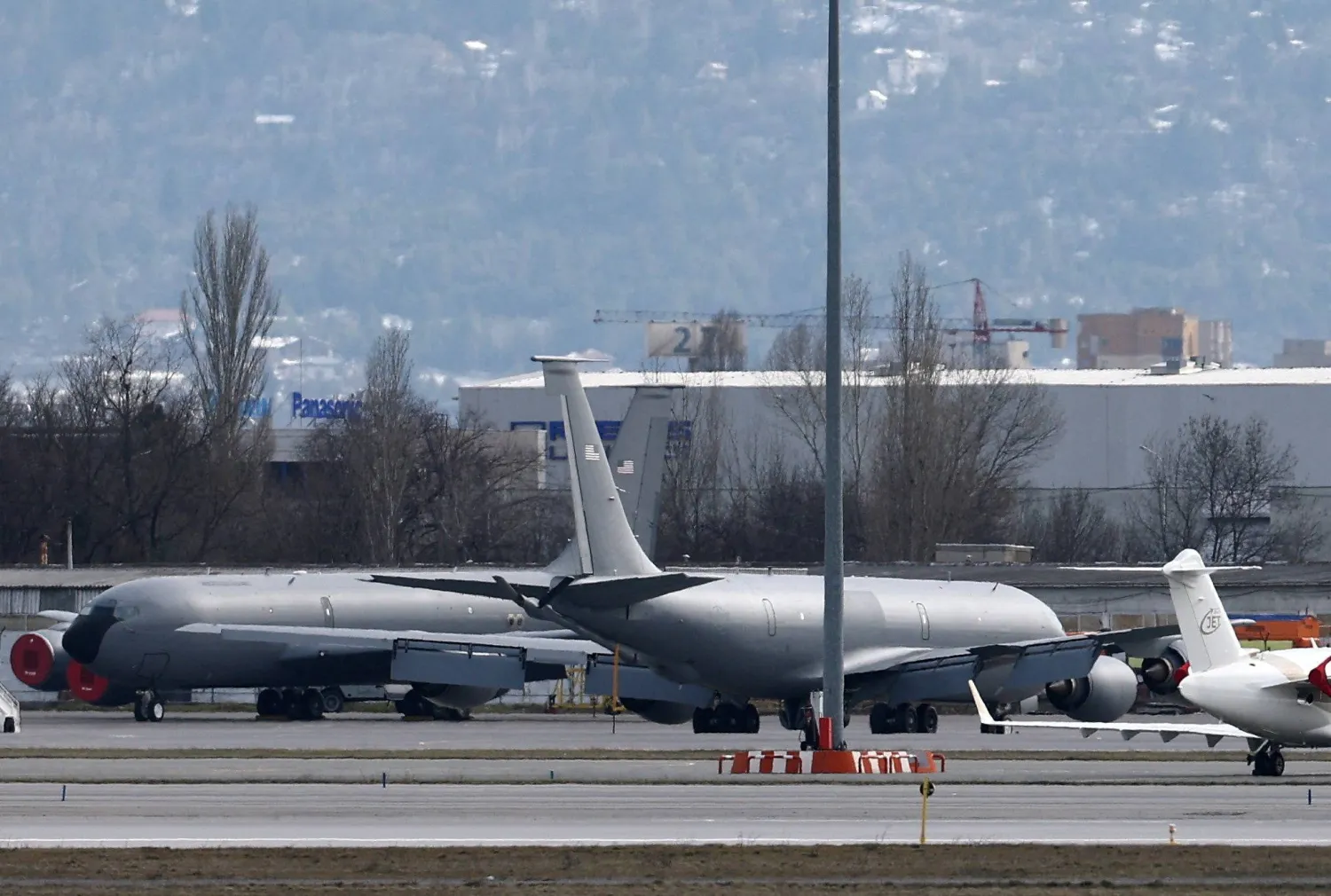
US Air Force planes on the tarmac of Sofia airport, Bulgaria, February 19, 2026. REUTERS/Stoyan Nenov/File Photo
TT

NATO Prepared to Address Iranian Threats Extending to Europe

US Air Force planes on the tarmac of Sofia airport, Bulgaria, February 19, 2026. REUTERS/Stoyan Nenov/File Photo

NATO is prepared to address any threat and will always do what is necessary to defend all allies, a NATO official said on Wednesday in response to questions about a report in the Financial Times that Iran has allegedly weighed attacking US military targets in Europe should Donald Trump escalate the war.

“As demonstrated earlier this year when NATO air defenses successfully intercepted ballistic missiles heading to Turkiye from Iran on four separate occasions, our deterrence and defense posture is strong and effective,” the official said.

Citing two regime insiders, the Financial Times reported on Wednesday that Iran has been weighing ways to broaden the confrontation beyond the Middle East if Washington intensifies military action.

One regime insider said Iran was preparing options to expand the conflict if Trump followed through on previous threats to attack Iranian infrastructure. Another said Tehran would place “no limits” on its response.

Iranian forces had assessed possible strikes against US assets in southeastern Europe, including Bulgaria, which approved the use of Bezmer Air Base by US refueling aircraft last month, the sources said.

Cyprus, where a British air base was hit by a drone in March, was also identified as a potential target for retaliation against a renewed US offensive, according to one of the sources.

Iran’s forces had separately examined attacks on subsea fiber-optic cables in the Strait of Hormuz if the conflict intensified, according to the report.

The sources described last month’s strike on a US base in Jordan, which killed three American service members, as Tehran’s most accurate long-range attack to date and evidence of its ability to hit targets farther afield.

“This was also a message to Europe: it can receive missiles, so it should know where it should stand in this war,” a first insider said. “A very big mistake, such as hitting our infrastructure, could make the war go beyond the region and reach Europe.”

Iranian Threats

Chief of the General Staff of Iran’s Armed Forces, Major General Ali Abdollahi, warned on Wednesday that any form of assistance to the US military will be interpreted by Tehran as active “complicity” with American forces.

In a statement posted on X, Abdollahi pointed to a rising concentration of US military aircraft across regional installations, saying, “It is improbable that this volume of military aircraft, particularly aerial refueling tankers, is operating out of regional bases without the awareness of host nations.”

He said Tehran will view any form of “assistance or facilitation” provided to the US military as direct military cooperation with American forces.

Also on Wednesday, Iran’s deputy Foreign Minister for Legal and International Affairs, Kazem Gharibabadi, emphasized that any country that hands its destiny over to foreigners will pay a heavy price.

He noted that today’s Iran determines its own future, with the nation refusing to retreat under pressure and standing firmer in the face of compulsion and threats.

Gharibabadi’s threats came after Bulgaria’s Parliament backed a government proposal to allow the US military to use an air base in the Balkan country to support US operations in the Middle East, while some expressed concern about becoming involved in the Iran war.

Legislators in Bulgaria voted to allow up to eight US KC-135 refueling aircraft along with 250 personnel and supporting equipment at Bezmer Air Base to Oct. 1.

Later, Iran's Foreign Minister Abbas Araghchi urged Bulgaria to reconsider its decision to allow the temporary deployment of US military aircraft at the ‌Bezmer air base, Iranian state media reported.

During a phone call last month with his Bulgarian counterpart, Velislava Petrova-Chamova, Araghchi said Sofia's approval of a US request to station military aircraft at the base to support military operations amounted to facilitating aggression against Iran, adding the move was unacceptable and contrary ⁠to the traditionally friendly relations between the two countries.

Ahead of the FT report, a senior Iranian official told Reuters on Monday that Iran will shift to a “fully offensive” military posture because efforts to negotiate a permanent end to the war with the US have stalled.

“Iranian entities must be prepared to escalate tensions in the Strait of Hormuz and wider region, as Iran will be ready to make decisions and take action on difficult decisions,” the Iranian official said, adding that Tehran would conduct a “timely and precise” military attack to break the US naval blockade if diplomacy failed.

Iran’s Medium-Range Missiles

Military analysts told the FT that Iran could deploy medium-range ballistic missiles against US assets in southern and southeastern Europe, such as its Shahab series. However, they said such missiles would likely struggle to cause significant damage at greater distances. The scale of any Iranian retaliation would depend on Washington’s next moves.

The analysts said heavier-duty missiles could also be deployed, but would have to carry a lighter payload to travel far enough — meaning damage would be minimal.

Douglas Barrie of the International Institute for Strategic Studies noted that earlier Iranian attempts against Diego Garcia indicated weapons exceeding 2,000 kilometers in range, making European contingencies more concrete, while unsuccessful outcomes exposed reliability, interception, and precision limitations.

In the weeks after the US and Israel launched the war in February, Washington accused Tehran of firing multiple missiles at Diego Garcia, the joint US-British military base in the Indian Ocean roughly 4,000 kilometers away. None of the missiles reached their target.

In March, Türkiye said NATO air defenses had intercepted several ballistic missiles launched from Iran. That same month, the British base at Akrotiri in Cyprus was hit by a drone.

Western officials assessed at the time that it was most likely an Iranian unmanned aircraft used by forces aligned with Tehran, rather than a direct strike by Iran itself.

And while reports said Iran will shift to a “fully offensive” military posture, Iranian Supreme Leader Mojtaba Khamenei has issued decrees appointing six military and IRGC officials to leadership positions.

He named Ahmad Vahidi as head of the IRGC, and Hossein Taeb as commander of the IRGC's Basij paramilitary. The appointments came after the preceding holders were killed in Israeli-US strikes during operations Roaring Lion and Epic Fury.

Yadollah Javani, the IRGC’s deputy for political affairs, told Iranian state television that Iran’s military actions had so far been defensive because its adversaries had started the war, but could become offensive in the future.

He said the armed forces would adopt new approaches following recent appointments and directives from Supreme Leader Mojtaba Khamenei and warned Iran’s adversaries to expect what he described as strategic surprises.

The threats reflect the mood inside Tehran, where a growing number of regime figures now see a resumption of hostilities as a matter of timing rather than likelihood.

At the same time, some within the Iranian regime are concerned that Tehran may be overplaying its hand. Many hardliners, however, believe the United States cannot be trusted to honor any agreement and argue that Iran must raise the cost for Washington to ensure it upholds its commitments under any eventual deal.

Among them is Mohsen Rezaei, a former commander of the Revolutionary Guards, whom Khamenei placed last week in the top post of the country’s security apparatus. Iranian analysts interpreted the move as a sign that figures such as Mohammad Bagher Ghalibaf, Tehran’s chief negotiator, have for now been sidelined, as prospects for a lasting agreement appear increasingly slim.

The second source said Iran was signaling that failure to reach an agreement with Ghalibaf would leave the West dealing with Rezaei instead, and summed up Tehran’s broader message as a warning that Washington should not push too far, since Iran was prepared to go further still.



WHO Eyes ‘Encouraging’ Signs in DR Congo Fight Against Ebola

A member of the civil protection team's dignified and safe burial service prepares to swab the body of a child suspected of having died from Ebola at the Butembo Unit Hospital morgue, in Butembo, North Kivu province, Democratic Republic of Congo, September 13, 2026. (Reuters)
TT

WHO Eyes ‘Encouraging’ Signs in DR Congo Fight Against Ebola

A member of the civil protection team's dignified and safe burial service prepares to swab the body of a child suspected of having died from Ebola at the Butembo Unit Hospital morgue, in Butembo, North Kivu province, Democratic Republic of Congo, September 13, 2026. (Reuters)

The Ebola epidemic in the Democratic Republic of Congo is still spreading but appears to be showing "encouraging" signs of improvement, the head of the World Health Organization said on Wednesday.

"We are starting to see encouraging signs that we're gaining ground," Tedros Adhanom Ghebreyesus told a news conference in Geneva.

Since the DRC declared its 17th Ebola outbreak in mid-May, more than 3,500 deaths have been recorded from over 7,200 cases to date across seven northern and eastern provinces plagued by widespread insecurity and a litany of armed groups.

Ebola, which is transmitted through contact with bodily fluids and can cause severe internal and external bleeding and organ failure, has killed more than 15,000 people in Africa over the last 50 years.

Tedros said that transmission was declining in the worst-affected areas of Ituri province, the epicenter of the outbreak, while South Kivu has not reported any new cases since May.

"Trials of treatments and post-exposure prophylaxis are picking up speed, due to increased community engagement," he added.

"Vaccine trials should begin in the coming weeks," Tedros said, while warning against complacency. "Make no mistake: the epidemic continues to grow and continues to kill," he said.

"We still have many, many months ahead of us," added Maria Van Kerkhove, director of epidemic and pandemic management at the UN health agency.

- Right response -

In North Kivu, the number of cases was rising "fast", Tedros said, with weekly cases almost doubling from about 100 to more than 200.

"The area is so vast that it is hard to speak of a single epidemic. It is many outbreaks, in many places. We must get the response right in every one of them," he added.

The remoteness of the province, high population mobility and attacks on humanitarian workers were further complicating efforts to fight the epidemic, he explained.

The Africa Centers for Disease Control and Prevention (CDC) and the WHO issued a funding appeal in June for $518 million to support the epidemic response until November.

Both organizations and the Congolese government earlier this month launched a new bid for $1.3 billion for the next six months, on top of the $1.1 billion requested by the UN in August for humanitarian assistance, WHO health emergencies chief Chikwe Ihekweazu said.

There is currently no approved vaccine or treatment against the Bundibugyo strain responsible for the current outbreak.

Some 70,000 doses of the Ervebo vaccine, which has been approved against the Zaire strain of Ebola, have been sent to the DRC to assess its effects on tackling the spread of Bundibugyo.

More than 3,000 health workers and frontline staff have already been vaccinated in Kisangani, said Meg Doherty, director of science for health at the UN health agency.

An observational study led by the Doctors Without Borders (MSF) charity will start on Saturday to evaluate the vaccine's effectiveness in reducing illness and death, she added.

Clinical trials of two vaccines in development against Bundibugyo will take place in the country on a date to be fixed.


Netanyahu’s Party Seeks to Impede Israeli Expat Voting

Israeli Prime Minister Benjamin Netanyahu greets supporters after delivering a statement to members of the press, in Jerusalem, September 8, 2026. (Reuters)
TT

Netanyahu’s Party Seeks to Impede Israeli Expat Voting

Israeli Prime Minister Benjamin Netanyahu greets supporters after delivering a statement to members of the press, in Jerusalem, September 8, 2026. (Reuters)

Prime Minister Benjamin Netanyahu's party on Wednesday petitioned the electoral commission to block initiatives aimed at helping Israelis who live abroad return to vote in upcoming close-fought elections.

Israel's electoral law does not allow citizens residing outside the country to vote abroad, except for diplomats and emissaries sent by certain organizations. The Central Bureau of Statistics estimates there are 600,000 Israelis living abroad.

Government opponents have been working for several weeks to encourage voters to come home to cast their ballots, hoping to strengthen the anti-Netanyahu camp in elections scheduled for October 27.

Initiatives include offering discounted plane tickets, assisting expatriates with the administrative procedures required to vote and organizing their transport from the airport.

Attorney Ilan Bombach, representing Netanyahu's right-wing Likud party, filed an appeal on Wednesday with the chairman of the Central Elections Committee demanding an end to these practices.

The petition specifically targets the US-based AID Coalition, an organization which says it is aimed at "strengthening and preserving the democratic foundations of the State of Israel" and is behind the "Fly&Vote" scheme.

The petition also targets the opposition Democrats party.

In his appeal, seen by AFP, Bombach likens these methods to an "electoral bribe" and argues that they violate the law on party financing.

Likud maintains that even if the passengers themselves pay for their plane tickets, the "Fly&Vote" scheme grants illicit benefits, such as discounted fares negotiated with airlines through group bookings.

The AID Coalition, which says it is an apolitical organization, has not immediately responded.

On its website, the organization describes the upcoming elections as "critical for the future of the country".

It says the law stipulating that Israelis must be physically in Israel to vote "impacts hundreds of thousands of dedicated Israelis who serve in the reserves... pay taxes, and never-endingly support Israel".

Michal Dagon from the AID Coalition recently told left-leaning daily Haaretz that the organization aimed to help bring between 50,000 and 70,000 voters from abroad to cast their ballots.

More than 30,000 Israelis have already registered, organizers said.

According to polls, the elections are expected to be tightly contested between the bloc led by Netanyahu and that of his main rival, centrist Gadi Eisenkot.


Putin Casts Parliamentary Election as Barometer of Support for War, Urges Russians to Vote

 Russian President Vladimir Putin listens to the Head of the Russian Federal Service for the Oversight of Consumer Protection and Welfare (Rospotrebnadzor) Anna Popova at the Kremlin in Moscow, Tuesday, Sept. 15, 2026. (Vyacheslav Prokofyev/Sputnik, Kremlin Pool Photo via AP)
Russian President Vladimir Putin listens to the Head of the Russian Federal Service for the Oversight of Consumer Protection and Welfare (Rospotrebnadzor) Anna Popova at the Kremlin in Moscow, Tuesday, Sept. 15, 2026. (Vyacheslav Prokofyev/Sputnik, Kremlin Pool Photo via AP)
TT

Putin Casts Parliamentary Election as Barometer of Support for War, Urges Russians to Vote

 Russian President Vladimir Putin listens to the Head of the Russian Federal Service for the Oversight of Consumer Protection and Welfare (Rospotrebnadzor) Anna Popova at the Kremlin in Moscow, Tuesday, Sept. 15, 2026. (Vyacheslav Prokofyev/Sputnik, Kremlin Pool Photo via AP)
Russian President Vladimir Putin listens to the Head of the Russian Federal Service for the Oversight of Consumer Protection and Welfare (Rospotrebnadzor) Anna Popova at the Kremlin in Moscow, Tuesday, Sept. 15, 2026. (Vyacheslav Prokofyev/Sputnik, Kremlin Pool Photo via AP)

President Vladimir Putin ‌on Wednesday framed participation in an upcoming parliamentary election as a barometer of support for Russia's war in Ukraine and urged Russians to vote.

Russia holds a three-day parliamentary election starting on Friday to choose the composition of its 450-seat lower house of parliament, the State Duma, which has a track record of faithfully approving the Kremlin's initiatives.

It is the first parliamentary election since Russia launched its ‌full-scale war ‌in Ukraine in February 2022 and ‌comes ⁠at a time when ⁠opinion polls show some Russians have become more anxious about how the conflict affects them, as the economy is under strain, and as most anti-war candidates have been excluded from the ballot.

The political system is tightly controlled and the ⁠ruling United Russia party, backed by Putin, ‌is widely expected to retain ‌its dominance.

In a televised address to the nation ‌ahead of the vote, Putin referred to the ‌war in Ukraine and to Russian-controlled parts of Ukraine, saying that casting a vote would help secure Russia's victory and demonstrate national resolve in the face of external ‌pressure.

"Your choice and your will once again demonstrate that millions of people ⁠stand ⁠behind our soldiers, that we are a united people bound together by shared values, historical memory, and love for our homeland, and that no one will succeed in dividing or intimidating us, or in undermining our statehood and our socio-political system," Putin said.

He said the vote would serve as a collective response to those seeking to weaken Russia, hinder its development, and deprive it of its sovereignty and right to determine its own future.