


US National Debt Crosses $40 Trillion Threshold

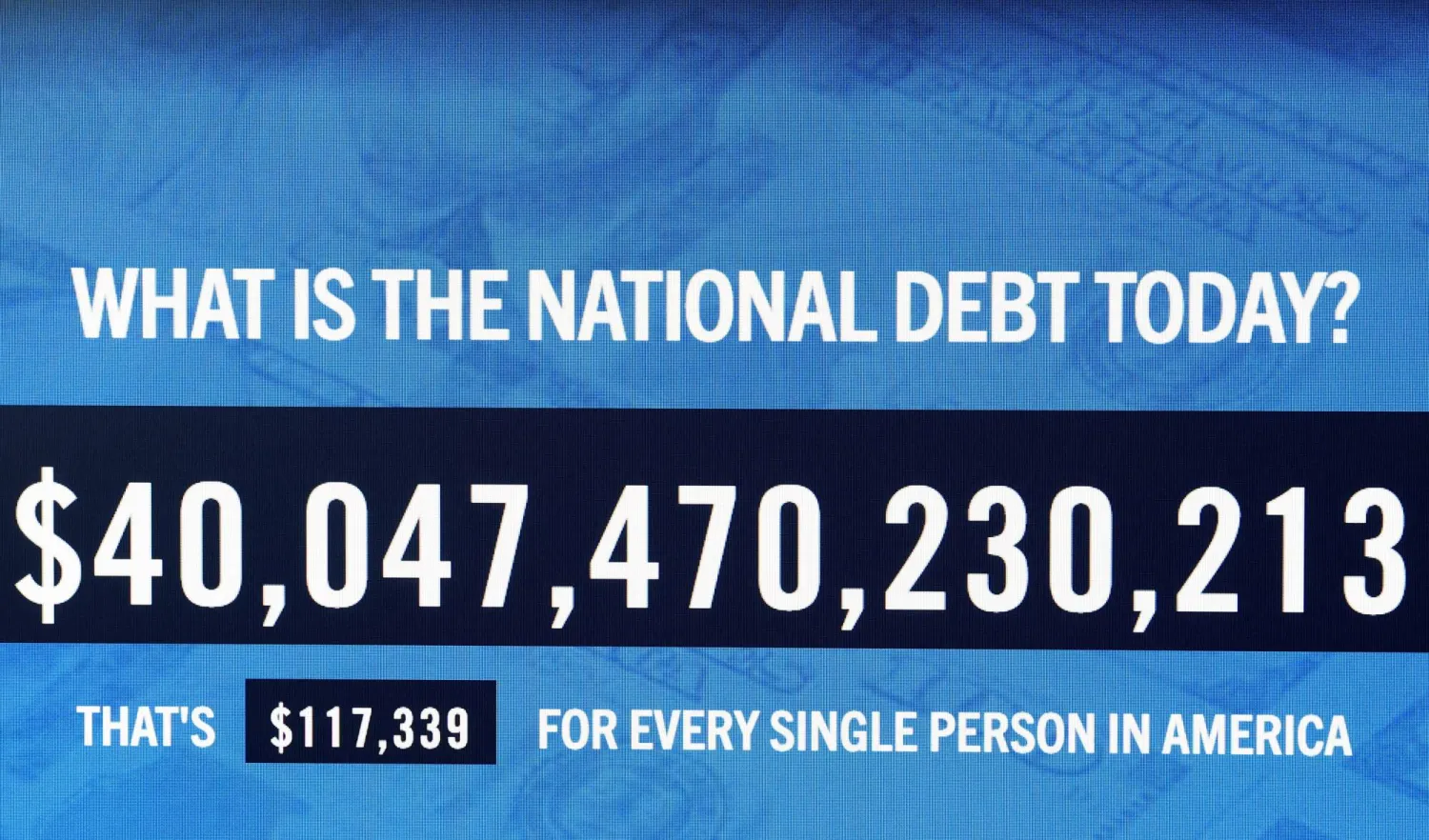
A screen displays the total US National Debt, which surpassed $40 trillion for the first time according to the Treasury Department, in New York City, US, August 19, 2026.  REUTERS/Brendan McDermid
A screen displays the total US National Debt, which surpassed $40 trillion for the first time according to the Treasury Department, in New York City, US, August 19, 2026. REUTERS/Brendan McDermid
TT

US National Debt Crosses $40 Trillion Threshold

A screen displays the total US National Debt, which surpassed $40 trillion for the first time according to the Treasury Department, in New York City, US, August 19, 2026.  REUTERS/Brendan McDermid
A screen displays the total US National Debt, which surpassed $40 trillion for the first time according to the Treasury Department, in New York City, US, August 19, 2026. REUTERS/Brendan McDermid

The national debt surpassed a record $40 trillion on Wednesday, a staggering milestone as defense costs, social programs like Social Security and Medicare and interest on the burgeoning deficit make up an enormous share of federal spending.

The milestone figure was recorded just five months after the US hit a record $39 trillion debt in March. It reached $38 trillion five months before that, in October.

The unprecedented $40 trillion figure highlights competing administration priorities, from boosting defense spending that the US relies on to carry out President Donald Trump's almost-6-month-old war in Iran to lowering the cost of gas and groceries.

Kush Desai, a White House spokesman, said the Trump administration “has been focused on slashing waste, fraud, and abuse in federal spending while accelerating economic growth to get America’s debt-to-GDP ratio trending in the right direction.”

However, experts say the exploding debt and the latest record milestone are already affecting Americans' pocketbooks by raising borrowing costs for things like mortgages and cars, lowering wages from businesses that have less money available to invest, and creating more expensive goods and services.

“If we want to improve our living standards, today and for the next generation, now is the time for lawmakers to put our nation on a more affordable and sustainable path," says Michael A. Peterson, CEO of the Peter G. Peterson Foundation, a think tank focused on US fiscal challenges.
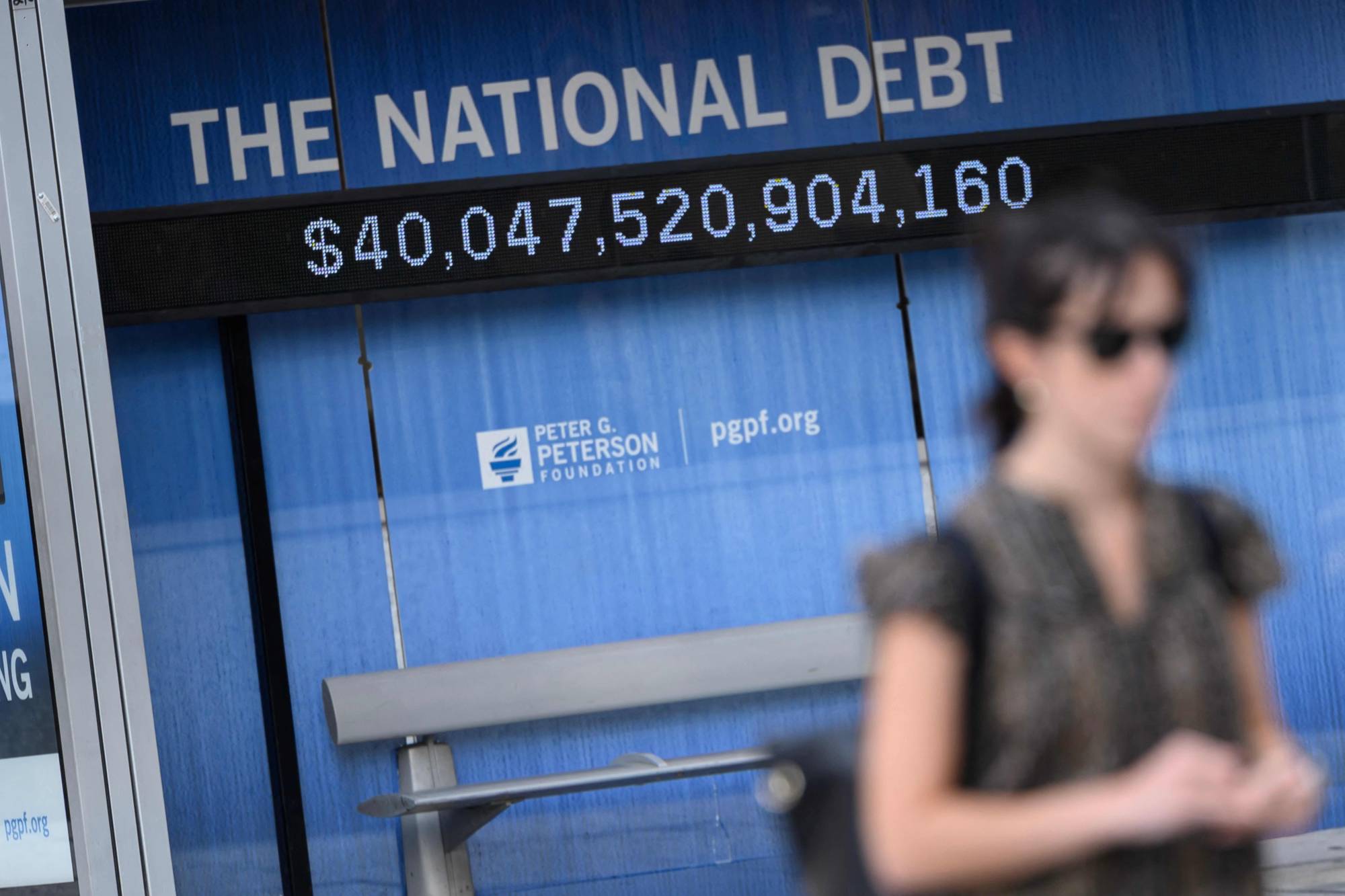
An electronic display shows the national debt in Washington, DC on August 19, 2026. (Photo by Mandel NGAN / AFP)

The debt has exploded over several presidential administrations, as the nation's leaders spend more money than it collects in taxes.

In recent memory, the multi-year COVID-19 pandemic shut down much of the US economy, where the federal government borrowed heavily during President Trump's first term and under former President Joe Biden to stabilize the economy and support a recovery.

More government spending was approved after Trump signed Republicans’ tax cut and spending legislation into law last year.

Advocates for a balanced budget also warn that the long-term trend of borrowing more and paying more in interest will force Americans to face tougher fiscal tradeoffs ahead.

"The federal debt is already raising the cost of living and choking out other spending and investment, threatening our economy and Americans’ long-term prosperity,” said Margaret Spellings, president and CEO of the Bipartisan Policy Center.

“Our current fiscal trajectory is plainly unsustainable, and that’s the best-case scenario. AI disruption, a recession, global war, or any number of other events could quickly push us over the edge from a challenge into a full-blown crisis," The Associated Press quoted Spellings as saying in a statement.

The US is subject to a statutory debt limit, or a limit to federal borrowing, which Congress has the authority to set, adjust or abolish.

The Bipartisan Policy Center estimates that the US will most likely reach the $41.1 trillion debt limit sometime between late winter and mid-summer of 2027, requiring Congress to again vote on whether to raise or suspend it.

The US' fiscal position stands as the worst among other developed countries, according to recent data analysis from the Organization for Economic Co-operation and Development.



Gold Retreats after Scaling over 2-month Peak on US Treasury Move

 AFP_A photo shows gold bangles and necklaces for sale at a gold shop at the Grand Baazar in Istanbul
AFP_A photo shows gold bangles and necklaces for sale at a gold shop at the Grand Baazar in Istanbul
TT

Gold Retreats after Scaling over 2-month Peak on US Treasury Move

 AFP_A photo shows gold bangles and necklaces for sale at a gold shop at the Grand Baazar in Istanbul
AFP_A photo shows gold bangles and necklaces for sale at a gold shop at the Grand Baazar in Istanbul

Gold fell on Thursday as investors booked profits after prices climbed to a more than two-month peak on a surprise US Treasury liquidity-support announcement for long-duration bonds, which weakened the dollar and lowered Treasury yields.

Spot gold was down 0.7% to $4,488.19 per ounce by 0750 GMT. Earlier, bullion was at $4,525.79, its highest since June 2, after a more than 4% advance on Wednesday.

US gold ‌futures were little ‌changed at $4,546.30. The US Treasury Department said ‌it ⁠would double the ⁠size of liquidity support buyback operations for longer-dated notes and bonds. That came after a major bond selloff as investors demanded higher returns on the back of increased inflationary risks stemming from the US-Israeli war on Iran.

The US dollar was hovering near three-month lows.

"There was obviously a huge rally (in gold), and ⁠there's going to be a degree of digestion ‌in markets after a big ‌move like that," said Ilya Spivak, head of global macro at Tastylive.

"The $4,400 ‌to $4,500 price range has been cleared. If prices hold above ‌this range, the upward momentum is likely to continue." Meanwhile, total US debt outstanding topped $40 trillion for the first time, drawing fresh warnings of fiscal crisis.

"Increasing concern about the financial stability of the market with ‌borrowing and debt and the inability to cut spending on the fiscal side is very ⁠bullish for ⁠gold," said Edward Meir, Marex analyst. Concerns over inflation deepened at the Federal Reserve's meeting last month, with "several" policymakers ready to raise interest rates, minutes of the session showed on Wednesday.

Traders are currently pricing in a 69% chance of a Fed hold and a 31% chance of a rate hike in September, according to the CME FedWatch Tool.

While gold is typically seen as a hedge against inflation, higher interest rates tend to diminish non-yielding bullion's appeal.

Among other metals, spot silver fell 0.5% to $66.60 per ounce, platinum dropped 1.6% to $1,794.91, and palladium slid 0.5% to $1,325.94.


Oil Hits 3-week High on Middle East Supply Concerns amid War Impasse

Oil platforms operated by Australian company Santos (Company website)
TT

Oil Hits 3-week High on Middle East Supply Concerns amid War Impasse

Oil platforms operated by Australian company Santos (Company website)

Oil prices climbed to three-week highs on Thursday, driven by concerns that the impasse in the Iran war will continue to disrupt supply from the key Middle Eastern producing region.

Brent crude futures for October delivery rose $1.20, or 1.3%, to $92.82 a barrel by 0813 GMT, while US West Texas Intermediate crude futures for September added 92 cents to $86.75 a barrel. The more-active October WTI contract was ‌up $1.13, or 1.3%, ‌to $85.52.

Both Brent and WTI benchmarks hit their highest ‌since ⁠late July during the ⁠session, gaining for a fifth straight session and having settled on Wednesday at their highest since July 24. The September WTI contract expires later on Thursday, Reuters said.

"Tensions in the Middle East remain high, leaving room for further supply disruptions," said UBS analyst Giovanni Staunovo. "Lower oil exports from the Middle East are once again tightening the oil market." The UAE's decision to suspend all financial and economic transactions with Iran until ⁠further notice has refocused the spotlight on fraught ties between ‌the major Gulf Arab oil producer and Iran.

"Oil ‌prices remained elevated as the market is supported by sporadic attacks in the Middle ‌East but lacks fresh momentum without a major escalation," said Hiroyuki Kikukawa, chief strategist ‌of Nissan Securities Investment.

"The market is likely to maintain a gradual upward trend given uncertainty over peace talks and tensions ...," he added. On Tuesday, US President Donald Trump said no talks were taking place with Iran ‌and that the Strait of Hormuz was open. Iran, however, said the waterway remained shut. Trump on Wednesday warned of ⁠economic consequences against ⁠any country that provided "any type of lifeline to Iran". Shipping traffic through the strait on Wednesday was unchanged from the day before as discussions to end the conflict remained deadlocked, according to the latest shipping data.

Prior to the war that began with US and Israeli strikes on Iran on February 28, shipments equal to about one-fifth of global consumption moved through the waterway. Current flows are far below pre-war levels.

The war has also impacted the supply of refined fuels and drawn down inventories with less crude available to refiners.

US stockpiles of distillate fuel, including diesel and heating oil, fell last week for a third week, the Energy Information Administration said on Wednesday. However, crude inventories unexpectedly rose by 4.4 million barrels.


Saudi Professionals Poised to Lead Major Projects in the Kingdom

Saudi engineers inspect a project in Saudi Arabia. (SPA)
TT

Saudi Professionals Poised to Lead Major Projects in the Kingdom

Saudi engineers inspect a project in Saudi Arabia. (SPA)

Saudi Arabia is pushing ahead with plans to deepen national participation in key sectors, shifting from “numerical Saudization” to a more sustainable, skills-based model.

A decision to raise the Saudization rate in private-sector project management jobs to 70% by February 2027 is expected to reshape the labor market, placing Saudi professionals in leading roles across major infrastructure, housing, tourism and construction projects.

The decision, issued by the Ministry of Human Resources and Social Development in partnership with the Ministry of Municipalities and Housing, applies to establishments employing three or more workers in project management roles, including managers, engineers and project management specialists.

The move comes as construction, infrastructure, housing and tourism expand rapidly across the Kingdom.

The ministry has also published an implementation guide detailing the jobs covered, enforcement mechanisms, how Saudization rates will be calculated and compliance requirements. The timeline gives private-sector companies room to reorganize their staffing structures and plan for future workforce needs before the rules take effect.

Stronger labor market ahead of rollout

The decision comes against a backdrop of improving labor market indicators.

Unemployment among Saudis fell to 6.8% in the first quarter of this year, while data from the Qiwa platform showed more than 258,000 new Saudi workers entered the market in the second quarter.

More than 419,000 employment contracts were documented during the same period.

Qiwa also processed more than 3 million services in the quarter, issued over 163,000 salary certificates and more than 63,000 experience certificates for Saudi nationals.

On Saudization specifically, the platform issued more than 72,000 certificates to establishments that met localization requirements, as part of efforts to monitor compliance with measures to increase the participation of Saudi talent.

Saudization beyond headcount

Badr al-Anazi, a board member of the Saudi Human Resources Association, described the decision as important and mature, particularly as major projects expand across Saudi Arabia and national talent develops under gradual, carefully planned replacement programs.

He told Asharq Al-Awsat that Saudi professionals were well placed to meet demand, but said the real challenge was not the number of available workers. It was experience.

Project management requires practical expertise in planning and in managing risk, costs and time, he stressed.

Al-Anazi said the decision should be seen as a move toward qualitative Saudization and knowledge transfer, rather than simply replacing a non-Saudi employee with a Saudi national. That requires sustained follow-up until Saudi professionals can independently lead major projects.

Competition for talent and wages

Al-Anazi explained the main challenge would not be the Saudization requirement itself, but whether the market can move from headcount-driven localization to sustainable, skills-based Saudization.

He expects demand for Saudi professionals to rise, intensifying competition over wages, particularly in major sectors and large projects, which could force companies to reassess their organizational and salary structures to retain staff and compete for talent in the Saudi market.

“Numerical Saudization” focuses on meeting a set percentage of Saudi employees. “Qualitative Saudization” goes further, focusing on the competence, experience and ability of Saudi professionals to perform their roles and lead operations effectively.

A market set for change

For Al-Anazi, success will not be measured by hitting 70% on paper. It will depend on whether the Saudi project managers and specialists who make up that share are genuinely capable of leading projects.

He said the impact could extend far beyond creating more jobs for Saudis and could reshape the project management market itself.

The Ministry of Human Resources has previously introduced Saudization requirements for project management jobs in phases, reflecting a broader drive to localize high-value, pivotal roles.

Al-Anazi expects the policy to support private sector productivity over the long term and strengthen its ability to absorb specialized Saudi talent as nationals take on a larger role in project management across engineering, administrative and technical professions.

Economic impact goes beyond hiring

Financial and economic adviser Dr. Hussein al-Attas said the decision was more strategic than employment-driven.

Project management, he told Asharq Al-Awsat, sits at the heart of delivering Saudi Vision 2030 targets across construction, infrastructure, tourism, housing and logistics.

Its economic impact will go beyond adding Saudi employees. It is expected to increase demand for specialized national talent and create higher-value jobs, he added.

In the short term, however, companies that rely heavily on specialized foreign labor could face higher hiring costs, pushing them to restructure teams and invest earlier in training.

Investing in human capital

Al-Attas said he did not expect the decision to become a major obstacle to local or foreign investment, pointing to the implementation period running until February 2027, giving companies time to adjust.

Instead, the measure could spur investment in human capital, training and professional certifications, he went on to say.

Companies will effectively face two choices: recruit qualified Saudi professionals or invest in developing their own workforce, he remarked. For foreign investors, clarity and stability in Saudization rules matter more than the percentage itself.

Three levels of impact

Al-Attas identified three stages for maximizing the decision’s local economic value: hiring and training Saudi professionals; transferring knowledge and expertise from international companies; and building a generation of Saudi project managers able to lead major projects at home and abroad.

Like Al-Anazi, he said success should not be judged by whether the 70% target is achieved on paper.

The real test will be whether Saudi professionals can manage projects to global standards on cost, time, quality and risk.

The central challenge remains the gap between academic qualifications and practical, on-the-ground experience, he noted.