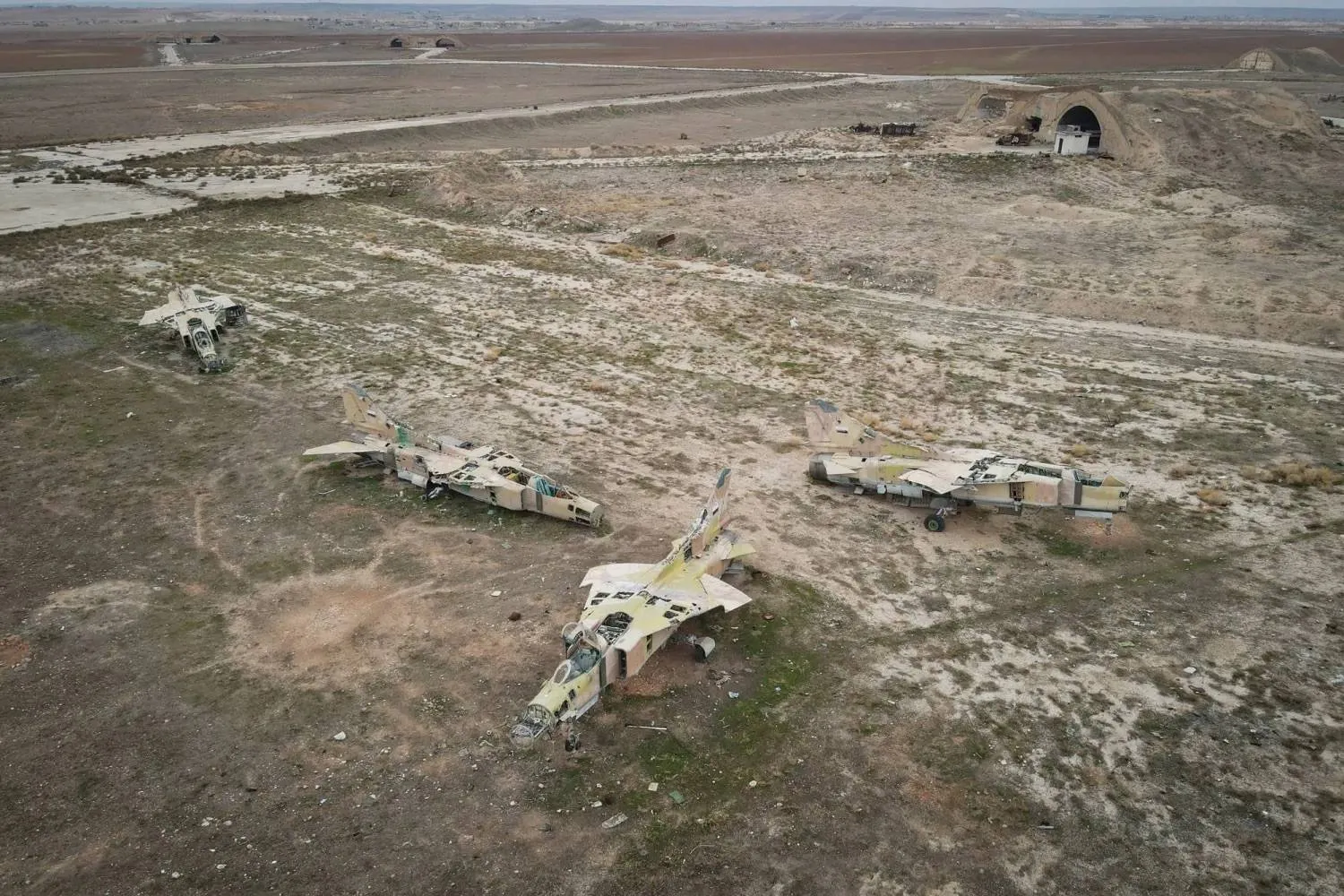

Türkiye has rejected Israeli claims about its military posture in Syria and Israel’s justification for strikes on the Abu al-Duhur military air base in Idlib, which Israel said were prompted by plans to deploy Turkish forces there.
The Turkish presidency said Wednesday that Israeli allegations that Syria had allowed Turkish forces to deploy at Abu al-Duhur were “baseless.”
Israel carried out eight airstrikes Tuesday on the base in southeastern Idlib province near the Turkish border.
Israeli Prime Minister Benjamin Netanyahu’s office accused Syria of accepting a Turkish troop deployment, saying Israel had repeatedly warned Damascus that such a move would threaten its security but that those warnings had been ignored. Israel “will not tolerate any threats to its security,” the statement said, adding that it would welcome a return to the status quo.
Türkiye’s Directorate of Communications said the allegations were intended to legitimize what it called Israel’s illegal strikes against Syria’s sovereignty and territorial integrity.
It noted that the accusations reflected Netanyahu’s intention to pursue expansionist and destabilizing policies in the region ahead of Israeli elections expected in October.
The statement said Türkiye, like the overwhelming majority of the international community, supported lasting peace in the Middle East and that this could only be achieved if Netanyahu abandoned aggressive policies and respected international law.
“Türkiye will resolutely continue its legitimate cooperation with the Syrian government to establish security, stability and prosperity in Syria and will under no circumstances allow Syria to be destabilized,” it read.
US Seeks Deconfliction Mechanism
US Ambassador to Ankara and Special Presidential Envoy for Syria and Iraq Tom Barrack said after the Israeli strikes that Washington was working to establish a deconfliction mechanism among Israel, Türkiye and Syria and was already facilitating information-sharing and dialogue among the parties.
Barrack told Reuters that Türkiye had not received advance notice of the Israeli strike and therefore detected the aircraft heading north toward its territory, meaning it could reasonably have prepared a response of its own.
“Thankfully, calm heads were able to prevent the situation from deteriorating further,” he said.
Turkish President Recep Tayyip Erdogan and US President Donald Trump also spoke by telephone. The Turkish presidency said they discussed bilateral relations and regional and global issues but did not say whether the Israeli strikes on Abu al-Duhur were raised.
Turkish Military Presence
Türkiye, whose relations with Israel have become increasingly strained since the 2023 Gaza war amid broader regional rivalry in Syria, trains the Syrian army and helps Damascus rebuild state institutions and infrastructure. It also provides military support as part of a plan to gradually reduce the presence of Turkish forces inside Syria.
Available information indicates Turkish forces are deployed at 126 military sites, including 12 main bases and 114 military and security observation posts, mainly across northern, northwestern and northeastern Syria.
They include areas covered by Türkiye’s Euphrates Shield operation in northern and eastern rural Aleppo, including Azaz, Jarablus, al-Bab, Marea, al-Rai and Dabiq.
Turkish forces are also present around Afrin, known as the Olive Branch area, through military bases and security points operating in coordination with local councils and the Syrian government, formerly represented there by the Syrian National Army.
The Turkish presence in Syria was previously estimated at about 20,000 military and security personnel, but troop numbers and deployments have changed significantly since the fall of Bashar al-Assad’s government and the establishment of the new administration headed by President Ahmed al-Sharaa.
Smaller positions have since been consolidated into larger bases, including Kuweires military air base in Aleppo and Taftanaz air base and Mastouma camp in Idlib.