Study: China's Rapid Solar Expansion Hurt Bird Diversity

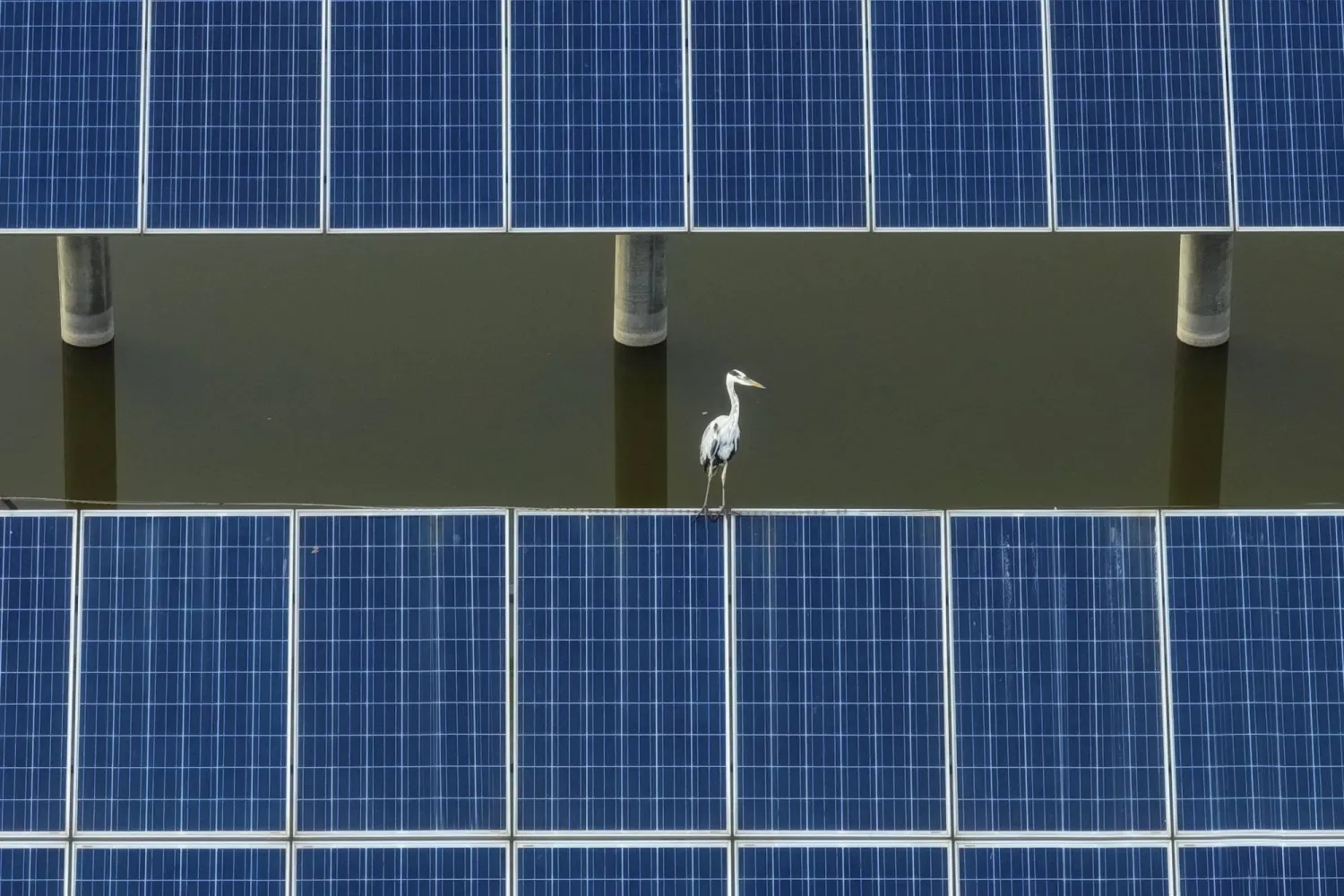
A bird perches on a solar panel at the Jingneng Helan 30-megawatt photovoltaic power station in Yinchuan, in northwestern China's Ningxia Hui Autonomous Region on August 20, 2026. (Photo by CN-STR / AFP) / China OUT
TT

Study: China's Rapid Solar Expansion Hurt Bird Diversity

A bird perches on a solar panel at the Jingneng Helan 30-megawatt photovoltaic power station in Yinchuan, in northwestern China's Ningxia Hui Autonomous Region on August 20, 2026. (Photo by CN-STR / AFP) / China OUT

The global push for solar energy expansion could carry hidden biodiversity costs, according to a study across China published in the journal Science on Thursday.

According to the research spanning more than 2,300 Chinese counties, pro-solar policies led to reductions in bird diversity in what the authors called an example of a "green dilemma" pitting carbon reduction against conservation.

"The main message is not to slow the renewable energy transition, but to make solar development more ecologically informed," first author Huiming Zhang, of the Nanjing University of Information Science & Technology, told AFP.

China's goal to achieve net zero before 2060 has seen it embark on a renewables revolution.

By 2024 its solar footprint reached an estimated 4,520 square kilometers (1,745 square miles) -- equivalent in size to the US state of Rhode Island -- and solar energy is projected to constitute 45 percent of its energy mix by 2060.

Choosing solar locations in China isn't just based on sunny locations and available land, but rather it is shaped by "Five-Year Plans" to promote economic development in certain regions.

Zhang and his colleagues exploited these variations in solar expansion policy across 2,344 counties across China from 2014 to 2023, while also accounting for national trends, weather, socioeconomic conditions, land cover, and birdwatching effort.

This data was paired with citizen science records to understand the impact on bird diversity.

Their findings revealed a negative trade off, with increased policy stringency consistently associated with decreased bird biodiversity, though the effect was moderate.

Using an index from 0 to 15.5 to measure the strength of solar policies, the study found that a four-point increase in policy strength was linked to a two percent decline in the Shannon index, a standard measure of species variety.

Rapid land conversion was the main culprit, particularly the transformation of cropland and grassland into developed areas, with the effects stronger in wealthier and non-desert regions.

Both resident and migratory birds suffered significant declines, but species that were native to mountain habitats poorly suited to solar farms were unaffected.

The push for solar farms was accompanied by greening efforts to satisfy environmental requirements, but here the authors identified what they called "inferior greening" -- where the total amount of leafiness may go up but because it was too homogenous, the ecological quality went down.

Writing in a related commentary, Yuanning Liang of Peking University said "birds serve as an effective indicator group for large-scale biodiversity assessment" because they are among the few animal groups for which abundance data over time and space is readily available.

Although the authors studied solar power, the siting problems they identified are relevant to renewable infrastructure more broadly, including wind power, she added.

According to AFP, the research team offered a number of recommendations, including directing large solar projects toward locations with lower ecological conflict, greater assessments of each site, and limiting land conversion in productive, habitat-rich regions.

"Clean energy development and biodiversity conservation do not have to come at each other's expense, but careful siting and biodiversity safeguards are essential," said Zhang.


Prince William, Wannabe DJ and Film-Lover, Appears on UK Chat Show

Britain's Prince William meets with the public on a street during a royal visit to the Aberfan Disaster Memorial Garden to mark the 60th anniversary of the 1966 disaster, in which 109 children and five teachers were killed at Pantglas Junior School when a coal spoil tip collapsed onto the Welsh village, Britain, October 21, 2026. (Reuters)
TT

Prince William, Wannabe DJ and Film-Lover, Appears on UK Chat Show

Britain's Prince William meets with the public on a street during a royal visit to the Aberfan Disaster Memorial Garden to mark the 60th anniversary of the 1966 disaster, in which 109 children and five teachers were killed at Pantglas Junior School when a coal spoil tip collapsed onto the Welsh village, Britain, October 21, 2026. (Reuters)

Prince William talked about his ‌love of Christopher Nolan films and how he once wanted to be a DJ as he appeared on a British television chat show on Friday to promote his annual award for climate change innovation.

The heir to the throne, 44, has in recent years regularly appeared in less formal settings in a bid to connect with younger audiences, including Radio One, one of UK's biggest stations for under 30s, and sports podcasts.

William surprised celebrity guests including actors Cate Blanchett and Hannah Waddingham when he joined them ‌on the ‌sofa for an episode of the BBC's Graham ‌Norton ⁠Show, which is ⁠due to air later on Friday.

Asked about how he relaxes, he said he and his family together enjoy reality show The Celebrity Traitors, while he personally turns to music and films.

"I'm a big fan of everything Christopher Nolan does. His films are fantastic – The Dark Knight series is psychologically dark and deep and I ⁠absolutely love that," William said.

"He takes concepts that ‌are completely out there and ‌makes them incredibly entertaining."

Before accepting that his future job would be that ‌of king, he said he had wanted to be a ‌policeman.

"Then I went through a phase of wanting to be a DJ – I wasn’t very good," he said.

William has in recent years sought to provide insights into his personal life, without creating waves by ‌giving too much away about the challenges of life in the public eye.

Two years ago, both ⁠his father, ⁠King Charles, and his wife Kate began treatment for cancer. His wife is now in remission, while Charles's treatment continues.

He has also been estranged from his brother Prince Harry for about six years, after Harry published a book detailing the breakdown of their relationship and repeatedly criticized the royal family.

Talking about The Earthshot Prize, which he set up six years ago to award five winners £1 million each to fund their ideas to save the environment, William said the aim was to bring optimism into an issue which can otherwise feel depressing.

"There are some amazing people out there doing things to protect the world," he said.


Monet’s ‘Iris’ Becomes Most Expensive Artwork Sold at Auction in France, Sotheby’s Says

This photograph shows French painter Claude Monet's "Iris", 1924–1925, during a preview of 28 Impressionist works of the Schlumberger Collection unveiled ahead of the October 22, 2026, sale at Sotheby's auction house in Paris on September 17, 2026.
TT

Monet’s ‘Iris’ Becomes Most Expensive Artwork Sold at Auction in France, Sotheby’s Says

This photograph shows French painter Claude Monet's "Iris", 1924–1925, during a preview of 28 Impressionist works of the Schlumberger Collection unveiled ahead of the October 22, 2026, sale at Sotheby's auction house in Paris on September 17, 2026.

Claude Monet's "Iris" was sold late on Thursday for €50 million ($56.05 million), becoming the most expensive work of art sold at auction in France, Sotheby's said.

The painting, completed toward ‌the end ‌of Monet's ‌life, attracted ⁠frantic bidding with six ⁠people battling it out for 45 minutes for the piece, before the final two continued ⁠to scrabble for a ‌further ‌20 minutes.

"Iris" finally went ‌to an Asian ‌collector who bid over the phone.

The painting was one of several works ‌up for auction from the Schlumberger Collection ⁠and ⁠had been expected to sell between €22 million and €30 million.

The previous French auction record was set in 2010, by Amedeo Modigliani's "Head of a Caryatid," which sold for €43.2 million.


Greece Passes Social Media Ban for Children Under 15

FILE PHOTO: Instagram app icon is seen on a smartphone in this illustration taken October 27, 2025. REUTERS/Dado Ruvic/Illustration/File Photo
TT

Greece Passes Social Media Ban for Children Under 15

FILE PHOTO: Instagram app icon is seen on a smartphone in this illustration taken October 27, 2025. REUTERS/Dado Ruvic/Illustration/File Photo

Greece's parliament approved a bill on Friday that bans the use of social media platforms for children under 15 amid growing concerns over their impact on the health and safety of minors.

The ban comes ‌into force ‌on January 1, ‌2027, said Reuters.

Australia was the ⁠first country to pass legislation to curb the use of social media by minors, doing so last year. A similar law ⁠passed in France ‌was struck ‌down by the country's Constitutional Council ‌in August

Greek Prime ‌Minister Kyriakos Mitsotakis said social media platforms have 2-1/2 months to devise a way ‌to verify users' ages and protect their privacy

Greece ⁠is ⁠among seven European Union countries seeking an age verification solution with the European Commission

Greece says it is standing by parents to help curb the "endless scrolling" that deprives children of sleep, concentration and time with their friends