

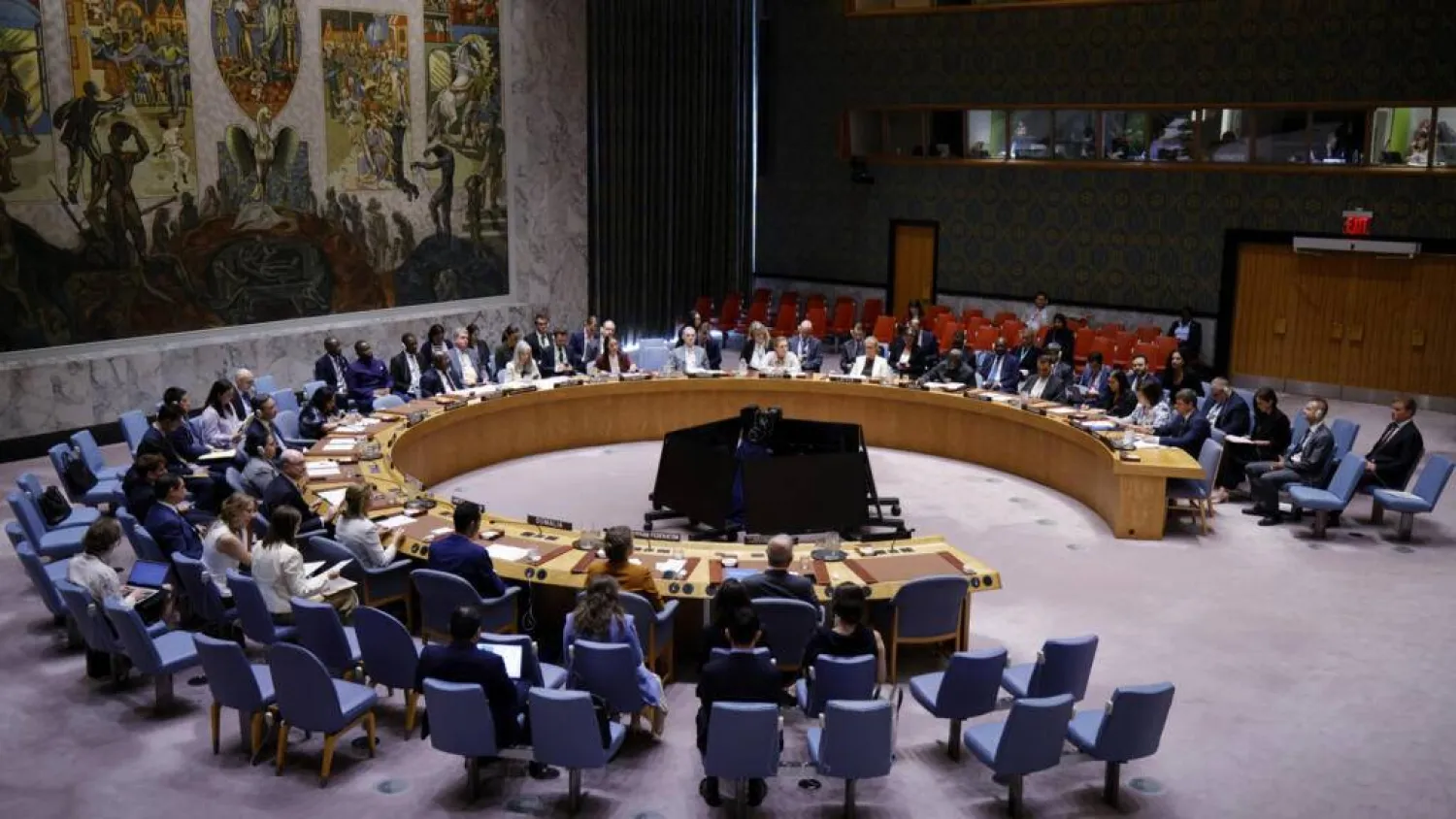

UN Holds Second Informal Poll for Next Leader

Diplomats are reluctant to predict the outcome of the race because of the sway of the five permanent members of the Security Council. Leonardo MUNOZ / AFP/File
TT

UN Holds Second Informal Poll for Next Leader

Diplomats are reluctant to predict the outcome of the race because of the sway of the five permanent members of the Security Council. Leonardo MUNOZ / AFP/File

The UN's most powerful body, the Security Council, meets Friday to hold another straw poll to gauge the popularity of a growing field of contenders to lead the embattled organization.

Costa Rica's Rebeca Grynspan was the front-runner after last month's first informal vote, in which the council's 15 members, including the five with veto power, pass judgment in secret on the candidates, said AFP.

Argentina's Rafael Grossi -- the current head of the UN nuclear watchdog -- is also a candidate along with Chile's Michelle Bachelet, Ecuador's Maria Fernanda Espinosa, Guyana's Carolyn Rodrigues-Birkett, Uganda's Olara Otunnu and Senegal's Macky Sall.

After the first round concluded, Ecuador's Ivonne A-Baki threw her hat into the race to succeed Antonio Guterres, who will complete his second five-year term on December 31, 2026.

"While the first straw poll set the scene for the Secretary-General race, the second may give us some direction about where it is headed," said the International Crisis Group's Daniel Forti.

"Diplomats expect fluctuations in the vote distribution compared to the July poll. Most will be watching to see whether the early front-runners consolidate their support or slip in the standings.

"It is unlikely that any candidate will emerge from (Friday's) poll with a decisive lead."

Forti said the veto-wielding nations -- Britain, China, France, Russia and the United States -- might wait until later to express their preferences, while new contenders could emerge.

Russia's ambassador to the UN, Vassily Nebenzia, said Thursday he could not rule out that possibility.

"If, for example -- I'm speculating now -- if there is a deadlock on any of the candidates we are seeing today, if nobody... flies, then I think that we may see other candidates as well," Nebenzia said.

- 'End of the road'? -

Even if a candidate earns the required nine votes from the 15 available in the Security Council, they must also avoid a veto by the five major powers, which are deeply divided.

Once a candidate clears those bars, their name will go to the General Assembly of all UN members for confirmation.

The Security Council straw poll was devised in the early 1980s in an attempt to break a deadlock between two candidates shut down by vetoes.

The informal mechanism has persisted, in various forms, despite criticism from countries opposed to the opaque process.

"There is a good chance that some nominees realize after (Friday's) vote that their campaigns have reached the end of the road," Forti added.

Each member state must anonymously assign each candidate one of three labels: "encourage,discourage," or "no opinion."

That would give those with no support the opportunity to withdraw -- though they are not obliged.

In the first rounds of the process expected to take several weeks, all ballots are the same color.

But after an unspecified number of votes, the ballots of the five permanent members will become a different color from those of the elected members, making it possible to identify potential vetoes, without knowing which country blackballed any given candidate.

It is tradition that the UN's top job should rotate between different regions.

Under that premise, the role should go to a candidate from Latin America this time. There are many candidates from the region, though Sall and Otunnu hail from Africa.



Russia Is Ready for New Ideas on Ukraine Peace, but with Conditions, Senior Diplomat Says

Russia's Deputy Foreign Minister Sergei Ryabkov attends a press conference in Moscow, Russia November 26, 2025. (Reuters)
TT

Russia Is Ready for New Ideas on Ukraine Peace, but with Conditions, Senior Diplomat Says

Russia's Deputy Foreign Minister Sergei Ryabkov attends a press conference in Moscow, Russia November 26, 2025. (Reuters)

Russia is open to listening to new proposals on how to reach a settlement on the Ukraine conflict, a senior Russian diplomat said, but any proposals should reflect the "realities on the ground".

Russian Deputy Foreign Minister Sergei Ryabkov said in an interview with media outlet News.ru published on Friday that the US demonstrated a readiness for "constructive dialogue" and an "understanding of Russia's position".

"At this stage, it is more important to what extent Washington is able to influence the decisions of the Kyiv regime and its European sponsors, who still dream of a 'strategic defeat' of ‌Russia," he ‌told the outlet.

Negotiations between Russia and the ‌US ⁠to bring about an end ⁠to the conflict in Ukraine have largely stalled amid the war in Iran.

The Kremlin said on Thursday that it had no information yet on a possible next visit to Moscow by US presidential envoys Jared Kushner and Steve Witkoff, who have led negotiations with Russia in the past.

US Secretary of State Marco Rubio said last month that Washington ⁠was committed to helping end the war, following ‌a meeting in Manila with Russian ‌Foreign Minister Sergei Lavrov.

But Rubio cautioned there was no quick deal ahead ‌and the US was trying to "find a middle ground".

Ryabkov said Russia ‌was ready to listen to Rubio's new ideas and continue dialogue with Washington.

"The Russian Federation is ready to listen to any reasonable proposals and ideas that are in line with the goals set by the Russian president ‌and meet the 'realities on the ground'," he said.

After almost 4-1/2 years of war, Russia holds around a ⁠fifth of Ukraine's ⁠internationally recognized territory. Moscow has repeatedly said it is open to talks, but that these must recognize the "new realities on the ground".

In the interview, Ryabkov also suggested Russia was keen to maintain discussions with the US on nuclear weapons. The New START nuclear treaty expired in February, leaving the world's two biggest nuclear-armed powers with no binding constraints on their strategic arsenals for the first time in more than half a century.

Moscow has said it will keep observing the treaty's missile and warhead limits as long as Washington does the same.

"We remain open in the future to find political and diplomatic ways to stabilize this area," Ryabkov said.


China, Indonesia Hold Talks on Security, Defense

Indonesian Foreign Minister Sugiono (R) welcomes Chinese Foreign Minister Wang Yi during the Comprehensive Strategic Dialogue meeting at the Ministry of Foreign Affairs in Jakarta on August 21, 2026. BAY ISMOYO / AFP
TT

China, Indonesia Hold Talks on Security, Defense

Indonesian Foreign Minister Sugiono (R) welcomes Chinese Foreign Minister Wang Yi during the Comprehensive Strategic Dialogue meeting at the Ministry of Foreign Affairs in Jakarta on August 21, 2026. BAY ISMOYO / AFP

China's foreign and defense ministers were in Jakarta Friday for talks with their Indonesian counterparts to seek greater political and military cooperation days after a joint navy drill Taiwan blasted as a "provocation".

The talks marked "an important milestone in our bilateral relations," Indonesia's foreign minister Sugiono, who goes by one name, said as he welcomed Chinese counterpart Wang Yi, reported AFP.

"It serves as a forward-looking strategic platform, guiding our bilateral partnership across all five pillars -- political, economic, maritime, people-to-people, and security."

Indonesia maintains a neutral foreign policy, what it calls "free and active" -- walking a diplomatic tightrope between Beijing and Washington.

Earlier this month, Jakarta and Beijing raised the ire of Taiwan with a joint navy drill off the democratic island's east coast.

The two countries said it was a "passing exercise" with an Indonesian frigate passing through on its return home from the Russian port city of Vladivostok.

Taiwan called it a "military provocation" from the Chinese Communist Party.

Wang said Friday it was crucial for Beijing and Jakarta to "increase strategic communication, to deepen strategic coordination" as important representatives of the Global South.

"Today's world is fluid and turbulent," he said in translated remarks provided by Indonesia's foreign ministry.

"We are seeing unilateralism and hegemonism. They have dealt a heavy blow to this world as well as to the global development agenda."

On the agenda for Friday was the inaugural meeting of what is being called a "China-Indonesia Comprehensive Strategic Dialogue Mechanism".

Among other things, it is meant to boost "the alignment of development strategies", Chinese foreign ministry spokesman Lin Jian told reporters ahead of Wang's visit.

Wang would later be joined by Chinese Defense Minister Dong Jun in talks with Indonesia on "political security and defense cooperation and international and regional situations", according to Beijing.

Last year, Jakarta joined the BRICS bloc of emerging economies that includes Russia and China.

But President Prabowo Subianto has also signed a trade deal with US President Donald Trump and joined his so-called "Board of Peace".

International relations researcher Pieter Pandie of the CSIS think tank told AFP that Jakarta still leaned "much more" towards Washington than Beijing.

"From the security and defense side of things, the Indonesia-China relationship is still very much less developed... compared with Indonesia's security cooperation with other Western and Asian partners," he said.

"I wouldn't look too much into whether or not (Friday's meeting) signals some sort of 'realignment' for Indonesia towards Beijing," added Pandie.


Japan Protests Russian Missile Tests off Disputed Islands

A man takes photographs of a Japanese government sign reading "Day of the Return of the Northern Territories, Day of Peace. The Northern Territories are an inherent part of Japan's territory," referring to the Russian-controlled Southern Kuril Islands claimed by Japan as its Northern Territories, in Tokyo on August 19, 2026. (AFP)
TT

Japan Protests Russian Missile Tests off Disputed Islands

A man takes photographs of a Japanese government sign reading "Day of the Return of the Northern Territories, Day of Peace. The Northern Territories are an inherent part of Japan's territory," referring to the Russian-controlled Southern Kuril Islands claimed by Japan as its Northern Territories, in Tokyo on August 19, 2026. (AFP)

Japan said Friday that it lodged a protest with Russia after its notification that it planned to conduct missile tests off disputed islands visited by President Vladimir Putin earlier this month.

"We lodged a protest in response to the notification about the plan to conduct a missile test" off the Kuril islands, known as the Northern Territories by Japan, a Japanese government spokesman told AFP.

Japanese news agency Kyodo quoted Russia's Pacific Fleet as saying that it had already conducted the missile test, although it was unclear when it took place.

The Russian naval fleet said a unit equipped with the Bastion surface-to-ship missile system conducted the test, Kyodo reported.

The guided missile cruiser Varyag, the flagship of the Pacific Fleet, also took part in the test, along with the Omsk nuclear-powered submarine, the news agency said.

The test simulated an attack on enemy vessels and succeeded in hitting all the intended targets at a range of at least 300 kilometers (186 miles), the fleet added, according to Kyodo.

Putin made his first official visit to the islands, administered by Russia since 1945, on August 13, prompting Japan to summon Russia's ambassador, a move then reciprocated by Moscow.

Putin went there after visiting the nearby Russian island of Sakhalin, where Russia's navy was conducting drills.