

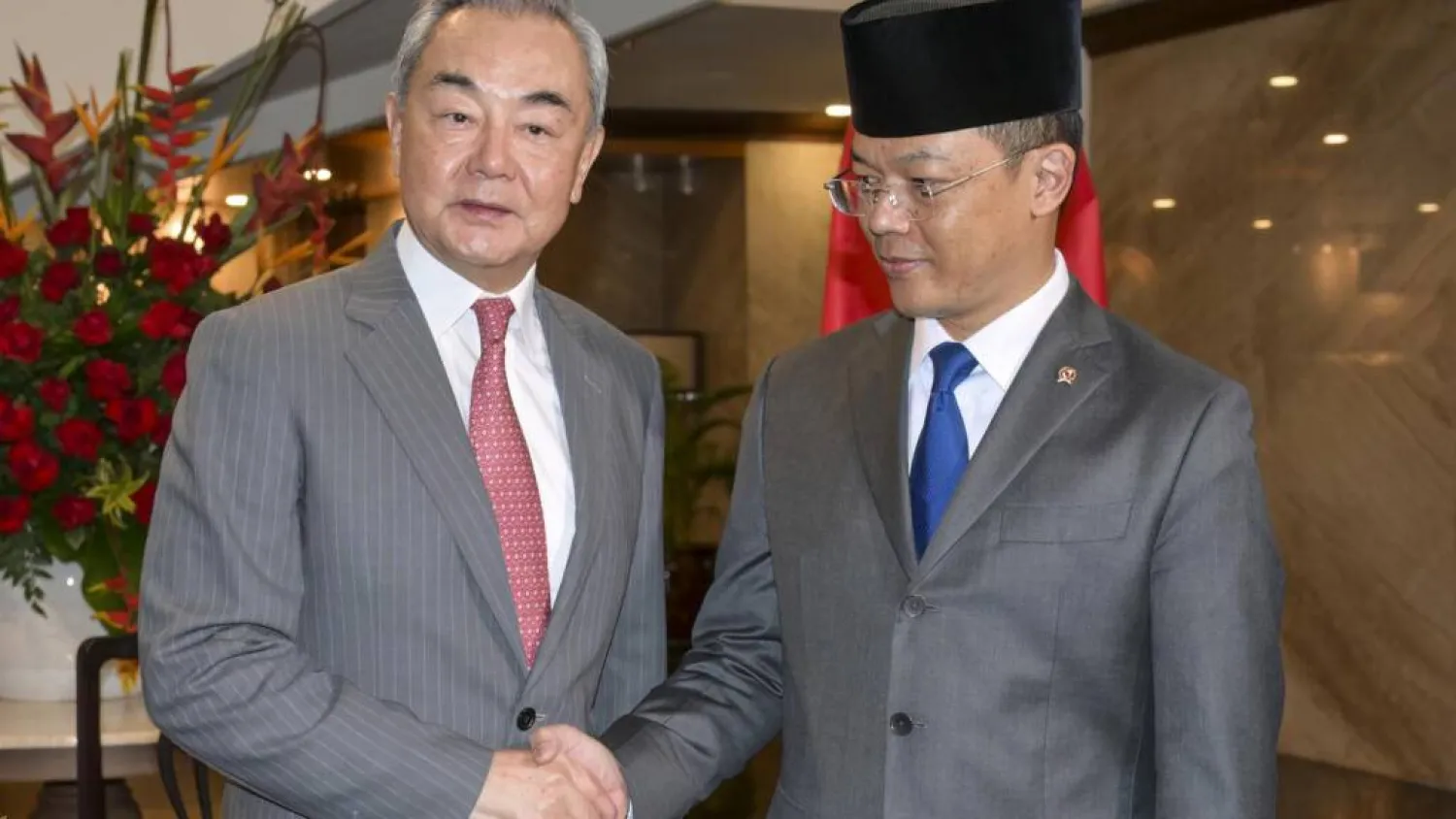

China, Indonesia Hold Talks on Security, Defense

Indonesian Foreign Minister Sugiono (R) welcomes Chinese Foreign Minister Wang Yi during the Comprehensive Strategic Dialogue meeting at the Ministry of Foreign Affairs in Jakarta on August 21, 2026. BAY ISMOYO / AFP
TT

China, Indonesia Hold Talks on Security, Defense

Indonesian Foreign Minister Sugiono (R) welcomes Chinese Foreign Minister Wang Yi during the Comprehensive Strategic Dialogue meeting at the Ministry of Foreign Affairs in Jakarta on August 21, 2026. BAY ISMOYO / AFP

China's foreign and defense ministers were in Jakarta Friday for talks with their Indonesian counterparts to seek greater political and military cooperation days after a joint navy drill Taiwan blasted as a "provocation".

The talks marked "an important milestone in our bilateral relations," Indonesia's foreign minister Sugiono, who goes by one name, said as he welcomed Chinese counterpart Wang Yi, reported AFP.

"It serves as a forward-looking strategic platform, guiding our bilateral partnership across all five pillars -- political, economic, maritime, people-to-people, and security."

Indonesia maintains a neutral foreign policy, what it calls "free and active" -- walking a diplomatic tightrope between Beijing and Washington.

Earlier this month, Jakarta and Beijing raised the ire of Taiwan with a joint navy drill off the democratic island's east coast.

The two countries said it was a "passing exercise" with an Indonesian frigate passing through on its return home from the Russian port city of Vladivostok.

Taiwan called it a "military provocation" from the Chinese Communist Party.

Wang said Friday it was crucial for Beijing and Jakarta to "increase strategic communication, to deepen strategic coordination" as important representatives of the Global South.

"Today's world is fluid and turbulent," he said in translated remarks provided by Indonesia's foreign ministry.

"We are seeing unilateralism and hegemonism. They have dealt a heavy blow to this world as well as to the global development agenda."

On the agenda for Friday was the inaugural meeting of what is being called a "China-Indonesia Comprehensive Strategic Dialogue Mechanism".

Among other things, it is meant to boost "the alignment of development strategies", Chinese foreign ministry spokesman Lin Jian told reporters ahead of Wang's visit.

Wang would later be joined by Chinese Defense Minister Dong Jun in talks with Indonesia on "political security and defense cooperation and international and regional situations", according to Beijing.

Last year, Jakarta joined the BRICS bloc of emerging economies that includes Russia and China.

But President Prabowo Subianto has also signed a trade deal with US President Donald Trump and joined his so-called "Board of Peace".

International relations researcher Pieter Pandie of the CSIS think tank told AFP that Jakarta still leaned "much more" towards Washington than Beijing.

"From the security and defense side of things, the Indonesia-China relationship is still very much less developed... compared with Indonesia's security cooperation with other Western and Asian partners," he said.

"I wouldn't look too much into whether or not (Friday's meeting) signals some sort of 'realignment' for Indonesia towards Beijing," added Pandie.



UN: DR Congo Ebola Outbreak 'Growing Exponentially'

People wearing protective clothing carry a coffin during a burial at Nyamurongo Cemetery in Bunia, Democratic Republic of the Congo, 18 August 2026. EPA/DIEUDONNE DIROLE
TT

UN: DR Congo Ebola Outbreak 'Growing Exponentially'

People wearing protective clothing carry a coffin during a burial at Nyamurongo Cemetery in Bunia, Democratic Republic of the Congo, 18 August 2026. EPA/DIEUDONNE DIROLE

The Ebola outbreak raging in the Democratic Republic of Congo is growing "exponentially,” the United Nations' senior Ebola coordinator warned Friday.

The Ebola outbreak is already the biggest in the country's history having killed more than 2,300 people from more than 5,000 cases, according to the African Union health agency.

The virus eruption is "growing exponentially," Julien Harneis told reporters in Geneva, speaking from DRC.

On Thursday, the World Health Organization said Congo has been allocated 70,000 doses of Merck's Ervebo vaccine for Ebola.

Last week Congo had requested a release of Ervebo vaccines from the global Ebola virus disease vaccine stockpile, managed by the International Coordinating Group (ICG) on Vaccine Provision, according to WHO.

The health agency said the group allocated 70,000 Ervebo doses ⁠for Congo, of ⁠which 20,000 shots will be used in a late-stage trial to understand the impact of the vaccine on the Bundibugyo virus.

Geneva-based global vaccine alliance Gavi said they would provide $7 million to fund the shipment to Congo along with another $6 million to help with ⁠vaccination efforts in high-risk areas.

The ongoing outbreak is caused by the Bundibugyo species of Ebola, which has no approved vaccines or treatments.

"It is not known whether Ervebo may be protective against the Bundibugyo virus in humans," WHO said, stressing the importance of clinical trials to provide new evidence.

Ervebo is approved to prevent disease caused by the more common Zaire ebolavirus strain.


Iran's Qalibaf Says Tehran Must Plan to Overcome 'Unjust Sanctions', Following US Threats

Iran's parliamentary Speaker Mohammad Bagher Qalibaf speaks during a news conference in Beirut on Oct. 12, 2024. (AP)
TT

Iran's Qalibaf Says Tehran Must Plan to Overcome 'Unjust Sanctions', Following US Threats

Iran's parliamentary Speaker Mohammad Bagher Qalibaf speaks during a news conference in Beirut on Oct. 12, 2024. (AP)

Iranian parliament speaker Mohammad Baqer Qalibaf said ‌Iran ‌must plan ‌to ⁠overcome the "unjust sanctions", ⁠after US Treasury Secretary ⁠Scott ‌Bessent announced ‌what he described ‌as ‌the toughest sanctions ‌ever imposed on Iran, according ⁠to ⁠Qalibaf's channel on Telegram.

Bessent said the United States will impose "the toughest sanctions in history" on Iran, a move he suggested would lessen the need for new major military operations, reported Reuters.

Bessent's comments on Thursday followed President Donald Trump's threat a day earlier of "Economic Warfare" and warning of economic consequences against any country that provided "any type ‌of lifeline to Iran." Bessent promised details next week.

Iran has weathered near-continuous, punishing economic sanctions for nearly 50 years, since the Iranian Revolution of 1979.

Before Bessent spoke, Iran's foreign ministry said it condemned US economic and trade sanctions, calling them "economic terrorism" that would not "create even the slightest hesitation in Iranians’ determination to safeguard Iran’s independence, dignity and national sovereignty."

Bessent told CNBC he would share more details on the latest package and "talk about exactly what we're going to do" on Iran at a press conference on Monday.


China Says US ‘Sanctions and Pressure’ on Iran Not a Solution

 Women walk past a portrait of the late Iranian Supreme Leader Ali Khamenei, who was killed in the US and Israel strike on Feb. 28, and images of the Iranian flag, on a sidewalk in downtown Tehran, Iran, Thursday, Aug. 20, 2026. (AP)
Women walk past a portrait of the late Iranian Supreme Leader Ali Khamenei, who was killed in the US and Israel strike on Feb. 28, and images of the Iranian flag, on a sidewalk in downtown Tehran, Iran, Thursday, Aug. 20, 2026. (AP)
TT

China Says US ‘Sanctions and Pressure’ on Iran Not a Solution

 Women walk past a portrait of the late Iranian Supreme Leader Ali Khamenei, who was killed in the US and Israel strike on Feb. 28, and images of the Iranian flag, on a sidewalk in downtown Tehran, Iran, Thursday, Aug. 20, 2026. (AP)
Women walk past a portrait of the late Iranian Supreme Leader Ali Khamenei, who was killed in the US and Israel strike on Feb. 28, and images of the Iranian flag, on a sidewalk in downtown Tehran, Iran, Thursday, Aug. 20, 2026. (AP)

China said on Friday that US "sanctions and pressure" would not resolve the Middle East conflict, after Washington urged governments including Beijing to join efforts to isolate the Iranian economy.

The United States has vowed it would "collapse" the Iranian regime with its threatened campaign, which Tehran has branded as "economic terrorism" doomed to fail, nearly six months since their war began.

Asked about US President Donald Trump's threats, Chinese foreign ministry spokesman Lin Jian told reporters on Friday that "sanctions and pressure will not help resolve the issue".

"China calls on all relevant parties to take responsible measures and resolve the problem through political and diplomatic means," he said.

US Treasury Secretary Scott Bessent has defended Trump's push for economic pressure on Tehran.

When asked whether the United States would pressure China to join the campaign, Bessent told CNBC that "many conversations are best to have in private", but called on Beijing "to get with the program".

Spokesman Lin reiterated the need for all parties to take "responsible measures" in resolving the war, when he was asked about Bessent's comments.

"China opposes illegal unilateral sanctions that have no basis in international law and are not authorized by the UN Security Council," Lin said.