


State Return to South Lebanon Extends Beyond Security to Services, Recovery

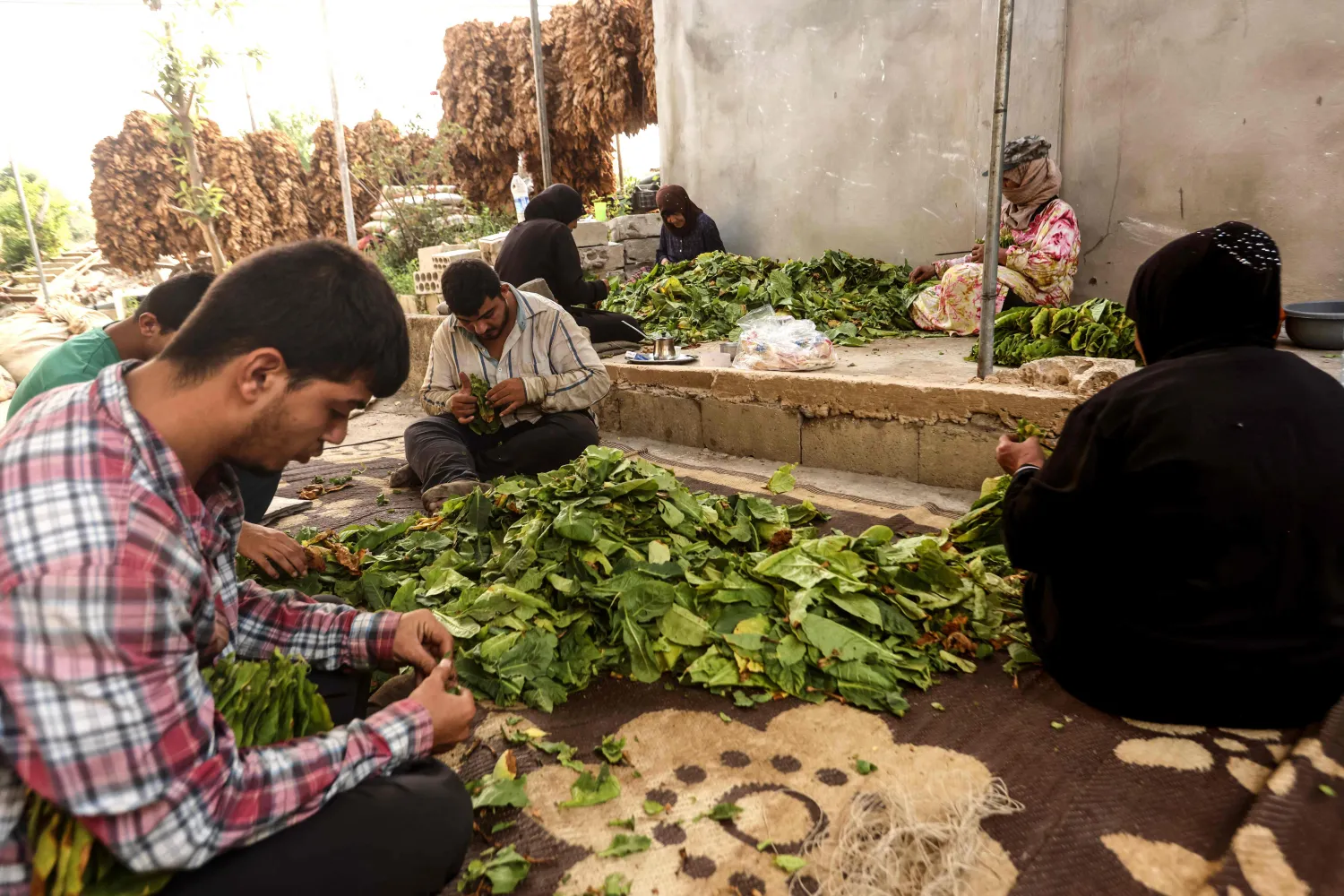
Workers sort tobacco leaves grown by the Issa family at a farm in the southern Lebanese village of Deir Qanoun Ras al-Ayn on August 21, 2026. (AFP)
TT

State Return to South Lebanon Extends Beyond Security to Services, Recovery

Workers sort tobacco leaves grown by the Issa family at a farm in the southern Lebanese village of Deir Qanoun Ras al-Ayn on August 21, 2026. (AFP)

Lebanon’s push to reassert the state’s presence in the south is moving beyond security deployments to a harder test: restoring schools, services, and livelihoods in communities battered by war.

Recovery programs are beginning to take shape, but a wide funding gap threatens efforts to keep residents in their towns and revive areas where infrastructure, agriculture, and education have sustained extensive damage.

A framework for return, but funding lags

In 2026, the government launched the “National Framework for Return, Early Recovery and Restoration of Basic Services,” covering the return of residents, social protection, the restoration of services and livelihoods, and preparations for reconstruction.

No consolidated budget has been announced yet.

One of its main financing tools is the Lebanon Emergency Assistance Project (LEAP), implemented by the Council for Development and Reconstruction.

The project was designed to scale up to $1 billion. So far, only $250 million has been secured, leaving a $750 million funding gap.

Of the available financing, $50 million is earmarked for immediate response measures, including debris removal, securing buildings, and reopening roads. Another $175 million is allocated to restoring water, energy, transport, health, and education services, while $15 million is set aside for studies and designs, and $10 million for project management.

Under the full framework, $455 million is allocated for reconstruction, most of it still unfunded.

In a parallel effort, the government launched a program in May worth about 32 million euros for southern Lebanon and the Bekaa, running through 2029.

The European Union is providing 24.8 million euros, Denmark 5.35 million euros, and the French Development Agency 2 million euros. The program targets local authorities, small businesses, and the agricultural sector, while seeking to create jobs.

Lebanese ministerial sources told Asharq Al-Awsat that “the new response framework provides a basis for attracting funding, but it is still not fully financed.”

They said the Ministry of Social Affairs was “continuing to work intensively to secure additional funding to help respond to the needs of affected groups.”

A safety net for more than one million people

Social protection is a central part of efforts to keep residents in their communities and support their return.

The sources said one of the main response measures was cash assistance provided by the Ministry of Social Affairs, covering about 230,000 families through the ministry’s shock-responsive social safety net.

Based on the average household size, more than 1 million people receive support.

The assistance is particularly significant in areas where returning home still depends on families' ability to repair their homes, restore access to services, and find work.

That makes social support part of the effort to re-establish communities, rather than simply an emergency measure.

Agriculture: getting farmers back to their land

The Ministry of Agriculture has divided its response plan into five tracks: emergency support for farmers; protection of food supply chains and markets; protection of livestock production and assets; continuity of programs and services; and coordination and needs assessment.

Measures include monitoring food supply chains, accelerating imports of plant products, extending import deadlines for some essential goods, and monitoring markets and prices in coordination with the Ministry of Economy.

The plan also provides emergency assistance to farmers in high-risk areas and steps up operations at ports, border crossings, quarantine centers, and laboratories to speed the entry of goods.

The report does not set an overall budget for the agricultural response.

Instead, it says the ministry is working with partners and donors to identify priorities, assess possible interventions, and secure resources.

Resources reported by the ministry’s network of agricultural partners that are being mobilized include $1,650,150 in cash assistance targeting 4,840 farmers.

In-kind assistance is expected to reach 1,850 farmers and includes solar-powered irrigation pump kits, agricultural inputs, animal feed, treatment support, and infrastructure.

The ministry has also launched a platform with the food security sector to identify and track available resources.

Schools face a September test

Education is emerging as one of the clearest tests of whether state institutions can resume normal operations in the South and Nabatieh governorates.

Sources at the Ministry of Education and Higher Education told Asharq Al-Awsat that the ministry aims to start the 2026-2027 academic year with in-person classes at schools that meet safety and readiness requirements, starting Sept. 15.

Schools in the affected areas of the South and Nabatieh will temporarily rely on remote learning until technical and operational assessments are completed.

The scale of the challenge is substantial.

Of 267 schools in the two governorates, 198 have been damaged. Eighty-nine sustained very minor damage, 64 moderate damage, and 15 severe damage. Another 30 were completely destroyed.

The ministry is using a “school cluster” model for planning, grouping schools and alternative learning spaces within the same geographical area.

Each cluster will have a file detailing student and teacher numbers, building conditions, capacity, and the locations of displaced students.

Students whose schools cannot reopen will remain enrolled in their original schools while temporarily attending a host school or alternative learning space.

Schools being used as shelters will operate under conditions designed to ensure the safe separation of their educational and shelter functions.

The ministry is also building an operational database to track schools and students and setting up a hotline.

Each school will receive an official operational decision specifying how classes will resume.

The ministry has also expanded its use of “Teaching Hubs,” or teaching and learning centers, aimed at restoring teachers’ roles in affected areas while providing students with places to receive support and continue their education.

The sources said the objective went beyond repairing damaged buildings.

“The goal is not limited to rehabilitating damaged school buildings, but also includes preserving the school as an existing institution even if its building has been destroyed, by maintaining its administration, teachers, and students,” they said.

That, they added, would ensure that each school retains its identity and educational role until it can be rehabilitated or rebuilt.



Yemeni Leadership Moves to Overcome Shock of Losing West Coast

An internally displaced (IDP) Yemen, one of many who fled their homes due to renewed clashes between Yemen's government forces and the Houthi group, sits in his shelter in the al-Kadha area of the Taiz governorate, southwestern Yemen on September 6, 2026. (AFP)
TT

Yemeni Leadership Moves to Overcome Shock of Losing West Coast

An internally displaced (IDP) Yemen, one of many who fled their homes due to renewed clashes between Yemen's government forces and the Houthi group, sits in his shelter in the al-Kadha area of the Taiz governorate, southwestern Yemen on September 6, 2026. (AFP)

The Yemeni leadership is moving to deal with the loss suffered by government forces on the west coast as a painful field setback, but one that should not become a turning point in the conflict with the Houthi group.

The government and Presidential Leadership Council are, meanwhile, seeking to rearrange forces and regain the initiative, while containing the humanitarian consequences of displacement and maintaining the operation of state institutions.

PLC member and Governor of Marib Sultan Al-Aradah said the developments on the west coast are "painful and regrettable," but are part of wars that witness advances and retreats.

The developments will not deflect from the main goal, he added.

In remarks carried by state media, he said the forces that withdrew from the coast are rearranging their ranks and will return to the battle "in one way or another."

Field developments on the west coast had forced government troops to redeploy after losing positions and areas, amid a broad Houthi escalation. The developments led to new waves of displacement, while a number of military personnel relocated to Marib, where Al-Aradah said authorities had prepared a camp for them and made arrangements to secure their needs.

Al-Aradah's remarks reveal that the Yemeni leadership is attempting to shift the handling of the west coast loss from a state of field shock to restoring combat capability.

This approach aligns with what Prime Minister Shaya Al-Zandani put forward during a cabinet meeting in the interim capital Aden, when he stressed that the difficult developments over the past days should not be understood as an end to the confrontation.

He stressed that battles are not measured by the outcome of a single day or a change in a position, but rather by the state's ability to reorganize its efforts, mobilize its resources, support its forces, maintain the cohesion of its institutions, and regain the initiative.

It appears that the Yemeni leadership's priority in the coming phase centers on rearranging the forces that withdrew from the coast and reintegrating them into operations, alongside elevating government support for the armed and security forces.

The cabinet confirmed that it reviewed a report from the minister of defense regarding the military situation across various fronts, operational readiness levels, and requirements, while underlining the need to boost the forces' capacity to confront the escalation and regain the initiative.

In Marib, Al-Aradah said that the governorate's forces are focused on victory and supporting various fronts, noting that the ultimate goal in the fighting, in Marib and elsewhere, remains the liberation of the capital, Sanaa, from the Houthis.

The forces and commanders on the ground bear a historic responsibility to defend the state and national dignity, he said.


Tareq Saleh’s Forces Accuses Iran’s Revolutionary Guards of Guiding Assault on Yemen’s West Coast

Smoke rises during clashes between Yemeni government forces and Houthis (Reuters)
TT

Tareq Saleh’s Forces Accuses Iran’s Revolutionary Guards of Guiding Assault on Yemen’s West Coast

Smoke rises during clashes between Yemeni government forces and Houthis (Reuters)

In its first statement since losing extensive positions on Yemen's west coast, the government’s National Resistance revealed the cost of a month-long battle against the Houthis. It accused Iran’s Revolutionary Guard Corps (IRGC) and its regional allies of providing direct support and managing the offensive, which culminated in the group seizing control of vast positions and areas along the coast.

The "National Resistance" forces, led by member of the Yemen’s Presidential Leadership Council Tareq Saleh, announced that more than 500 of their personnel were killed and nearly 1,500 others wounded. This was compared to more than 1,000 dead and thousands wounded among the Houthis, according to the statement about the battles that spanned from August 9 to September 10.

The statement, broadcast by the military forces' media, comes following a major field shift on the west coast fronts, with the Houthis advancing and seizing control of Hays, al-Khawkha, Mokha and its port, and extending their control to Bab al-Mandeb, Mayyun Island, and the rest of the Yemeni islands in the southern Red Sea.

The National Resistance described the battles as some of the "fiercest clashes" they have fought against the Houthis, stating that the offensive began with intensive missile bombardment and attacks using drones and booby-trapped boats, before expanding across the Hays, al-Kadha, Maqbanah, and al-Barah areas.

It added that the Houthis deployed large numbers of fighters and reinforcements from various axes in an attempt to shift the balance of power on the ground and besiege the defending forces.

The National Resistance linked the nature of the offensive and the Houthis' ability to mobilize forces and execute simultaneous operations to what they described as direct support from personnel and expertise of the IRGC and its regional allies.

A Yemeni gunman brandishes his weapon during a rally to recruit more fighters in Sanaa on September 10, 2026. (AFP)

It said the offensive was prepared in advance to exploit the terrain and establish fire control over several commanding heights, in an attempt to tighten the siege on the forces and destroy their combat capability.

It added that the course of the battles revealed, according to its assessment, the nature of the Iranian role in supporting the Houthis, accusing the group of executing a project that targets Arab national security and international waterways.

Faced with the intensity of the offensive and the succession of reinforcements, the National Resistance revealed that its leadership decided to reposition forces into new defensive lines, aiming to preserve its "strike force" and foil the plan to encircle and destroy it.

The repositioning is not the end of the fight, but rather a measure to preserve its forces and rearrange their deployment after losing extensive positions.

The statement praised Saudi support, which it said continued until the "last moment," alongside the backing of the Giants Brigades, National Shield, and tribal volunteers, saying this is an embodiment of the unity among anti-Houthi forces.

The National Resistance said the developments underscore the need for integrating anti-Houthi fronts and mobilizing them simultaneously, rather than relying on a single military sector, aiming to regain the initiative and impose a new military reality.

In an attempt to avoid holding other Yemeni factions responsible for the loss, the statement stressed that the resistance has no intention of "accusing anyone of treason" or engaging in "settling scores or political posturing." It called for viewing developments objectively, drawing lessons, and rearranging priorities for the upcoming phase.


Israeli Strike Kills Two People in Gaza, Medics Say

Internally displaced Palestinians walk among the ruins of destroyed residential buildings in the Al-Sheikh Radwan neighborhood, east of Gaza City, Gaza Strip, 10 September 2026. (EPA)
TT

Israeli Strike Kills Two People in Gaza, Medics Say

Internally displaced Palestinians walk among the ruins of destroyed residential buildings in the Al-Sheikh Radwan neighborhood, east of Gaza City, Gaza Strip, 10 September 2026. (EPA)

An ‌Israeli airstrike on Sunday killed at least two Palestinians in a vehicle and wounded 13 others in the Gaza Strip, medical staff said.

The strike in the Tel Al-Hawa neighborhood in western Gaza City, left the vehicle mangled, according to footage circulated on social media. Local medical staff told ‌Reuters that ‌they urged people to provide ‌information ⁠that could help identify ⁠the two people who were killed and whose bodies were dismembered by the explosion.

The Israeli military said the strike targeted two Hamas fighters, without giving further information.

An October 2025, ⁠US-backed, ceasefire halted large-scale fighting in ‌Gaza, but ‌it has not ended Israeli strikes and ‌there has been little progress on ‌steps towards permanent peace.

Hamas accuses Israel of violating the ceasefire and undermining efforts to implement US President Donald Trump's broader plan ‌to end the Gaza conflict, which includes the Israeli withdrawal ⁠from ⁠the strip and the disarmament of Hamas.

Israel says Hamas has been violating the deal.

More than 1,300 Palestinians, mostly civilians, have been killed in Gaza since the ceasefire took effect, according to the territory's health officials, while the Israeli military says four Israeli soldiers have been killed.

Hamas does not usually disclose information about fatalities among its fighters.