


US, Iran Keep Up Hostile Rhetoric Ahead of New Sanctions

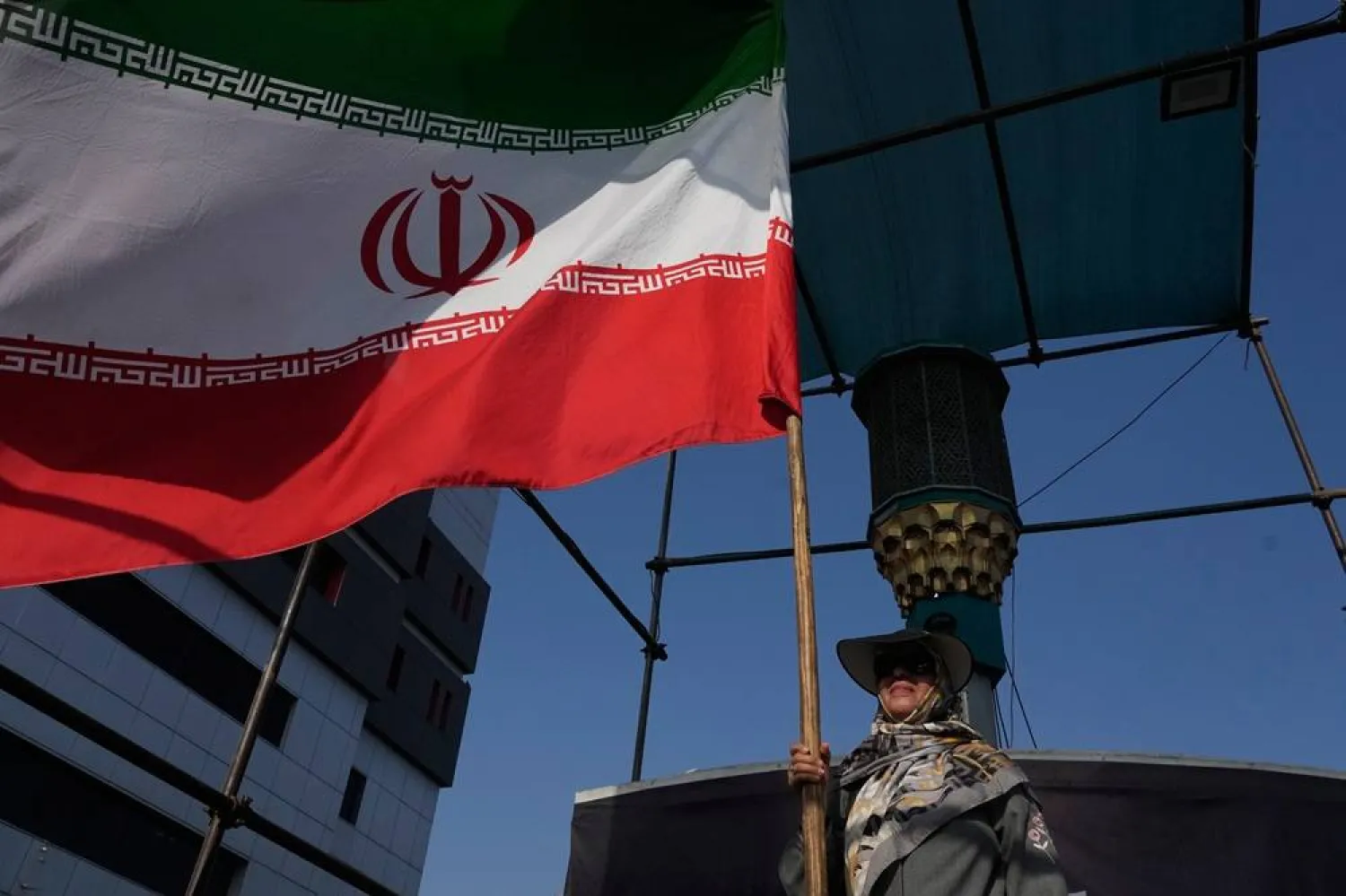
A woman holds an Iranian flag during a pro-government campaign in downtown Tehran, Iran, Monday, Aug. 17, 2026. (AP)
TT

US, Iran Keep Up Hostile Rhetoric Ahead of New Sanctions

A woman holds an Iranian flag during a pro-government campaign in downtown Tehran, Iran, Monday, Aug. 17, 2026. (AP)

The United States and Iran exchanged defiant messages ahead of Monday's scheduled announcement of new US economic sanctions that could impact the country and Tehran's most important trading partners including China.

As the war neared six months old, the two sides were not exchanging fire but also not pursuing peace talks. All the while, oil shipments through the Strait of Hormuz have virtually halted as Tehran clings to its leverage by threatening to strike any unauthorized oil tankers that attempt to transit the narrow waterway.

US Treasury Secretary Scott Bessent will hold a press conference on Monday amid promises to reveal "the toughest sanctions in history" on Iran while also urging China to cooperate with Washington.

China buys more than 80% of Iran's ‌shipped oil, according ‌to 2025 data from analytics firm Kpler. Beijing urged diplomacy.

Iran's Foreign Ministry spokesperson ‌Esmaeil ⁠Baghaei said on Saturday ⁠that the imminent US announcement of new economic sanctions on Iran was an "assertion of extraterritorial sovereignty over every independent member state of the United Nations."

"Such secondary sanctions find no foundation in international law," he said in a post on X.

US President Donald Trump, who has warned of economic consequences against any country that provides "any type of lifeline to Iran," said on Friday that Washington was observing "what happens" in the conflict.

"They would love to make a deal, but they're not ready to make the right deal, in my opinion," Trump said of Iran.

HORMUZ TRAFFIC HALTED

While the US has ⁠effectively blockaded Iranian vessels in their ports, the Strait of Hormuz remained bottled ‌up with thousands of seafarers stranded on hundreds of vessels.

Only four ‌commodity ships sailed along the strait on Thursday, none of them large crude carriers or liquefied natural gas tankers, ship-tracking data ‌showed.

US Energy Secretary Chris Wright said the US military helped move a seven-day average of 8 million ‌barrels a day of oil through the strait. That's down from more than 20 million per day before the war or about one of every five barrels consumed worldwide.

US attacks have severely diminished Iran's economy and devastated its navy and air force, but Tehran maintains enough missile and drone capability to impede oil tanker traffic and attack regional countries.

Trump, meanwhile, has yet to ‌achieve objectives he set at the start of the war such as dismantling Iran's nuclear program - the state of which remains uncertain given that UN inspectors have ⁠been shut out since ⁠2025 - and creating conditions for Iranians to overthrow their clerical rulers.

Thousands have been killed, including 168 Iranian school children on the first day of the war. The US has reported more than 750 military personnel wounded and 18 killed.

IRANIAN ECONOMY DAMAGED

The chief of staff of Iran's armed forces, Major General Ali Abdollahi, promised on Friday that Iran would respond to enemy threats militarily with "crushing, punishing and devastating responses.”

Still, President Masoud Pezeshkian called for a diplomatic solution.

"It would be better to end the war today, when we are powerful and have dignity, and the whole world acknowledges our victory and emphasizes that America, contrary to all regulations, attacked our schools, hospitals, and infrastructure and is hated in the world," Pezeshkian said, according to the ISNA news agency.

Iran's parliament speaker, Mohammad Baqer Qalibaf, the country's main negotiator in mediated talks with the US, acknowledged the strain on Iran's economy in comments to Iranian and Iraqi businesspeople late on Thursday.

"No matter how much military power we have, we won't survive if people are hungry and we don't have financial turnover, economic growth and national production," Qalibaf said, according to official news agency IRNA.



Iran Says It Has Conveyed Conditions to Re-Engage in Talks, End War with US

 Women draped in Iranian flags march during the state-organized military-style parade in Tehran, Iran, Friday, Sept. 18, 2026. (AP)
Women draped in Iranian flags march during the state-organized military-style parade in Tehran, Iran, Friday, Sept. 18, 2026. (AP)
TT

Iran Says It Has Conveyed Conditions to Re-Engage in Talks, End War with US

 Women draped in Iranian flags march during the state-organized military-style parade in Tehran, Iran, Friday, Sept. 18, 2026. (AP)
Women draped in Iranian flags march during the state-organized military-style parade in Tehran, Iran, Friday, Sept. 18, 2026. (AP)

‌Iran has conveyed its conditions to mediators for re-engaging in negotiations aimed at ending the war with the ‌US, Al ‌Jazeera cited ‌Iran's ⁠Security Chief Mohsen Rezaei ⁠as saying in an interview on Saturday.

The conditions ⁠include ending the ‌war ‌on all ‌fronts, unfreezing Iranian ‌funds and ending the naval blockade, Rezaei said, adding ‌that consultations were continuing with ⁠Qatari ⁠and Pakistani mediators and that Tehran was awaiting a response from US President Donald Trump.


Trump Says He Is Banning Media Outlets CNN, MS NOW, Politico from White House

The CNN booth at the White House after US President Donald J. Trump announced he would ban CNN, MS NOW, and Politico, from the White House in Washington, D.C., US, September 18, 2026. REUTERS/Evan Vucci
TT

Trump Says He Is Banning Media Outlets CNN, MS NOW, Politico from White House

The CNN booth at the White House after US President Donald J. Trump announced he would ban CNN, MS NOW, and Politico, from the White House in Washington, D.C., US, September 18, 2026. REUTERS/Evan Vucci

US President Donald Trump said on Friday he is banning three major news outlets – CNN, MS NOW and Politico – from the White House in his latest threat to the independent press.

The move is almost certain to face legal challenges as free speech experts said it conflicts with the US Constitution's First Amendment protections for free speech and a free press, Reuters said.

Trump accused the outlets of "reporting FAKE NEWS" in a social media post, and said they "shouldn't be able to constantly write or report FICTION and LIES when they're covering the President of the United States." Trump added, "Other Fake News Media Outlets to follow."

Representatives of all three outlets could be seen working in the White House on Friday afternoon following Trump's post. The White House was informing all three they would be banned from the White House grounds as of Saturday, Fox News reported, citing an unnamed senior White House official.

Trump said there was no specific incident that prompted the ban, telling reporters in the Oval Office, "It's really just cumulative stories over the past few years."

Trump added, "I don't have to let them into my, into the people's house."

When asked what he meant by ‌others "to follow," Trump mentioned ‌the New York Times and Washington Post as what he called "fake news."

The extent of the ban announced by ‌Trump ⁠was not immediately clear, ⁠and the legality of any move could depend on its scope.

Courts have given presidents broad discretion over selective access to events such as Oval Office meetings and small press pools, while broader exclusions from generally available White House press facilities or credentials could face stronger challenges under the First Amendment and constitutional protections for due process.

Trump's move came weeks ahead of the November 3 midterm elections in which Trump's fellow Republicans are defending narrow majorities in Congress. Reuters/Ipsos polls show the public souring on Republicans, as Trump's own approval ratings stand near historic lows amid the deeply unpopular Iran war he kicked off that has sent energy prices soaring.

DECADES OF TRADITION

The Trump administration has upended decades of tradition in dealings between the White House and press, cutting back the access many major news organizations have had to the ⁠president while elevating the presence of new media outlets seen as more sympathetic to the administration.

CNN in a statement ‌said it stands behind its journalists who cover the White House.

"We have a right under the ‌US Constitution to do that reporting without hindrance or interference from the government," CNN said in a statement. "Should the ban which President Trump threatened go ahead, it would be ‌an illegal assault on that fundamental and constitutionally protected right."

Politico said on X that it would "continue to fairly report on this White House and future ‌ones."

"We will vigorously defend our First Amendment rights against any attempt to restrict them," Politico said.

MS NOW declined to comment.

"It's difficult to imagine a more blatant violation of the First Amendment than Trump banning news outlets from the People's House for criticizing the government," Seth Stern, chief of advocacy at Freedom of the Press Foundation, said in a statement.

Jameel Jaffer, executive director of the Knight First Amendment Institute at Columbia University, said the First Amendment prohibits the president from punishing journalists because he does not like their coverage.

"If ‌President Trump means to expel these news organizations from the White House press pool, his action is doubly unconstitutional because the press pool is a 'public forum' under the First Amendment, which means the president can't exclude ⁠journalists from it on the basis ⁠of their viewpoints," Jaffer said in a statement.

TABLOID HISTORY

Trump rose to fame as a New York developer skilled in getting the city's tabloid newspapers to cover his social life, and went on to build his profile as a reality television personality before making a serious push into politics.

Since his successful 2016 campaign, Trump has regularly criticized the press, stepping up his complaints during his second term in office. He has repeatedly urged broadcasters to drop comedy or news programs he dislikes or which have joked about or criticized him or his administration, calling on the Federal Communications Commission to strip disfavored broadcast stations of their licenses.

Trump has filed several lawsuits against the press, including the Wall Street Journal, the New York Times, the BBC and the Des Moines Register. The suits can have a chilling effect. His defamation suits against ABC and CBS were settled for $15 million and $16 million, respectively.

In his first term, Trump's White House sought to revoke or suspend the credentials of Playboy correspondent Brian Karem and CNN's Jim Acosta, but federal judges ordered their White House press passes restored.

Since returning to the presidency in January 2025, Trump has openly badgered reporters, particularly from US television networks.

Last year, he also banned the Associated Press from the usual pool of reporters that cover his movements because the news agency did not adopt Trump's preferred name for the Gulf of Mexico, which Trump has instructed executive branch employees to refer to as the Gulf of America.


US and Denmark Reach Deal on Greenland, Trump Says

US President Donald Trump (AFP/Getty)
TT

US and Denmark Reach Deal on Greenland, Trump Says

US President Donald Trump (AFP/Getty)

The United States, Denmark and Greenland have entered into an agreement for the US to develop a significant military presence on Greenland, while prohibiting US adversaries from building their own bases on the island, Donald Trump said on Friday.

In a Truth Social post, the US president wrote that no US enemies would be able to make sensitive investments on the island without the approval of the United States and that the agreement had no expiry date.

"At my direction, we worked with representatives of Denmark and Greenland to guarantee that the United States will FOREVER have the complete ability to do what is necessary ‌in Greenland in order ‌to secure and defend the security of Greenland, and the United States ‌of ⁠America," Trump wrote.

Earlier ⁠on Friday, Reuters exclusively reported that the US and Denmark were closing in on a deal that would result in an increased US military presence in Greenland, an autonomous territory of Denmark, but would stop well short of Trump's long-held dream of acquiring the island for the United States.

The US already has nearly total overflight and basing rights in Greenland due to a 1951 treaty.

Trump's announcement suggests he was nonetheless pleased with the outcome of the negotiations and that he might not revive his territorial claims, at least in the near future. He said, without elaborating, that ⁠the US would soon be rolling out a large military presence on the ‌island, which already hosts one Space Force base in its remote ‌northwest.

"This is a dream come true for the United States of America," Trump wrote.

EXTENT OF AGREEMENT REMAINS UNCLEAR

The Danish ‌prime minister's office said on Friday that the agreement would strengthen North Atlantic and Arctic security.

Greenland's prime ‌minister, Jens-Frederik Nielsen, said in a statement that the agreement recognized Greenland's interests and the Arctic island's place in international cooperation. "This benefits us all," he said.

Much was unclear as of Friday night, including whether any new US bases would be constructed as a result of the agreement. Trump's Truth Social posts about negotiations or agreements often lack context or specifics.

Imran Bayoumi, ‌a former Pentagon official now with the Atlantic Council think tank, said it would be new if the US can build bases without the approval of ⁠Greenland or Denmark but that ⁠largely "it seems that Washington could have achieved a lot of these objectives through diplomacy and dialogue without straining the broader US-NATO relationship.”

It was also unclear how the agreement would be received in Greenland, an autonomous territory of Denmark. The island's residents aspire to independence and have bristled at US attempts to assert control.

In a separate statement, US Secretary of State Marco Rubio said that the deal "permanently and completely" addressed Washington's national security concerns with respect to the island.

"Greenland will forever be part of the strategic defense area of North America and exclude any adversary from it and the surrounding area," he wrote.

A State Department official, speaking on condition of anonymity to discuss specific terms, said the deal prohibits non-NATO countries from building a base in Greenland and will allow only the US and its allies to make unspecified "sensitive investments." The official said the agreement grants the US permanent access, basing and overflight rights, and would continue to apply even if Greenland becomes independent.