


Sudan Farms Lie Barren as El Nino Leaves Nile Banks Dry

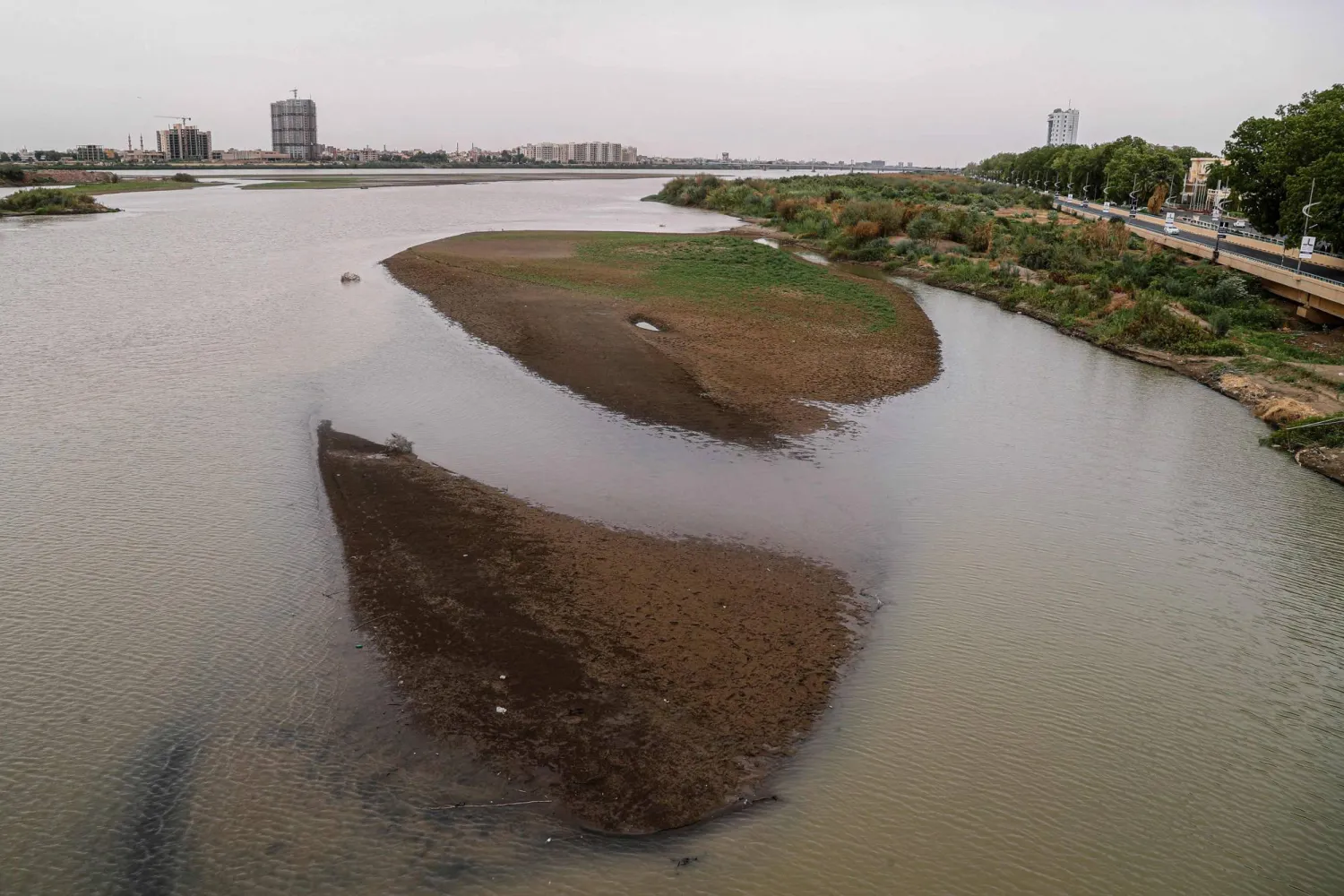
A photograph shows the exposed riverbed of the Blue Nile in Khartoum on July 27, 2026. (AFP)
TT

Sudan Farms Lie Barren as El Nino Leaves Nile Banks Dry

A photograph shows the exposed riverbed of the Blue Nile in Khartoum on July 27, 2026. (AFP)

Along the bone-dry riverbanks of the Nile in Sudan, farmers struggle to pull water to their crops. Others gather to pray for rainfall over cracked earth.

Across the country, farmland that could feed the world's largest hunger crisis many times over lies fallow, as weary farmers once again find themselves in the crosshairs of faraway destruction.

First came war between the country's army and rival paramilitaries, which since April 2023 has killed more than 200,000 people and pushed nearly 20 million into crisis levels of hunger.

Then a more distant conflict, between Iran and the United States, crippled fuel and fertilizer supply through the Strait of Hormuz, causing costs to soar.

And now the powerful El Nino climate pattern strengthening in the Pacific Ocean, which impacts winds and rains across the world, has delayed crucial rains and led water levels in the life-giving Nile to drop precipitously.

Just south of the capital Khartoum, farmer Al-Tigani Fadlallah points to an island that shouldn't be there.

"The water usually covers it by July, but you can see it even now," he told AFP this month, seeing in the sunbaked sandbank a bad omen for his parched crops.

Through the length of Sudan, from the northern fields near Egypt, along the Nile river to the Ethiopian border, farmers told AFP reporters the water they need is not rising from the riverbanks nor falling from the sky.

The UN's food and agriculture organization says the season "is unfolding under heightened climate risk, driven by El Nino conditions" including delayed and below average rains, and long and frequent dry spells.

Farmers say it is one of the hardest seasons in recent memory, but climate research shows it will not be the last.

- Pray for rain -

Climate and hydrology scientist Elfatih Eltahir, at the Massachusetts Institute of Technology, has studied the link between El Nino and the Nile for thirty years.

His research has shown El Nino is closely associated with low Nile flow and, when it begins in late spring, as it did this year, brings a high probability of drought in southeastern Sudan and northwestern Ethiopia, where the Blue Nile originates.

Water levels at the reservoir behind Ethiopia's massive Grand Renaissance dam on the Blue Nile, which contributes the majority of water feeding the Nile river, was six meters lower this July compared to the same month last year, according to data from Germany's University of Tubingen.
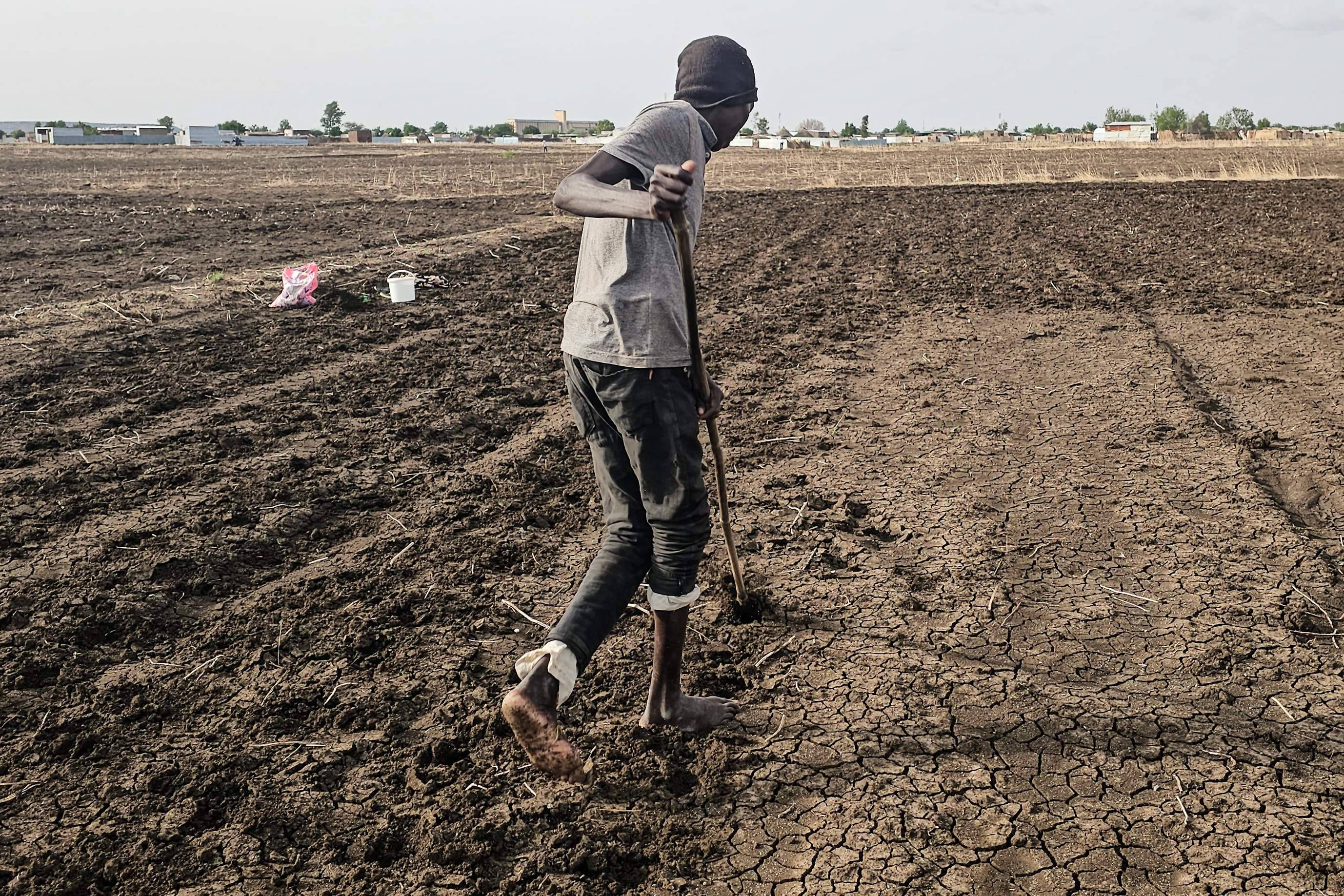
A Sudanese farmer ploughs agricultural land in Gedaref State, eastern Sudan, on July 18, 2026. (AFP)

But Eltahir warns "more transparency and cooperation" are also needed between Ethiopia, Egypt and Sudan over Addis Ababa's management of the reservoir, especially as climate change brings more extreme floods and droughts.

This summer, the Blue Nile basin has already seen as little as half of its usual rainfall, according to UC Santa Barbara's Climate Hazards Center, and regional forecasts predict below average rainfall for the rest of the rainy season.

Farmers in Gedaref state on the Ethiopian border, where the bulk of Sudan's staple crops such as sorghum and sesame are planted, are already feeling it.

When August rolled in and their usually-verdant fields were still a dull brown, frustrated farmers gathered behind local imams for rain-invoking prayers.

"We need these rains for our crops and our livestock, and they're late," local farmer Abdelmajid Hussein told AFP after a prayer.

Agriculture minister Ismat Qurashi told AFP farmers are being told to choose drought-resistant crops and to delay planting.

Moussa Yaacoub, 75, has planted sesame for decades, including three wartime growing seasons each harder than the last.

Now, standing sentinel over the cracked earth, he wonders if he will make it through the next, with his land now costing him "four times as much to plant".

- Can't catch a break -

Downstream, in Sudan's other breadbasket state Al-Jazira, Hassan Ahmed stares out at the farm that has been in his family for 100 years.

When Ahmed returned to it last year, after the army recaptured Al-Jazira from the Rapid Support Forces, he found it had been ransacked by looting paramilitaries, and his trees stood wilting in the sun.

He and his sons got to work bringing it back to life, but this year have struggled anew.

"I'm 63 and I have never seen the Nile this low in August," he told AFP. "By now we should have taken our water pump out because the flood had drenched the soil several meters in."

Buffeted by a perfect storm -- low water, soaring costs and a crippled market -- many farmers have abandoned their lands, at a time when 65 percent of Sudan's vast arable land is already out of commission.

Some farmers, hopeful at the start of the season, "planted their crops but then left them to die because it just wasn't worth the harvest," young farmer Mohamed al-Tijani told AFP near Khartoum.

Sudan imports all of its fuel and most of its fertilizer, costs for which have multiplied by up to five this year as a result of war in the Middle East.

Veteran farmer Ahmed Othman is one of many who know he won't break even in the market, already devastated with most of the country out of work.

"But at least I can say I'm working at all," he told AFP, back bent from decades of toiling in the fields.


At Least 13 Tunisians Missing after Migrant Boat Sinks off Tunisia

Migrants on a boat waiting for assistance from a rescue vessel in the Mediterranean Sea, July 24, 2025 (Reuters)
TT

At Least 13 Tunisians Missing after Migrant Boat Sinks off Tunisia

Migrants on a boat waiting for assistance from a rescue vessel in the Mediterranean Sea, July 24, 2025 (Reuters)

At least 13 Tunisians are missing after a migrant boat sank off the Tunisian coast while sailing towards Italy, and two people were rescued, the head of a migrant rights group said on Saturday.

The boat set off early on Thursday, Mostafa Abdelkebir, the head of the Tunisian Observatory for Human Rights, told Reuters.

One of the two ‌survivors told ‌rescuers in a local boat ‌they had ⁠been stranded at ⁠sea for hours after their vessel capsized. The second survivor was in critical condition, said Abdelkebir, whose group monitors migration issues.

Tunisia was once a major departure point for migrants crossing the Mediterranean, but departures have fallen sharply over the ⁠past two years amid a crackdown ‌and tighter maritime controls, ‌backed by European funding and modern border-monitoring equipment, particularly ‌from Italy.

Human Rights Watch, Amnesty International and ‌dozens of other human rights and humanitarian groups said in a statement last month that the EU-Tunisia migration deal had fueled and normalized serious abuses against ‌migrants and asylum seekers in Tunisia.

The groups called on the EU to suspend ⁠funding ⁠for migration and border-control activities involving Tunisian security forces.

Tunisia has not commented on the statement but has repeatedly said it is bearing the brunt of a major migration influx. President Kais Saied said in 2023 that the influx was aimed at changing the country's demographic makeup.

The central Mediterranean route is one of the world's deadliest migration routes, used by migrants from Africa and the Middle East seeking to reach Europe, often in overcrowded or unseaworthy boats.


Salam Inspects Military Units South of Litani: No Capable Lebanese State without One Strong Army

Lebanese Prime Minister Nawaf Salam during his visit to South Lebanon on Friday. (NNA)
TT

Salam Inspects Military Units South of Litani: No Capable Lebanese State without One Strong Army

Lebanese Prime Minister Nawaf Salam during his visit to South Lebanon on Friday. (NNA)

Prime Minister Nawaf Salam tied the restoration of state authority in South Lebanon to a broader process extending beyond military deployment to strengthening institutions, restoring services and advancing reconstruction.

During a visit to the Benoit Barakat Barracks in Tyre, Salam stressed that “every position where the army deploys in the South is a place where the state regains its authority.”

“Restoring sovereignty requires building a capable state, and there can be no capable state without one strong army,” he added, arguing that sovereignty restored through security must also be consolidated economically and socially.

One authority

“We want the South, like all of Lebanon, to be under one authority, and Lebanese citizens there to feel safe because they have an army protecting them,” the PM declared, linking lasting stability to the state and its constitutional institutions regaining control over decisions of war and peace.

At the same time, he acknowledged the challenges confronting the military amid continuing Israeli attacks. “True sovereignty is neither taken nor given; it is built,” he emphasized.

Salam reaffirmed his government’s commitment to building a national state faithful to the constitution, describing efforts to strengthen the army as “a strategic choice at the heart of our project to restore the state,” rather than a secondary priority.

The government continues to mobilize Arab and international support to develop the army’s personnel capabilities, improve its equipment and enhance service members’ living conditions, he went on to say.

He described the military as one of the few institutions around which Lebanese citizens remain united.

Addressing troops, Salam urged them to shield the army from political and sectarian divisions.

“Preserve the unity of the army. Do not allow politics to divide you and accept only the constitution and the law as your guide,” he told them, warning against allowing “the evils of sectarianism” to infiltrate their ranks.

Lebanon could emerge from its current predicament only by having “one army, one flag and one state,” he maintained.

Salam also paid tribute to fallen service members, telling their families: “Your sons are not only martyrs of the military institution; they are martyrs of the entire nation.”

Beyond army deployment

“The return of the state to the South is not limited to the deployment of the army, but extends across all sectors, including education, reconstruction and everything else,” he added, reiterating the government’s commitment to providing the military with everything needed to carry out its mission successfully.

He pledged that the state would spare no effort to secure Israel’s complete withdrawal from Lebanese territory, recover prisoners and advance reconstruction.

Defense Minister Michel Menassa similarly framed Salam’s visit as an affirmation of state sovereignty.

“Our visit to the South is not merely an inspection tour. We are here today to reaffirm our unwavering position seeking to restore state sovereignty,” he vowed.

He identified the government’s primary negotiating objective as “the complete withdrawal of the Israeli enemy from Lebanon.”

Menassa praised the army as a symbol of “dignity, sacrifice and loyalty” that brings Lebanese citizens together and safeguards national unity and civil peace.

He also commended its professionalism in carrying out missions despite difficult conditions and pressure.


Syria Cautiously Welcomes Abdi’s Integration Announcement, Awaits Implementation

SDF Commander Mazloum Abdi with his fighters wearing the military uniform of the Syrian army in February. (Social media)
TT

Syria Cautiously Welcomes Abdi’s Integration Announcement, Awaits Implementation

SDF Commander Mazloum Abdi with his fighters wearing the military uniform of the Syrian army in February. (Social media)

Ahmed al-Hilali, deputy governor of Syria’s Hasakah province and spokesperson for the presidential team tasked with overseeing integration with the Syrian Democratic Forces (SDF), welcomed SDF commander Mazloum Abdi’s announcement on integration, describing it as an acknowledgment of the SDF’s dissolution.

He cautioned, however, that “there is a difference between announcing an integration decision and completing its implementation on the ground.”

Syrian Kurdish writer and political researcher Ali Tami told Asharq Al-Awsat that integration was “complex and intertwined and cannot be concluded with a statement.”

He also challenged Abdi’s assertion that fighters who had come to support the SDF had left the region, noting that thousands of foreign fighters and remnants of the former regime remained in Hasakah.

Al-Hilali and Abdi attended celebrations Thursday marking the 100th anniversary of the founding of Qamishli. In a speech, Abdi announced the “completion of the military, security and administrative integration” of his forces into Syrian state institutions under the January 29 agreement.

Late Thursday, al-Hilali told Syria’s Al-Ikhbariya television that Abdi’s remarks were “an important and positive development,” viewing them as a clear transition from understandings to actual implementation of integration into state institutions.

He explained that the announcement would translate into practical measures, including unifying institutions and administrative authority and restoring the state’s full powers, ensuring unified decision-making and Syrian sovereignty.

Abdi's remarks were aimed at ending “dual structures and parallel entities” and establishing “one state, one army and unified institutions,” he added.

Syrian President Ahmed al-Sharaa and SDF Commander Mazloum Abdi meet in Damascus earlier in August. (SANA)

Implementation

Al-Hilali stressed that the issue could not be considered definitively resolved through statements alone.

“What was announced, together with earlier steps, such as removing partisan symbols and flags from institutions and public squares, confirms that the process is moving forward,” he noted.

While describing the announcement as a highly significant political step, he emphasized that it did not mean all stages of administrative, security and military implementation had been completed.

The objective now is to turn the decisions into a fully institutionalized reality in which Syrian state institutions become the sole authority, all institutions and bodies return to the state framework, and security, military and administrative decision-making is unified, he explained.

In separate remarks carried by Syria TV, al-Hilali said Abdi’s declaration that military and security integration had been completed as an acknowledgment of the SDF’s dissolution.

Integration declared complete

Abdi announced that the integration of military, service and administrative institutions into national state institutions had been completed and that “from now on, a new process begins.”

In areas formerly under the Kurdish Autonomous Administration, new institutions are being established in the name of the Syrian state while existing institutions will continue operating, he explained, urging residents to protect them.

Abdi also announced that forces from other “parts of Kurdistan” that had supported the SDF during Syria’s civil war had withdrawn under an agreement and at the SDF’s own request, an apparent reference to Kurdistan Workers’ Party (PKK) fighters.

Tami remained skeptical, arguing that the SDF had not formally announced its dissolution and that integration was too complicated to be settled by statements alone.

He maintained that the PKK controls the SDF and regards it as one of its instruments in confronting Türkiye, making it unlikely that the group would surrender its weapons before the direction of the peace process in Türkiye becomes clearer.

“In principle, we all support sparing the region further bloodshed, and integration is possible, but unfortunately the chances of success are very slim,” Tami lamented.

He also dismissed Abdi’s assertion that Kurdish forces that previously assisted the SDF had left the region as “illogical,” pointing to thousands of foreign fighters and former regime remnants still in Hasakah.

With efforts underway to ease tensions, integration continues to face major difficulties and challenges, he remarked.

SDF fighters in Ain al-Arab. (Reuters file)

From Autonomous Administration to integration

The Autonomous Administration traces its origins to the Kurdish Supreme Committee, formed by Syria’s Democratic Union Party (PYD) and the Kurdish National Council following the July 12, 2012, Erbil agreement. Its armed structures included the People’s Protection Units (YPG), Women’s Protection Units (YPJ) and Asayish security forces, followed in 2015 by the Kurdish-dominated SDF.

The administration expanded between 2014 and 2023, accompanied by growth in its military, security and civilian institutions, which employ tens of thousands.

The SDF lost a significant portion of its territory during nearly two weeks of clashes with the Syrian army in late 2025 and early 2026, followed by the January 29 agreement.

The accord provides for a ceasefire and gradual integration of Kurdish-established military and civilian institutions into the Syrian state, the handover of border crossings and oil and gas fields, and the departure of foreign fighters.

In July, residents in Hasakah mobilized for several days to demand that the state extend its authority across the entire province, allow displaced people to return to their towns and villages, and end SDF dominance and its abuses against residents.
