South Korea to Send First Container Ship Through Arctic Route

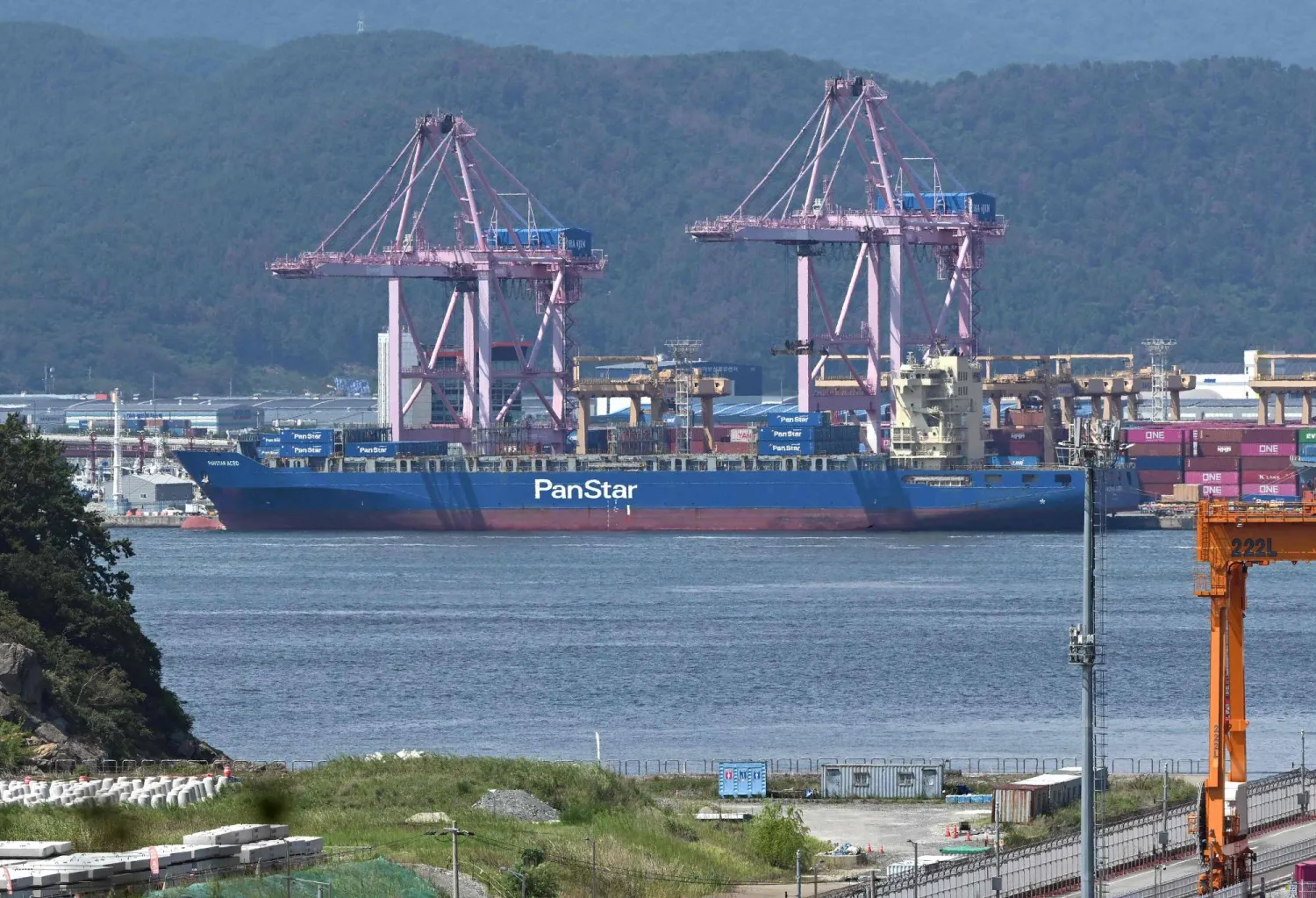
The container ship "Panstar Acro" is anchored to load containers at Busan New Port in Busan on August 22, 2026, as the vessel is scheduled to sail to Europe via the Arctic to test the commercial viability of the shipping route opened by melting ice. (AFP)
TT

South Korea to Send First Container Ship Through Arctic Route

The container ship "Panstar Acro" is anchored to load containers at Busan New Port in Busan on August 22, 2026, as the vessel is scheduled to sail to Europe via the Arctic to test the commercial viability of the shipping route opened by melting ice. (AFP)

South Korea was set Saturday to send its first trial container through the Arctic, as the Middle East war rattles global shipping, while environmental groups warned the route could accelerate polar ice melt.

The Middle East conflict, sparked by US-Israeli strikes on Iran in February, has roiled global shipping, sending governments and shipping firms scrambling to seek alternative routes.

Sailing from Busan New Port, the container ship -- the "PanStar Acro" -- will sail to Europe via the Arctic, testing whether a route opened by melting sea ice can be commercially viable.

"The ship will depart at 8 pm (1100 GMT) today unless there are unforeseen circumstances, such as bad weather," an oceans ministry official told AFP on Saturday.

The ship will leave for Felixstowe in Britain, Rotterdam in the Netherlands and Gdansk in Poland before returning, with the voyage expected to take about 45 days, according to the ministry.

The voyage follows that of the Chinese container ship "Dubai Tower", which left the eastern port city of Ningbo for Europe this month, heading north through the Bering Strait before turning west along Russia's Arctic coast.

The usual maritime route between Asia and Europe runs through the Suez Canal, but travelling through the Arctic can cut the journey by around 7,000 kilometers (4,300 miles) and about 10 days, according to the Korea Institute for International Economic Policy.

South Korea's Vice Oceans Minister Nam Jae-hon said the Arctic route was "bound to become an alternative" to Middle Eastern shipping lanes -- as geopolitical risks and technological advances make it increasingly competitive.

Marc Lanteigne, a political science professor at the Arctic University of Norway, said the voyage -- coming soon after China's "Dubai Tower" began its own Arctic journey -- showed the Northern Sea Route (NSR) was becoming normalized as a "secondary maritime transit corridor".

A successful voyage would demonstrate South Korea's interest in "developing alternative shipping sea lanes", he told AFP, with concerns that it could fall behind as Chinese firms expand regular services through the increasingly viable Arctic route.

- Russia issue -

Some experts warn South Korean ships using the Arctic route could risk breaching Western sanctions on Russia -- currently a key security ally of North Korea -- as they would receive Russian navigation and weather services involving payments, albeit small ones.

South Korea's foreign ministry declined to comment when asked by AFP about the concerns involving Russia.

The oceans ministry said this week that "consultations with key relevant countries and agencies" have been completed to "implement administrative procedures necessary" for the voyage.

Vladimir Tikhonov, Korean Studies professor at the University of Oslo, said "strictly speaking, US and EU sanctions are not international law, unlike UN sanctions".

"And with continued uncertainty in the Middle East - itself driven in part by US actions - South Korea may have few alternatives if the Arctic route proves economically viable," he told AFP.

Lanteigne said China's Northern Sea Route ambitions were more politically driven than South Korea's, with Beijing viewing the polar regions as "strategic new frontiers", raising Western security concerns.

Meanwhile, environmental groups warned growing traffic along the shorter NSR could accelerate Arctic sea ice loss already driven by global warming.

Major carriers including CMA CGM, MSC and Hapag-Lloyd have pledged to avoid Arctic shipping routes.

The NSR is believed to be accessible only during the time of year when the ice is melted enough to allow transits without icebreakers.

"The Northern Sea Route has become increasingly viable as the Arctic warms about four times faster than the global average, leading to a sharp decline in sea ice," South Korean environmental group Paran Ocean Citizen Science Center said in a statement last year.

"But making the route commercially viable would require further warming, putting the policy at odds with efforts to combat climate change."


China’s January-September Fiscal Revenue up 5.1% y/y

People look at their phones in a touristic area in Beijing, China, 22 October 2026. (EPA)
TT

China’s January-September Fiscal Revenue up 5.1% y/y

People look at their phones in a touristic area in Beijing, China, 22 October 2026. (EPA)

China's fiscal revenue increased 5.1% in the first nine months of 2026 from a year earlier, following a gain of 5.7% in the January-August period, the finance ministry said on Friday.

In the January-September period, fiscal revenue totaled 17.2 trillion yuan ($2.58 trillion), with tax revenue growing 6.1% year-on-year and non-tax ‌revenue expanding ‌1.2%.

Fiscal expenditure was up ‌1.0% ⁠on the year ⁠in the period, slowing from a rise of 1.2% in the first eight months.

China has accelerated local special bond issuance this year and plans to front-load part of its 2027 ⁠quota, finance ministry official Zhao Zeyong ‌told a press ‌conference on Friday.

Net special bond issuance ‌from January to September reached 3.56 trillion ‌yuan, accounting for 81% of the annual quota, and issuance for September was at 633.5 billion yuan, up by 214.8 billion yuan ‌from the same month last year, Zhao said.

Revenue from ⁠government ⁠land sales fell 27.9% on the year for the period from January to September, narrowing from a fall of 28.6% in the first eight months of this year.

The property sector downturn that began in mid-2021 has eroded land-sale revenue, long a crucial funding source for Chinese local governments.


Asian Stocks Mixed Ahead of Weekend as Tech Recovers Early Losses

 A person walks in front of an electronic stock board showing Japan's Nikkei index at a securities firm Thursday, Oct. 22, 2026, in Tokyo. (AP)
A person walks in front of an electronic stock board showing Japan's Nikkei index at a securities firm Thursday, Oct. 22, 2026, in Tokyo. (AP)
TT

Asian Stocks Mixed Ahead of Weekend as Tech Recovers Early Losses

 A person walks in front of an electronic stock board showing Japan's Nikkei index at a securities firm Thursday, Oct. 22, 2026, in Tokyo. (AP)
A person walks in front of an electronic stock board showing Japan's Nikkei index at a securities firm Thursday, Oct. 22, 2026, in Tokyo. (AP)

Asian equities were mixed Friday as tech firms managed to claw back some early losses on bargain-buying at the end of tough week for the sector, while traditional safe havens benefited from a generally cautious mood.

Since AI-linked companies hit record highs in June, their equity prices have been pummeled by concerns they were overvalued, their huge outlays on infrastructure and hardware might not return a profit and, more recently, their servicing costs were spiraling.

That has combined with an Iran war-fueled surge in oil prices to more than $100 that has ramped up inflation, forced central banks to hike interest rates and sent government borrowing costs to multi-decade highs.

Strong earnings in past quarters have been able to temper many of the concerns, but analysts pointed out that investors are demanding better and better results to justify their backing.

Earnings from Facebook-parent Meta and chip equipment maker Lam Research this week have beaten forecasts but seen their shares dive.

"Even positive news is being ignored," said FOREX.com's Fawad Razaqzada.

"Strong results are no longer enough if the outlook fails to match an already demanding valuation. Investors are becoming much less forgiving."

The rush out of tech has, however, boosted industrial companies overlooked for much of the AI boom, with the Dow rising this week while the Nasdaq and S&P 500 retreated.

The general losses in New York filtered through to Asia in the morning, but some markets staged a comeback as the day progressed.

Seoul -- which was at the forefront of the AI boom and has led recent losses -- shed more than two percent after the open but was up at the close.

Chipmaker and market heavyweight SK hynix -- a major target amid the waves of buying and selling -- ended up more than four percent. However, its US shares fell more than eight percent Thursday after it said it was scrapping plans for an initial public offering for its US subsidiary Solidigm, citing "market conditions and share price trends".

There were also gains in Hong Kong, Shanghai, Sydney, Singapore and Jakarta.

Tokyo's Nikkei 225, which is also heavily weighted to tech, ended in the red, though well off earlier lows. Wellington, Mumbai and Manila were also down. Taipei was closed as Typhoon Champi neared Taiwan.

London, Frankfurt and Paris dropped in the morning.

Safe havens benefited, with the yen rallying against the dollar, helped by strong Japanese inflation data that boosted bets on another interest rate hike.

The currency has struggled against the greenback in recent years owing to the wide interest rate gap between the United States and Japan, as well as worries about the Asian giant's fiscal situation.

US Treasuries were also in demand, with yields falling from two-decade highs.

"Markets are looking for safe havens as the now familiar fears over AI and the tech sector, alongside ever higher oil and energy prices are powering a move back into bonds," said National Australia Bank's Gavin Friend.

"Regardless of the continued climb in oil prices, investors are increasingly looking for safe havens with the recent pullback in US Treasury yields getting a sizeable push," he said, adding that two- and 10-year Treasury yields were at one-month lows.

And Carol Kong at Commonwealth Bank of Australia said the yen could benefit further if the tech trade continued to deteriorate.

Oil prices added to the dour mood on fresh Middle East worries. Brent extended Thursday's spike and headed back towards $115 a barrel for the first time since May, while WTI topped $100.

The latest rally came after Iran threatened to hit US bases in the region if its military continued to escort ships through the Strait of Hormuz.


Gold Heads for Steep Weekly Loss as Oil Prices Fuel Fed Rate Concerns

British gold bars and Sovereign gold coins are displayed at Baird & Co. in Hatton Garden, London (Reuters)
TT

Gold Heads for Steep Weekly Loss as Oil Prices Fuel Fed Rate Concerns

British gold bars and Sovereign gold coins are displayed at Baird & Co. in Hatton Garden, London (Reuters)

Gold eased on Friday, headed for its steepest weekly decline in over four months as elevated oil prices bolstered higher-for-longer interest rate expectations, while investors awaited next week's Federal Reserve policy meeting.

Spot gold eased 0.1% to $4,021.04 per ounce by 0554 GMT, paring losses slightly after touching its lowest level since July 20 earlier in the session. The metal has fallen ‌3.6% so far ‌this week, putting it on track for ‌its ⁠worst week since June.

US ⁠gold futures for December delivery dropped 0.6% to $4,035.50.

Speculators are trying to defend the key $4,000 level for gold because a clean break below would signal that the market has stopped pricing rate relief and started pricing sticky inflation, elevated yields, and a stronger dollar, said Monte Safieddine, head of market research at Capital.com.

Oil ⁠prices rose on Friday after Houthi attacks in ‌Saudi Arabia stoked concerns of further ‌disruption to energy supplies from the Middle East.

Elevated energy prices bolster expectations ‌of higher-for-longer interest rates by the Fed, increasing the opportunity cost ‌of holding non-yielding bullion.

"Any further escalation on the geopolitical front risks pushing oil even higher. Higher oil is reviving inflation fears, lifting yields, and delaying Fed easing. That is a difficult cocktail for bullion," ‌Safieddine added.

Focus has turned to the Fed's October 27-28 policy meeting and next week's Personal ⁠Consumption Expenditures ⁠data, a closely watched gauge because it is the central bank's preferred inflation measure for its 2% inflation target.

Traders are largely expecting the central bank to leave interest rates unchanged next week, but expectations for an interest rate hike in December remain at 76%.

Meanwhile, analysts at HSBC cut their average 2026 platinum and palladium price forecasts in a research note on Thursday, citing shifting market fundamentals and investor liquidation.

Among other metals, spot silver slid 0.4% to $54.31 per ounce, platinum rose 0.3% to $1,574.33 and palladium gained 0.3% to $1,056.49.

However, all three metals were headed for weekly declines.