


European Wildfires Reveal a Hidden Danger: Buried Bombs and Mines from WWI and WWII

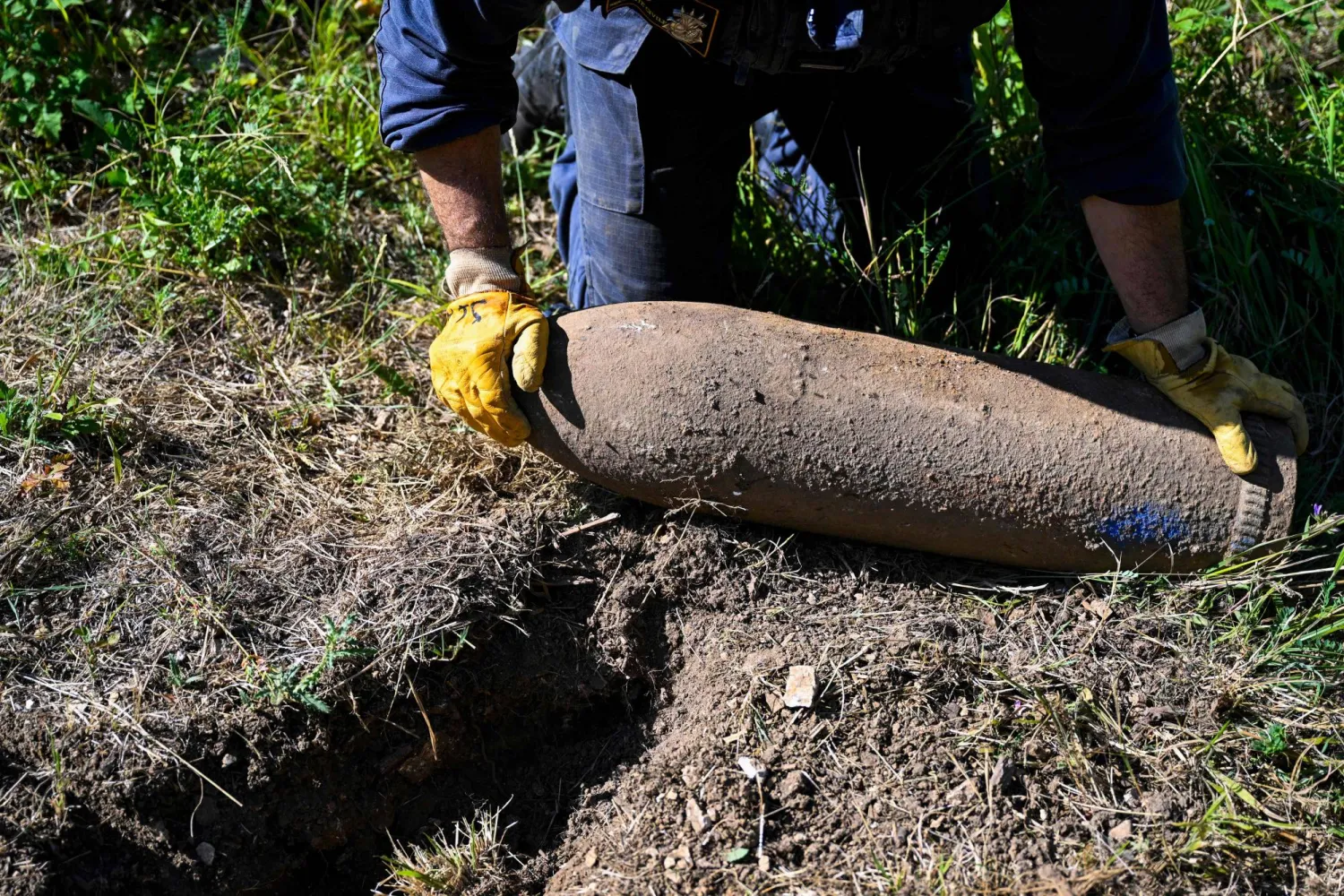
A member of Metz' mine-clearing center, Civil Protection Mine Clearance Task Force (Groupement d’Intervention du Déminage / GID) recovers a WWI German 22cm shell reported by the ONF (Office National des Forêts) in the area of Douaumont, northeastern France on July 8, 2026. (AFP)
TT

European Wildfires Reveal a Hidden Danger: Buried Bombs and Mines from WWI and WWII

A member of Metz' mine-clearing center, Civil Protection Mine Clearance Task Force (Groupement d’Intervention du Déminage / GID) recovers a WWI German 22cm shell reported by the ONF (Office National des Forêts) in the area of Douaumont, northeastern France on July 8, 2026. (AFP)

The wildfires burning across Europe this summer have exposed a potentially deadly threat lurking beneath the blackened landscape: rusty bombs and mines from World War I and II that threaten crews responding to the flames.

Some of the weapons have exploded in the intense heat. Blasts have been reported in France, Belgium, Germany and the Netherlands, where a bomb-disposal team was dispatched to check a forest threatened by flames near a site of fierce fighting in the Limburg province in 1944.

Fueled by climate change, the fires and explosions show that the continent’s “climatic luck” is running out, said Sarah Njeri, a peace and conflict scholar at London’s School of Oriental and African Studies. Steady temperatures and predictable rainfall once ensured that most buried weapons stayed dormant.

“Climate change is now doing the work of unburying and reactivating what was previously stable,” Njeri said. Fires can ignite old munitions but can also burn away the scrub and brush that hides them.

This wildfire season was supercharged by heavy rains in January that spurred vegetation growth, which became kindling when the summer heat arrived. Those temperatures, combined with drought conditions, low humidity and stiff winds, offered an ideal environment for fire, according to a study issued last month by the World Weather Attribution group.

Flames chewed up old battlefields and set off buried explosives

As they advanced, the flames moved over territory that has long been known to hold unexploded weapons, a lethal legacy that lingered long after the guns fell silent.

In a forest in tinder-dry France, a massive wildfire outside the southwestern city of Bordeaux uncovered a cache of what is believed to be World War II-era ammunition.

In the eastern Belgian province of Liege, Gov. Hervé Jamar said “a few sporadic detonations" were recently heard and that emergency services were adapting to account for munitions buried in a fire area. He said no fire crews were in danger, but local media published photos of a firefighter handling a rusted bomb.

During World War II, booby traps, bombs and mines were sprinkled throughout the province's dense peat-bog forest known as the High Fens. In the first four years after Germany’s surrender in 1945, the munitions killed six civilians, said Bernard Collard, a local historian who runs the Truschbaum Museum near Belgium's border with Germany that houses a collection of found objects from the war.

“When you go into a forest like this, you are not sure where the explosives are,” he said. He remembers his father detonating a found bomb in a quarry.

The fire in the High Fens, which stretches across the border with Germany, is smoldering atop a much-bloodied battlefield where Nazis fought Allied troops. The Battle of the Bulge was fought in and around the High Fens.

The fire is even closer to the sites of two lesser-known skirmishes along Elsenborn Ridge and in the Hurtgen Forest, which lasted 88 days and killed about 33,000 American and 28,000 German troops.

Every year, Belgium responds to thousands of calls about explosives

Collard is authorized to scan with a metal detector the former battlefields, now forests, pastures and farmland. He has found mortar shells, machine guns, helmets, cigarette cases, and once, a human skeleton.

“You never know what you might come across, and you shouldn’t take it lightly,” Collard said while standing in a field that was once a blood-soaked site. Nearby, blueberry bushes cover old foxholes, trenches and deep craters from artillery fire.

He frequently works with the Belgian demining squad. “It’s part of our history. We live with it,” Collard said.

Unexploded ordnance is even more dangerous around wildfires because heat can trigger the explosives, said Jonas Tepe, a spokesperson for North Rhine-Westphalia, just across the border in Germany.

The Belgian Ministry of Defense said it receives requests from the region about every week to assist in disarming explosives, yet it does not consider the area a “hot spot” compared to elsewhere in Belgium. Such requests are even more common in the west, where farmers in towns such as Ypres — infamous for harrowing trench warfare in World War I — call the annual tilling of the soil “ the iron harvest ” because it turns up so many war remnants.

Every year across the nation, Belgium’s Explosive Ordnance Disposal and Destruction Service responds to more than 3,000 calls and disposes of 200 to 250 tons of munitions left over from both world wars.

Flames are not the only threat

Drought has also helped to lay the past bare by shrinking rivers and lakes to reveal old weapons.

In Slovakia, the Danube River fell and exposed two naval mines that police pulled out of the water and buried in a trench for a controlled demolition. Authorities in Hungary closed Budapest's Margaret Bridge after a bomb dating from World War II emerged at its base in receding water.

As the Rhine dried up, German authorities also found a WWII-era bomb.

Christina Greene, a researcher at the University of Arizona who, with Njeri, wrote an article on Europe’s wildfires and unexploded ordnance risk, said “the legacy of war keeps creeping up” because of climate change.

“It's reliving the legacies of war and conflict in a way that we haven't had to deal with in a while in certain places."



Green Riyadh Launches Tree-Planting and Cleanup Campaign

File photo of the Saudi capital Riyadh - File/AAWSAT
TT

Green Riyadh Launches Tree-Planting and Cleanup Campaign

File photo of the Saudi capital Riyadh - File/AAWSAT

Green Riyadh, one of the programs overseen by the Royal Commission for Riyadh City, has launched a tree-planting and cleanup campaign at Shuaib Umm Qasr to coincide with Saudi National Day celebrations, the Saudi Press Agency said Sunday.

The campaign will be held on September 23 from 1:00 p.m. to 5:00 p.m. and is open to male and female volunteers from all segments of society. Participants will receive volunteer certificates in recognition of their active contributions to environmental service.

The initiative aims to attract volunteers to participate in tree planting and cleanup activities, thereby promoting community engagement and a culture of volunteerism while supporting national efforts to protect the environment and achieve sustainability.


82-year-old Dies after Beach Fight in Greece over Sun Lounger

Tourists from a nearby hotel watch military helicopters fly overhead during Medusa 15, a joint military exercise led by Greece and Egypt, at Maleme on the Greek island of Crete, Friday, Sept. 18, 2026. (AP Photo/Thanassis Stavrakis)
TT

82-year-old Dies after Beach Fight in Greece over Sun Lounger

Tourists from a nearby hotel watch military helicopters fly overhead during Medusa 15, a joint military exercise led by Greece and Egypt, at Maleme on the Greek island of Crete, Friday, Sept. 18, 2026. (AP Photo/Thanassis Stavrakis)

An 82-year-old man died Sunday after he got into a fight over a sun lounger on a beach in Greece near Athens, local media reported.

The octogenarian had a dispute with a 76-year-old man and a 21-year-old woman over the sun lounger, with the argument degenerating into a scuffle between the two men, according to police, the ANA news agency and ERT state television channel reported.

The 82-year-old, badly hurt, was transported to hospital from the Vouliagmeni beach resort area where the argument broke out. He was later declared dead at the hospital, AFP said.

Both the 76-year-old man and the 21-year-old woman were arrested, ANA said, with police investigating what happened.


10 Lions Die in Suspected Poisoning at Tanzania Wildlife Reserve

Lions are seen in their counpound at the Artis Amsterdam Royal Zoo in Amsterdam, Netherlands in this handout photo released to media on January 28, 2021. Artis Amsterdam Royal Zoo/Handout via REUTERS
TT

10 Lions Die in Suspected Poisoning at Tanzania Wildlife Reserve

Lions are seen in their counpound at the Artis Amsterdam Royal Zoo in Amsterdam, Netherlands in this handout photo released to media on January 28, 2021. Artis Amsterdam Royal Zoo/Handout via REUTERS

Ten lions were found dead in Tanzania's Ngorongoro wildlife reserve this week and preliminary findings suggest they may have been poisoned, the area's management authority said.

The deaths raise concerns over the conservation of lions in one of Africa's most renowned wildlife ecosystems. Poisoning has been a recurring threat to large ⁠carnivores across parts ⁠of East Africa, often linked to conflicts between predators and livestock owners.

The lions were discovered on September 18 in the Ndutu area of Endulen Ward in Arusha ⁠region, Reuters quoted the Ngorongoro Conservation Area Authority as saying in a statement released late on Saturday.

"Preliminary findings suggest the animals may have died after ingesting poison," the authority said, adding that it had launched an investigation to determine the cause and identify those responsible.

The Ngorongoro Conservation Area, a UNESCO ⁠World ⁠Heritage Site in northern Tanzania, is one of the country's leading tourism attractions. It is home to a wide range of wildlife, including lions, elephants, buffaloes and endangered black rhinos.

Last month, police arrested four suspects in an investigation into the deaths of 18 elephants across the border in Kenya.