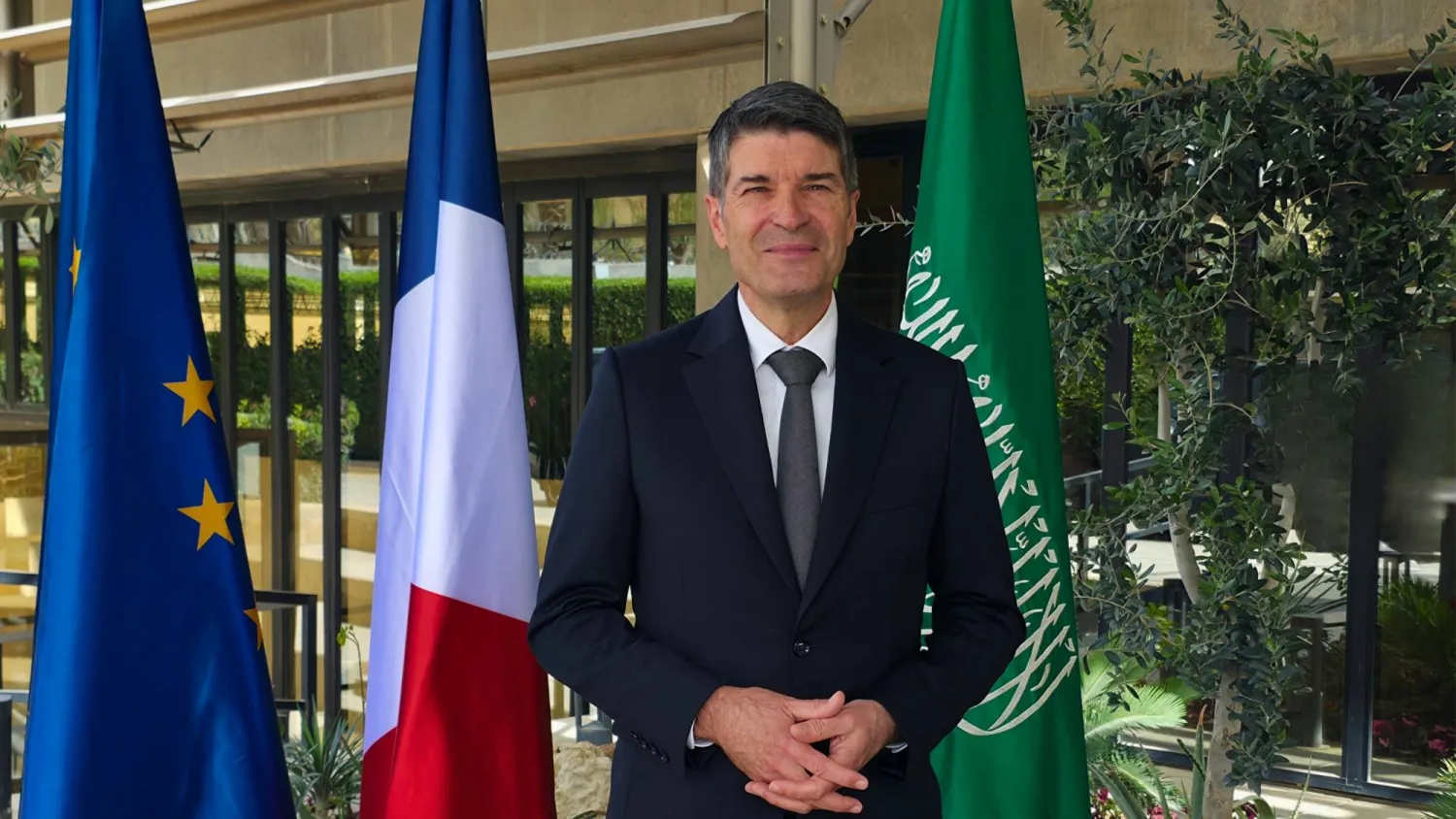
French Ambassador to Asharq Al-Awsat: Mohammed bin Salman’s Visit Paves Way for New Phase of Strategic Partnership

Patrick Maisonnave, French Ambassador to Saudi Arabia (Asharq Al-Awsat).
TT

French Ambassador to Asharq Al-Awsat: Mohammed bin Salman’s Visit Paves Way for New Phase of Strategic Partnership

Patrick Maisonnave, French Ambassador to Saudi Arabia (Asharq Al-Awsat).

A senior French official stressed that Saudi Crown Prince Mohammed bin Salman’s visit to France on Sunday means, in short, that Riyadh and Paris are entering a new phase of a genuine strategic partnership. He said the visit will address diplomacy, security, defense, investment, energy, culture, technology, and education.

Patrick Maisonnave, the French ambassador to Saudi Arabia, told Asharq Al-Awsat that the momentum is now being further strengthened through the visit of Crown Prince and Prime Minister Mohammed bin Salman to France and the first meeting of the French-Saudi Strategic Partnership Council.

According to Maisonnave, the council is particularly important because it provides a permanent institutional framework for this political ambition, allowing both countries to set priorities, measure progress, and develop long-term cooperation across the main pillars of the relationship.

He added that as the two countries seek to keep pace with profound geopolitical, economic, and technological changes, Mohammed bin Salman’s visit demonstrates a shared determination to move from a very strong bilateral partnership to a comprehensive strategic partnership.

He continued by saying that the readiness of the two leaderships to work together is not limited to bilateral issues, but also extends to regional stability, global challenges, and the major transformations shaping their societies, as the partnership enters a new phase with this visit.

He explained that the transformation Saudi Arabia is undergoing under Vision 2030, together with France’s strengths in sectors such as energy, infrastructure, culture, innovation, artificial intelligence, education, and creative industries, is creating new areas for convergence.

He stressed that the strategic dimension of the partnership lies precisely in this development, moving from a relationship based on strong cooperation to one increasingly grounded in shared objectives, long-term planning, and joint initiatives.

A Convergence Resilient to Challenges

Maisonnave affirmed that Riyadh and Paris have a well-established partnership and mutual trust that enable them to overcome the geopolitical challenges facing the region. He noted that the bilateral convergence translates into close coordination on the region’s most prominent crises.

He added that Paris and Riyadh are working together to support a two-state solution for Israelis and Palestinians and create the necessary political conditions for lasting peace. The two countries also share an interest in Yemen’s stability and in protecting freedom of navigation and the security of strategic maritime routes.

According to Maisonnave, the two countries support efforts to end the devastating war in Sudan and preserve the country’s unity and institutions. They also support Syria’s sovereignty, unity, and recovery, as well as the establishment of a stronger Lebanese state capable of exercising its authority, while reducing external interference and the influence of non-state armed groups.

He continued by saying that France and Saudi Arabia naturally have their own interests and perspectives, but have developed the ability to engage in frank dialogue, particularly during periods of regional tension and profound international changes. This has enabled the relationship not only to endure, but also to continually reinvent itself.

Ambassador Maisonnave said the distinctive nature of the Saudi-French relationship lies in its rare combination of historical depth, political trust, and a shared ability to look to the future. Over the past century, he explained, the two countries have built a relationship based on mutual respect, continuous dialogue, and, most importantly, strategic autonomy.

He added that the relationship is no longer defined solely by its history or traditional areas of cooperation. Instead, it is increasingly focused on what the two countries can build together over the coming decades. French President Emmanuel Macron’s visit to Saudi Arabia in December 2024 was a landmark moment that gave new political momentum to bilateral relations.

He attributed the resilience of bilateral relations since their establishment in 1926 to the fact that their strength lies in a century of accumulated trust, sustained political engagement at the highest levels, and a determination to adapt the partnership to each new historical period, despite some turning points along the way.

Maisonnave added that since diplomatic relations were established in 1926, France and Saudi Arabia have steadily expanded the scope of their cooperation. The relationship has accompanied the transformation of the Kingdom itself while responding at the same time to successive regional and international challenges. After 100 years, he said, the relationship is broader and deeper than at any previous stage in its history.

He continued by saying that this continuity is particularly evident today in diplomatic cooperation. At a time when the Middle East is going through one of its most significant periods of transformation, France and Saudi Arabia share a fundamental objective: preventing instability from becoming permanent and restoring the priority of diplomacy, state sovereignty, and international law.

Of particular importance, according to Maisonnave, is that this diplomatic coordination is developing alongside an equally deep economic and societal partnership. France is accompanying the transformation taking place in Saudi Arabia under Vision 2030 in areas ranging from investment and energy to culture, tourism, technology, education, and human capital development.

In his view, this gives the relationship an unprecedented scope, noting that strategic dialogue at the highest political levels is reinforced by growing ties between the two countries’ economies, institutions, and societies.

He also noted that the centenary of the establishment of diplomatic relations represents more than a commemoration of the past. It symbolizes the transition from one chapter to another in the history of the relationship.

Maisonnave explained that the first 100 years established and laid the foundations for a relationship based on trust. He stressed that the next 100 years must build on this legacy, making France and Saudi Arabia not merely partners in a changing world, but partners in shaping the future.


Military Helicopter Crashes in Southern Türkiye, Killing 4

Rescuers and security officers examine the wreckage of an ambulance helicopter after it collided with a hospital building and crashed into the ground, in Mugla, Türkiye, December 22, 2024. REUTERS/Kenan Gurbuz Purchase
TT

Military Helicopter Crashes in Southern Türkiye, Killing 4

Rescuers and security officers examine the wreckage of an ambulance helicopter after it collided with a hospital building and crashed into the ground, in Mugla, Türkiye, December 22, 2024. REUTERS/Kenan Gurbuz Purchase

A military helicopter crashed in southern Türkiye on Thursday, killing four personnel, the Turkish Defense Ministry said.

The aircraft crashed for unknown reasons in Samankoy, a neighborhood on the southern outskirts of the provincial capital Malatya in the early evening.

“As a result of an accident involving our S-70 helicopter in Malatya, for a reason not yet determined, 4 of our heroic comrades-in-arms aboard the helicopter were martyred,” the ministry said in a social media post.

“We pray that God will have mercy on our martyrs and offer our condolences and prayers for strength to their grieving families, our Turkish Armed Forces, and our noble nation.”

According to The Associated Press, TV images showed the wreckage of the helicopter burning near a cluster of buildings in an otherwise open area of land. The Demiroren News Agency reported that flames had spread to a nearby house but reported no casualties on the ground.

Police, firefighters and medical teams were dispatched to the crash.


Trump Says US Does Not Need Iran Deal

US President Donald Trump and Vice President JD Vance look on during a Veterans Day ceremony at Arlington National Cemetery in Arlington, Virginia, US, November 11, 2026. REUTERS/Kylie Cooper
TT

Trump Says US Does Not Need Iran Deal

US President Donald Trump and Vice President JD Vance look on during a Veterans Day ceremony at Arlington National Cemetery in Arlington, Virginia, US, November 11, 2026. REUTERS/Kylie Cooper

President Donald Trump said on Thursday the US does not need a deal with Iran and directed Vice President JD Vance, who has played a role in efforts to resolve the war, to focus "his complete and total attention" on alleged crime and corruption in Democratic-run cities and states.

Trump's directive came a day after the Wall Street Journal reported that Vance was considering face-to-face peace talks with a hard-line Iranian security official and a week after the vice president blamed the costly war with Iran for Republicans' midterm elections drubbing.

Trump's comments marked a shift in tone after he had suggested ⁠in recent weeks ⁠that Iran would be more willing to strike a deal in the eight-month conflict after the US elections.

"We don’t need a deal with Iran. Those days have long since passed. We’ve got their money, Hundreds of Billions of Dollars, and we’ve got their Strait!" Trump wrote on social media, referring to the Strait of Hormuz, the critical ⁠shipping route near Iran where the US military has been working to secure safe passage for international shipping.

Trump said he asked Vance to focus instead on a domestic issue the president previously put in his portfolio: leading an effort targeting alleged fraud in Democratic-run cities and states throughout the US.

"Our Budget could be quickly BALANCED with the correction of this large-scale criminal activity. CORRUPTION is in the Democrat Leadership’s blood!" Trump wrote on Thursday.

Vance's office did not immediately respond to a request for comment.

The Wall Street Journal reported on Wednesday that ⁠Vance was considering ⁠meeting with a senior Iranian security official, a move that would have put Vance at the center of peace negotiations. Reuters has not confirmed the potential talks.

Vance, who is viewed as a leading contender for the 2028 Republican presidential nomination, distanced himself from the war last week after Republicans' midterm election rout by Democrats.

The vice president blamed the costs of the Iran war in part for the party's losses. He also said an earlier recommendation to end the war was "sound advice."

Trump responded to Vance's position by defending the war as necessary to stop Iran from obtaining a nuclear weapon.


Iran: Four Tankers Struck by Explosions in Strait of Hormuz

Iran: Four Tankers Struck by Explosions in Strait of Hormuz
TT

Iran: Four Tankers Struck by Explosions in Strait of Hormuz

Iran: Four Tankers Struck by Explosions in Strait of Hormuz

Four oil tankers were hit by explosions in the Strait of Hormuz, Iran's military said on Thursday, adding that the vessels had ignored warnings and entered what it considers restricted areas of the strategic waterway.

Tankers are still facing attacks across the strait, despite a rebound in traffic and expectations of a de-escalation in the war between the United States and Iran that have been reflected in falling oil prices.

Iran's Revolutionary Guards Navy said two supertankers were disabled by explosions on Wednesday after they ignored ⁠warnings against using what ⁠it said was an "unauthorized route".

Reuters could not immediately verify the Iranian account.

The two vessels "exploded after hitting naval mines", Iranian state media reported, broadcasting what it said was video footage of the incidents.

Iran's army later said two other tankers had hit mines on Thursday afternoon while sailing through the eastern Strait of Hormuz after ignoring ⁠warnings and disabling their radar systems, state TV reported. The tankers entered a restricted area and subsequently caught fire, it reported.

Earlier in the US-Israeli war with Iran, which began in February, the IRGC Navy announced its attacks on tankers. More recently, however, it has instead reported that vessels have caught fire after hitting naval mines while traversing the southern part of the strait, which it has declared an unauthorized route.

In several of those cases, the United Kingdom Maritime Trade Operations agency (UKMTO) has said vessels had been struck by unknown projectiles.

The ⁠UKMTO said ⁠in reports on Thursday that a vessel was hit by an unidentified projectile about 14 nautical miles northwest of the UAE emirate of Ras Al-Khaimah on Wednesday while exiting the strait, causing a fire in its engine room.
Firefighting efforts were under way and all crew had been evacuated, it added.

At least 10 ships were hit in the first 10 days of November, after 37 attacks in October, which was the highest monthly tally since the conflict began in late February, according to data from the Washington Institute for Near East Policy.