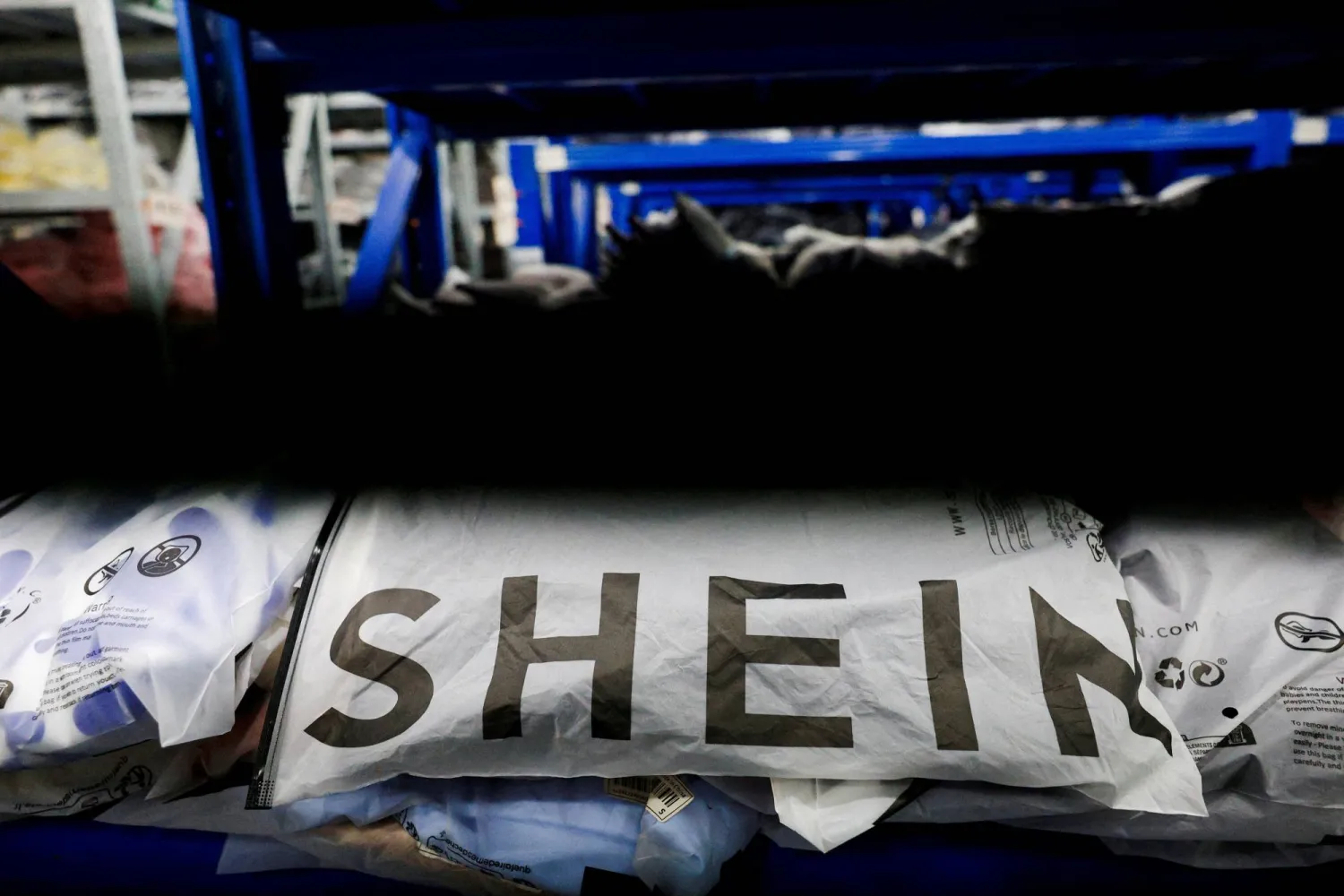
Shein Grapples with EU Backlash, But Clients Keep Coming

FILE PHOTO: Packs of clothing are displayed at a garment factory for Shein in Panyu District, Guangzhou, Guangdong province, China, July 27, 2026. REUTERS/Go Nakamura/File Photo
TT

Shein Grapples with EU Backlash, But Clients Keep Coming

FILE PHOTO: Packs of clothing are displayed at a garment factory for Shein in Panyu District, Guangzhou, Guangdong province, China, July 27, 2026. REUTERS/Go Nakamura/File Photo

Shein's meteoric growth has made it a lightning rod for critics of ultrafast fashion in Europe, where officials are trying to rein in its operations in the name of social and environmental responsibility.

The probes, financial penalties and fierce debates have dampened but not fully curbed the enthusiasm of millions of clients in a key market for the China-founded online juggernaut.

The company's $1.7 billion stock market listing, announced on Monday, aims in particular to juice its international expansion, AFP said.

- Short-lived Paris store -

Starting in 2012, Shein began online sales of its continually renewed stock of tops, dresses and other items, drastically undercutting the prices of its rivals -- to say nothing of traditional clothing stores.

Its European customer base rose to 156 million average monthly users by the end of last year, making Shein one of the continent's biggest e-commerce platforms alongside China's AliExpress (193 million users), and Amazon (around 180 million).

In November, the group made waves with its first-ever physical outlet, a dedicated space in the storied BHV department store in Paris.

Hundreds of customers lined up on its opening day, and dozens more people gathered to protest, requiring a heavy police presence to keep the tense situation from getting out of hand.

Demonstrators slammed what they called inhumane working conditions at Shein's suppliers, the environmental costs of selling clothes not made to last, and unfair competition against brick-and-mortar retailers struggling to stay open.

The company says it holds its suppliers to strict compliance standards and does not tolerate forced labor.

- Sex doll scandal -

It did not help that just a few days before the Paris opening, France's consumer protection agency said it had discovered childlike sex dolls for sale on Shein's platform.

Accusing the company of fostering child pornography, French officials asked the European Commission to open an inquiry under the bloc's wide-reaching Digital Services Act.

The EU investigation that opened in February 2026 targeted the sale of illicit goods "including child sexual abuse material" as well as what it alleged was Shein's "addictive design".

In June, French authorities imposed two fines on Shein totaling more than 22 million euros ($25 million), citing problems with product traceability, environmental labelling and delivery times.

The next month it secured an EU-wide halt on the sales of items with crocodile logos -- deemed a counterfeit of France's famed Lacoste brand of polo shirts.

Overall, Shein has paid over 210 million euros in various French fines over the years, and Italy has also imposed fines alleging misleading environmental claims.

In June, the BHV's new owners said they would part ways with Shein, calling the decision to welcome a physical outlet a "strategic error".

- Regulatory pushback -

Shein has called the penalties "disproportionate and discriminatory", while China's commerce ministry says they violate World Trade Organization rules.

That did not stop the European Union from imposing duties on the billions of small, inexpensive retail parcels entering the bloc each year -- most of them from Chinese e-commerce sites.

Since July, a duty of three euros per item applies to packages valued at less than 150 euros, similar to a move last year by US President Donald Trump's administration against products originating in China.

But the EU fee applies to the type of item imported, not the number. So a person buying five T-shirts pays just three euros, but someone buying a T-shirt, jeans and socks would pay nine euros.

Brussels says the duty helps compensate for overwhelmed customs authorities given the popularity of e-commerce, in particular for clothes and other items from China and elsewhere that do not comply with EU standards.

According to the head of the European Parliament's trade committee, Bernd Lange, the number of small parcels from abroad have more than quadrupled to 5.88 billion since 2022.

Starting in November, the EU will impose a still-undetermined handling fee on such parcels.

It is far from clear how effective the duties will be, especially as online giants like Shein could build warehouses in Europe to limit the impact.

After France imposed its own duty of two euros on such parcels this year -- before the EU system kicked in -- the customs office estimated it brought in around 2.3 million euros per month.

That was far below the 33 million euros per month the government had expected in the 2026 budget.


Paolo Bulgari, Italian Jeweler Who Turned a Family Business into Global Luxury Brand, Dies at 89

 Paolo Bulgari leaves his residence in Rome, April 14, 1975. (AP)
Paolo Bulgari leaves his residence in Rome, April 14, 1975. (AP)
TT

Paolo Bulgari, Italian Jeweler Who Turned a Family Business into Global Luxury Brand, Dies at 89

 Paolo Bulgari leaves his residence in Rome, April 14, 1975. (AP)
Paolo Bulgari leaves his residence in Rome, April 14, 1975. (AP)

Paolo Bulgari, the grandson of a Greek silversmith who helped transform the family jewelry business into a global luxury brand synonymous with Italian glamour and design, has died. He was 89.

His family announced his death Saturday, describing him as “the greatest jeweler of our time” and praising his humanity and entrepreneurial talent.

Bulgari presided for decades over a brand celebrated by supermodels, Hollywood stars and collectors for its bold designs and distinctive use of color.

Born in Rome in 1937, he was the grandson of Sotirios Voulgaris, who founded the jewelry business after leaving Greece. Originally from Paramythia, a mountain village in the Epirus region of northwestern Greece renowned for its silver jewelry, Voulgaris fled Ottoman rule and settled in Naples before opening a shop in Rome, adapting both his craft and his family name to his new home.

Paolo Bulgari joined the family business shortly after leaving school. Working alongside his father, Giorgio, he initially focused on precious stones, developing an expertise in gemstones that would inform his work as a designer and businessman throughout his career.

Turning away from the delicate aesthetic associated with Parisian jewelry houses, the Bulgari family embraced bold gemstones, rich yellow gold, generous proportions and unexpected combinations of color. Drawing inspiration from ancient Rome and Italy’s artistic heritage, the distinctive style helped set the brand apart internationally.

Alongside his brother Nicola and nephew Francesco Trapani, Bulgari led the company’s expansion into major luxury markets, opening stores in New York, Paris, Geneva and Monte Carlo. The business diversified beyond jewelry into watches, perfumes, leather goods and, eventually, hotels.

Heading the group since the mid-1980s, Bulgari guided the company through a period of significant international growth. Its jewelry was a fixture on celebrities spanning from Elizabeth Taylor to Zendaya. Tall and silver-haired, he occasionally appeared alongside the stars wearing his creations, maintaining a characteristically reserved presence.

In 2011, the family sold a controlling stake in the company to French luxury conglomerate LVMH in a deal valued at more than $5 billion, ending decades of direct family control.

Despite his association with the glamorous world of international luxury, Bulgari frequently referred to his family’s humble start. In 2019, he and his wife established the Paolo Bulgari Foundation to support young people through schooling and job training in disadvantaged neighborhoods on the outskirts of Rome.

“Many people don’t know it,” he wrote in the foundation’s introduction, “but at the origin of my surname there is a story of migration.”

His funeral will be held Monday at the Basilica of Santa Croce in Rome.


L'Oréal-led Group Reportedly Eyes Up to 15% Stake in Armani

A Giorgio Armani ad hangs behind broken glass during a demonstration organised by labor unions as part of nationwide protests called by the "Yellow Vests" movement joined by French high school and university students against the cost of living and rising fuel prices, in Paris, France, October 31, 2026. REUTERS/Pedro Nunes
TT

L'Oréal-led Group Reportedly Eyes Up to 15% Stake in Armani

A Giorgio Armani ad hangs behind broken glass during a demonstration organised by labor unions as part of nationwide protests called by the "Yellow Vests" movement joined by French high school and university students against the cost of living and rising fuel prices, in Paris, France, October 31, 2026. REUTERS/Pedro Nunes

French cosmetics group L'Oréal is set to lead a consortium of investors interested in buying a combined 15% in Italian fashion house Armani, with EssilorLuxottica set to join, the Corriere della Sera said on Thursday.

Citing sources, the Italian daily said L'Oréal aims to acquire around 10% of Armani, while EssilorLuxottica could take a stake of up to 5%.

According to Reuters, it added that luxury ⁠giant LVMH was ⁠no longer involved in the discussions.

Negotiations are well under way but no deal has been reached as discussions over valuation and other terms are continuing, the paper said.

Reuters reported this month ⁠that heirs of late designer Giorgio Armani, who now control the eponymous fashion empire, favor an eventual stock market listing over a sale to a large industry player, as they pursue an initial minority stake deal.

Armani, who died at 91 last year, said in his will his heirs should sell about 15% of ⁠the ⁠company between 12 and 18 months after his death, followed by the disposal of a further stake of 30% to 54.9% or a bourse listing.

In his will, he explicitly mentioned long-standing licensing partners L'Oréal, EssilorLuxottica and LVMH as preferred buyers, though without ruling out other industry players of "equal standing.”

Armani, L'Oreal, EssilorLuxottica and LVMH were not immediately available for comment.


JD Sports Cuts Profit Outlook Again as Third-quarter Sales Fall

A logo is seen outside the newly renovated JD Sports store at Westfield Stratford City in London, Britain, July 30, 2024. REUTERS/Hollie Adams/File Photo
TT

JD Sports Cuts Profit Outlook Again as Third-quarter Sales Fall

A logo is seen outside the newly renovated JD Sports store at Westfield Stratford City in London, Britain, July 30, 2024. REUTERS/Hollie Adams/File Photo

British sports and fashion retailer JD Sports cut its profit outlook for the second time in four months on Thursday after a 2.6% fall in third-quarter like-for-like sales, though trading did improve in its key North American market.

JD Sports forecast a year to end-January 2027 profit before tax and adjusting items of £700 million to £750 million ($919-$985 million). Its previous guidance was £700 million to £800 million.

Prior to Thursday's update, ⁠analysts were on ⁠average forecasting £723 million. It made £852 million in 2025/26.

Group organic sales for the 13 weeks to October 31 fell 1.1%while like-for-like sales fell 2.6%, having been down 3.1% in its second quarter, Reuters reported.

Like-for-like sales in the ⁠key North America market, where the group makes over a third of total sales, fell 2.2%, having been down 6.8% in the second quarter.

Like-for-like sales fell 2.7% in Europe, 2.6% in the UK and 5.3% in Asia Pacific.

Saw resilient sales trends in apparel and accessories, despite unseasonably warm weather delaying autumn/winter demand.

Footwear remained soft given ongoing ⁠product ⁠cycle evolution, amidst a continued promotional market.

Trading in Europe was affected by civil unrest, it said.

The outcome also reflects cost-of-living pressures on JD's core young and less affluent customer base and a lack of innovation from Nike - JD's most important brand partner which is struggling to overhaul its business.

Shares in JD are up 12% so far this year but down on a two-year basis.