

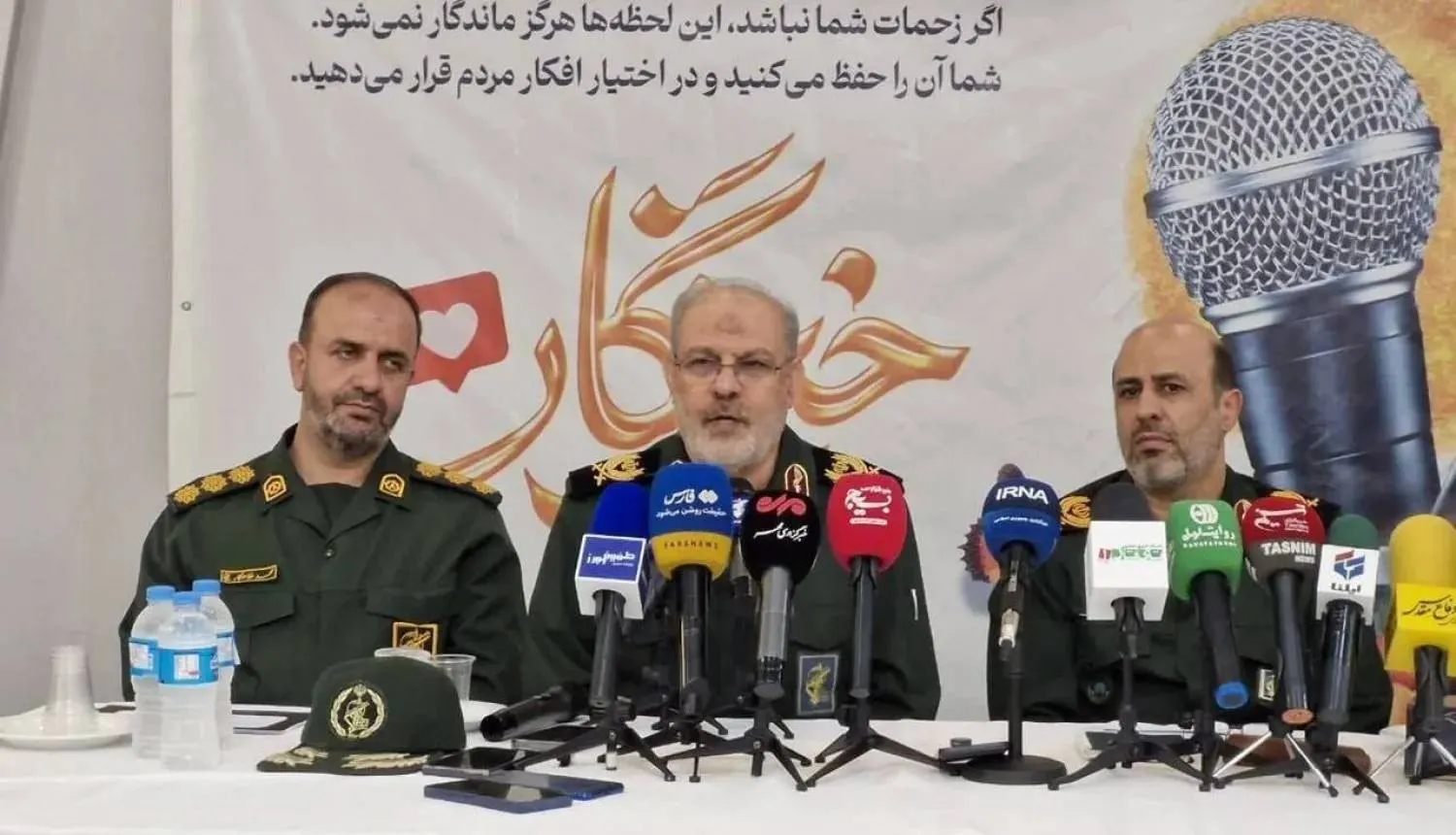

IRGC Says it Prepared Scenarios to Avoid US Sanctions

The Iranian Revolutionary Guard Corps (IRGC) spokesman, Hossein Mohebi (center), speaks at a press conference in Kharg, west Tehran (IRNA)
TT

IRGC Says it Prepared Scenarios to Avoid US Sanctions

The Iranian Revolutionary Guard Corps (IRGC) spokesman, Hossein Mohebi (center), speaks at a press conference in Kharg, west Tehran (IRNA)

Tehran has prepared economic scenarios, including expanding trade networks with regional allies to bypass tightening US sanctions, Hossein Mohebi, the Iranian Revolutionary Guard Corps (IRGC) spokesman said on Sunday, adding that the results of the new measures would become evident in the near future.

His comments came shortly before US Secretary of the Treasury Scott Bessent announced imposing new sanctions on Iran at dawn Monday, described as “the toughest in history.”

Speaking at a press conference on Sunday, Mohebi said: “We have scenarios to counter the adverse effects of the enemy’s war and can easily establish economic relations with countries.”

Cited by Tasnim, the IRGC spokesman said Iran is maintaining economic interactions “right under America’s nose” and bypassing US pressure, and that the results would become evident in the near future.

Mohebi, however, offered no specifics regarding nations, firms, or financial conduits used to bypass US restrictions, asserting only that Iran maintains broad alternative economic plans.

Last week, US President Donald Trump threatened “tremendous economic consequences” on any nation that does business with Iran, without offering details.

Mohebi said the economic warfare is nothing new, noting that the US has imposed sanctions on Iran’s economic sectors for 47 years.

The current US campaign, he added, is primarily aimed at shaping public perceptions and creating the belief that Washington is prevailing.

He described Trump’s announcement of a new economic campaign against Iran as an “implicit admission” that Washington had failed militarily.

Mohebi attributed a large part of his press conference to the nature of the ongoing war, saying the US-Iran war is multifaceted and not limited to military operations, but includes the economic and media sectors.

Touching on previous military confrontations with the US, Mohebi said that before the last war, Iranian forces had targeted “between 30 and 40 US warships” inside the Arabian Gulf.

He did not provide details of the names of the ships, the timing of the attacks or the extent of the damage. There is no independent evidence to prove his statements are correct.

The IRGC spokesperson said the US has no warships left in the Arabian Gulf, affirming a major retreat of American forces following the recent regional clashes. “US troops are now deployed 400 kilometers away from the Gulf waters,” he noted.

Addressing Washington, Mohebi said: “You mobilized all your military capabilities to close the Strait of Hormuz, but you couldn't.”

He warned that if Iran faces another threat, it could target energy pipelines, power plants and internet-connected systems.

Mohebi’s comments came as the Strait of Hormuz remains a focal point of the US-Iran conflict following the collapse of a sixty-day ceasefire negotiated in mid-June 2026.



Iran Dismisses US Threat of 'Economic D-day'

FILE - Iran's Ambassador to the International Atomic Energy Agency, IAEA, Kazem Gharibabadi, waits for the start of the IAEA board of governors meeting at the International Center in Vienna, Austria, Nov. 21, 2019. (AP Photo/Ronald Zak, file)
TT

Iran Dismisses US Threat of 'Economic D-day'

FILE - Iran's Ambassador to the International Atomic Energy Agency, IAEA, Kazem Gharibabadi, waits for the start of the IAEA board of governors meeting at the International Center in Vienna, Austria, Nov. 21, 2019. (AP Photo/Ronald Zak, file)

Iran on Monday dismissed Washington's declaration of a massive economic pressure campaign, saying it disproved US claims to have dismantled Tehran's military and nuclear capabilities.

"Your narrative doesn't add up: you say that Iran's military power has been 'dismantled', 100% of its military factories 'destroyed' and its nuclear program 'buried'," Kazem Gharibabadi, deputy foreign minister, said in a post on X.

Yet, he added, "there is a need for 'the largest financial invasion in history' and the mobilization of 'all institutions and powers' of the United States! Is this a victory or an admission of America's defeat?"

Earlier, US Treasury Secretary Scott Bessent wrote in the Financial Times that Washington was launching the "single greatest financial offensive marshalled against an adversary" -- calling it an "economic D-Day".

Bessent posted on X that the measure came after the United States "dismantled Iran's military capabilities, destroyed nearly 100 percent of its military factories, and buried its nuclear program."

He is scheduled to explain the new US sanctions on Iran on Monday.

Meanwhile, Iran's foreign ministry warned countries against joining the US economic campaign. Spokesman Esmaeil Baqaei said taking part would "definitely have its own consequences".

The United States and Israel triggered the Middle East war with a massive wave of strikes against Iran on February 28, triggering Iranian retaliation across the region.

An April 8 ceasefire ended nearly 40 days of intense bombardment, but control over the Strait of Hormuz soon emerged as a key flashpoint in the conflict.

Iran has controlled the vital energy conduit since the war began. Reopening the strait, vital for global oil and gas supplies, has become a US priority, but Tehran insists the waterway will remain closed until Washington lifts its naval blockade on Iranian ports, removes oil sanctions and unfreezes Iranian assets abroad.

Last week, US President Donald Trump announced that Washington would ramp up economic pressure on Iran "on an unprecedented scale."

Washington has urged other governments, including Beijing, to join efforts to further isolate Iran's economy.

In an article published on Monday in Iran's Ettela'at newspaper, Tehran's Foreign Minister Abbas Araghchi said relations with China "have taken on deeper, more structural, and more comprehensive dimensions."

Iran has faced US and international sanctions since the 1979 Iranian revolution.

Trump has repeatedly pursued a "maximum pressure" policy of economic sanctions against Iran, reinstating the approach after returning to office in January 2025 following a similar campaign during his first term.

Iran has repeatedly dismissed the sanctions policy as a failure, insisting that economic pressure and threats will not force it to change course.


US Cancels Joint Marine Drills with SKorea over Iran War

Apache choppers take off at Camp Humphreys in Pyeongtaek, South Korea, 04 March 2024, to join the Freedom Shield 2024 exercise on the first day of the 11-day annual South Korea-US joint drill against North Korean provocations.  EPA/YONHAP
Apache choppers take off at Camp Humphreys in Pyeongtaek, South Korea, 04 March 2024, to join the Freedom Shield 2024 exercise on the first day of the 11-day annual South Korea-US joint drill against North Korean provocations. EPA/YONHAP
TT

US Cancels Joint Marine Drills with SKorea over Iran War

Apache choppers take off at Camp Humphreys in Pyeongtaek, South Korea, 04 March 2024, to join the Freedom Shield 2024 exercise on the first day of the 11-day annual South Korea-US joint drill against North Korean provocations.  EPA/YONHAP
Apache choppers take off at Camp Humphreys in Pyeongtaek, South Korea, 04 March 2024, to join the Freedom Shield 2024 exercise on the first day of the 11-day annual South Korea-US joint drill against North Korean provocations. EPA/YONHAP

The United States cancelled a joint amphibious landing drill scheduled for next month with South Korea, Seoul's Marine Corps said on Monday, after Washington cited constraints on the availability of US forces due to the war in Iran.

The US Marine Corps formally notified its South Korean counterpart in June that force availability would be constrained for the division-level exercise, known as Ssangyong, a South Korean ⁠Marine Corps spokesperson ⁠told a press briefing.

The allies remain in close consultations on resuming the drills, Reuters quoted the spokesperson as saying. He did not specify what measures might be taken to prevent future cancellations or to make ⁠up for lost training opportunities.

US Forces Korea did not immediately respond to a request for comment.

The cancellation follows US President Donald Trump's surprise order to scale back a separate annual joint military exercise that ended last Friday, citing the cost and Seoul's refusal to take part in the Iran war.

Trump also wrote on his Truth Social ⁠platform ⁠that the Ulchi Freedom Shield drills sent "a signal that was totally inappropriate and hostile, to a Country that, as long as Donald J. Trump has been President, has been unthreatening and respectful."

Despite the reduction of the exercises, Pyongyang fired 10 short-range ballistic missiles last week and issued a statement denouncing the exercises.

North Korea has long condemned such joint exercises as rehearsals for invasion.


Oman FM to Visit Iran to Discuss Hormuz Strait

Oman's Foreign Minister Badr al-Busaidi. (Reuters file)
TT

Oman FM to Visit Iran to Discuss Hormuz Strait

Oman's Foreign Minister Badr al-Busaidi. (Reuters file)

Oman's Foreign Minister Badr al-Busaidi will visit Tehran on Tuesday to ‌continue talks between ‌Iran and ‌Oman ⁠on the Strait ⁠of Hormuz, Iran's Foreign Ministry Spokesperson Esmaeil ⁠Baghaei said ‌on ‌Monday.

Al-Busaidi will hold the "ongoing political consultations between the two sides, as two littoral states of the Strait of Hormuz, to help strengthen peace and security in the region," Baqaei added in a statement.

"The visit is aimed at strengthening Iran-Oman bilateral cooperation and al-Busaidi will meet with Iran's Foreign Minister Abbas Araghchi to discuss bilateral and regional issues," he went on to say.

Iran has exerted control over Hormuz, a key waterway for oil and gas shipping, since the outbreak of the war in the Middle East on February 28. It requires vessels to obtain permission and pay transit fees before using the waterway.

The United States wants the strait to return to its pre-war system of free navigation, while US President Donald Trump claims Washington "has total control" over Hormuz, through which around one fifth of the world's oil and LNG exports passed before the war.

Iran and Oman have been in talks to establish a new route through the strait, the only entrance to the Gulf and which separates their two countries, but a deal has not yet been finalized.

Tehran, however, says even if the talks bear fruit, that would not on its own open the waterway unless the US meets Iran's broader demands including the lifting of its blockade on Iranian ports.