

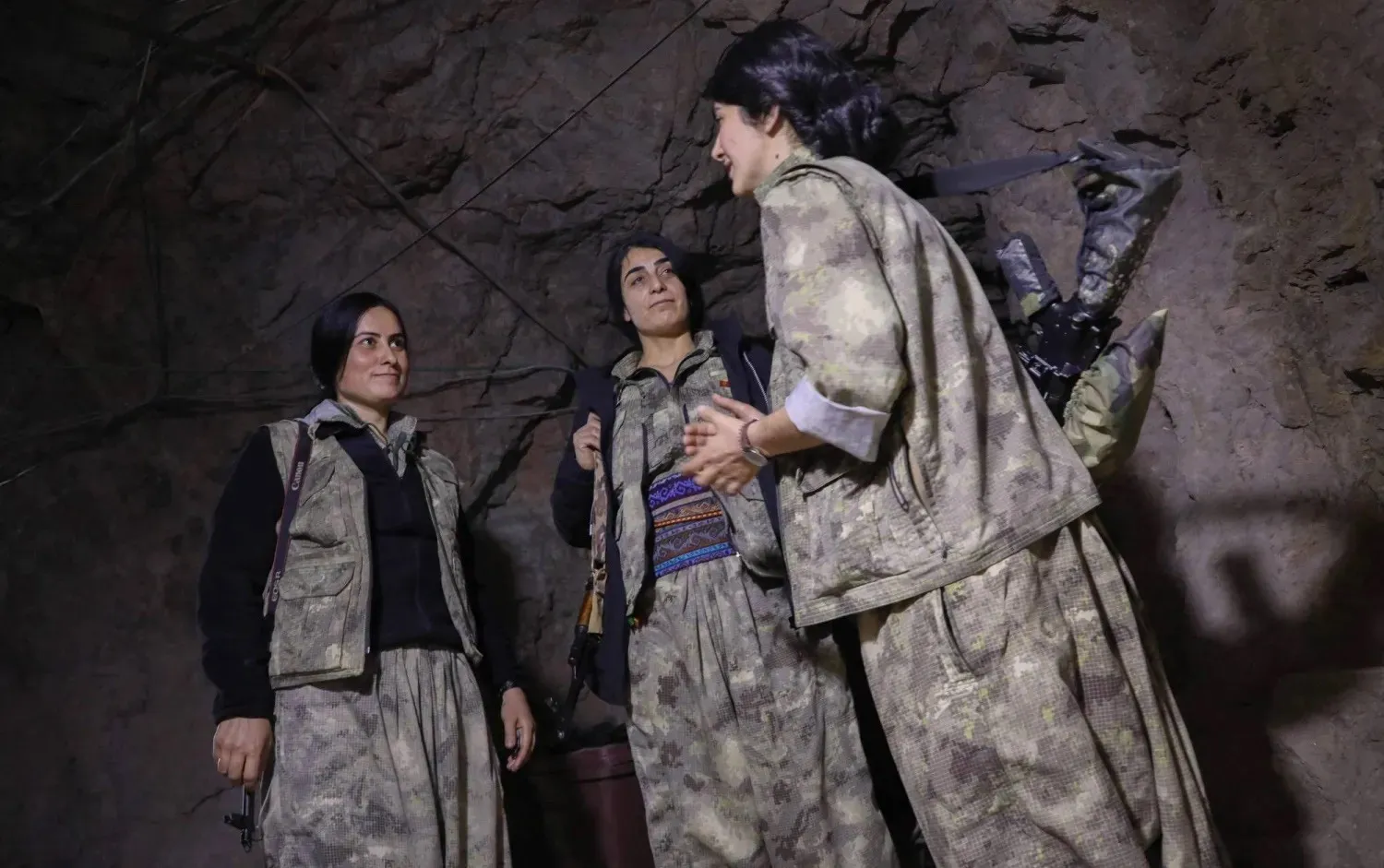

Türkiye Takes First Steps to Integrate PKK Members

A law passed by the Turkish parliament on August 10 allows for the conditional return of PKK members after their weapons have been verified. (AFP)
TT

Türkiye Takes First Steps to Integrate PKK Members

A law passed by the Turkish parliament on August 10 allows for the conditional return of PKK members after their weapons have been verified. (AFP)

Türkiye has begun implementing a law aimed at advancing the peace process based on the dissolution and disarmament of the Kurdistan Workers’ Party (PKK), which the government calls the “Terror-Free Türkiye” process.

The 12-article Law on Strengthening National Solidarity and Social Integration, known as the process’s “framework law,” was passed by parliament on August 10 and approved by President Recep Tayyip Erdogan eight days later.

Implementation begins Monday with the inaugural meeting of the Monitoring, Coordination and Implementation Council, chaired by Vice President Cevdet Yilmaz.

The council includes the justice, defense, interior and foreign ministers, as well as the intelligence chief and the secretaries-general of the presidency and National Security Council. It is tasked with verifying and endorsing the full dissolution and disarmament of the PKK.

Once the council issues a report confirming that process, the National Security Council will formally declare the end of the group’s existence, triggering a six-month process to reintegrate eligible members into Turkish society.

The one-time law will apply to PKK members in northern Iraq’s Qandil Mountains, Iran, Syria and Europe, as well as people prosecuted or wanted on charges of PKK membership and similar offenses.

Initial estimates put the number potentially covered at around 10,000, in addition to roughly 4,000 people held in Turkish prisons. Some 230 senior PKK leaders are excluded and are expected to reside in a safe area in Iraq’s Sulaymaniyah province.

Yilmaz said the council’s first meeting would discuss its working mechanisms and rules, as well as subcommittees to be formed according to the needs of the disarmament and dissolution process.

The council may request the creation of subcommittees to follow up on specific tasks. Parliament will also form a monitoring committee chaired by Speaker Numan Kurtulmus and comprising lawmakers from parties represented in parliament, except the nationalist IYI Party, which opposes the process and rejects any dialogue with imprisoned PKK leader Abdullah Ocalan.

Ocalan’s role

Pervin Buldan, deputy speaker of parliament and a lawmaker from the pro-Kurdish Peoples’ Equality and Democracy Party (DEM Party), said a subcommittee called the “Disarmament and Politicization Committee” would also be established.

Buldan, a member of the Imrali delegation involved in talks between Ocalan and the state, said Ocalan would sit on the committee, which would organize the disarmament process and political integration.

The Turkish government has neither confirmed nor denied plans for such a committee.

Nationalist Movement Party (MHP) leader Devlet Bahceli, whose party is the main ally of Erdogan’s ruling Justice and Development Party (AK Party) in the People’s Alliance, had called in May for an office or committee dealing with politicization, with Ocalan given the role of “peace and politicization coordinator.”

Bahceli has also repeatedly called for Ocalan to be granted the “right to hope,” which could open the possibility of release under a legal principle recognized by the European Court of Human Rights for prisoners who have served 25 years of an aggravated life sentence. Ocalan has spent 27 years in prison on Imrali Island in western Türkiye.

Buldan said the Imrali delegation also raised the need for a women’s committee during its August 13 meeting with Erdogan and in talks with other government officials.

A new Kurdish movement

Buldan described the law as fundamental but said Ocalan regarded it as merely a framework for addressing the Kurdish issue and intended to discuss how it could be developed in subsequent stages.

She quoted Ocalan as saying during his latest meeting with the Imrali delegation on August 1 that he had made considerable efforts to reach the current stage and is seeking to move from armed struggle to political struggle.

According to Buldan, Ocalan has discussed a new party to replace the DEM Party, changes to its charter, program and members, and a broader Kurdish movement. She said those issues would be discussed at a DEM Party congress in September.

How will the weapons be handled?

The pro-government Yeni Safak newspaper reported that a registration and monitoring system would be established to prevent surrendered PKK weapons from being transferred elsewhere or falling into the hands of other terrorist organizations.

Citing unidentified sources, it said weapons and ammunition would be handed to the Turkish Defense Ministry under intelligence supervision. A detailed inventory would be compiled and compared with intelligence reports to determine whether any arms or ammunition were missing.

After technical inspection, surrendered weapons would be divided into three categories.

Unused weapons and ammunition, including conventional arms compatible with NATO standards and technologically advanced drones, could be added to the Turkish military’s arsenal after the necessary inspections.

Weapons incompatible with Turkish military systems, but usable by other countries, could be sold, with proceeds going to the state treasury or exchanged for usable weapons.

Equipment unsuitable for military use, but valuable as raw material, would be melted down and recycled for projects run by Türkiye’s environment, industry and agriculture ministries.



Report: Pakistan’s Munir Spoke to Trump Ahead of Tehran Visit

Pakistan's army chief Asim Munir. (Reuters file)
TT

Report: Pakistan’s Munir Spoke to Trump Ahead of Tehran Visit

Pakistan's army chief Asim Munir. (Reuters file)

Pakistan's army chief Asim Munir spoke with US President Donald Trump last week, according to three Pakistani sources, days before Munir was expected to hold talks in the Iranian capital Tehran on Monday.

The call, which has not been previously reported, came as the US threatened to roll out major economic sanctions targeting Iran and its trade partners.

The White House Office of the Press Secretary did not immediately respond to a request for comment. It was unclear what Munir and Trump ‌discussed.

Pakistan's military ‌confirmed the visit on Monday, saying ‌it was "part ⁠of Pakistan’s efforts ⁠to promote regional peace and stability." Iranian officials had confirmed the visit on Sunday, saying it was focused on security and peace.

Trump last week warned of economic consequences against any country that provided "any type of lifeline to Iran" as he seeks to isolate the country. Iran in turn vowed ⁠to shut down all oil exports from the ‌Gulf.

Pakistan, which has played ‌a key mediating role between the US and Iran this year, has ‌remained a trading partner of Iran throughout the recent ‌fighting.

Munir was expected to meet with people close to Iran's Supreme Leader Mojtaba Khamenei on Monday, one Pakistani source said.

Pakistan's earlier mediation efforts between the US and Iran resulted in an interim peace agreement signed in June. But the Islamabad Memorandum quickly faltered, amid new fighting between Iran and the US that has threatened to spiral into a wider regional conflict in recent weeks.

"There is a trust deficit on both sides," a third Pakistani source said about the US and Iran, adding that Munir's aim was to mitigate the lack of mutual trust on Monday.


Iran Says France's Move to Expel Two Iranian Diplomats 'Illegal'

Iranian Foreign Ministry spokesperson Esmaeil Baqaei (Archive photo – MEHR)
TT

Iran Says France's Move to Expel Two Iranian Diplomats 'Illegal'

Iranian Foreign Ministry spokesperson Esmaeil Baqaei (Archive photo – MEHR)

Iran's foreign ministry said on Monday that France's decision to expel two Iranian diplomats in response to Tehran's ban on two French diplomats was "illegal".

"The action that France took is an illegal action in response to Iran's legal action, and is in no way helpful to bilateral relations," ministry spokesman Esmaeil Baqaei said at a weekly press conference.

Last week, Baqaei said two French diplomats who were briefly arrested in Iran in July over "interference" in Iran's internal affairs "would not be permitted to return".

French Foreign Minister Jean-Noel Barrot responded by saying that two Iranian diplomats in France would be expelled "in the coming days".

Barrot said the French move was a consequence of "intolerable" treatment of the French diplomats, who were briefly detained last month in Tehran.

He said the pair had been targeted by Iranian officials "in flagrant violation of diplomatic immunity".

They had also suffered "an extremely serious act of intimidation" at the hands of Iran's security service, he added.

Baqaei had previously said Paris should apologize for the actions of the French diplomats, which he said had violated the Vienna Convention.


Iran’s Currency Hits New Record Low as US Prepares to Announce More Sanctions

People walk in the Grand Bazaar in Tehran, Iran, August 23, 2026. Majid Asgaripour/WANA (West Asia News Agency) via Reuters
TT

Iran’s Currency Hits New Record Low as US Prepares to Announce More Sanctions

People walk in the Grand Bazaar in Tehran, Iran, August 23, 2026. Majid Asgaripour/WANA (West Asia News Agency) via Reuters

Iran’s currency hit a new record low Monday as Washington prepared to announce new sanctions it said would be an “economic D-Day” and would add further pressure on an economy already battered by previous sanctions and a US naval blockade.

The rial dropped to 2.02 million to the US dollar as trading opened on informal currency markets. Iran’s official Central Bank rate stood at around 1.5 million rial to the dollar, but the informal rate is what most Iranians pay.

The currency had already been under pressure before the US and Israel attacked Iran on Feb. 28, with double-digit inflation and negative growth, but has been hitting new record lows as nearly six months of war have taken an even greater toll.

Still, US President Donald Trump has been unable to win concessions from Iran, which continues to keep a firm grip on shipping through the Strait of Hormuz, the key waterway through which a fifth of the world’s traded oil transited freely before the war began.

Iranian attacks and threats have severely hampered that traffic during the war.