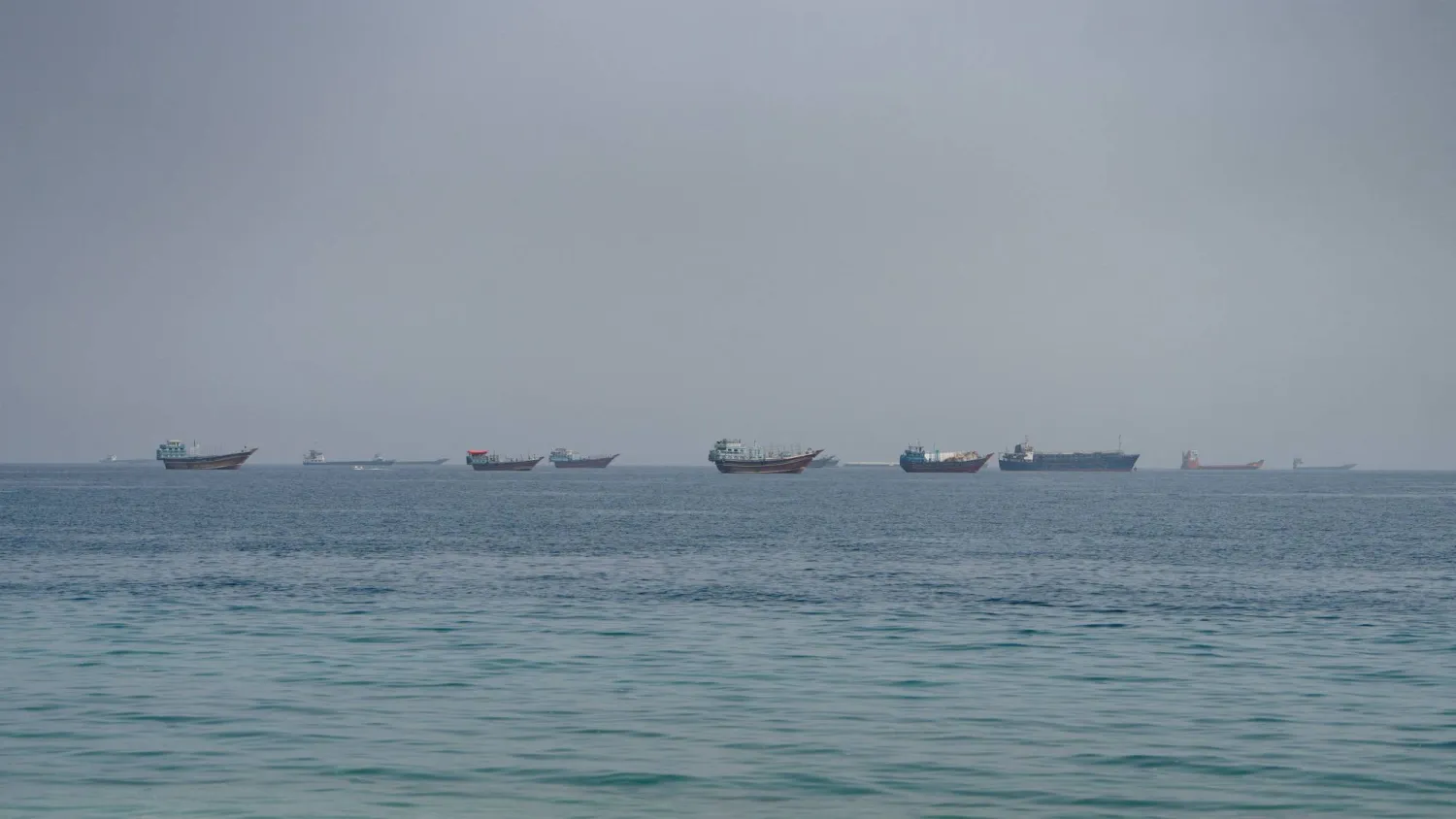
Fewer Than 20 Ships Transited Strait of Hormuz at the Start of the Week

Vessels near the Strait of Hormuz, as seen from Musandam, Oman, August 24, 2026. REUTERS/Stringer
TT

Fewer Than 20 Ships Transited Strait of Hormuz at the Start of the Week

Vessels near the Strait of Hormuz, as seen from Musandam, Oman, August 24, 2026. REUTERS/Stringer

Fewer than 20 commodity vessels transited the Strait of Hormuz at the start of the week, shipping data showed on Monday, as Iranian and US blockades restrict traffic through the chokepoint for energy shipments.

Four vessels crossed the strait on Sunday, initial data from shiptracker Kpler showed by 0228 GMT, with 13 on Saturday. The figures could change as some ships had switched off transponders on their way through.

That compared with Friday's figure of 16 transits, with two empty very large crude carriers (VLCCs) entering the Gulf with the tracking devices switched off, one heading to Iraq and the other to ⁠Bahrain, the data ⁠showed.

A VLCC carrying 2 million barrels of Emirati crude exited the strait on Thursday.

Eight very large gas carriers transited the strait over the past three days, the data showed, according to Reuters, six of them entering empty while the others carried liquefied petroleum gas (LPG) loaded from Iran and exited the Gulf.

Overall traffic volumes remained suppressed ⁠in the week to August 21, as vessels aborted transit plans or switched routes through the strait's north after attacks, the United Kingdom Maritime Trade Operations (UKMTO) agency said in a report.

A total of 89 vessels exited the strait while 103 entered over the seven-day period, the report, based on Automatic Identification System (AIS) data, showed.

"Traffic remains well below normal levels, with AIS-detected transits approximately 90% below pre-conflict baselines and declining since the June 24 to June 26 peak," it added.

Tanker traffic, at 45% of the total, continued ⁠to dominate movement ⁠through the strait, the agency said. Of these, 56% were tankers that carry crude oil, oil products or chemicals while LPG carriers accounted for a further 24%.

Since July 6, the UKMTO has reported 23 incidents of projectile strikes, leading to bridge, engine-room, and structural damage across vessels in the strait and its vicinity.

A total of 24 commodity vessels sailed through the Bab el-Mandeb strait on Sunday, down from Saturday's figure of 32, which was an increase from 22 on Friday, Kpler data showed.

Two VLCCs entered the Red Sea on Saturday with one carrying Iraqi Basrah crude and the other empty, it showed.


AI Powers UK Economic Growth in Third Quarter

Growth was driven by the services sector, particularly computer programming.  Brook Mitchell / AFP
Growth was driven by the services sector, particularly computer programming. Brook Mitchell / AFP
TT

AI Powers UK Economic Growth in Third Quarter

Growth was driven by the services sector, particularly computer programming.  Brook Mitchell / AFP
Growth was driven by the services sector, particularly computer programming. Brook Mitchell / AFP

Britain's economy expanded 0.7 percent in the third quarter, official data showed Thursday, as spending on the AI boom helped offset higher energy prices and other disruptions caused by the US-Iran war, AFP reported.

The July-September reading for gross domestic product was an acceleration from 0.5 percent growth in the second quarter, the Office for National Statistics said in a statement.

The third-quarter figure, in line with market expectations, was the fastest quarterly growth rate since the first three months of 2024, the ONS said.

It said the latest growth was driven by strength of the services sector, particularly computer programming, which has helped lift economic output throughout the year.

"Many of the businesses reporting the largest increases in turnover are involved in activities related to artificial intelligence and cloud computing," the ONS said.

GDP grew 0.4 percent in July before stalling in August, then returning to a 0.2 percent expansion in September.

"Growth was unusually concentrated in AI-related sectors," said Ruth Gregory, deputy chief UK economist at Capital Economics.

"The latest monthly data suggests the economy is entering into Q4 with more momentum than we expected," she said.

The Bank of England last week lifted its economic growth forecast for this year and next, citing strength in business investment linked to AI-related demand.

The central bank delivered its forecasts as it raised its benchmark interest rate for the first time in more than three years as soaring energy costs push up global inflation.

- 'Resilience' -

Along with Ukraine's strikes on Russian refineries, disruptions to energy supplies owing to the US-Iran war have caused record-high diesel prices around the world.

"The Middle East conflict has hit growth worldwide, yet Britain is showing stand-out resilience," finance minister John Healey said in response to Thursday's figures.

However, the Bank of England expects in its central forecast for UK inflation to peak at 4.9 percent in the second quarter of next year.

In its worst-case scenario, where oil prices soar far beyond $100 a barrel, the bank warned that UK inflation risked hitting 6.2 percent in the third quarter of next year from 3.5 percent currently.

Millions of Britons face a jump in energy bills from the start of 2027, even after the Labor government offered some assistance in its annual budget announcement last month.

Oil prices have eased to around $90 a barrel in recent weeks on hopes for diplomatic talks aimed at ending the US-Iran war.

"The economy continues to show resilience but there are fears it will lose momentum just as energy-driven inflation is keeping pressure on interest rates," said Kit Rees, investment strategist at wealth management firm Quilter.


Britain Seeking EU Deal Where Benefits Outweigh Trade-offs, Healey Says

British Finance Minister John Healey (AFP)
TT

Britain Seeking EU Deal Where Benefits Outweigh Trade-offs, Healey Says

British Finance Minister John Healey (AFP)

British finance minister John Healey said on Thursday the government would pursue closer cooperation with the ‌European Union ‌at next ‌week's ⁠UK-EU summit in areas ⁠where the benefits to businesses and consumers outweigh the costs.

Asked ⁠by the ‌BBC ‌whether efforts ‌to improve ‌post-Brexit ties risked creating fresh uncertainty, Healey said Britain ‌was seeking agreements on areas including ⁠food ⁠and farming that would reduce red tape, ease costs for businesses and help bring down prices.


Oil Gains after Early Drop as Geopolitical Risks Support Market

Oil prices are set for a sharp weekly decline amid expectations of a de-escalation in the Iran war following election losses suffered by Trump's party (Reuters).
TT

Oil Gains after Early Drop as Geopolitical Risks Support Market

Oil prices are set for a sharp weekly decline amid expectations of a de-escalation in the Iran war following election losses suffered by Trump's party (Reuters).

Oil prices rose on Thursday after recovering from earlier losses, as persistent geopolitical tensions in the Middle East offset pressure from rising regional crude output.

Brent futures advanced 45 cents, or 0.49%, to $93.21 a barrel by 0732 GMT. US West Texas Intermediate crude climbed 27 cents, or 0.31%, to $86.80, Reuters said.

Both contracts fell more than $1 per barrel in early Asian trading.

"We are ‌currently in ‌a 'no war, no peace' situation which is allowing Middle ‌East ⁠oil production to ⁠recover despite the deadlock in US–Iran negotiations," said Ole Hansen, head of commodity strategy at Saxo Bank.

Middle East production that has returned after recent disruptions is pressuring crude prices, though persistent geopolitical risks are likely to cap further downside, Hansen said.

Iranian security chief Mohsen Rezaei said in televised remarks Iran will not allow even a single particle of enriched nuclear material to ⁠leave the country and there will be consequences if ‌the US launches new strikes.

Washington has ‌said nuclear issues must be part of any initial negotiations with Iran aimed at ‌ending the eight-month-old war, while US officials downplayed the need for further ‌military strikes.

The comments from Iran and US officials highlighted the obstacles to a broader agreement that could ease tensions around the Strait of Hormuz, a key route for global oil shipments.

In the waterway, tankers are still ablaze, oil ‌spills are washing ashore, and drones and missiles have hit infrastructure across the region.

Elsewhere, Russian and Ukrainian negotiators ⁠agreed to a major ⁠prisoner exchange after two days of peace talks in Abu Dhabi that ended on Wednesday, although US mediators said differences remained on other major issues, including territory.

Ukrainian President Volodymyr Zelenskiy said Kyiv hoped to achieve concrete results on resolving the war this year.

US crude stocks rose by 9 million barrels in the latest week, market sources said, citing data from the American Petroleum Institute. Official data from the US Energy Information Administration is due on Thursday, delayed a day because of a US national holiday on Wednesday.