


New NASA Telescope to Probe Dark Energy, Dark Matter and Exoplanets

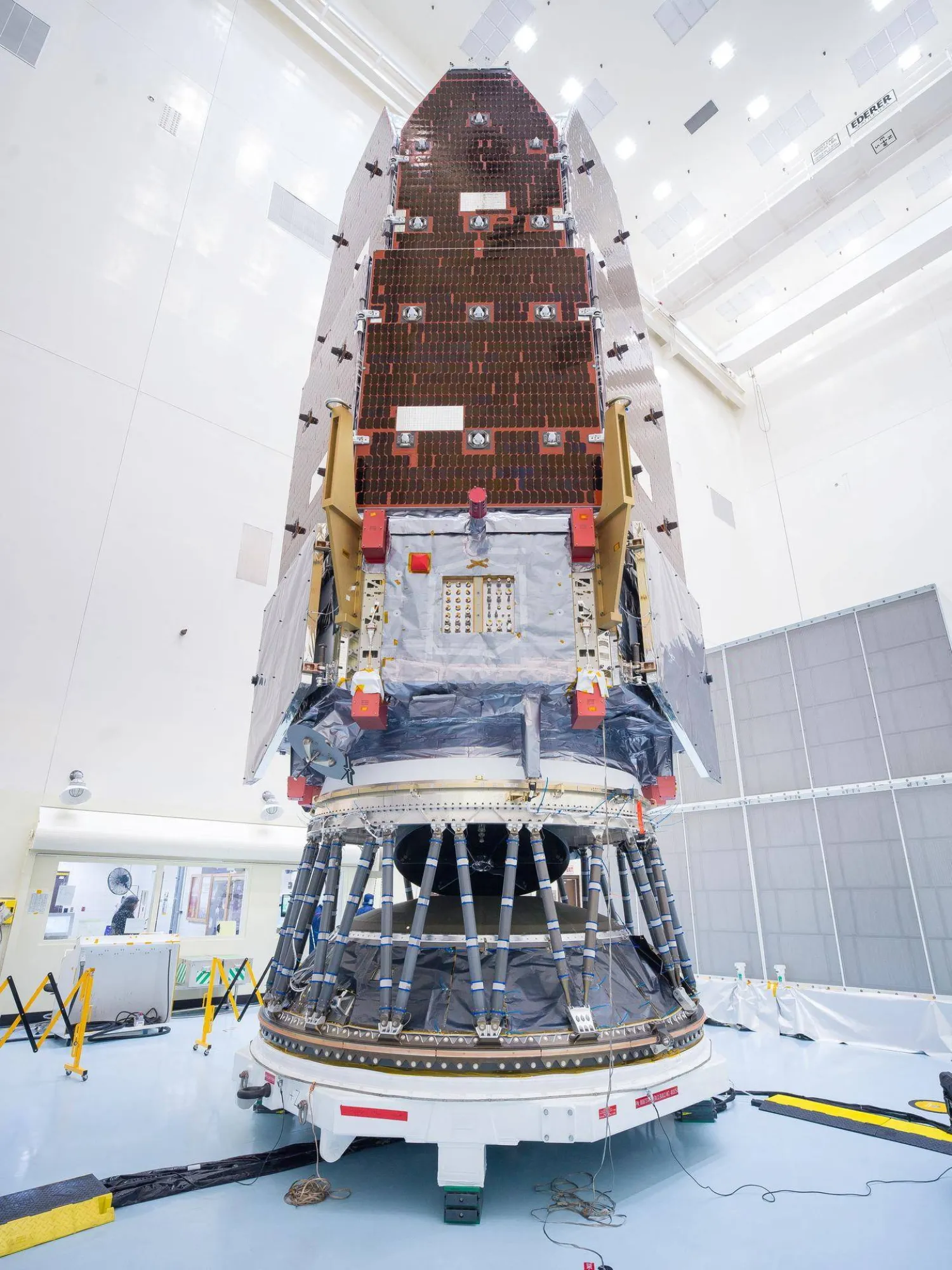
NASA's Nancy Grace Roman Space Telescope stands after engineers and technicians working inside the Payload Hazardous Servicing Facility mated the observatory to its payload adapter and a strut payload attach fitting, a specialized piece of hardware designed for large, heavy loads at NASA's Kennedy Space Center in Cape, Canaveral, Florida, US August 7, 2026 NASA/Jolearra Tshiteya via REUTERS
TT

New NASA Telescope to Probe Dark Energy, Dark Matter and Exoplanets

NASA's Nancy Grace Roman Space Telescope stands after engineers and technicians working inside the Payload Hazardous Servicing Facility mated the observatory to its payload adapter and a strut payload attach fitting, a specialized piece of hardware designed for large, heavy loads at NASA's Kennedy Space Center in Cape, Canaveral, Florida, US August 7, 2026 NASA/Jolearra Tshiteya via REUTERS

NASA is preparing to launch its next flagship space observatory, one that scientists plan to use to investigate some of the universe's biggest mysteries including dark energy and dark matter, while also testing gravity at vast scales and hunting for planets beyond our solar system.

The launch of the Nancy Grace Roman Space Telescope, a roughly $4 billion project, is planned for Sunday at NASA's Kennedy Space Center in Florida, with the observatory to be lofted into orbit aboard a SpaceX Falcon Heavy rocket. The launch comes nine months ahead of schedule, according to US space agency officials.

Roman is a follow-on to the Hubble Space Telescope, launched in 1990, and the James Webb Space Telescope, launched in 2021, and has capabilities that can expand on the knowledge gained by those pioneering observatories, both of which continue to operate.

The new telescope's panoramic view of space and its rapid survey speeds offer the opportunity for scientists to study the cosmos as never before, with wide-field surveys examining its structure, composition and evolution.

"Roman's vast reach will allow us to find the weird, the rare and the unusual," Julie McEnery, Roman's senior project scientist ⁠at NASA's Goddard ⁠Space Flight Center in Maryland, told reporters.

"Roman's primary instrument combines exquisite performance and sensitivity with the ability to quickly and efficiently survey the large regions of the sky," Reuters quoted McEnery as saying.

The telescope's main survey will take more than a year, McEnery said.

"The survey will contain over two billion galaxies and enable us to study how the structures in our universe — the stars, the galaxies, the clusters of galaxies — grew and evolved. We'll also measure how our universe has expanded over time. And these are the keys that will allow us to unlock the fundamental nature of dark matter and dark energy and the fabric of the universe itself," McEnery said.

The Big Bang event roughly 13.8 billion years ago initiated the universe, and ⁠it has been expanding ever since. Scientists in 1998 disclosed that this expansion was actually accelerating, with an invisible force called dark energy as the hypothesized reason.

The universe's contents include ordinary matter — stars, planets, gas, dust and all the familiar stuff on Earth — as well as dark matter and dark energy, whose physical nature remains unknown. Ordinary matter represents perhaps 5% of the contents. Dark matter, known through its gravitational influences on galaxies and stars, may represent about 27%. Dark energy may represent about 68%.

"The key questions are: Is dark energy simply a property of empty space that remains constant over time, or does it evolve in time?" cosmologist Mustapha Ishak of the University of Texas at Dallas, a member of Roman's scientific collaboration, told Reuters.

"The recent results from the DESI — Dark Energy Spectroscopic Instrument — collaboration indicate tantalizing hints of a time evolution of dark energy.

Could the observed acceleration instead indicate that our theory of gravity needs modification on the largest scales? Answering these questions is one of the most important goals of modern cosmology," Ishak said.

Physicist Albert Einstein in 1915 presented his theory of general ⁠relativity explaining gravity, and it ⁠remains foundational.

Roman will map how galaxies cluster and how matter bends light through a phenomenon called gravitational lensing.

"These measurements allow us to test whether Einstein's theory remains valid across billions of light-years or whether modifications to gravity (theory) are required," said Ishak. "This is important because it addresses one of the most fundamental questions in physics: What law governs the universe on its largest scales?"

To date, more than 6,350 exoplanets — planets outside our solar system — have been discovered, as scientists search for evidence of potential life beyond Earth.

Roman will conduct one of the most comprehensive searches ever for exoplanets. It is expected to discover thousands of new ones and provide the first statistical census of planetary systems similar to our own. It also will demonstrate new technology to directly image some relatively nearby exoplanets.

After launch and separation from the rocket, the telescope will travel toward a location called Lagrange Point 2, situated about a million miles (1.6 million km) from Earth, about four times the distance to the moon. Webb also resides at this orbital location. Hubble is in low-Earth orbit.

Roman's mission is planned for five years, though NASA said the telescope may have enough fuel for five additional years. US President Donald Trump's administration tried during both his first and second terms to reduce or eliminate funding for Roman, but Congress preserved it.

The telescope is named after Nancy Grace Roman, NASA's first chief astronomer. Roman died in 2018 at age 93.


Trove of Everyday Items Dating Back to 1800s Found at Buckingham Palace

 11 September 2026, United Kingdom, London: Members of the Massed Bands of the Guards Division perform on the forecourt of Buckingham Palace in London during a commemorative Changing of the Guard ceremony marking the 25th anniversary of the 11 September 2001 terrorist attacks. (dpa)
11 September 2026, United Kingdom, London: Members of the Massed Bands of the Guards Division perform on the forecourt of Buckingham Palace in London during a commemorative Changing of the Guard ceremony marking the 25th anniversary of the 11 September 2001 terrorist attacks. (dpa)
TT

Trove of Everyday Items Dating Back to 1800s Found at Buckingham Palace

 11 September 2026, United Kingdom, London: Members of the Massed Bands of the Guards Division perform on the forecourt of Buckingham Palace in London during a commemorative Changing of the Guard ceremony marking the 25th anniversary of the 11 September 2001 terrorist attacks. (dpa)
11 September 2026, United Kingdom, London: Members of the Massed Bands of the Guards Division perform on the forecourt of Buckingham Palace in London during a commemorative Changing of the Guard ceremony marking the 25th anniversary of the 11 September 2001 terrorist attacks. (dpa)

A pair of battered, hobnailed boots and a decades-old newspaper cutting are among a trove of everyday objects unearthed during restoration work at Buckingham Palace, reported the BBC.

The misplaced items are thought to belong to staff who worked at the palace decades ago and were found by workers carrying out the £369 million refurbishment.

A ticket for a “whist drive” - a card game event hosted by the Palace on April 14, 1949 - was found embedded in a lump of brick.

Several betting slips, a bottle of spring water, an empty Silk Cut cigarette carton and a newspaper article about the gang jailed for the 1963 Great Train Robbery were also found under floorboards.

Blank Littlewoods Football Pool betting slips from 1957 and a scrap of West End theatre listings from The Standard newspaper in 1889 were also found, alongside fragments of Minton decorative ceramic tiles from a fireplace hearth, with the design dated to around the mid-1800s, according to BBC.

Among the discoveries was a typed schedule detailing Queen Elizabeth II's plans to host a diplomatic reception in her Silver Jubilee year of 1977.

It revealed the monarch would work the room in a “clockwise direction,” and that aides were asked to encourage the 350 British guests to mingle with the diplomats at the annual gathering.

Also discovered were pages from the Daily Express newspaper in 1966 detailing the “maximum security” prison where the Great Train Robbers were incarcerated.

The article had pictures of Durham Prison, revealing that “the men who were found guilty of stealing a fortune in mailbags spend their week stitching them for nine shillings.”

BBC wrote that King Charles and Queen Camilla are currently residing in Clarence House, which stands beside St James's Palace and was once the Queen Mother's home.

They will not live in Buckingham Palace after the refurbishment is completed.


Europe Puts into Orbit Two Earth Observation Satellites

A Vega-C rocket carrying European satellites FLEX and Sentinel-3C lifts off from the Guiana Space Center in Kourou, French Guiana, on September 15, 2026. (AFP)
TT

Europe Puts into Orbit Two Earth Observation Satellites

A Vega-C rocket carrying European satellites FLEX and Sentinel-3C lifts off from the Guiana Space Center in Kourou, French Guiana, on September 15, 2026. (AFP)

The European Space Agency has successfully put into orbit two satellites designed to better detect extreme weather events linked to climate change, officials said.

The European Vega-C rocket successfully launched the Sentinel-3C and Flex satellites after lifting off from the Kourou space center in French Guiana at 10:21 pm Monday (0121 GMT Tuesday), according to an AFP journalist on the scene.

The two satellites were placed into a sun-synchronous orbit nearly two hours after liftoff.

The first satellite, Flex (Fluorescence Explorer), will provide data on the impact of heatwaves on plant matter.

It will monitor fluorescence, the red light emitted by plants when they carry out photosynthesis, aiming to establish the link between "plant stress and fluorescence" and to "quantify it", head of the Flex program Thierry Huiban told AFP at Thales Alenia Space in April.

The second satellite, the Sentinel-3C from the European Union's Copernicus Earth observation program, will measure the marine environment -- including temperature, wave height and ocean currents -- as well as land use and land cover, aiming to optimize yields to prevent food crises.

Such missions are "essential" in helping with the "climate change we are experiencing", said Simonetta Cheli, Director of Earth Observation Programmes at the European Space Agency (ESA), speaking from Kourou.


Astrophysics Study Suggests Venus May Have Swallowed Its Moon

Data from NASA's Magellan spacecraft and Pioneer Venus Orbiter is used in an undated composite image of the planet Venus. (NASA/JPL-Caltech/Handout via Reuters)
TT

Astrophysics Study Suggests Venus May Have Swallowed Its Moon

Data from NASA's Magellan spacecraft and Pioneer Venus Orbiter is used in an undated composite image of the planet Venus. (NASA/JPL-Caltech/Handout via Reuters)

A California-based astrophysicist presented a new theory on Monday to explain why Venus, the planet most like Earth in size, mass and structure, lacks its own moon. Call it a case of celestial cannibalism.

The extremely slow speed at which Venus rotates on its axis would have doomed any natural satellite that may once have orbited that planet to gradually spiral closer to its parent and ultimately be consumed in a cataclysmic smash-up.

So goes the theory offered by scientists at the University of California, Riverside, and published on Monday in The Astrophysical Journal, marking a departure from past explanations for why Venus, the second planet from the sun, is without a lunar companion.

"If it had a moon, and it ‌likely did at ‌some point, it could not have kept it," astrophysicist Stephen Krane, lead ‌author ⁠of the study, told ⁠Reuters on Monday. "That moon would have crashed down on the planet in a relatively short time scale."

Krane said data from computer models based on planetary physics and simulating the gravitational mechanics of hypothetical Venusian moons of various sizes showed them all meeting the same fate - sooner or later collapsing into their mother planet.

Such a presumed moon-gobbling event likely occurred within the first billion years in the history of Venus, Krane said.

Scientists previously theorized that Venus, ⁠known as Earth's "twin," either never acquired its own moon to begin ‌with, or possibly had a moon that was obliterated in ‌the massive impact from another celestial object.

EARTH SPINS MORE SWIFTLY THAN VENUS

The UC Riverside study, focusing on Earth-moon ‌dynamics, found that planetary rotational speed was the key factor.

In contrast to Venus, which takes 243 ‌Earth days to complete a single rotation - slightly longer than its orbit around the sun - Earth spins on its axis every 24 hours, more than 200 times more rapidly than Venus, Krane said.

The transfer of energy from Earth's faster rotation is gradually pushing our moon farther away, causing it to recede from Earth at the rate of ‌4 centimeters (1.6 inches) a year - precisely measured by mirrors left on the lunar surface in 1969 by Apollo 11's astronauts.

Venus, the third brightest object ⁠in the night sky ⁠after the sun and moon, looms large as point of study for scientists seeking to learn more about Earth's history, and its future.

Similar in its rocky structure but slightly smaller than Earth, Venus is enveloped in a thick, toxic atmosphere that has created a runaway greenhouse effect, scorching its surface at temperatures as high as 880 degrees Fahrenheit (471 degrees Celsius), hot enough to melt lead.

While there is no proof a Venusian moon ever existed, it is unlikely that Venus, in its infancy, somehow avoided the kind of world-shattering collision with another proto-planet that is widely believed to have formed Earth's moon, according to Krane.

The dawn of the inner solar system was crowded with large rocky objects hurtling through space and smashing into one another, with Venus probably taking more celestial hits than Earth because Venus was closer to the sun.

Scientists hope to unlock more secrets of Venus with two forthcoming NASA missions set for launch in the late 2020s or early 2030 dubbed DAVINCI+ and VERITAS to study the planet's atmosphere and geologic features.
