

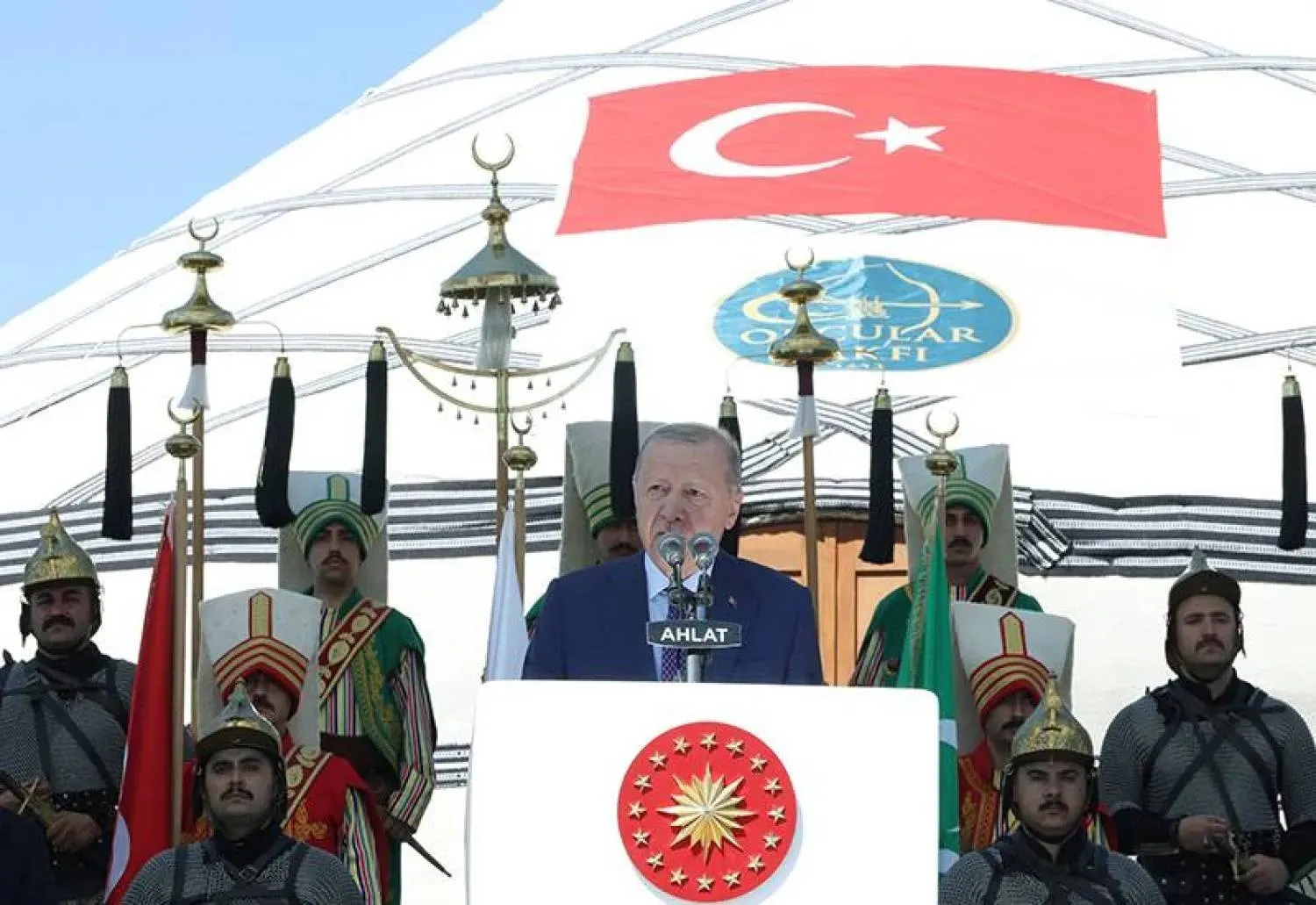

Erdogan: Türkiye Will Thwart Plots Against Brotherhood Among Turks, Kurds and Arabs

Turkish President Recep Tayyip Erdogan vowed to thwart plots targeting brotherhood among Turks, Kurds and Arabs. (Turkish Presidency)
TT

Erdogan: Türkiye Will Thwart Plots Against Brotherhood Among Turks, Kurds and Arabs

Turkish President Recep Tayyip Erdogan vowed to thwart plots targeting brotherhood among Turks, Kurds and Arabs. (Turkish Presidency)

Turkish President Recep Tayyip Erdogan vowed on Tuesday to thwart attempts to undermine ties among Turks, Kurds and Arabs, reaffirming his commitment to a process aimed at disarming the Kurdistan Workers’ Party’s (PKK).

Türkiye calls the initiative Terror-Free Türkiye, while the Kurdish side refers to it as the “Peace and Democratic Society Process.” It is based on the PKK’s dissolution and disarmament.

“When this process achieves its goal, the merchants of blood, the opportunists who profit from terrorism and the ‘architects of genocide’ seeking to destabilize our country and region will lose,” Erdogan said.

Speaking at a ceremony marking the 955th anniversary of the Battle of Manzikert, where the Seljuks defeated the Byzantines, Erdogan said the process would open the way for a new era.

“Humanity, brotherhood, peace and stability will prevail,” he said.

In what was seen as an indirect message to Israel following last week’s attack on Syria’s Abu al-Duhur military airport near the Turkish border and an attack on him by Israeli Prime Minister Benjamin Netanyahu, Erdogan said: “Whatever you do, you will not divert us from our path or prevent Turks, Kurds and Arabs from embracing one another.”

“We know the games you are playing, and we know very well the ‘dirty’ hands reaching into our region. If you have an agenda, we also have an agenda and a plan,” he added.

Separately, the Turkish presidency’s Center for Countering Disinformation said Türkiye had faced a deliberate, foreign-backed psychological campaign in recent days targeting “social unity, brotherhood and peace.”

"No malicious plan or group will achieve its goal, thanks to our nation’s deep wisdom and our state’s firm stance,” the center, which operates under the presidency’s Directorate of Communications, said in a statement.

It urged citizens to remain alert to malicious content, reject posts from unknown sources and rely only on official statements.

Domestic peace process

Erdogan’s pledge to press ahead with the peace process and the presidency’s warnings came as the Monitoring, Evaluation and Coordination Council decided to establish four committees to oversee the PKK’s dissolution and disarmament.

The council held its first meeting under Vice President Cevdet Yilmaz and issued a statement late on Monday.

It said the “historic” process — launched to rid Türkiye and the region entirely of terrorism, eliminate violence and weapons, and foster brotherhood — had reached a critical stage.

Parliament’s Aug. 10 adoption of Law No. 7595 on “Strengthening National Solidarity and Social Integration” reflected the nation’s will and broad political and social consensus, the council said.

Implementation began after Erdogan approved the law on Aug. 18, bringing it into force, it added.

The council described the law as a key pillar of the “Century of Türkiye” vision. It said the legislation would strengthen Türkiye’s internal cohesion and help turn the region into an oasis of peace, prosperity and security amid instability beyond the country’s borders.



US Refuses Visas for Iran UN Delegation Members

Iranian President Masoud Pezeshkian delivers a speech in the United Nations General Assembly Hall in New York (File photo/UN)
TT

US Refuses Visas for Iran UN Delegation Members

Iranian President Masoud Pezeshkian delivers a speech in the United Nations General Assembly Hall in New York (File photo/UN)

The United States has refused to issue visas for members of Iranian President Masoud Pezeshkian's delegation, including his communications team, for this week's trip to the UN General Assembly, Iranian state media reported Monday.

Pezeshkian will be the highest-ranking Iranian official to enter the United States since the Middle East war began with US-Israeli strikes on Iran in February.

"In an unprecedented hostile move by the US government, (US President Donald) Trump has denied US visas to certain members of the president's high-level delegation, including members of his communications team," state news agency IRNA reported.

The Mehr news agency also carried the story, citing a spokesperson for the Iranian presidency, and added that Pezeshkian will address the UN General Assembly on Wednesday.

The US has authorized the Iranian delegation to travel for the UN General Assembly but will, like last year, put restrictions in place.

Iran's delegation will not, for instance, be allowed to purchase luxury goods or other items, the State Department said on Thursday.

Iranian Foreign Minister Abbas Araghchi, part of the delegation to the UN, left Iran on Sunday evening for a stopover in Qatar.

Iran says it has conveyed to the US, via Qatar as mediator, conditions for reopening the strategic Strait of Hormuz oil and gas shipping route, which it has choked off since the war began.

The United States, in turn, is imposing a counterblockade of Iranian ports.


100 Leading Israeli Thinkers Warn of ‘Internal Collapse’

An Israeli boy holds a toy gun in the occupied West Bank city of Hebron in March 2024 (AFP) 
TT

100 Leading Israeli Thinkers Warn of ‘Internal Collapse’

An Israeli boy holds a toy gun in the occupied West Bank city of Hebron in March 2024 (AFP) 

One hundred prominent Israeli thinkers, researchers and former officials have warned that Israel faces a critical choice: become a major power or risk collapse, arguing that while the country has the potential to achieve greater regional influence, its “foundations are rusting.”

The warning emerged from an in-depth study by MIND Israel, a nonpartisan organization specializing in foreign and security strategy. Maariv reported Sunday that the research identified another type of danger alongside external security threats: an existential threat from within.

“If we do not address these foundations, not only will we fail to become a major power, but the entire structure will collapse,” warned Dr. Avner Golov, MIND Israel’s vice president.

The study, involving 100 experts, identified six critical issues requiring urgent decisions: Israel’s regional standing, the quality of its human capital, the relationship between the economy and security, governance and national resilience, demographic changes, and relations with the United States.

MIND Israel President Maj. Gen. (res.) Amos Yadlin noted that the organization intends to present the issues to the public ahead of elections in late October and encourage voters to question party leaders about them.

Presenting the research, Golov explained that the researchers’ review of history found that civilizations tend not to be destroyed from outside while they remain strong internally.

“Internal processes dismantle them,” he added, citing declining social cohesion, erosion of trust in state institutions, the prioritization of short-term political gains over long-term national interests and an inability to adapt.

Contrasting views

Golov outlined two opposing assessments encountered by the researchers. One held that Israel had survived a global pandemic, social upheaval, the Oct. 7 attack and its aftermath while maintaining a resilient economy, technological leadership and strong security capabilities — evidence, in that view, that the country was moving toward becoming a major power.

The other argued that a process of collapse had already begun, driven by an identity crisis, declining governance and a political emergency.

“We believe both sides are right,” Golov concluded, arguing that Israel simultaneously faces historic opportunities and serious internal vulnerabilities.

Asked what the public should do with the questions raised by the study, Golov urged voters to look beyond questions of governing coalitions and demand concrete plans from political leaders. Key measures, he maintained, should be taken during a new government’s first 100 days.

Turning to security policy, Golov called for an updated version of Israel’s traditional “Iron Wall” doctrine following Oct. 7.

He argued that Israel could no longer rely solely on containing enemies behind defensive barriers but must seek to shape developments beyond them.

“The wall still needs to be strong, but we cannot rely only on that,” he stressed.

Golov also urged Israel not to depend exclusively on the United States and to strengthen regional relationships.

“Alongside the walls, we need bridges,” he concluded.


Iran's Guards Threaten to Hit New Targets if US Attacks

Image from a video published by the US Central Command (CENTCOM) of its operations within the naval blockade on Iran.
TT

Iran's Guards Threaten to Hit New Targets if US Attacks

Image from a video published by the US Central Command (CENTCOM) of its operations within the naval blockade on Iran.

Iran's Revolutionary Guards on Monday warned they would attack new targets and deploy new weapons if the US launches further attacks on the country.

Almost seven months into their war, Tehran and Washington remain locked in a stalemate, though neither side appears willing to return to full-scale war, said AFP.

In a statement, a spokesman for the Iranian Revolutionary Guards Corps, the ideological arm of Iran's military, said "there will certainly be significant changes in our defense and our counteroffensive" in the event of a new US attack.

"We will introduce new weapons with new capabilities into the battlefield, and the world will be surprised," he said.

"Our targets will not necessarily be the same as before either. We have new targets that have not yet been attacked."

The Guards also said they were prepared for a "prolonged war".

On Saturday, the central command of Iran's military said the US was planning new action against Tehran, according to state television, but it did not elaborate.

Fighting between the US and Iran has eased in recent days after a flare-up at the end of last month, though Tehran continues sporadic attacks on commercial ships in the Strait of Hormuz.

Both sides are maintaining rival blockades in the waterway in an effort to exert pressure.