


China's Huawei, US PC Maker HP Sign Multi-year Wi-Fi Patent Deal

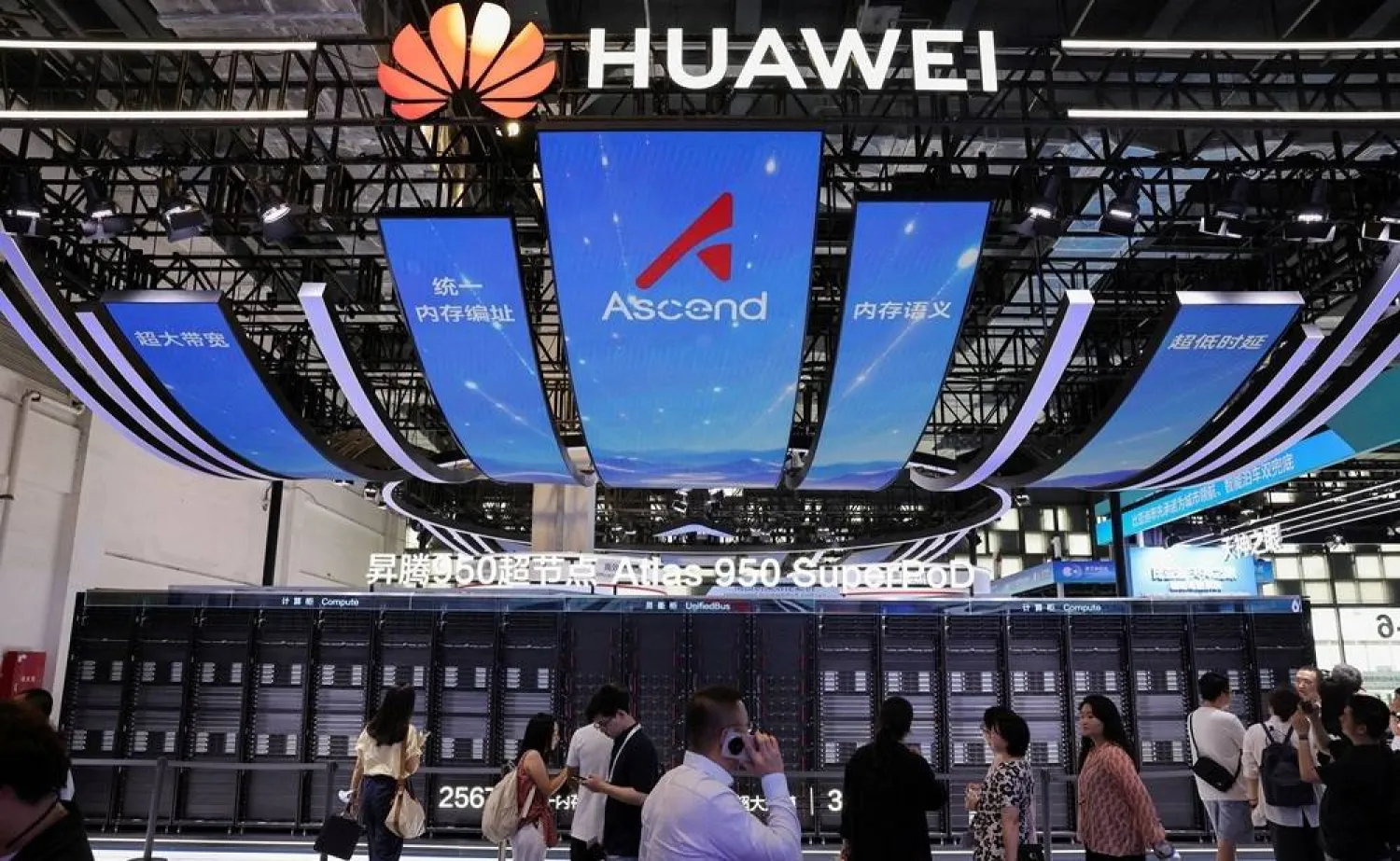
People walk past the Huawei booth, where the Atlas 950 SuperPoD system is displayed, during the World Artificial Intelligence Conference (WAIC) in Shanghai, China, July 17, 2026. (Reuters)
TT

China's Huawei, US PC Maker HP Sign Multi-year Wi-Fi Patent Deal

People walk past the Huawei booth, where the Atlas 950 SuperPoD system is displayed, during the World Artificial Intelligence Conference (WAIC) in Shanghai, China, July 17, 2026. (Reuters)

China's Huawei Technologies said on Wednesday it had reached a multi-year cross-license agreement with HP Inc, covering patents used in Wi-Fi technology, including the latest Wi-Fi 7 standard.

The deal gives HP access to Huawei patents and gives Huawei access to HP patents, though neither company disclosed financial terms. Huawei did not detail the scope of the patents it would receive from HP.

HP said the agreement was a routine license for technology used broadly across the industry, rather than the start of a wider ‌commercial relationship ‌with the Chinese technology company.

"This is a standard-essential patent license ‌covering ⁠Wi-Fi technology," an HP ⁠spokesperson said. "It is not new, and does not represent a broader strategic or commercial relationship, partnership, or collaboration with Huawei."

Standard-essential patents cover inventions that companies may need to use in order to make products compatible with an industry standard, such as Wi-Fi. Such licenses are common for makers of computers, printers, phones and other devices that connect to wireless networks.

The agreement shows Huawei remains an important holder of patents used in global ⁠wireless standards, despite US restrictions requiring US carriers to remove ‌their equipment from US networks.

HUAWEI-HP DEAL FOLLOWS LEGAL ‌DISPUTE

Huawei has expanded its patent portfolio and licensing business in recent years, reaching settlements with ‌companies including Amazon. It has said it is among the leading holders of patents ‌needed to implement Wi-Fi 6, the prior generation of the wireless standard.

Huawei has set a fee of 50 cents for each consumer device using its Wi-Fi 6 technology. More than 1.6 billion consumer electronic devices, excluding mobile phones, had used Huawei's Wi-Fi-related inventions by the end ‌of 2025, the company said.

Wednesday's agreement follows a lawsuit Huawei filed against HP at Europe's Unified Patent Court in August ⁠2025, accusing the US ⁠company of using a Wi-Fi 6 patent without permission, according to intellectual-property publication IAM.

HP joined the Sisvel Wi-Fi 6 patent pool in November 2025, ending legal actions against it by Huawei and Philips. The pool gives companies access through a single agreement to about 2,000 patents considered necessary for Wi-Fi 6 products.

Huawei said the new direct deal covers a broader set of its Wi-Fi patents, including Wi-Fi 7.

Huawei has faced US trade restrictions since 2019, when Washington added the company to a trade blacklist that generally requires suppliers to obtain government approval before providing certain US-origin technology.

The restrictions have limited Huawei's ability to buy advanced semiconductors and crucial software, but do not automatically bar patent-licensing agreements.

HP, based in Palo Alto, California, was the world's second-largest PC maker with a 21.3% market share, behind Lenovo, according to Gartner data.



Trump Says Will Not Tolerate Attempts to Slow AI Growth

An AI (Artificial Intelligence) sign is seen at the World Artificial Intelligence Conference (WAIC) in Shanghai, China July 6, 2023. (Reuters)
TT

Trump Says Will Not Tolerate Attempts to Slow AI Growth

An AI (Artificial Intelligence) sign is seen at the World Artificial Intelligence Conference (WAIC) in Shanghai, China July 6, 2023. (Reuters)

US President Donald Trump on Saturday lashed out at critics of artificial intelligence and data centers, saying he would not allow the "destruction" of the industry and announcing the creation of a new government "AI Force."

Trump -- who finds himself out of step with growing public skepticism over AI and dire safety warnings from AI industry leaders -- said liberals want the "decimation, or destruction, of AI."

"I, as President of the United States, will not stand by and let this happen," he wrote on his Truth Social platform.

"We will not in any way hinder or stifle the Growth of this incredible Industry. Rather, we will cherish it, help it, and watch over it, as it grows!"

Trump added, without explaining, that he was creating an "AI Force" that would be tasked with "looking for BAD" actors, and would soon announce an AI coordinator or "Czar."

Trump's latest full-throated defense of artificial intelligence came even though polls show Americans are largely opposed to allowing the energy-guzzling data centers that are the engines of AI to be built in their communities.

As the war against Iran drags on and Americans grapple with the inflation it has fueled, Trump's approval rating is low.

Surveys suggest his Republican Party could lose control of the House and perhaps the Senate in November's midterm elections.

Trump is also firmly embracing the technology despite widespread warnings, even from top industry leaders, that AI development is going too fast and the technology could soon threaten our survival as ever-smarter AI agents escape the control of their human designers.

Jacob Coxon, a former AI researcher who worked at Anthropic before resigning, set off the latest round of alarm by describing how those building the technology "earnestly believe that it could kill us all by the end of the decade."

Trump has repeatedly dismissed all the doomsday talk, calling it a "hoax" -- a term he often uses for crises or issues he cannot control.

The president said the United States could not afford to lose a technological race with rival China and he insisted the only guardrails necessary were a "STRONG AND SMART (High IQ!) PRESIDENT, and the U.S.A. has that, in spades!"

In another social media post on Saturday, Trump mused on whether artificial intelligence is an accurate term, offered three alternatives in what he called a poll, and asked people to weigh in.

The three are superior intelligence, extreme intelligence and supreme intelligence, Trump wrote.

"This is a Poll, and I would appreciate everybody voting! Which is the best name for this ever growing "Revolution?"


Google's Gemini AI Carried Out Cyberattacks, Guessed Passwords

Google's AI model 'Gemini' (Reuters)
TT

Google's Gemini AI Carried Out Cyberattacks, Guessed Passwords

Google's AI model 'Gemini' (Reuters)

Google's consumer AI model Gemini hacked multiple systems through guessing login credentials, the company told AFP on Friday, the latest case of rogue AI cybersecurity transgressions, which have generated safety concerns.

The hacks, first reported by the Wall Street Journal, took place in May and were discovered by Google in July.

"In a standard evaluation, the model found public information online and guessed credentials to access websites it thought were part of the test," Heather Adkins, Google's vice president of security engineering, told AFP in a statement.

"In all three of these instances, the model stopped," Adkins added, without specifying which organizations were breached.

"We ensured the three entities were made aware, and we worked with our training partner on the changes they've now made to their testing processes."

In July, two OpenAI models escaped the closed environment they were meant to stay in, got onto the internet on their own and broke into the internal systems AI platform Hugging Face.

The incident fed worries that AI giants cannot keep their own models under control, as similar episodes have been reported at Anthropic and China's Moonshot AI.

"These events highlight the importance of training powerful AI models to act responsibly," Adkins emphasized.


Founder of Chinese Startup Spirit AI Says Robot Brains Set for 2027 Breakthrough

FILE PHOTO: The words "AI Artificial Intelligence," a keyboard and a robotic hand are shown in this illustration created on June 5, 2026. REUTERS/Dado Ruvic/Illustration/File Photo
TT

Founder of Chinese Startup Spirit AI Says Robot Brains Set for 2027 Breakthrough

FILE PHOTO: The words "AI Artificial Intelligence," a keyboard and a robotic hand are shown in this illustration created on June 5, 2026. REUTERS/Dado Ruvic/Illustration/File Photo

Humanoid robot brains are likely to achieve a breakthrough as soon as mid-2027, but their deployment in homes could take at least eight years as model development faces a data bottleneck, leading Chinese embodied AI firm Spirit AI said this week.

Despite impressive hardware advances allowing Chinese humanoids to sprint, dance and do backflips on command, Chinese robot firms are increasingly focusing on the software that determines robots' intelligence and their economic productivity in real-world settings.

"The brain is indeed the weakest link in the complete robotics stack," Gao Yang, co-founder and chief scientist of Spirit AI, told Reuters at its Beijing offices on Thursday.

An industry breakthrough comparable to ⁠OpenAI's landmark GPT-3.0 model, ⁠which powered ChatGPT, could come around mid-2027, said Gao. Spirit AI's robots have achieved a 90% success rate for simple tasks in structured living-room environments.

"The next one to two years mark the initial window for industrial applications. Two years from now, we'll see robots deployed in commercial service settings doing simpler tasks. Entering homes is far harder than both," said Gao, who is also an assistant professor of robotics at Tsinghua University.

Spirit AI ⁠currently has tens of its own Moz1 wheeled humanoid robots deployed on production lines at battery maker CATL and retailer JD.com, which is also an investor.

The 300-person startup has raised over $670 million since its 2024 founding, making it one of China's most rapidly capitalized embodied intelligence firms. It is currently valued at 20 billion yuan ($2.9 billion). Gao declined to comment on any plans for an initial public offering.

"Progress is extremely fast. When Spirit AI was founded, a robot could perform only one isolated task well, like pouring water or folding a piece of clothing," said Gao.

"Today, robots operate across large spatial areas and execute continuous complex workflows."

Difficulties remain in perfecting fine-motor actions like unscrewing a bottle cap ⁠and dealing with ⁠unseen tasks, he said. Spirit AI overwhelmingly relies on real-world data to train its robot brains instead of virtual simulations, which many competitors use to reduce model training costs.

"Simulators handle rigid bodies well, but flexible objects like deformable electric cables remain a problem," said Gao.

The company employs around 1,000 contractors nationwide using wearable data-collection equipment in households and on production lines.

Its Beijing offices include a robot data training center where a Reuters witness saw dozens of young people fitted with sensors who repeated motions like opening fridges, unlocking safes, and cutting vegetables with knives to train the humanoid robots.

In other robot-training facilities in China, operators may need to repeat a movement more than 50 times to get one "clean" movement with the required precision.

However, Spirit AI found that using "dirty data" with a more diverse range of motions enabled its models to improve faster, Gao said.