Iran Says US Sanctions Will Achieve Nothing as Netanyahu Dismisses Diplomacy

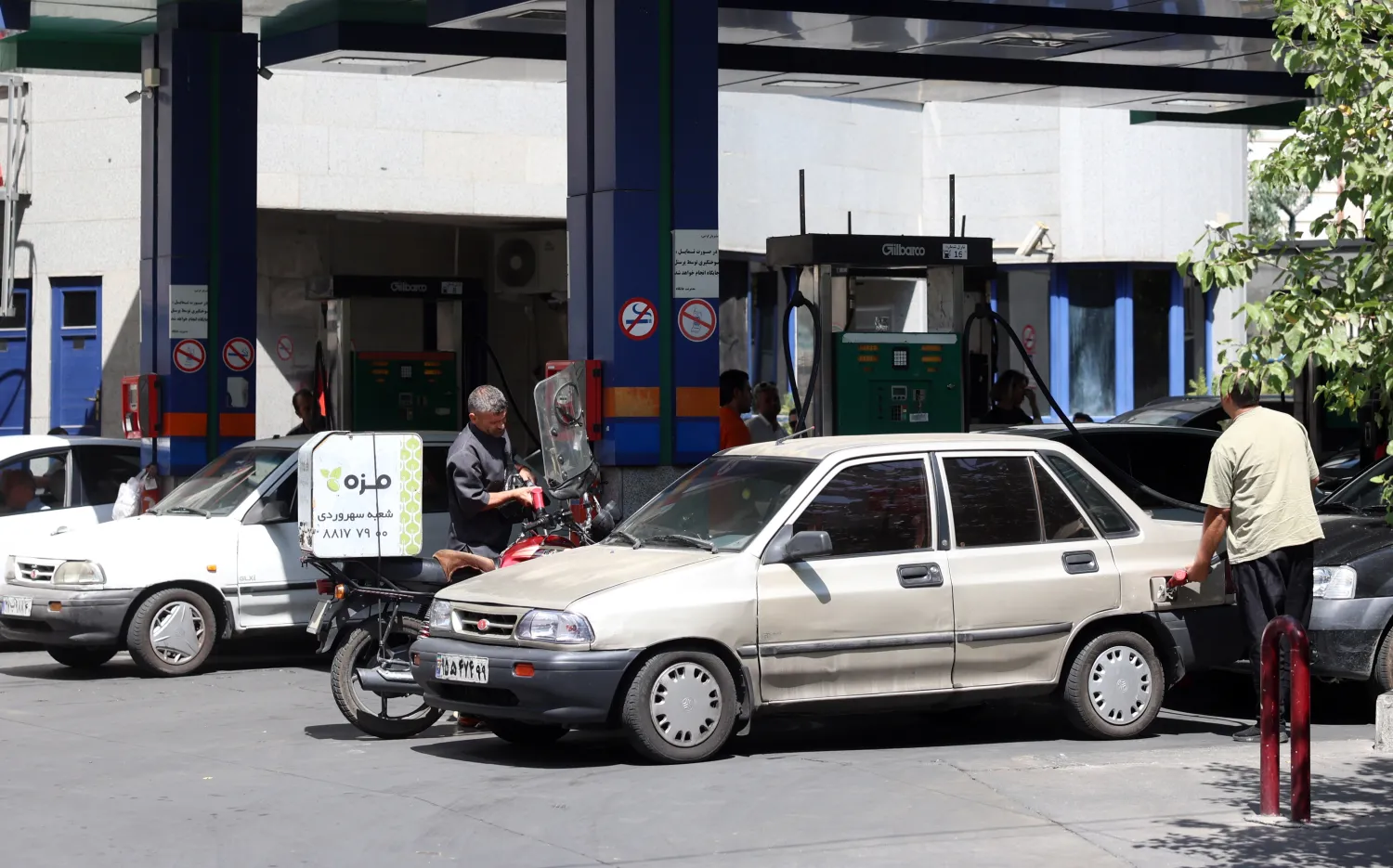
An Iranian fills up at a petrol station in Tehran, Iran, 25 August 2026. (EPA)
TT

Iran Says US Sanctions Will Achieve Nothing as Netanyahu Dismisses Diplomacy

An Iranian fills up at a petrol station in Tehran, Iran, 25 August 2026. (EPA)

Iran's president insisted on Wednesday that the United States will achieve nothing with its sanctions campaign after Washington laid out plans to collapse the country's economy. 

Almost six months into their war, the two sides are locked in a stalemate, with Iran keeping the key Strait of Hormuz shut and Washington persisting with a naval counter-blockade of Iran. 

Under political pressure at home over the impacts of the conflict, US President Donald Trump has pivoted away from military action to economic levers, expanding sanctions and warning of consequences for countries that do not join. 

But Iran's leaders have remained defiant, saying they have a two-year plan to counter the pressure, while Iran's army said Wednesday it had rebuilt or replaced all weapons systems damaged during the fighting. 

"America will not achieve anything with economic pressure at this stage, just as it was unable to achieve anything in the war," Iranian President Masoud Pezeshkian said Wednesday, according to the country's ISNA news agency. 

"We will stand firm against economic pressures, as we have done so far and will continue to do." 

Army spokesperson Mohammad Akraminia told state television that the military had replenished its combat capabilities with the reconstruction of all damaged weapons systems and import of new equipment from abroad. 

On Monday, US Treasury Secretary Scott Bessent claimed the US had "dismantled Iran's military capabilities, destroyed nearly 100 percent of its military factories, and buried its nuclear program". 

- 'Savages' - 

The US and Israel launched the war against Iran in late February, vowing to end an alleged Iranian nuclear weapons program and threatening to topple the regime in Tehran. 

Iran responded by firing on Gulf countries and closing the Strait of Hormuz, a vital shipping route for global supplies of oil and gas. 

The waterway's closure has strained the world economy as shipments fail to reach major markets, pushing up the price of oil and placing pressure on Trump ahead of mid-term elections in November. 

Repeated rounds of negotiations brokered by mediators have failed to produce a lasting diplomatic settlement, with a ceasefire collapsing last month. 

Trump had frequently claimed a deal was close, but has since backed away from diplomacy, while Israeli Prime Minister Benjamin Netanyahu on Tuesday dismissed any prospect of a deal, calling Iran's leaders "savages". 

"I tell you -- an agreement cannot be reached," Netanyahu said, adding that he had discussed the issue with Trump at a recent meeting. 

"I doubt, however, that an agreement can be reached with that group there, with those savages." 

Announcing the new US economic measures, Bessent said expanded secondary sanctions would target Iran's digital assets and its technology, gold, aviation and shipping sectors. 

But Iran's regime has already endured decades of sanctions since its founding in 1979. 

- 'Total control' - 

The Strait of Hormuz remains at the heart of the dispute between the two sides. Iran says it will not reopen the vital waterway until the US meets its demands, and has frequently attacked vessels. 

Tehran has also indicated it intends to impose fees for use of the waterway, which the US and others in the region oppose. 

Trump meanwhile insists the US navy has "total control" of the strait and has even called it US territory. 

Oman, which sits on the other side of Hormuz, has been discussing with Iran a temporary transit corridor, as laid out in a US-Iran memorandum of understanding signed in June which failed to produce peace. 

On Wednesday, Iran's Revolutionary Guards, the ideological arm of the nation's military, said the talks with Oman included the two countries agreeing to share revenues received for management of the strait. 

"Some agreements were made regarding the share of each country in the waters of the strait and the share of Iran and Oman in its revenues," said IRGC spokesman Hossein Mohebi, adding that the US was "obstructing work" to finalize the deal. 

Omani Foreign Minister Badr Albusaidi said on Tuesday that he hoped his country and Iran would "soon announce" the temporary corridor. 

"Future management of the strait and a permanent solution will follow in due course," he wrote on X following talks in Tehran. 


China's Xi Says Middle East Should Not Become Battleground for Great Power Rivalry

Chinese President Xi Jinping attends a signing ceremony with Oman's Sultan Haitham bin Tariq (not pictured) during the Sultan's state visit to China, at the Great Hall of the People, in Beijing, China, 02 November 2026.  EPA/TINGSHU WANG / POOL
Chinese President Xi Jinping attends a signing ceremony with Oman's Sultan Haitham bin Tariq (not pictured) during the Sultan's state visit to China, at the Great Hall of the People, in Beijing, China, 02 November 2026. EPA/TINGSHU WANG / POOL
TT

China's Xi Says Middle East Should Not Become Battleground for Great Power Rivalry

Chinese President Xi Jinping attends a signing ceremony with Oman's Sultan Haitham bin Tariq (not pictured) during the Sultan's state visit to China, at the Great Hall of the People, in Beijing, China, 02 November 2026.  EPA/TINGSHU WANG / POOL
Chinese President Xi Jinping attends a signing ceremony with Oman's Sultan Haitham bin Tariq (not pictured) during the Sultan's state visit to China, at the Great Hall of the People, in Beijing, China, 02 November 2026. EPA/TINGSHU WANG / POOL

The Middle East and Gulf region should not become a battleground for great-power rivalry and China is willing to work with Arab nations to achieve lasting peace, Chinese President Xi Jinping told Oman's sultan on Monday.

China has traditionally played a low-key diplomatic role in the Middle East, but has stepped up efforts to try to help end tensions amid the US-Israeli war on Iran, which has snarled the Strait of Hormuz and driven up global energy and shipping costs.

Xi told Omani Sultan ‌Haitham bin Tariq ‌al-Said that the world is undergoing profound changes.

"The Middle ‌East ⁠Gulf region should ⁠not become an arena for great-power rivalry and geopolitical conflict. Peace and stability in the region require joint nurturing and protection by all parties," Xi said, according to China's Foreign Ministry.

China has consistently been committed to stopping the war, and hopes to contribute "wisdom and solutions to resolving the region's security dilemmas," he added.

China is willing to strengthen communication and coordination with Arab countries, including the Gulf Cooperation Council states, to work together ⁠toward restoring peace and achieving lasting stability and security, Xi ‌said.

China's Foreign Ministry said later on Monday that ‌Zhai Jun, its special envoy to the Middle East, would visit Iran, Oman and Saudi ‌Arabia this month.

FIRST CHINA TRIP

Haitham arrived in Beijing on Sunday for a ‌two-day visit, the first by an Omani head of state since the countries established ties in 1978.

Haitham told Xi his government had deep appreciation for China's positions on key issues concerning the region, Omani state media reported.

"We believe that development and stability are inextricably linked," he said.

"The ‌prosperity of nations requires an environment defined by security, peace, respect for state sovereignty, and adherence to international law — an ⁠environment where disputes ⁠are resolved through peaceful means."

He also said Oman was open to entering into a preferential bilateral trade and investment agreement with China.

"We are confident that such an agreement would open new avenues for trade and investment, facilitate and enhance commercial and investment exchanges between our two nations," Haitham said.

China is Oman's largest trade partner, with tourism and business links boosted by direct flights between Beijing and Muscat since November last year.

Oman, which exports crude oil and energy products to China, has also been looking to further develop its renewable energy supply chains and digital commerce.

The Omani leader, who was welcomed on the tarmac in Beijing by People's Bank of China Governor Pan Gongsheng, also emphasized cooperation between investment and financial institutions.


Taliban Government Voices 'Serious Concern' over US Afghan Deportation Plans

TOPSHOT - Taliban security personnel stand guard near the Torkham border crossing between Afghanistan and Pakistan in the Nangarhar province on February 27, 2026. (Photo by Aimal Zahir / AFP)
TT

Taliban Government Voices 'Serious Concern' over US Afghan Deportation Plans

TOPSHOT - Taliban security personnel stand guard near the Torkham border crossing between Afghanistan and Pakistan in the Nangarhar province on February 27, 2026. (Photo by Aimal Zahir / AFP)

Afghanistan's Taliban authorities voiced concern on Monday over reported plans by Washington to deport scores of Afghan immigrants to Pakistan with the aim of their eventual return to their home country.

More than 150 Afghans in the United States would be deported via Pakistan to Afghanistan, including relatives of those who assisted US forces before their 2021 withdrawal, according to US media reports and an advocacy group.

"The Islamic Emirate of Afghanistan expresses its serious concern over reports that the United States intends to deport some Afghan refugees to Pakistan who have not yet been able to obtain legal residency documents in that country," foreign ministry spokesman Abdul Qahar Balkhi said in a statement.

Advocacy groups have warned that the removal of former allies and their families could endanger their lives.

After regaining power, Taliban authorities announced a general amnesty for Afghans who worked with Western-backed forces and governments and have repeated promises this year that their former foes could safely return home.

However, the United Nations has recorded reports of extrajudicial killings, detentions and abuses.

President Donald Trump's administration last year issued travel bans for a number of countries, including Afghanistan, as part of a broad immigration crackdown.

His administration sort to sought to end deportation protections for Afghans, some of whom were granted special immigrant visas following the 2021 takeover by Taliban authorities.

Among those expected to be deported are relatives of Afghans who assisted the US military in the country prior to the fall of Kabul, according to AfghanEvac, a group seeking to help former Afghan allies.

While the United States cannot arrange deportations directly to Afghanistan, anonymous US officials told The New York Times that Pakistan will oversee their expulsion to Afghanistan.

In recent years, Germany and Türkiye have deported Afghan nationals directly to Afghanistan, despite concerns from human rights groups over the risks facing returnees.

Balkhi said Taliban authorities urged "the United States of America to adopt a responsible and measured approach in this regard and to take any decisions and measures regarding the fate of Afghan citizens with clear mutual understanding, necessary coordination, and consideration of the rights and legitimate demands of the individuals concerned".

"The Afghan side is ready to interact in this regard in a practical and mutually understanding manner," he added.

Pakistan's government earlier this year ordered law enforcement nationwide to arrest Afghan citizens without visas as part of a years-long repatriation policy that has pushed back millions of Afghans who fled throughout decades of war.

Relations between Pakistan and Afghanistan have been fraught since the Taliban authorities took power and worsened after deadly border clashes last October that led to near-total closure of the border.


Nine Dead in Small Plane Crash Near Trump’s Florida Home

A Learjet explodes after crashing in a residential area in Palm Beach County, Florida, US, November 1, 2026, in this still image obtained from social media video. (Aki Kuusisto/via Reuters)
TT

Nine Dead in Small Plane Crash Near Trump’s Florida Home

A Learjet explodes after crashing in a residential area in Palm Beach County, Florida, US, November 1, 2026, in this still image obtained from social media video. (Aki Kuusisto/via Reuters)

A Learjet plummeted into a neighborhood in southern Florida miles from US President Donald Trump's resort home on Sunday, killing all nine people on board, officials said.

Several unverified clips posted to social media depicting the deadly crash showed an aircraft nearly vertical slamming at high speed into the ground, creating a large fireball and leaving a flaming crater near a busy roadside.

"Today's plane crash in Palm Beach County, Florida is a horrific tragedy," Transportation Secretary Sean Duffy said in a statement, confirming that all nine people on the aircraft were killed.

Duffy said the plane, a Learjet 60, had departed from Austin, Texas and was headed for the Bahamas.

The crash occurred near Cresthaven, a neighborhood in Palm Beach County that is less than seven miles (11 kilometers) from Trump's resort home Mar-a-Lago.

"Obviously this is a cataclysmic plane crash," Florida Governor Ron DeSantis told reporters near the scene.

"It looked like a missile going down," he said, adding there were no reports of anyone on the ground being injured.

Trump had been at Mar-a-Lago on Sunday but departed from the nearby and newly renamed President Donald J. Trump International Airport shortly after he boarded Air Force One at 11:55 am (1655 GMT), about an hour before the crash of the Learjet aircraft.

The plane came down near the entrance to a mobile home park, Palm Beach County Commissioner Joel Flores said, noting about 600 residents were evacuated and relocated to shelters.

"The FAA and National Transportation Safety Board will investigate" the crash, the Federal Aviation Administration said in a statement.

Storms had been reported in the area. Trump carried an umbrella as he boarded Air Force One.

In an audio recording posted to air traffic website liveatc.net, someone in the cockpit can be heard reporting "moderate turbulence" and saying the crew was "managing the ice."

The person said the plane was "picking up precipitation" and needed "to climb" shortly before saying: "Mayday, mayday, we're descending 10,000 feet per minute."

Seconds later, the person said they were "declaring an emergency" as the plane descended 20,000 feet per minute.

"We're going to crash into the ground," the person said, shortly before communications stopped.