


At Least 98 Killed and Hundreds Missing After Flash Floods in Nepal and China

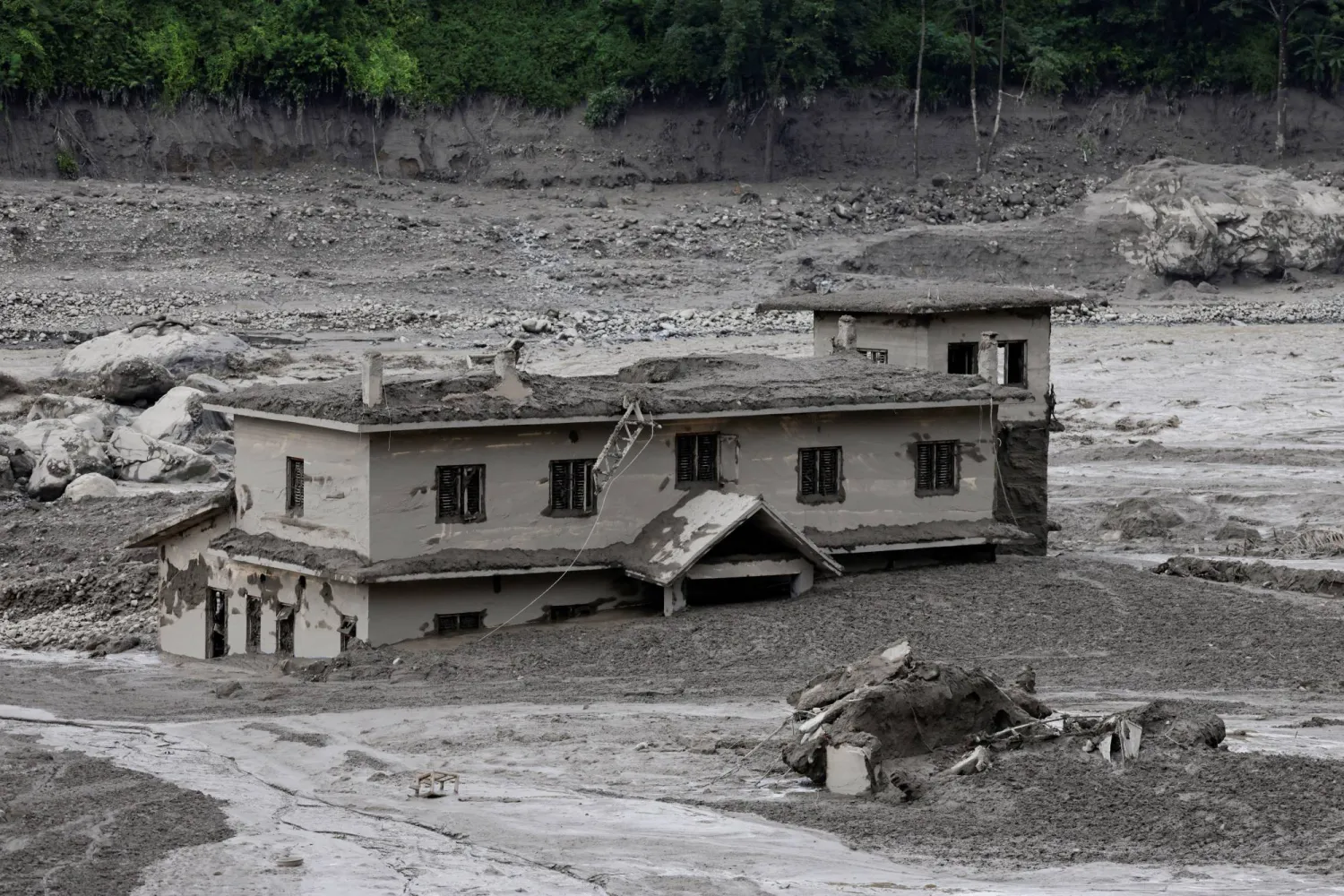
A mud-covered building following a flash flood at Trishuli in Nuwakot district, Nepal, August 26, 2026. (Reuters)
TT

At Least 98 Killed and Hundreds Missing After Flash Floods in Nepal and China

A mud-covered building following a flash flood at Trishuli in Nuwakot district, Nepal, August 26, 2026. (Reuters)

Massive flash floods in a border area of Nepal and China on Wednesday killed at least 98 people and left hundreds of tourists, workers and others missing after sweeping through communities and bringing travel in some areas to a halt.

The prime minister’s office in Nepal reported at least 95 dead. China’s state broadcaster CCTV said a mudslide in the Tibet region’s Gyirong County near the border killed at least three and left 265 missing.

Officials in Nepal said 403 people, including 341 foreign nationals were reported missing. Sunil Sharma, a tourism board spokesperson, said 133 were from India on pilgrimage to Mount Kailash in Tibet, a sacred site for Hindus. Also missing were 47 from the United States, 34 from Australia, 33 from the Britain and 24 from Canada, he said.

At least 62 missing Nepali citizens were among hundreds of locals trekking in the Gosaikunda lake in Rasuwa, coinciding with the local festival of Janai Purnima on Friday, Sharma added. Nepal police spokesperson Abi Narayan Kafle told The Associated Press that at least 28 police officials were missing.

Officials warned residents in several of Nepal’s districts to stay away from the banks of the Bhotekoshi, Trishuli and Narayani rivers. The Bhotekoshi flooded around 9 a.m. Wednesday, destroying several villages, roads and hydropower projects, officials said.

“We have asked both India and China to help us with the rescue efforts,” said Sasmit Pokharel, a Nepali government spokesperson.

Nepal’s steep valleys are economic lifelines and travel corridors but precarious ones when disaster strikes. Images showed what appeared to be the second floors of buildings in hard-hit Nuwakot district slathered in mud after the torrent rushed by. Debris hung from tree branches and wires, vehicles were buried and stunned survivors were caked in mud.

The US Geological Survey reported a magnitude 4.4 earthquake early Wednesday, about 100 kilometers (60 miles) north of Kathmandu, near the border with China’s autonomous region of Tibet.

Though the current monsoon season is less favorable for trekking in Nepal, it’s a major season for Kailash trekking in Tibet, which follows the route in Nepal’s Rasuwa district bordering Tibet’s Gyirong.

Countries express alarm over missing citizens

South Korean government officials said nine of its citizens working on building a hydropower plant in Nepal were among those reported missing.

Malaysia’s foreign ministry said its embassy in Kathmandu received reports from travel agencies that they had lost contact with 11 Malaysians believed to be in the Rasuwa district, also hit hard by floods.

Chinese authorities were conducting large-scale search and rescue operations in the Tibetan border area of Gyirong, according to state broadcaster CCTV. Chinese President Xi Jinping ordered authorities to step up the efforts, state news agency Xinhua reported.

Indian Prime Minister Narendra Modi spoke with Nepal’s Prime Minister Balendra Shah and offered help. “India is prepared to provide Nepal with all possible types of humanitarian assistance. Our teams are closely coordinating on rescue and relief efforts,” Modi said on social media.

In a joint statement, Australia, Britain, the European Union, Finland, France, Norway and Switzerland expressed solidarity with the affected people in Nepal., adding: “We encourage all those in affected areas to follow the guidance of local authorities and official safety advisories as the situation continues to evolve.”

The same region saw flash floods last year

The same regions saw similar flash floods in August last year, when a glacial lake in Tibet overflowed because of high temperatures. Nine people were killed, and critical infrastructure, including a bridge connecting Nepal and China, was damaged.

Climate experts at the Kathmandu-based International Centre for Integrated Mountain Development said an avalanche from a glacier likely caused Wednesday’s flash flood.

The Lhende Khola River, a tributary of the Bhotekoshi, had maximum flooding Wednesday, they said.

“The Lhende Khola has flooded twice in 14 months, this time triggered by an ice rock avalanche from a glacier on the Nepal side that blocked the river and released a sudden surge downstream,” said Saswata Sanyal, a disaster risk reduction specialist at the climate research group.

He noted the importance of early warnings in “a warming Himalaya.”

The Himalayan region, which spans several countries including India, is especially vulnerable to heavy rains, floods and landslides because it is warming faster than the rest of the world due to human-caused climate change. Research shows that extreme weather events, including heat waves, rains and melting glaciers, have become more frequent.

Researchers in Kathmandu found earlier this year that glaciers across the Hindu Kush Himalaya region are melting at an accelerating rate, with ice loss rates doubling since 2000, primarily due to rising global temperatures and climate change.



Tehran Races to Curb Inflation, Stem Rial’s Slide

Iranian President Masoud Pezeshkian sits between Economy Minister Ali Madanizadeh and Central Bank Governor Abdolnasser Hemmati during a financial meeting on Wednesday. (Iranian Presidency)
TT

Tehran Races to Curb Inflation, Stem Rial’s Slide

Iranian President Masoud Pezeshkian sits between Economy Minister Ali Madanizadeh and Central Bank Governor Abdolnasser Hemmati during a financial meeting on Wednesday. (Iranian Presidency)

Iranian President Masoud Pezeshkian discussed the foreign exchange market, liquidity, inflation and the balance of payments during a three-hour meeting at the central bank, two days after the rial fell to a record low and Washington announced an expanded campaign to “choke” Iran’s economy.

Pezeshkian stressed the need to maintain economic stability and curb inflation expectations amid war, an economic blockade and external pressure, calling for full coordination between the central bank and institutions responsible for managing financial and currency markets, state news agency ISNA reported.

The Iranian president reviewed reports on liquidity levels, the foreign exchange market, the international balance of payments, monetary regulation policies and measures planned to steer the economy during and after the war.

Pezeshkian called for continued meetings with economic experts and for their proposals to be considered in shaping monetary, fiscal, banking, trade and corporate management policies. He also urged officials to explain the country’s economic problems to Iranians directly and transparently.

The meeting came after the United States imposed a new package of sanctions targeting about 60 individuals, entities and vessels, while expanding the risk of secondary sanctions to the digital assets, technology, gold, aviation and shipping sectors.

US Treasury Secretary Scott Bessent said Washington was seeking to sever “every economic lifeline” keeping the Iranian government afloat, pledging to hold accountable countries and companies that continue to deal with Tehran.

Pezeshkian said Tehran would continue to resist economic pressure, arguing that just as the United States had failed to achieve its objectives in the war, it would also fail through economic pressure.

Fuel stations

Pressure on the currency and prices coincided with disruption in the fuel market. Fuel stations in Tehran saw growing lines of cars and motorcycles on Tuesday after authorities announced a rare reduction in long-standing fuel quotas and imposed higher prices on purchases exceeding the allocated amounts.

Brent crude, meanwhile, fell below $90 a barrel on Tuesday as markets interpreted the new US sanctions as reducing, for now, the prospect of a resumption of large-scale military operations, despite continued risks to shipping through the Strait of Hormuz.

The dollar breached the 2-million-rial mark for the first time on Monday, trading at about 2.02 million rials on the open market, compared with an official central bank rate of about 1.5 million rials.

The dollar was worth about 1.65 million rials before the war began on Feb. 28, reflecting a further decline in the currency over the past six months.

Central Bank Governor Abdolnasser Hemmati sought to calm markets, describing the latest rise in foreign currency prices as “temporary” and saying the current volatility did not warrant a change in monetary policy direction.

He said the central bank had supplied the economy with an average of $175 million in foreign currency a day since the start of the Iranian year, compared with about $205 million during the same period a year earlier.

Hemmati announced a plan to allocate $20 billion to meet the industrial sector’s foreign-currency needs through the end of the year and pledged to supply the currency needed for medicines and essential goods.

He said the central bank had anticipated the outbreak of war since February and had therefore distributed foreign currency reserves across “different locations” that could be accessed when needed to secure essential supplies.

Hemmati described the past six months as “extremely difficult” but drew a distinction between enduring pressure and the “collapse” that authorities say the United States is seeking to force upon Iran’s economy.

He pledged to focus on curbing inflation and the currency’s decline, saying the central bank could not “print money without purpose and increase liquidity”.

Official data showed that annual inflation reached 66% in July, while consumer prices rose 87.9% from the same month a year earlier and food-price inflation reached 128%.

Rice prices have risen about 60% since the war began, while beef prices have increased by more than 150%, according to the Associated Press. The International Monetary Fund expects Iran’s economy to contract by more than 5%.

Financing production

The central bank plans to provide 700 trillion tomans to finance production through instruments it says do not rely on issuing new money.

Deputy Governor for Monetary Policy Vahid Majid said financing provided through instruments linked to production chains reached 197 trillion tomans during the first four months of the current Iranian year, as the bank seeks to expand “sustainable, non-inflationary financing”.

The central bank is also working to give exporters and importers greater flexibility in foreign currency trading, including by allowing direct agreements between the two sides and reducing the role of some intermediaries.

Hossein Tajiknejad, an official responsible for foreign currency allocation, said the central bank no longer purchased foreign banknotes itself but had allowed banks and importers to buy them at mutually agreed prices.

Tehran is also facing mounting restrictions on its foreign trade channels after the United Arab Emirates announced last week that it was suspending trade dealings with Iran, while the new US sanctions threaten companies and countries that continue to provide it with financial and commercial channels.

China, the largest buyer of Iranian oil and one of Tehran’s leading trading partners, warned that it would defend its interests after Washington announced the expansion of secondary sanctions.

Chinese Foreign Ministry spokesperson Lin Jian said the policy of “maximum pressure” and economic warfare would not resolve problems, warning that such measures could destabilize the global economic and financial system and harm other countries’ rights.

He said Beijing would “take all necessary measures” to protect its interests, posing a test of Washington’s ability to enforce the new restrictions on Iranian trade, particularly regarding Chinese-Iranian economic ties.

Iranian Economy Minister Ali Madanizadeh said his country had prepared a “two-year plan” to counter the new sanctions and that Washington would not achieve through economic pressure what, in his words, it had failed to achieve militarily.


Iranian Messages Seek to Defuse Iraq Dispute Over Armed Factions

Iraqi Prime Minister Ali al-Zaidi attends a Coordination Framework meeting in Baghdad. (INA)
TT

Iranian Messages Seek to Defuse Iraq Dispute Over Armed Factions

Iraqi Prime Minister Ali al-Zaidi attends a Coordination Framework meeting in Baghdad. (INA)

Iran has urged leaders of Iraq’s Coordination Framework to contain a dispute over armed factions’ weapons and avoid a confrontation with groups that may refuse to disarm after a Sept. 30 deadline set by Baghdad.

Iraq’s judiciary, meanwhile, said it would take action against anyone carrying weapons after the deadline.

Local reports cited informed sources as saying Tehran had called for negotiations with the factions rather than confrontation. The proposed talks would cover which weapons could be surrendered, how they would be handed over, and what the factions might receive in return.

Committees could also be formed to manage the process and prevent a direct confrontation with the government or the United States.

The move comes as Prime Minister Ali al-Zaidi’s government pushes ahead with a plan to place all weapons under state control.

Baghdad has tied the end of September to the conclusion of the US-led international coalition’s military mission against ISIS and the start of a new phase in bilateral security relations.

National Security Adviser Qassem al-Araji said this week that the coalition’s mission would end on Sept. 30. Dialogue with the factions over restricting weapons could begin afterward, he said, in an apparent effort to ease tensions over the deadline.

An informed source said a senior Iranian official briefly attended a recent Coordination Framework meeting and delivered messages on how to handle the coming political and security developments.

The messages also addressed the communication channel between the Framework and Tehran.

The reports identified the official as Mohsen Qomi, a representative of Iran’s supreme leader. Qomi attended part of the meeting in Baghdad during a visit that the source said was also intended to formally introduce his role to the Iraqi government and political and religious leaders.

The source said Qomi left shortly afterward and did not take part in all the discussions.

Qomi also met Coordination Framework leaders in Baghdad, including Iraqi Islamic Supreme Council President Humam Hamoudi and al-Zaidi.

The meeting, held at Hamoudi’s office, covered issues of mutual interest, according to the Iraqi News Agency.

The reports said Qomi told Framework leaders that Hamoudi had been designated as a channel of communication between Iran and Iraq. The move would organize political contacts with Tehran as pressure mounts on Iran-aligned armed factions.

The reports attributed the delay in Qomi’s visit to security conditions in Iran. His arrival coincided with growing debate in Iraq over the future of armed groups after the coalition’s mission ends.

Ghalib al-Daami, a professor of media studies at Mustansiriyah University, said the Coordination Framework forces understood the risks of confronting the United States over the weapons issue.

But they also did not want disarmament to be carried out quickly or fully if that would strengthen the government and the prime minister, he said.

Daami said Shi’ite forces could seek a formula that partly meets US demands without handing the government a major political victory. In his view, those forces generally prefer to keep the prime minister’s success within limits they can control.

Washington says ending the coalition’s military mission does not mean abandoning its security relationship with Baghdad. Instead, the relationship will shift to a bilateral defense partnership.

The United States and Iraq agreed in 2024 on a timetable to end the coalition’s military mission in Iraq by September.

The deadline has brought growing pressure on Iran-backed armed groups to surrender their weapons or fully integrate into state institutions.

Iraqi officials say some factions are resisting the move, making the issue one of the most sensitive tests facing al-Zaidi’s government as the coalition mission draws to a close.

International coalition withdrawal

In the Kurdistan Region, German forces serving with the international coalition ended their military and advisory duties this week, another step in the coalition’s gradual withdrawal.

An official ceremony was held on Tuesday at Camp Stephan at Erbil International Airport.

Officials from the Kurdistan Regional Government and the Peshmerga Ministry attended, along with representatives of the German Defense Ministry.

The Peshmerga Ministry said the German advisers and trainers had completed their mission after years of working with Peshmerga forces in the fight against ISIS.

Kurdistan Region President Nechirvan Barzani told a member of the German parliament that the region valued Germany’s support during the war against terrorism.

He highlighted the assistance Germany provided while Peshmerga forces were fighting and the region was receiving large numbers of displaced people.

The German withdrawal comes as US troops and the remaining coalition forces finalize plans to leave Iraq.

The United States and Iraq agreed in 2024 to end the coalition’s military mission and move to a bilateral security partnership. Cooperation against ISIS will continue under the new arrangements.

Separately, Iraqi Supreme Judicial Council President Faeq Zidan met with Joshua Harris, chargé d’affaires at the US Embassy in Baghdad, on Wednesday.

They discussed judicial measures against individuals and groups carrying weapons in violation of the Constitution and the law.

The meeting signaled a growing focus on the judiciary’s role as the end of the coalition’s military mission approaches.

The Supreme Judicial Council said the talks covered measures the judiciary would take after the mission ends on Sept. 30. They also discussed how to enforce the rule of law equally.

The meeting followed Zidan’s visit to Iran, where he met several senior officials.

They included Judiciary Chief Gholam-Hossein Mohseni-Eje’i, President Masoud Pezeshkian, Parliament Speaker Mohammad Bagher Ghalibaf and Supreme National Security Council Secretary-General Mohsen Rezaei, according to statements from Iraq’s judiciary.

After meeting Zidan in Tehran, Rezaei said the countries of the region would determine their own future and that the US would have no place there.

He said Iran wanted “an independent and strong Iraq.”

Rezaei also called for resolving the status of groups opposed to Iran that are based along the two countries’ border, a reference to Iranian Kurdish parties in Iraq’s Kurdistan Region.


Trump Believes Iran’s Supreme Leader Is Still Alive

Iranians shop at a bazaar in northern Tehran, Iran, 25 August 2026. (EPA)
TT

Trump Believes Iran’s Supreme Leader Is Still Alive

Iranians shop at a bazaar in northern Tehran, Iran, 25 August 2026. (EPA)

US President Donald Trump on Wednesday said he believes Iran's supreme leader, who has not been seen in public since taking over after his father's killing in February, remains alive. 

"I don't think he's dead. He was very seriously wounded. The left side of his body, the arm, the leg, the whole thing. He was very seriously wounded. But I don't think he's dead," Trump said in an interview with conservative radio host Glenn Beck. 

Officially, Mojtaba Khamenei continues to lead his country under US and Israeli attack. However, his public absence and the rise to power of veteran Revolutionary Guards figures has fueled speculation that he is either dead or not fully in command. 

His father was killed in bombing at the start of the US-Israeli assault. 

Trump -- who has already declared victory over Iran on multiple occasions but remains unable to force the opening of the Hormuz sea route or force Iran to surrender its nuclear materials -- said again that military and economic pressure was working. 

"Those things are going toward a very big victory," he said. "We're going to have a big victory here very soon." 

Trump also insisted that the Strait of Hormuz, where Iran's military has disrupted and to a large extent blocked shipping, is in fact fully open. 

"You could really say, you know, because the Strait is open. We take a lot of ships through the Strait now. We're taking them in. The mines are gone," he said. 

"We cannot let Iran have a nuclear weapon. That's what it's all about. That's 99.9 percent. We cannot let them because they are crazy and they will use it," he said, before adding that he had already "stopped it twice."