


Official Leading Trump's Gaza Ceasefire Effort Criticizes Israel for Its Attacks

Peace Council High Representative Nikolay Mladenov (Reuters)
TT

Official Leading Trump's Gaza Ceasefire Effort Criticizes Israel for Its Attacks

Peace Council High Representative Nikolay Mladenov (Reuters)

The official in charge of President Donald Trump's ceasefire plan for Gaza criticized Israel on Wednesday for its attacks on the war-battered Palestinian territory and warned that the alternative to the US proposal is the next war, The Associated Press said.

Nikolay Mladenov, the Board of Peace high representative, insisted to the UN Security Council that Trump's 20-point plan has not stalled and “has moved from the negotiating table to the engineering table.”

The group Hamas has agreed to the proposal’s key provision to disarm and turn Gaza over to civilian rule, he said. But Israel’s ongoing strikes since last October’s ceasefire are still killing Palestinians — though much fewer — and Gazans can’t feel that the conflict is ending, he said.

“After three years of war and 20 years of military operations, I ask, will another strike on a munitions depot stop Hamas from rearming or tightening its grip on Gaza?" Mladenov said. “It will not. It only delays the demilitarization that would happen” and obstructs the transfer to a civilian government.

A recent US deal with Hamas to disarm was seen as a potential breakthrough to end the war, which was sparked by the militant group’s deadly Oct. 7, 2023, attacks in southern Israel. But Israeli Prime Minister Benjamin Netanyahu said his forces won’t withdraw from their current lines in Gaza until Hamas has handed over all its weapons.

Mladenov said that at a meeting he took part in last week with Netanyahu and Jared Kushner, Trump’s son-in-law and adviser, “we went through his government’s concerns one by one and narrowed the areas that still require technical work.”

Israel’s deputy UN ambassador, Noa Furman, reiterated to the Security Council his country’s commitment to Trump’s plan, but stressed that it can’t succeed while Hamas remains armed. He said Israel is working closely with the US to achieve Hamas’ disarmament.

The US ambassador to the UN, Mike Waltz, said concerns about Trump's plan are being addressed and Hamas' disarmament will be judged on its actions.

Mladenov warned of the distance between the roadmap and what’s happening on the ground, and said if war resumes, there won’t be a roadmap to return to or anything left on the ground to rebuild.

“That would not be a setback,” he said. “it would be a point of no return for everyone.”

Mladenov stressed the need for political will to overcome the differences and said there is a choice to be made: “A Gaza disarmed, rebuilt and reconnected to the world. Or a Gaza rearmed, divided and in rubble, with a radicalized generation raised inside it and the next war already on the horizon."

As for the Palestinians, Mladenov said, the Trump plan includes a “credible pathway to a political horizon" and a two-state solution to the decades-old conflict. Netanyahu vehemently opposes a Palestinian state.



Washington Targets Hezbollah’s Alternative Funding Networks

Hezbollah supporters hold up a portrait of the group’s former secretaries-general, Hassan Nasrallah and Hashem Safieddine, during the second anniversary of their assassinations in Beirut’s southern suburbs (AP). 
TT

Washington Targets Hezbollah’s Alternative Funding Networks

Hezbollah supporters hold up a portrait of the group’s former secretaries-general, Hassan Nasrallah and Hashem Safieddine, during the second anniversary of their assassinations in Beirut’s southern suburbs (AP). 

The United States is stepping up efforts to track alternative financing channels used by Hezbollah as tighter sanctions threaten its traditional sources of funding, particularly Iranian money that has long underpinned the group’s military and security capabilities and political influence in Lebanon.

Washington’s campaign extends beyond restricting Iranian transfers to tracing foreign funding networks and cross-border commercial activities that Hezbollah could use to compensate for any decline in Tehran’s support.

A Reuters report last week that Hezbollah had received $200 million in cash from Iran the previous month to assist tens of thousands of families displaced by the war prompted a response from the US State Department.

The department expressed doubt that the money had reached Hezbollah but reaffirmed its commitment to maintaining pressure on the group’s funding sources through sanctions, while supporting the legitimate Lebanese government’s efforts to rebuild southern Lebanon.

New round of sanctions

Sami Nader, director of the Middle East Institute for Strategic Affairs, described the measures as part of a new round of US sanctions aimed at tightening financial pressure on Iran and its regional affiliates.

“The issue is not specifically Hezbollah, but primarily Iran,” Nader told Asharq Al-Awsat, pointing to a recent US announcement describing Hezbollah as an integral part of Iran’s Revolutionary Guard Corps.

Nader said Tehran had developed alternative channels to circumvent financial restrictions, particularly through gold and cryptocurrencies.

He described an expanding network of such activities across the region, with links to Iran and Hezbollah.

The latest sanctions are designed to target these alternative mechanisms, he explained.

Nader added that if cryptocurrency offices linked to these networks are found to exist, Lebanese authorities would likely be asked to shut them down and take action against them, while also tightening oversight of gold transactions.

Four sources of financing

Hezbollah has long relied on multiple funding sources, particularly under previous Lebanese administrations that turned a blind eye to billions of dollars reaching the group, including through official border crossings.

Economist Antoine Farah identified four principal sources of financing: The first was direct Iranian support, provided through regular transfers from Tehran. The second involved illicit activities, particularly drug smuggling and the Captagon trade, which Farah said Hezbollah had engaged in both inside Lebanon and abroad, notably in several Latin American countries. The third consisted of substantial donations from Shiite financiers and supporters around the world. The fourth was a network of front businesses established to generate additional revenue, launder money and conceal the origins and destinations of funds.

Farah told Asharq Al-Awsat that Hezbollah’s ability to draw on most of these sources had declined considerably, while the group faced mounting pressure from legislative and regulatory measures being strengthened in Lebanon.

Stricter financial oversight

Farah highlighted amendments being introduced to Law No. 44 on combating money laundering and terrorist financing, particularly provisions requiring the identification of the ultimate beneficial owners of companies and commercial enterprises.

Identifying who ultimately benefits from commercial activities, while tracing the origins and destinations of funds, would help restrict the operations of front businesses established by Hezbollah, he explained.

Farah also pointed to measures being taken by Banque du Liban, Lebanon’s central bank, to regulate currency exchange dealers and money transfer companies.

He said the measures were making it increasingly difficult to exploit these sectors to transfer money and channel financing to Hezbollah.


Syrian Security Forces Step Up anti-ISIS Operations, Pursue Former Regime Loyalists

A scene from the arrests carried out in Masyaf (Hama Security Correspondent).
TT

Syrian Security Forces Step Up anti-ISIS Operations, Pursue Former Regime Loyalists

A scene from the arrests carried out in Masyaf (Hama Security Correspondent).

Syrian security forces have intensified operations against ISIS cells following a deadly September bus attack near Masyaf in central Syria, while separately pursuing former regime operatives accused of crimes against civilians.

Within a week, authorities announced the dismantling of an ISIS cell in Homs province, following the arrest of the group’s alleged military commander there. Seven former regime suspects were also detained as part of transitional justice efforts.

The Internal Security Forces announced that raids in the Houla area of northern Homs, conducted with the General Intelligence Directorate, had dismantled an ISIS-linked cell and foiled planned attacks on places of worship and security patrols.

Two suspects were arrested and two explosive devices were seized. Preliminary investigations indicated that the detainees had received and transported explosives and monitored potential targets as part of plans to incite unrest and undermine security.

One suspect was caught attempting to plant an explosive device on a railway track, authorities reported. Investigations are continuing to identify other cell members and their connections.

The operation followed the arrest about three days earlier of Khaled Raed Bayrouni, known as Abu Hassan Doshka, in Hujayra, near Damascus. The Interior Ministry described him as ISIS’s operational arm in Homs and the group’s overall military commander in its so-called Homs province.

Bayrouni is accused of planning and overseeing bombings and sectarian attacks, including an explosion at an Alawite mosque in Homs that killed eight people in late 2025.

Authorities also launched raids and arrests following a Sept. 27 attack on a bus transporting workers near the Masyaf bypass bridge, on the road linking Masyaf and Homs, that killed seven civilians.

Despite ISIS’s territorial defeat in Syria and Iraq, its small cells remain a security threat, exploiting instability and security gaps, particularly in remote areas.

In early October, the international coalition against ISIS pledged more than $75 million to support Syria’s counterterrorism efforts, including measures to address security vulnerabilities and dismantle dormant cells.

Separately, the Defense Ministry reported Saturday that a Syrian army soldier had died of wounds sustained in a shooting by unidentified gunmen Tuesday evening in Buqrus, eastern Deir Ezzor province.

Two customs patrol members were also wounded when unidentified attackers opened fire near Izraa bridge in Daraa province as officers escorted a transit convoy, the General Authority for Ports and Customs announced Saturday.

Former regime suspects arrested

In a parallel operation, security forces detained seven former regime suspects in Masyaf, Hama province, accusing them of serious abuses against civilians.

Nabil Adnan Ismail and Ghazi Mohammed Ismail allegedly commanded groups within militias affiliated with the former Air Force Intelligence Directorate and participated in kidnappings, looting and massacres, including violence in Aqrab village. They also face extortion allegations.

Brothers Taher Youssef al-Mohammed and Talal Youssef al-Mohammed, who served in Air Force Intelligence and the Scientific Studies and Research Center, are accused of repression, arrests and exploiting access to detainees’ files to extort their families.

Faisal Badour, nicknamed “Tiger Cub” for his alleged brutality toward civilians, joined armed militias in 2012 and participated in former regime military operations in Hama and Aleppo provinces.

Another detainee, Assef Salameh, served as a noncommissioned officer at defense factories until 2018.

Authorities had earlier arrested Shaheen Hamdan al-Shaheen, a founder of the Air Force Intelligence-linked Shaheen Regiment militia.

He is accused of involvement in massacres in eastern Hama and along the Athriya–Raqqa road in 2017. His militia allegedly committed killings, arrests, torture and destruction in Palmyra and Deir Ezzor province through 2019.


Abbas Calls for Palestinian Presidential, Legislative Elections in September 2027

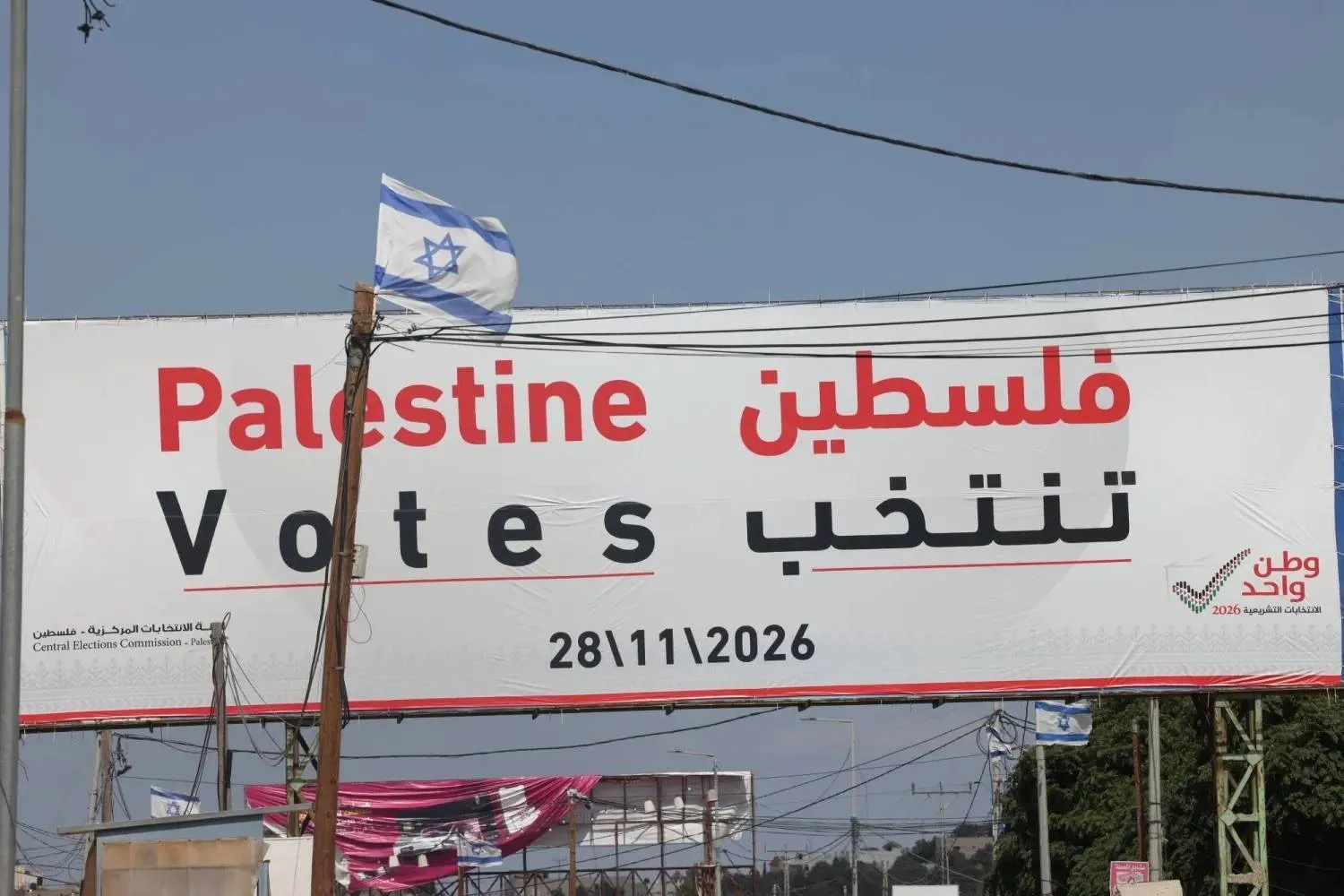
 A sign promoting Palestinian legislative elections on a road near the West Bank city of Jenin (File photo: EPA). 
 A sign promoting Palestinian legislative elections on a road near the West Bank city of Jenin (File photo: EPA). 
TT

Abbas Calls for Palestinian Presidential, Legislative Elections in September 2027

 A sign promoting Palestinian legislative elections on a road near the West Bank city of Jenin (File photo: EPA). 
 A sign promoting Palestinian legislative elections on a road near the West Bank city of Jenin (File photo: EPA). 

Palestinian President Mahmoud Abbas has issued a decree calling for simultaneous presidential and legislative elections on Sept. 11, 2027, canceling a legislative vote scheduled for Nov. 28, 2026, after his Fatah movement and other Palestinian factions agreed to postpone it.

The widely anticipated decision sets a new date for Palestinians to elect both their president and lawmakers amid concerns over Israeli restrictions and the security situation in Gaza and the West Bank.

The decree calls on Palestinians in Jerusalem, the West Bank and Gaza Strip to participate in free, direct presidential and legislative elections to choose the president of the State of Palestine and members of the Palestinian Legislative Council, in accordance with the law.

Abbas had previously issued decrees calling for legislative elections on two occasions, most recently scheduling them for November 2026, before canceling the plans.

An informed source told Asharq Al-Awsat that setting a firm date for simultaneous presidential and legislative elections was intended to demonstrate the Palestinian leadership’s commitment to holding the vote and reassure France and the international community that it would proceed with renewing the legitimacy of Palestinian institutions.

The decision followed a recommendation by the Executive Committee of the Palestine Liberation Organization (PLO) to revoke Decree No. 4 of 2026, which had called for legislative elections in November.

At a meeting Saturday, the PLO Executive Committee approved moving the legislative vote to September 2027 to coincide with the presidential election.

It attributed the decision to national consultations with Palestinian factions and political forces, which had produced a consensus on the obstacles posed by Israeli measures to holding elections on the original date.

The committee also cited the need to establish suitable political, security and on-the-ground conditions to ensure free, fair and comprehensive elections.

In a statement, the committee argued that circumstances had changed substantially since the election date was announced several months earlier, following successful elections for trade unions, professional associations, and local authorities.

It pointed to the failure to implement UN Security Council Resolution 2803, the absence of international stabilization forces and Palestinian police in Gaza, and the continued presence of Israeli troops in the territory.

The committee also cited ongoing attacks, insecurity and restrictions preventing the Central Elections Commission and local and international observers from entering Gaza.

These conditions, it maintained, made it impossible to establish an environment conducive to elections or guarantee the safety of voters, candidates and election workers.

The committee further warned that what it described as catastrophic conditions in the West Bank, including East Jerusalem, posed serious obstacles to holding the vote.

It accused Israeli settlers of carrying out daily attacks, including burning homes, uprooting olive trees and stealing crops and livestock, under the protection of Israeli forces.

The statement also condemned what it called the Israeli government’s continued expansion of settlements, seizure of Palestinian land, demolition of homes and attacks on Muslim and Christian holy sites.

It cited checkpoints, movement restrictions, pressure on the Palestinian economy and the withholding of Palestinian funds totaling nearly $7 billion as additional obstacles.

Despite the postponement, the PLO Executive Committee reaffirmed its commitment to holding elections with the participation of all Palestinians in the State of Palestine, including those in Gaza and East Jerusalem.

It stressed that the vote must be conducted safely and fairly, with international observers present, free from Israeli obstruction, while preserving the unity of Palestinian territory, people and institutions.