


Death Journey from Kordofan Ends in Hunger in Omdurman

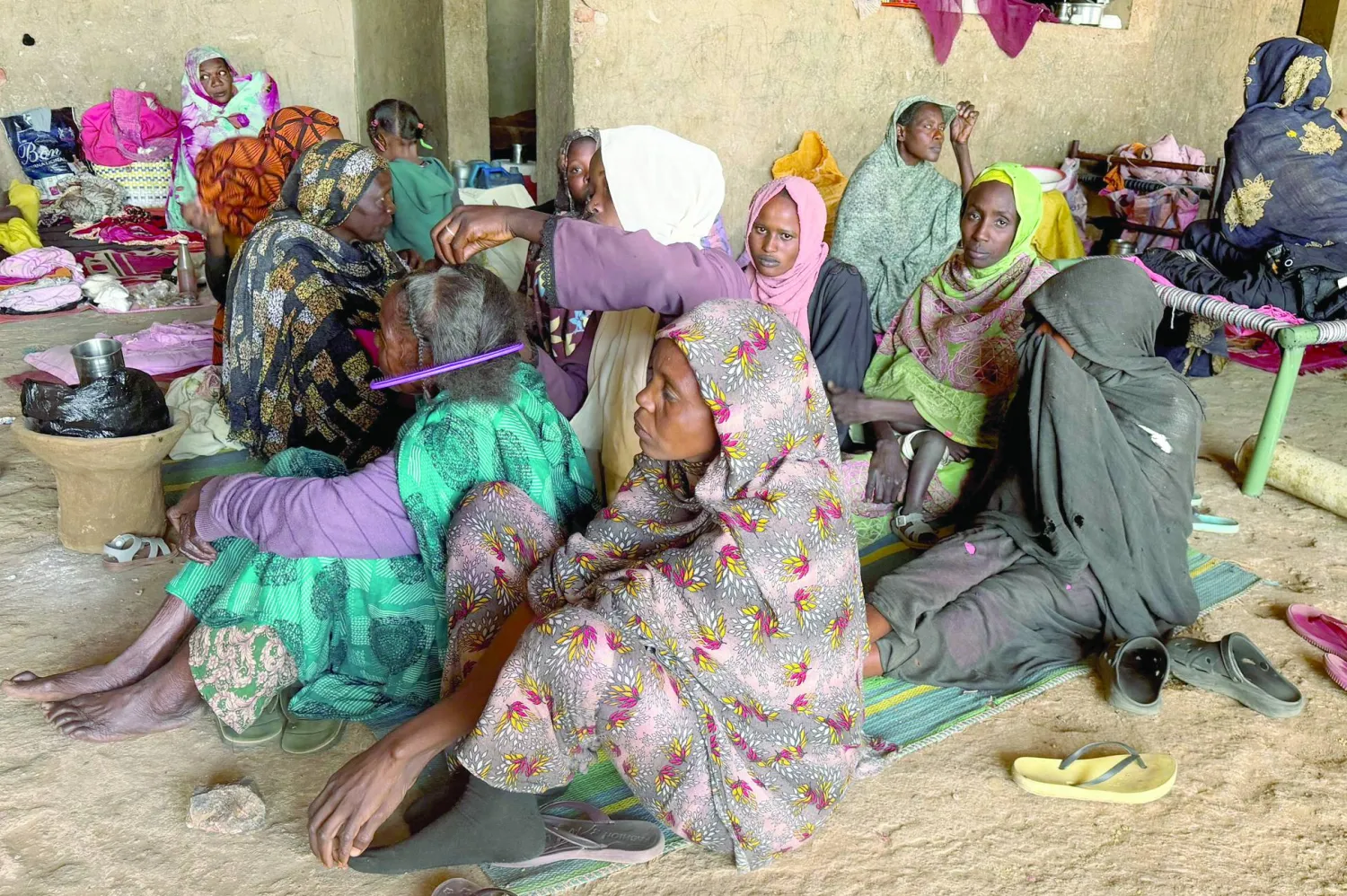
A displaced woman from Dalanj braids her grandmother's hair at a displacement registration center in El Obeid, North Kordofan State, Sudan, January 15, 2026. REUTERS/El Tayeb Siddig
TT

Death Journey from Kordofan Ends in Hunger in Omdurman

A displaced woman from Dalanj braids her grandmother's hair at a displacement registration center in El Obeid, North Kordofan State, Sudan, January 15, 2026. REUTERS/El Tayeb Siddig

A long journey marked by fear, hunger and thirst has been undertaken by large numbers of Sudanese families fleeing cities and towns in North Kordofan state, where fighting has flared again, for Omdurman, the second-largest city in the capital Khartoum.

Families that have lost children, relatives, and perhaps all their possessions have been forced to leave their homes and take difficult routes through mountains and valleys. Some have travelled on foot, while others have relied on animal-drawn carts or trucks. Others have become stranded before reaching safety.

Reports by local and international aid organizations said hundreds of families — with some estimates putting the number at more than 3,000 — have been displaced in recent weeks following a resurgence of military operations in parts of North Kordofan, amid what the reports described as “dire humanitarian conditions”.

After weeks of hardship, the families reached the far western outskirts of Omdurman “hungry and exhausted,” carrying what remained of their belongings and memories of the homes they had left behind.

Others had lost family members along the arduous journey. But reaching Omdurman did not end their ordeal. Displaced families face shortages of food and drinking water and a lack of humanitarian assistance, while cases of diarrhea, fever and infections are spreading among children, turning their escape from the war into an open-ended ordeal with no clear end in sight.

The Arduous Journey

The Sudanese Armed Forces and allied forces are seeking to expand their control in North Kordofan and secure the area around the state capital, El Obeid, while large numbers of the Rapid Support Forces are positioned west and south of the city.

Halima Dhow al-Bait said she fled with her family of nine from the Al-Jamama area of Sodari locality in North Kordofan after they were forced to leave their home at gunpoint.

Her journey took several days aboard cargo trucks and was arduous and exhausting, while some residents and neighbors became stranded in the mountains and among the trees.

“We arrived in Omdurman in a state of extreme exhaustion,” the Sudanese woman told Asharq Al-Awsat. “During the first few days, we received some food supplies, including oil, sugar and flour, but those supplies later stopped.”

Another displaced woman said: “During the journey, three of my children fell ill because of hunger, thirst and the hardships of the road.”

“We left our homes, our property and everything we owned. We left with nothing but the clothes we were wearing,” she said. “Our situation is now extremely difficult, and we are receiving no humanitarian assistance.”

“We saw death with our own eyes”

Sudan’s humanitarian crisis has deepened as a result of the war between the Sudanese army and the Rapid Support Forces, which has continued since April 2023, killing hundreds of thousands of people and displacing about 13 million others as refugees and internally displaced people, according to UN estimates.

Sayedah Khamis, a displaced woman from the town of Al-Jamama, recounted the details of her arduous journey.

“Our journey took about 13 days. At times we travelled on foot, and at others in donkey-drawn carts,” she said.

“We left because of the deteriorating security situation, violations and the looting of civilians’ property,” she added.

The displaced woman described the hardship of the journey and the harsh conditions her family endured throughout those days.

A New Reality

Renewed fighting in Sudan’s Kordofan region has displaced hundreds of families to El Obeid, Khartoum, Kosti and Omdurman. The crisis has also displaced about 200,000 people in North Darfur and a similar number in Blue Nile state.

Mohamed Ali, who was also displaced from Abu Hadid, said armed conflict forced his family to leave the area. They traveled for about two weeks through mountains and valleys, using different forms of transport and sometimes sleeping outdoors in harsh conditions amid insects and disease.

He said they lost several family members along the way and now urgently need food and clean drinking water, particularly as flies have contributed to illnesses among children.

Although the families’ displacement journey to Omdurman may have ended, their hardship continues. They have lost homes, property and relatives, and now face a daily struggle for food, water and healthcare. Their hope of returning home remains on hold until the violence ends, turning their escape from war into an ongoing fight for survival.


Israeli Minister Calls for West Bank War, Annexation of Lebanon, Gaza Areas

Far-right Israeli Finance Minister Bezalel Smotrich reviews the 'E1' settlement map in the West Bank (Archival - AFP)
TT

Israeli Minister Calls for West Bank War, Annexation of Lebanon, Gaza Areas

Far-right Israeli Finance Minister Bezalel Smotrich reviews the 'E1' settlement map in the West Bank (Archival - AFP)

Israel's far-right finance minister Bezalel Smotrich called on Sunday for the annexation of areas of south Lebanon and the Gaza Strip currently under Israeli military control and for Israeli forces to "go to war" against Palestinians in the occupied West Bank, reported AFP.

"I would like us to annex at least as far as the Yellow Line in Gaza (which demarcates the areas under Hamas and Israeli control) and as far as the Litani River in Lebanon... because if a war ends along the same lines where it began, what will deter the enemy from going to war again," Smotrich said in a podcast for Israeli news site Ynet.

"I think we need to go to war in Judea and Samaria, to dismantle the Palestinian Authority that supports terror," he added, using the biblical term for the West Bank.

Smotrich is the leader of a far-right party that advocates the annexation of the entire West Bank, which has been occupied by Israel since 1967.

The West Bank has seen a surge in violence since the outbreak of war in the Gaza Strip following Hamas's attack on Israel on October 7, 2023.

More than 500,000 Israelis live in West Bank settlements, which are illegal under international law, in the Palestinian territory among some three million Palestinians.


Libya Oil Pipeline Reopens after Being Blocked by Armed Group

Sharara oil field (Libyan News Agency)
TT

Libya Oil Pipeline Reopens after Being Blocked by Armed Group

Sharara oil field (Libyan News Agency)

Libya's national oil firm announced Saturday that an oil pipeline blocked for several days by an armed group had reopened, ending a disruption it said had cost $95 million.

The pipeline links the Al-Sharara oilfield in southwest Libya to the Zawiya export terminal on the Mediterranean coast, said AFP.

The National Oil Corporation (NOC) said in a statement that valve number seven had been reopened, allowing crude pumping through the pipeline to resume.

The pipeline is operated by Akakus, a joint venture between the NOC, Spain's Repsol, France's TotalEnergies, Austria's OMV and Norway's Equinor.

An armed group shut the valve on Monday, causing a sharp drop in production, according to the NOC. It gave no details about those responsible or their demands.

Blockades of oil and gas facilities have been common in Libya in recent years, driven by social grievances, security threats or political disputes.


Egyptian Source Denies Cairo Involvement in Ethiopia Unrest

Gunmen in Tigray hand over light weapons to Ethiopian defense forces earlier (Ethiopian News Agency)
TT

Egyptian Source Denies Cairo Involvement in Ethiopia Unrest

Gunmen in Tigray hand over light weapons to Ethiopian defense forces earlier (Ethiopian News Agency)

An informed Egyptian source on Saturday rejected allegations linking Cairo to renewed unrest in northern Ethiopia’s Tigray region where fighting resumed between Tigrayan forces and the federal government, nearly four years after a peace deal ended a two-year war.

Field Marshal Birhanu Jula, chief of general staff of the Ethiopian National Defense Force, accused foreign powers of supporting a newly formed armed alliance seeking to destabilize Ethiopia.

“The Tigray front and the alliance cannot achieve anything on their own unless they are pushed, supported and supplied by Sudan, Egypt and other forces,” Jula said in remarks carried by Ethiopian media Friday.

He also accused Eritrea of acting as an intermediary between foreign powers and armed groups inside Ethiopia.

Tigrayan forces seized three airports in the region and launched attacks in neighboring Afar and Amhara in recent days, marking the most serious escalation since the devastating 2020-2022 war.

The Egyptian source told Asharq Al-Awsat that Ethiopia’s insinuations were “allegations that do not merit a response,” adding that Cairo “has nothing to do with such polemics.”

The source urged Ethiopian authorities to “address their own internal crises and problems instead of trying to blame their domestic failures on external parties.”

The Tigray crisis was a longstanding internal issue, the source added, stressing that Egypt maintains “a consistent and strict policy of non-interference in the internal affairs of other countries.”

Egyptian strategic and military expert Samir Ragheb similarly told Asharq Al-Awsat that the Ethiopian military chief’s remarks amounted to assumptions intended to shift responsibility for Addis Ababa’s internal problems onto outside actors.

Ragheb argued that Ethiopia’s reference to outside support was based largely on geography, given Tigray’s northern borders with Sudan and Eritrea.

“If Egypt had sought to intervene in Ethiopia to exert pressure over other issues, it would have done so during the 2020 fighting, when the conflict was at its height and before construction phases of the Grand Ethiopian Renaissance Dam had been completed,” he said.

Ragheb described the fighting as a longstanding domestic struggle over power and resources, stemming from disputes over governance and efforts to weaken Ethiopia’s federal system.

He also urged that the Tigray conflict be kept separate from the dispute over the Grand Ethiopian Renaissance Dam, saying there was no operational or strategic link between fighting in Tigray and the dam.

Ragheb argued that Addis Ababa’s accusations were intended to deflect attention from what he described as failures to fulfill commitments under the 2022 Pretoria peace agreement. He stressed that Cairo does not support armed factions or movements against African states.

The Tigray People’s Liberation Front dominated Ethiopia’s ruling coalition from 1991 until Prime Minister Abiy Ahmed came to power in 2018 and marginalized the group, contributing to tensions that erupted into war in 2020.

The Pretoria agreement ended that conflict in 2022, but tensions and intermittent clashes subsequently returned before escalating sharply this month.
