

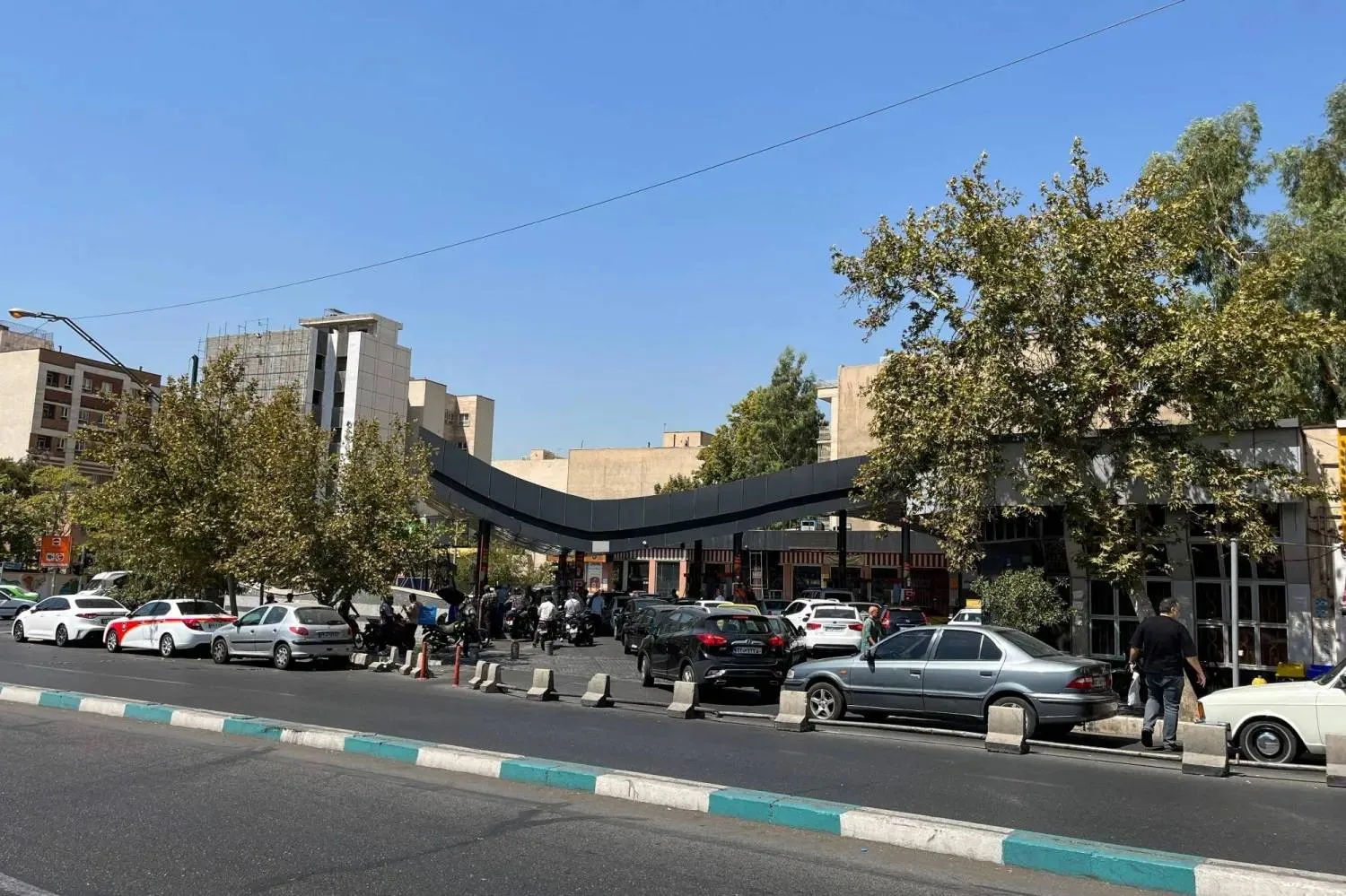

Iran Unable to Import Petrol amid US Blockade

Drivers queue at a petrol station to refuel in Tehran, on August 25, 2026. (AFP)
TT

Iran Unable to Import Petrol amid US Blockade

Drivers queue at a petrol station to refuel in Tehran, on August 25, 2026. (AFP)

Iran has been unable to import enough petrol to make up for insufficient domestic production because of a US naval blockade, a senior Iranian official said.

"Petrol production is insufficient, and because of the US naval blockade, we cannot import it," the official IRNA news agency quoted Vice President Mohammad Jafar Ghaempanah as saying on Wednesday.

The remarks came as Iranians have in recent days queued outside petrol stations, with the war with the United States increasingly shifting towards economic pressure on Tehran, said AFP.

On Monday, the Iranian president's chief of staff Mohsen Haji-Mirzaei said petrol quotas would be reviewed, without elaborating.

War broke out between Iran and the United States on February 28. Tehran has since seized control of the strategic Strait of Hormuz, with Washington imposing a naval counter-blockade on Iranian ports.

Ghaempanah criticized the distribution of highly subsidized fuel in Iran, saying the current system disproportionately benefits people who own multiple vehicles.

"The distribution of petrol in the country is inequitable. Owners of several vehicles benefit from subsidies, unlike those who do not own one," he said.

Iran, a major oil producer with some of the world's cheapest fuel, has for years heavily subsidized petrol, making any changes to pricing politically sensitive.



Iran's Guards Threaten to Hit New Targets if US Attacks

Image from a video published by the US Central Command (CENTCOM) of its operations within the naval blockade on Iran.
TT

Iran's Guards Threaten to Hit New Targets if US Attacks

Image from a video published by the US Central Command (CENTCOM) of its operations within the naval blockade on Iran.

Iran's Revolutionary Guards on Monday warned they would attack new targets and deploy new weapons if the US launches further attacks on the country.

Almost seven months into their war, Tehran and Washington remain locked in a stalemate, though neither side appears willing to return to full-scale war, said AFP.

In a statement, a spokesman for the Iranian Revolutionary Guards Corps, the ideological arm of Iran's military, said "there will certainly be significant changes in our defense and our counteroffensive" in the event of a new US attack.

"We will introduce new weapons with new capabilities into the battlefield, and the world will be surprised," he said.

"Our targets will not necessarily be the same as before either. We have new targets that have not yet been attacked."

The Guards also said they were prepared for a "prolonged war".

On Saturday, the central command of Iran's military said the US was planning new action against Tehran, according to state television, but it did not elaborate.

Fighting between the US and Iran has eased in recent days after a flare-up at the end of last month, though Tehran continues sporadic attacks on commercial ships in the Strait of Hormuz.

Both sides are maintaining rival blockades in the waterway in an effort to exert pressure.


Explosion Injures 3 South Korean Military Officers in Border Area with North Korea

This handout photo taken on August 4, 2025 and provided by the South Korean Defense Ministry shows South Korean soldiers removing loudspeakers that were set up for propaganda broadcasts near the Demilitarized Zone separating the two Koreas in an undisclosed location in South Korea. (Photo by Handout / South Korean Defense Ministry / AFP)
TT

Explosion Injures 3 South Korean Military Officers in Border Area with North Korea

This handout photo taken on August 4, 2025 and provided by the South Korean Defense Ministry shows South Korean soldiers removing loudspeakers that were set up for propaganda broadcasts near the Demilitarized Zone separating the two Koreas in an undisclosed location in South Korea. (Photo by Handout / South Korean Defense Ministry / AFP)

An explosion near South Korea's heavily fortified border with North Korea injured three South Korean military officers on Monday, South Korea's Defense Ministry said.

The ministry said the explosion occurred during an unspecified operation in the Demilitarized Zone, a border buffer zone separating the two nations that is commonly referred to as the DMZ.

The cause was not immediately clear, the ministry said.

South Korean officials did not say whether it was possible the explosion was caused by a land mine planted by North Korea, which has added mines, anti-tank barriers and other front line fortifications in recent months as relations between the war-divided rivals have sharply deteriorated.

Two of the officers were airlifted from the site by helicopter, while the third was transported by land before being airlifted, according to the ministry. The officers are being treated at a military hospital near the capital Seoul, The Associaqted Press said.

The DMZ, which is 248 kilometers (155 miles) long and 4 kilometers (2.5 miles) wide, is one of the world’s most heavily armed borders. An estimated 2 million mines are peppered inside and near the border, which also is guarded by barbed wire fences, tank traps and combat troops on both sides. The zone is a legacy of the Korean War from 1950 to 1953, which ended with an armistice but not a peace treaty.

There have been growing concerns in South Korea about increased activity by North Korean soldiers near the military demarcation line as the North strengthens its border defenses during prolonged tensions between the countries. The South Korean military has not officially confirmed media reports that North Korean soldiers crossed the MDL more than 20 times during front line operations in August alone.

The South’s military fired warning shots to repel some 10 North Korean soldiers who crossed the military demarcation line at the eastern section of the DMZ in April 2025. The North Korean soldiers retreated after the South broadcast audio warnings and fired the shots and there were no clashes. In June 2024, North Korean troops crossed the border three times, prompting South Korea to fire warning shots.

North Korean leader Kim Jong Un in recent years has suspended virtually all cooperation and diplomacy with South Korea while declaring Seoul as his most hostile enemy during a stalemate in his larger nuclear negotiations with Washington.

North Korean mines in past years have occasionally washed down a swollen river into South Korea, killing or injuring civilians. In August 2015, land mine blasts maimed two South Korean soldiers and caused tensions between the two Koreas to flare.


Washington Proposes Exchanging AI Safety Alerts with Beijing

US Treasury Secretary Scott Bessent stands next to US Trade Representative Jamieson Greer, speaking to the media, after meeting with China's Vice Premier He Lifeng (AFP) 
TT

Washington Proposes Exchanging AI Safety Alerts with Beijing

US Treasury Secretary Scott Bessent stands next to US Trade Representative Jamieson Greer, speaking to the media, after meeting with China's Vice Premier He Lifeng (AFP) 

US Treasury Secretary Scott Bessent said Sunday Washington has proposed a new “notification mechanism” for artificial intelligence incidents that could affect national security, part of weekend discussions ahead of talks at the White House this week between US President Donald Trump and China’s Xi Jinping.

“We want a shared vision of common goals and common threats,” Bessent told reporters after talks with Chinese Vice Premier He Lifeng in New York.

“We think that just like any cross-border activity, that moving from opaque to more transparency between the No 1 and the No 2 AI powers in the world is very important,” he added.

Trump has resisted calls to slow down AI development, saying that would help China catch up to US companies.

Standing together in the soaring lobby of the JPMorgan Chase headquarters late Sunday, Bessent and US Trade Representative Jamieson Greer said the groundwork had been laid for talks between Xi and Trump set to take place on Thursday.

They said the two sides had agreed to operationalize a new “Board of Trade” that the two leaders had discussed when they met in Beijing in May.

“Today those notions have become reality,” Greer said.

Greer said the countries were still discussing what “nonsensitive” items could be considered for lower tariffs, but that the list could potentially include consumer and agricultural goods, energy products and medical devices.