Gold Drifts Higher, Eyes on Fed Chair Warsh's Comments

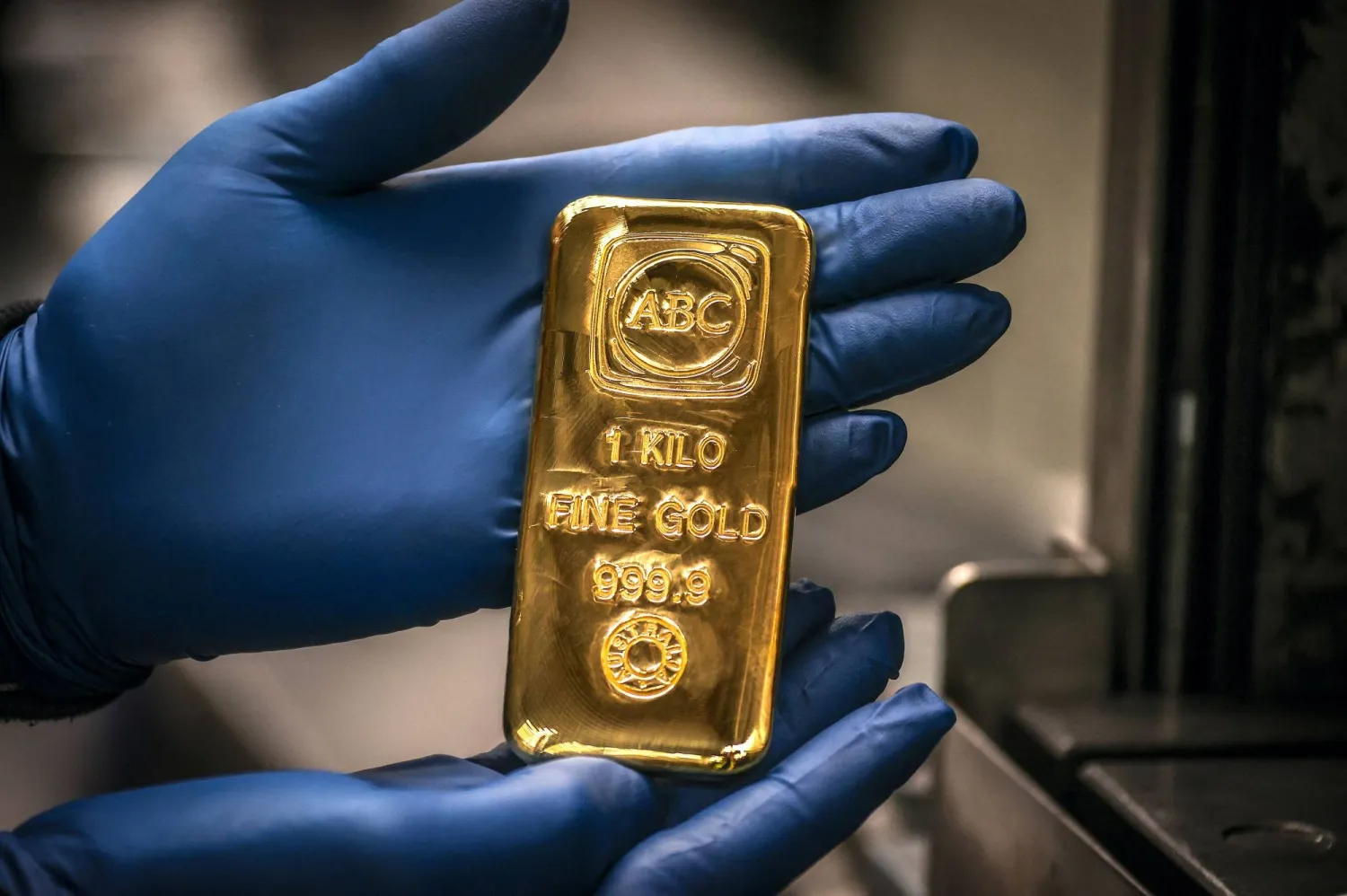
AFP_A worker displays a one kilogram gold bullion bar at the ABC Refinery in Sydney
TT

Gold Drifts Higher, Eyes on Fed Chair Warsh's Comments

AFP_A worker displays a one kilogram gold bullion bar at the ABC Refinery in Sydney

Gold prices drifted higher on Thursday as so-called dollar debasement fears lingered, while attention shifted to highly anticipated remarks from US Federal Reserve Chair Kevin Warsh this week.

Spot gold was up 0.4% at $4,611.16 per ounce by 0630 GMT. US gold futures rose 0.3% to $4,664.50, Reuters reported.

The dollar-debasement narrative, coupled with concerns about the US budget deficit, remains supportive of gold in the medium term, said Kelvin Wong, a ‌senior market ‌analyst at OANDA.

Gold prices rose over 5% ‌last ⁠week after the ⁠US Treasury's move to expand buybacks of older long-dated bonds, which renewed dollar-debasement fears.

Warsh's remarks at the annual Jackson Hole symposium in Wyoming on Friday are expected to be closely watched for further direction.

"The market is awaiting the speech for greater clarity on how the Fed will navigate the current economic landscape. ⁠If he does not provide specific forward-looking monetary ‌policy guidance, current market pricing for ‌rate hikes is likely to remain largely unchanged," Wong said.

Markets see ‌a 36.1% probability of a September US rate hike and ‌a 72.1% chance by December, according to the CME FedWatch Tool.

Data on Wednesday showed that annual US inflation held steady in July, well above the Fed's 2% target, and the unexpected pause in the ‌decline from a recent Iran war-induced peak is likely to intensify the central bank's debate ⁠over whether rates ⁠should be lifted or held steady. On the geopolitical front, Qatar's prime minister will visit Tehran to relaunch diplomacy after the US and Iran traded recriminations over Washington's promise to increase economic pressure on Tehran.

Gold is considered a hedge against geopolitical and economic risks, but higher interest rates can diminish its appeal as it pays no interest.

"The $4,700 area remains an important short-term barrier. Gold may need to consolidate within the $4,500–$4,700 range before developing fresh momentum," said Linh Tran, market analyst at XS.com.

Spot silver gained 1% to $68.77, platinum rose 0.5% to $1,837.48 and palladium firmed 0.1% to $1,329.81.


Barclays Bank to Cut about 5,000 Jobs amid AI Drive

Barclays says the job cuts are due to AI efficiencies. Paul ELLIS / AFP/File
TT

Barclays Bank to Cut about 5,000 Jobs amid AI Drive

Barclays says the job cuts are due to AI efficiencies. Paul ELLIS / AFP/File

British bank Barclays announced Thursday plans to cut around 5,000 jobs, or roughly five percent of its global workforce, by the end of 2026 in an AI efficiency drive.

The announcement came alongside an earnings update that showed Barclays' net profit grew 13 percent in the third quarter, fueled by surging income across its equities division, said AFP.

Barclays said in an earnings presentation that it was implementing "organizational simplification and technology change efficiency driven by AI".

"About 60 percent of the job losses relate to support functions, including fewer developers as AI makes our people more productive," it added.

The bank's profit after tax grew to £1.65 billion ($2.2 billion) in the third quarter from £1.46 billion in the July-September period a year earlier.

Barclays chief executive C. S. Venkatakrishnan noted "ongoing momentum of... operational and financial performance" and said the investment bank division "delivered strong equities performance".

Revenue from equities jumped 47 percent year-on-year, while total group income for the quarter climbed three percent to £7.37 billion.

Barclays' share price was up slightly following the news updates.

The AI "announcement comes as the company failed to match expectations with its third-quarter performance -- with the unveiling of a healthy share buyback failing to entirely ease investors' disappointment", noted AJ Bell investment director Russ Mould.

"Across the wider group, costs went up and Barclays shareholders are also having to contend with two major clouds over the business.

"The first being a widely expected increase in tax on the sector in next week's (UK) budget and the other being a reported probe into possible misrepresentation of risks in its private credit portfolio."


Norway Sovereign Wealth Fund Loses Over $30 Bn in 3rd Quarter

A view shows the building of Norway’s central bank (Norges Bank) in Oslo, Norway, June 23, 2022. REUTERS/Victoria Klesty/ File Photo
TT

Norway Sovereign Wealth Fund Loses Over $30 Bn in 3rd Quarter

A view shows the building of Norway’s central bank (Norges Bank) in Oslo, Norway, June 23, 2022. REUTERS/Victoria Klesty/ File Photo

Norway's sovereign wealth fund, the world's largest with assets of more than $2 trillion, on Thursday reported a negative return of 278 billion kroner ($31 billion) in the third quarter as it was weighed down by higher interest rates.

It posted a negative return of 0.5 percent in the quarter, dragged down by a negative return of 3.5 percent in its fixed-income investments, while its equity and property portfolios increased by 0.5 percent and 0.4 percent respectively.

"The fund's return was close to flat, ending slightly negative as rising interest rates led to weaker results on our fixed-income investments," the fund's deputy CEO Trond Grande said in a statement.

Invested primarily in equities, bonds and real estate across the globe, the fund reported a value of 22,014 billion kroner at the end of September.

Inflation around the world, fuelled in particular by soaring energy prices linked to the conflict in the Middle East, has led several central banks, including the US Federal Reserve and the European Central Bank, to raise interest rates in the third quarter.

"Equity returns were also close to zero, but there were large differences between sectors.

Energy companies rose the most, while interest-rate-sensitive sectors such as utilities and real estate fell," Grande said, according to Reuters.

Fueled by the Nordic country's oil revenues, the fund is invested in more than 7,100 companies spanning the globe, and holds around 1.5 percent of all listed companies worldwide, making it the world's largest single investor.


IMF: Non-Oil Activities Bolster Saudi Economy’s Resilience to Disruptions

King Fahd Highway in Riyadh (SPA)
TT

IMF: Non-Oil Activities Bolster Saudi Economy’s Resilience to Disruptions

King Fahd Highway in Riyadh (SPA)

The International Monetary Fund’s outlook for the Saudi economy points to promising prospects for recovery and growth, despite pressures from regional disruptions affecting energy production, trade flows and supply chains.

While the Kingdom’s GDP is expected to be affected in 2026 by a decline in oil and gas activity, non-oil activities are proving more resilient. The economy is projected to rebound strongly in 2027 as energy production gradually returns to normal and security and trade conditions improve.

The IMF’s Regional Economic Outlook, issued in October 2026, places Saudi Arabia among the major economies of the Middle East, North Africa, Afghanistan and Pakistan region, at a time when the region is grappling with the repercussions of conflicts and disruptions to energy supplies and global trade.

Temporary Growth Contraction, Non-Oil Activities Remain Resilient

The report forecasts that Saudi Arabia’s real GDP will contract by 3.3 percent in 2026, reflecting a decline in hydrocarbon-sector activity during the first half of the year amid disruptions affecting energy production, shipping and regional supply chains, particularly those linked to the Strait of Hormuz and Bab al-Mandab.

By contrast, the Kingdom’s non-oil activities have demonstrated resilience and performed relatively better than the energy sector, supported by sustained investment momentum and economic diversification programs associated with Vision 2030.

In the tourism sector, the Kingdom recorded the smallest decline in hotel occupancy rates compared with other countries directly affected by regional tensions, reflecting its relative ability to sustain tourism and services activity under the current circumstances.

Strong Rebound Expected in 2027

Despite the contraction expected in 2026, the IMF projects a strong rebound in the Saudi economy the following year, with real GDP forecast to grow by 7.9 percent in 2027.

The recovery is linked to the gradual return of energy production to normal levels, greater stability in security and trade conditions, and an improvement in global supply chains.

Over the medium term, the report projects Saudi real GDP growth to stabilize at around 3.6 percent by 2031, reflecting a return to a more stable growth trajectory following the volatility expected during the current period.

Inflation and Monetary Policy

On prices, average inflation in Saudi Arabia is estimated at around 2.7 percent in 2026 before stabilizing at approximately 2 percent in subsequent years, according to the projections cited in the report.

Factors including subsidies, price controls and fiscal discipline have helped contain inflationary pressures and maintain relative price stability compared with several other economies in the region.

On monetary policy, Gulf central banks, including Saudi monetary authorities, have taken steps in line with moves by the US Federal Reserve, with the aim of supporting financial market stability and limiting potential inflationary pressures.

Fiscal Resilience and Capacity to Absorb Shocks

Saudi fiscal policy in 2026 is characterized by discipline and prudence, while retaining room to direct spending toward strategic priorities, including infrastructure development, improving spending efficiency and supporting long-term structural reforms.

According to the report, the Kingdom also entered the period of regional disruption with comfortable reserves and fiscal buffers, helping it absorb temporary shocks that could affect the current account and official reserves.

These fiscal buffers are particularly important amid heightened regional and global uncertainty, providing greater capacity to withstand volatility while continuing to invest in economic priorities.

Artificial Intelligence

Investment in technology and artificial intelligence is one of the areas in which Saudi Arabia, alongside other Gulf countries, is seeking to expand its presence. The report examines announced investments in AI infrastructure and data centers, which, according to figures cited in the report, exceed 5 percent of GDP. These investments are expected to contribute to stronger productivity and growth over the medium term.

At the same time, structural reforms remain an important factor in strengthening the economy’s ability to withstand external shocks by increasing labor-market flexibility, investing in human capital and diversifying non-oil exports.

The report also points to the progress made by Gulf Cooperation Council countries in diversifying their merchandise exports over the past two decades, underscoring the importance of continuing efforts to broaden the production and trade base and reduce dependence on traditional sources of income.

Taken together, these trends underscore the importance of economic diversification and investment in new sectors in strengthening Saudi Arabia’s ability to weather the repercussions of current disruptions while preserving its medium-term growth prospects.