

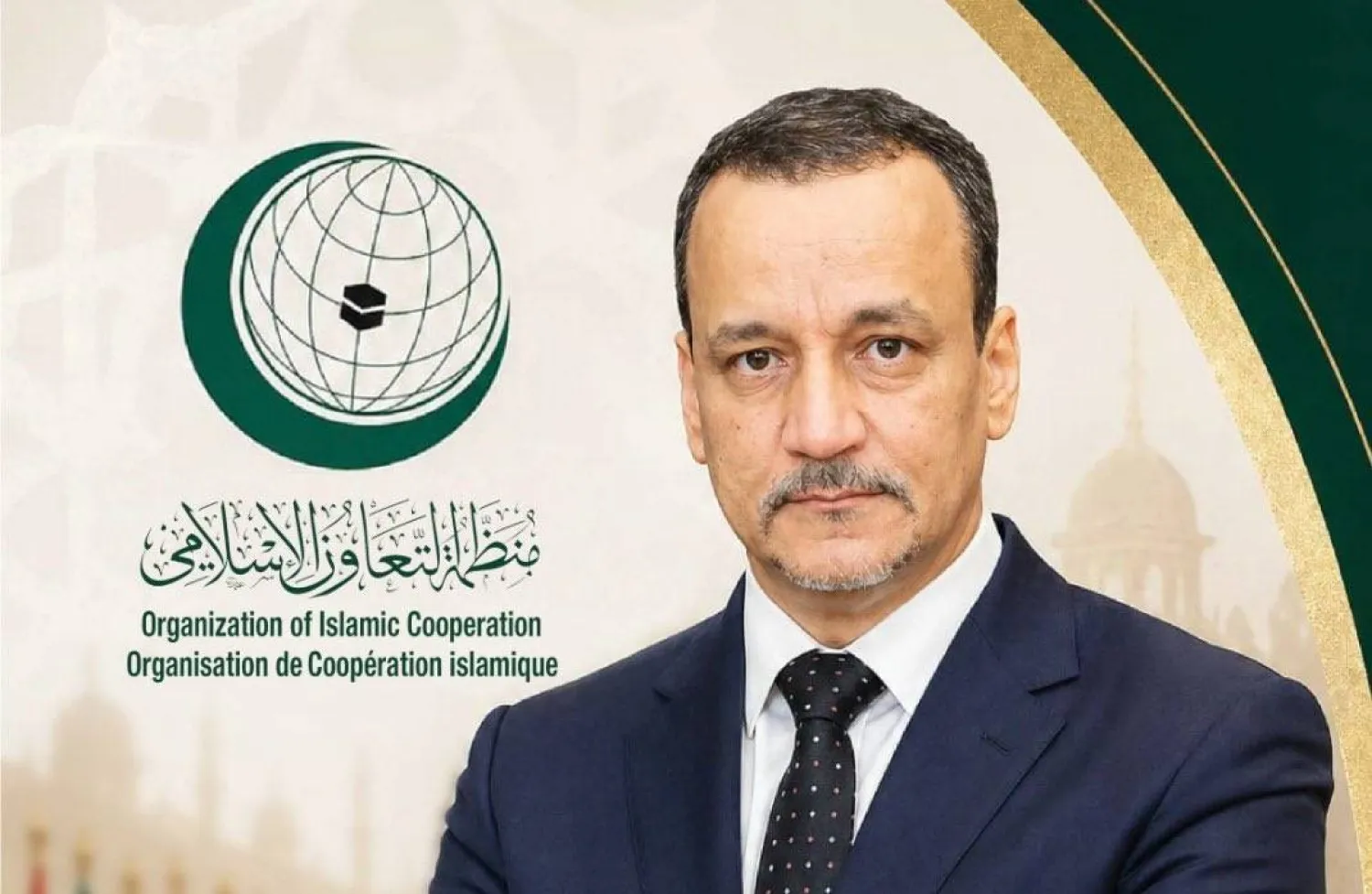

Ismail Ould Cheikh Ahmed Elected Secretary-General of the Organization of Islamic Cooperation

The new Secretary-General, Ismail Ould Cheikh Ahmed (Organization of Islamic Cooperation)
TT

Ismail Ould Cheikh Ahmed Elected Secretary-General of the Organization of Islamic Cooperation

The new Secretary-General, Ismail Ould Cheikh Ahmed (Organization of Islamic Cooperation)

Foreign ministers of the member states of the Organization of Islamic Cooperation elected Mauritanian diplomat Ismail Ould Cheikh Ahmed as the organization's new secretary-general on Thursday. The organization comprises 57 countries.

Ould Cheikh Ahmed succeeds Chadian Hussein Ibrahim Taha, who took office as secretary-general in November 2021 and whose term officially ends in November 2026.

The Mauritanian diplomat arrives in Jeddah, in western Saudi Arabia, where the organization's General Secretariat is based, bringing more than three decades of extensive experience between UN work and crisis hotspots.

The organization's charter sets the secretary-general's term at five years, renewable only once. The secretary-general is elected by the Council of Foreign Ministers of the member states according to the principles of fair geographical distribution, rotation, and equal opportunity, while taking competence, integrity, and experience into account.

The charter does not provide for a fixed sequence for the transfer of the position among the Arab, African, and Asian groups. Instead, it makes rotation and fair geographical distribution the basis for the selection.

In February, the African Union formally endorsed Ould Cheikh Ahmed's candidacy for the position for the 2027-2032 term, listing Mauritania within the Northern Africa region.



GCC Secretary-General Highlights Gulf’s Leading Global Position in Cybersecurity

GCC Secretary-General Jasem Albudaiwi. SPA
TT

GCC Secretary-General Highlights Gulf’s Leading Global Position in Cybersecurity

GCC Secretary-General Jasem Albudaiwi. SPA

Secretary-General of the Gulf Cooperation Council (GCC) Jasem Albudaiwi said that GCC member countries occupy a leading global position in cybersecurity, driven by strengthened national capabilities, data protection, and enhanced cyber threat response, SPA reported.

These remarks were made during the fifth meeting of the GCC Ministerial Committee for Cybersecurity, held in Manama.

He also pointed to recent developments in the region and the accompanying escalation of cyber risks and threats, noting that the GCC cybersecurity ecosystem demonstrated a high level of readiness and efficiency.

He highlighted key achievements in joint Gulf action, including the Executive Plan for the GCC Cybersecurity Strategy (2024–2028), the GCC International Cooperation Framework in the Field of Cybersecurity, the governance mechanism for information sharing on the Cyber Threat Intelligence Platform, and the annual organization of joint Gulf cyber drills.


Qatari PM in Tehran to Discuss Hormuz, De-escalation

US Vice President JD Vance speaks next to Pakistan's Prime Minister Shehbaz Sharif and Qatar's Prime Minister Sheikh Mohammed bin Abdulrahman bin Jassim Al Thani at the start of a quadrilateral meeting between the United States, Iran, Pakistan and Qatar at the Burgenstock luxury hotel complex overlooking Lake Lucerne, Switzerland, on June 21, 2026.  FABRICE COFFRINI/Pool via REUTERS
US Vice President JD Vance speaks next to Pakistan's Prime Minister Shehbaz Sharif and Qatar's Prime Minister Sheikh Mohammed bin Abdulrahman bin Jassim Al Thani at the start of a quadrilateral meeting between the United States, Iran, Pakistan and Qatar at the Burgenstock luxury hotel complex overlooking Lake Lucerne, Switzerland, on June 21, 2026. FABRICE COFFRINI/Pool via REUTERS
TT

Qatari PM in Tehran to Discuss Hormuz, De-escalation

US Vice President JD Vance speaks next to Pakistan's Prime Minister Shehbaz Sharif and Qatar's Prime Minister Sheikh Mohammed bin Abdulrahman bin Jassim Al Thani at the start of a quadrilateral meeting between the United States, Iran, Pakistan and Qatar at the Burgenstock luxury hotel complex overlooking Lake Lucerne, Switzerland, on June 21, 2026.  FABRICE COFFRINI/Pool via REUTERS
US Vice President JD Vance speaks next to Pakistan's Prime Minister Shehbaz Sharif and Qatar's Prime Minister Sheikh Mohammed bin Abdulrahman bin Jassim Al Thani at the start of a quadrilateral meeting between the United States, Iran, Pakistan and Qatar at the Burgenstock luxury hotel complex overlooking Lake Lucerne, Switzerland, on June 21, 2026. FABRICE COFFRINI/Pool via REUTERS

Qatar’s Prime Minister and Foreign Minister Sheikh Mohammed bin Abdulrahman Al Thani will travel to Tehran on Thursday for mediation efforts between Iran and the United States.

He is set to discuss de-escalation and create conditions for dialogue, as well as seek to restore navigation through the Strait of Hormuz to the situation before the war began on Feb. 28.

Al Thani will meet several Iranian officials during the visit to discuss reducing tensions and creating conditions for dialogue.

Qatar Foreign Ministry spokesperson Majed Al Ansari said the talks would also address freedom of navigation through the Strait of Hormuz and the need to restore it to the situation that prevailed before Feb. 28.

He said Doha remained committed to the diplomatic track to resolve disputes and promote security and stability in the region.

Iranian Foreign Ministry spokesperson Esmaeil Baghaei said Al Thani would discuss with Iranian officials the continuation of Qatar’s mediation efforts and regional developments.

Iran’s ILNA news agency said the visit was part of mediation efforts between Iran and the United States, following similar moves by Pakistan’s army chief, Field Marshal Asim Munir, and Omani Foreign Minister Badr Albusaidi in Tehran.

Qatar played an unofficial mediating role between Washington and Tehran during the war and took part in contacts that preceded a ceasefire in June, before the understandings collapsed and tensions escalated again.


Kuwait Foils Biggest Drug Operation in Its History

Sheikh Fahad Yousef Saud Al-Sabah, Kuwait's First Deputy Prime Minister and Minister of Interior. (KUNA)
TT

Kuwait Foils Biggest Drug Operation in Its History

Sheikh Fahad Yousef Saud Al-Sabah, Kuwait's First Deputy Prime Minister and Minister of Interior. (KUNA)

Sheikh Fahad Yousef Saud Al-Sabah, Kuwait's First Deputy Prime Minister and Minister of Interior, announced on Wednesday the foiling of the largest drug bust in Kuwait's history, consisting of approximately 5 tons of raw "Lyrica" powder and nearly 4 million capsules ready for sale, worth around 150 million Kuwaiti dinars, or around $486.8 million US dollars.

Speaking as part of a national drug prevention campaign, he said that Tuesday's bust also included an integrated factory for producing the psychotropic substance Lyrica, alongside equipment for filling and distributing capsules.

The bust reflects the magnitude of the danger of drugs to society, he added.

"The quantity seized was ready to be sold, but the suspect did not act to distribute it out of fear of falling under the jurisdiction of the new law."

Al-Yousef stressed that the new drug law "has contributed to boosting deterrence, making drug dealers think twice before attempting to harm any citizen or resident on Kuwaiti soil."

"Combating drugs is at the forefront of the Ministry of Interior's priorities, which continues to crack down on smugglers and distributors, tighten surveillance and seizure measures, and dry up the sources of this scourge," he said.