
Yayoi Kusama, Who Splashed Polka Dots Across the Art World, Dies at 97 in Tokyo

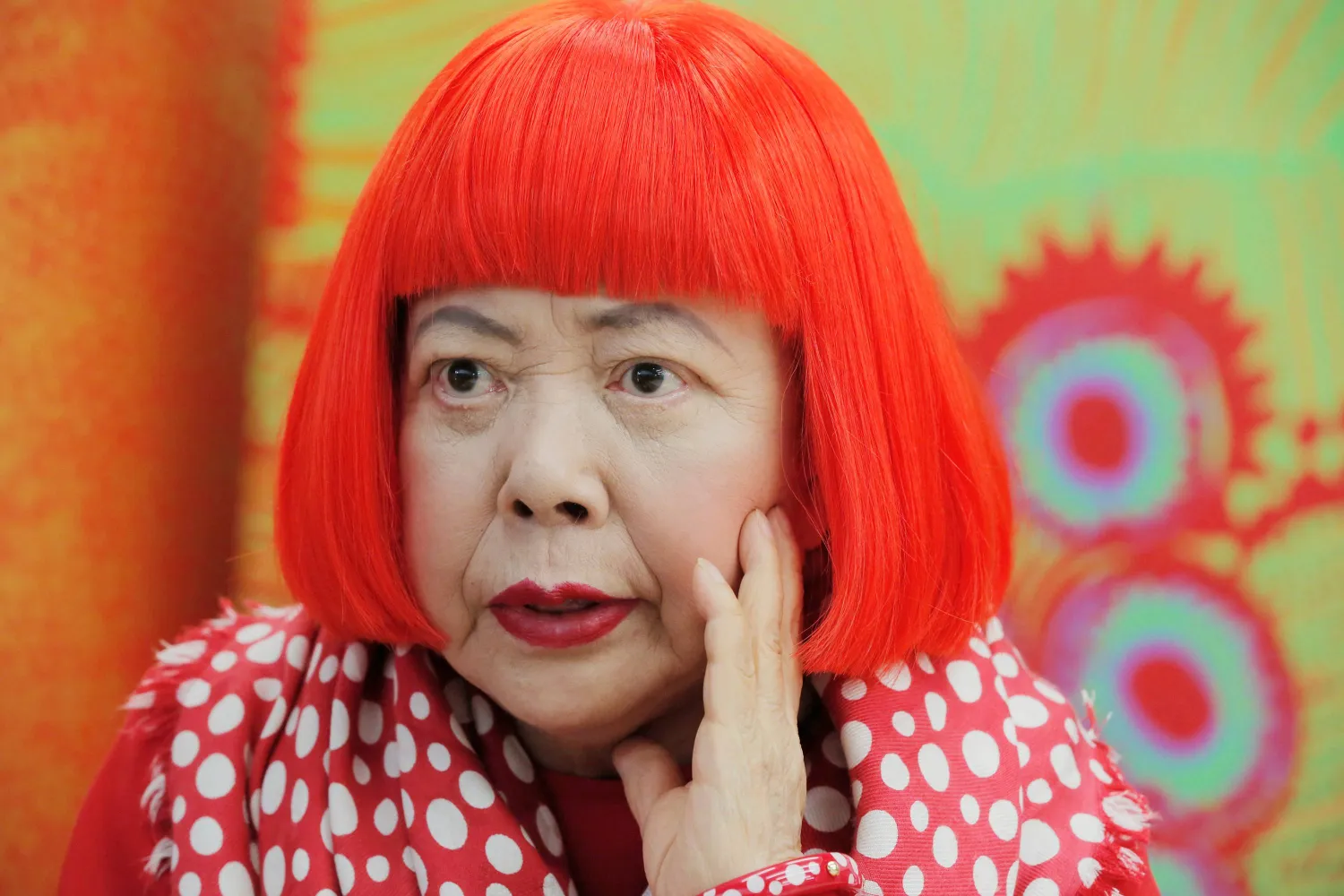
 Japanese avant-garde artist Yayoi Kusama, wearing a bright red wig and a Louis Vuitton polka dot scarf, speaks during an interview at her studio in Tokyo, on Aug. 1, 2012. (AP)
Japanese avant-garde artist Yayoi Kusama, wearing a bright red wig and a Louis Vuitton polka dot scarf, speaks during an interview at her studio in Tokyo, on Aug. 1, 2012. (AP)
TT

Yayoi Kusama, Who Splashed Polka Dots Across the Art World, Dies at 97 in Tokyo

 Japanese avant-garde artist Yayoi Kusama, wearing a bright red wig and a Louis Vuitton polka dot scarf, speaks during an interview at her studio in Tokyo, on Aug. 1, 2012. (AP)
Japanese avant-garde artist Yayoi Kusama, wearing a bright red wig and a Louis Vuitton polka dot scarf, speaks during an interview at her studio in Tokyo, on Aug. 1, 2012. (AP)

Japanese artist Yayoi Kusama, who splashed her signature polka dots on paintings, sculptures and museum installations around the world, has died, her studio said Thursday. She was 97.

Kusama died Aug. 14 at a hospital in Tokyo, Yayoi Kusama Studio said, without specifying the cause of death.

“She continued to paint until her final days, never setting aside her brush, and continued exploration of forever love and eternal soul,” the studio's statement said. “We will carry forward Kusama’s wishes and, through art, continue to bring hope and strength for the future to people around the world.”

Kusama, one of Japan’s most respected contemporary artists, was widely exhibited around the world, including the Museum of Modern Art, the Whitney Museum of American Art in New York and the Museum Ludwig in Germany.

Repetitive motifs were her trademark, in various shapes, resembling netting, swirls or worms, but most often dots, dancing proudly on her canvases, or as sparkling balls or dots of light in her installations, in all their vibrant psychedelic glory.

“Polka dots are fabulous,” Kusama said in a 2012 interview with The Associated Press, appearing in her signature orange bob wig and polka dot attire.

“I want to create a thousand paintings, maybe two thousand paintings, as many as I can draw,” she said in her childlike but matter-of-fact tone. “I will keep painting until I die.”

Kusama insisted she drew the way she saw the world: covered with spots, part of the hallucinations she said she had from childhood. She was in and out of psychiatric institution for decades, although her sickness did not hold her back as she was one of the first Japanese women to go to New York to pursue her art, in 1957.

Although soft-spoken and shy in her mannerisms, Kusama was always unabashedly bold in the assertion of her dotty vision, not only in sticking to the style for decades but also in making it accessible to the masses.

In her later years, as the times caught up with her art, she enjoyed fame. She signed on with fashion brands like Louis Vuitton as well as other licensed products like teacups, T-shirts and key chains with her illustrations, including replicas of her likeness that were used in show windows and other marketing.

In 2008, Christie’s auctioned her work for $5.8 million. In 2016, she won the most prestigious award Japan gives its artists, the Order of Culture.

Upon receiving the award, she told reporters she was more determined than ever to pursue her art, stressing that the sincerity and devotion she had demonstrated in her personal life were crucial parts of her artistic legacy.

“I feel there is little left in my life, but I am now still fighting to the death for my art,” she said. “I am giving all I have so that many people will continue to be interested in my art, even after I am dead.”

Kusama was called pop, avant-garde, feminist, just to name some of the categories thrown at her, most of which Kusama brushed off as not quite representative of her art.

She was born in a middle-class family but felt misunderstood, as her parents wanted her to simply get married. They wanted to buy her kimono, not paints and brushes. She knew she had to get away. She chose America.

When she arrived in New York, the fad was “action painting,” characterized by dribbles, swooshes and smears, not dots. She suffered years of poverty and obscurity. But she kept painting dots.

She put circles of paper on people’s bodies, and once a horse, in “happening” anti-war performances in the late 1960s, which got some people arrested for obscenity but helped get media attention for her art. While in New York, she befriended artists like Andy Warhol, Georgia O’Keeffe and Joseph Cornell, who praised her innovative style.

Over the years, Kusama made quirky but stunningly celebratory works like “Macaroni Girl,” a female figure plastered with macaroni, which expresses the fear of food and “The Visionary Flowers,” giant sculptures of twisting tulips.

Kusama, who has also made films and published several novels, said she wasn’t sure where she got her ideas. She just picked up her brush and started drawing. The process was so mysterious sometimes she surprised herself, she told AP.

“I think, ‘Oh, I drew that? I was thinking that,’” she said.

But she appeared happy to have her art be the focus of media attention and praise, reading one of her poems to a reporter or tackling her artworks with gusto for photos.

But she was also a charmingly disarming mix of vulnerability and defiance, at one moment declaring herself “an artistic revolutionary,” and then the next, mumbling: “I am so afraid, all the time, of everything.”

The news of her death was met with an outpouring of sadness from around the world, including museums that had exhibited her works.

Fans and artists alike praised her courageous persistence in vowing to continue creating art that, she said, will be recognized thousands of years after her death.

Messages recognizing her death were sent from people throughout Japan including Tokyo Gov. Yuriko Koike and Yoshitomo Nara, a younger Japanese artist who has exhibited widely abroad.

“RIP Kusama-sensei,” Nara wrote on his X account, respectfully calling her a teacher in Japanese.

Egypt’s Fayoum Mummy Portraits to Travel Abroad for 1st Time after Restoration

Fayoum portraits, "Tondo of the Two Brothers", Egyptian icons from the Greco-Roman period the 1st century BC, are displayed at the Egyptian Museum in Cairo, Egypt, Sunday, Oct. 11, 2026, after being restored. (AP Photo/Amr Nabil)
TT

Egypt’s Fayoum Mummy Portraits to Travel Abroad for 1st Time after Restoration

Fayoum portraits, "Tondo of the Two Brothers", Egyptian icons from the Greco-Roman period the 1st century BC, are displayed at the Egyptian Museum in Cairo, Egypt, Sunday, Oct. 11, 2026, after being restored. (AP Photo/Amr Nabil)

Egypt unveiled Sunday a restored version of the “Tondo of the Two Brothers,” a prized 2nd-century painting from the famed Fayoum portraits.

Specialists from Rome worked alongside conservators from the Egyptian Museum in Tahrir — where the collection is usually kept — for three weeks to restore the artwork, officials said at a press conference.

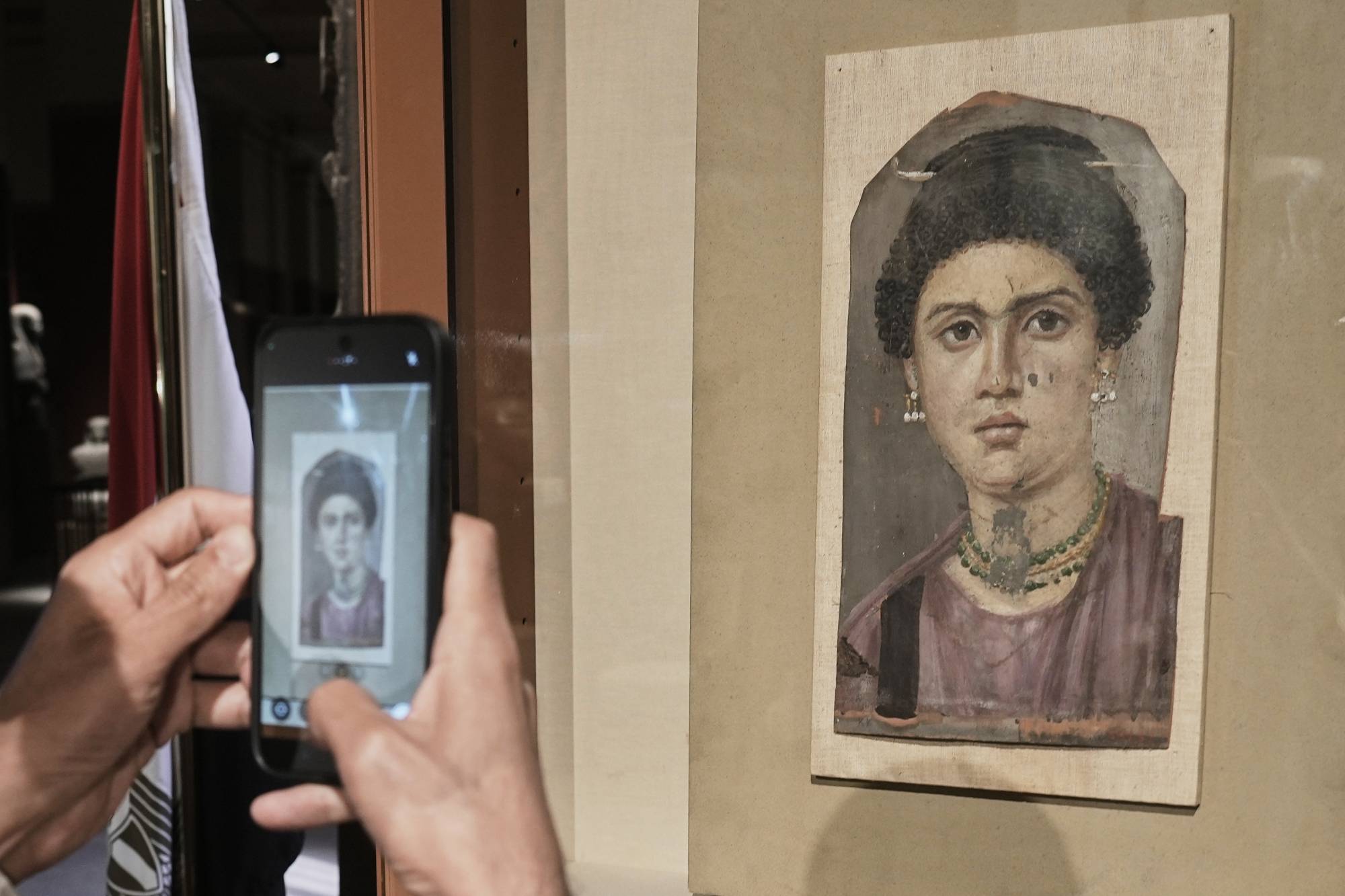
A visitor films one of Fayoum portraits, "Demos", from the Greco-Roman period the 1st century BC, at the Egyptian Museum in Cairo, Egypt, Sunday, Oct. 11, 2026, after being restored. (AP Photo/Amr Nabil)

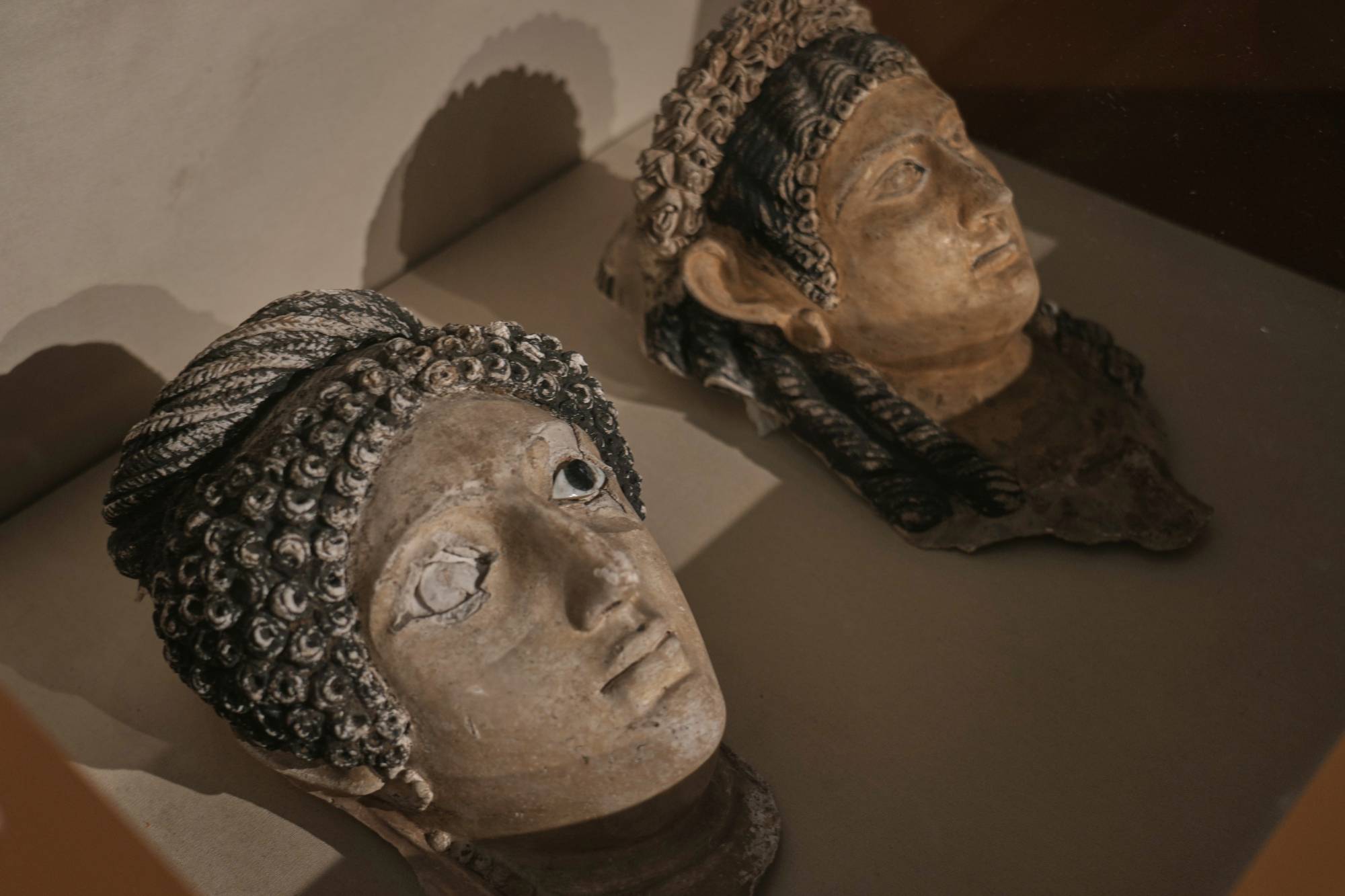
Fayoum mummy portraits were painted primarily on thin wooden panels and placed over the faces of the deceased within mummy wrappings, combining Egyptian funerary traditions with artistic influences from the wider Greco-Roman world.

Egypt will lend a major part of the collection to a temporary exhibition in Rome, marking the first time it will travel abroad.

“The restoration of the Tondo of the Two Brothers is an important example of what can be achieved through international cooperation in the preservation and study of cultural heritage,” said Sherif Fathy, Egypt’s minister of tourism and antiquities. “Egypt and Italy share deep historical and cultural ties, and this project brings together Egyptian and Italian expertise to preserve an exceptional work of art for future generations.”

Experts describe the painting as unusual because of its circular shape and its depiction of two people instead of one, and rank it among the most vivid surviving portraits from Roman-era Egypt. It was painted using a technique in which pigments are mixed with molten wax, and restorers were able to recover the features of the brother on the right.

Aly Abdel Halim, director general of the Egyptian Museum in Tahrir, said the conservation required careful intervention because both the wooden support, damaged by termites, and the painted surface were fragile.

Fayoum portraits, "Tondo of the Two Brothers", Egyptian icons from the Greco-Roman period the 1st century BC, are displayed at the Egyptian Museum in Cairo, Egypt, Sunday, Oct. 11, 2026, after being restored. (AP Photo/Amr Nabil)

The portraits will be featured in an exhibition in Rome from November to May 2027, The Associated Press reported.

Tomaso Radaelli, chairman of MondoMostre, the exhibition’s organizer, said it will bring together more than 110 objects, including painted panels, funerary shrouds, masks, marble portraits, plaster casts and ancient jewelry.


Mayor: Two Renoir Paintings Stolen in France Recovered

FILE PHOTO: A sign indicates the entrance of the Renoir Museum in Cagnes-sur-Mer, on the French Riviera, France, September 8, 2026. REUTERS/Manon Cruz/File Photo
TT

Mayor: Two Renoir Paintings Stolen in France Recovered

FILE PHOTO: A sign indicates the entrance of the Renoir Museum in Cagnes-sur-Mer, on the French Riviera, France, September 8, 2026. REUTERS/Manon Cruz/File Photo

Two paintings by French master Pierre-Auguste Renoir have been recovered a month after they were stolen from a museum in southern France, the town's mayor said Friday.

In September, thieves broke into the museum in Cagnes-sur-Mer and managed to escape with two works by the French impressionist painter, abandoning two others as they fled.

"These two paintings are not simply works of art. They are part of our city's history," said Bryan Masson, the mayor of Cagnes-sur-Mer.

"Knowing they have been recovered is an immense relief."

There has not yet been any statement from the police and Masson did not give any details regarding where the works were found or their condition.

The suspects cut through a fence to enter the museum's tree-lined grounds, smashed a window to get inside, and used an electric saw to cut through the frame mountings, Masson said at the time of the robbery in early September.

The theft took place in just a matter of minutes, shortly before 6:00 am (0400 GMT).
A source close to the probe told AFP earlier this week that police had arrested five people as part of the investigation.

According to Masson the museum alarm and police sirens forced the burglars -- which he described as "well equipped and well informed" about the museum -- to hurry.

They made off with a portrait titled "Madame Colonna Romano" and the depiction of a woman at a well called "Jeune femme au puits", his office said.

The paintings dropped during their escape include "Madame Pichon" and "Coco lisant", a portrait of Renoir's young son Claude reading.

The police said at the time of the robbery that it was clear that they were not first-time offenders, and that they had scoped out the premises before the crime.

The Renoir Museum lies a half-hour drive from the southern city of Nice, in Renoir's last home before he died aged 78 in 1919.

Its collection comprises nine paintings by Renoir, according to the museum.

It also includes several sculptures by him, as well as objects and furniture that belonged to the painter, such as his easel and wheelchair.

A spate of heists at French museums -- including at the Louvre -- has highlighted inadequate security in some cases and led to questions about whether criminal gangs see them as soft targets.

Crown jewelry valued at around $100 million was stolen in broad daylight from the Louvre in Paris last year.

The four suspected Louvre robbers have been arrested, but the jewels they are accused of grabbing in the seven-minute heist have still not been found.

Italian police in August said they had recovered paintings by Renoir, Cezanne and Matisse worth over $10.4 million that were stolen in a three-minute heist from a museum in March.
And earlier this week, a book featuring a cover made of bronze and designed by Spanish surrealist painter Salvador Dali was stolen from an art museum in central France.


PM: Anne Carson's Nobel Literature Prize 'a Proud Moment for Canada'

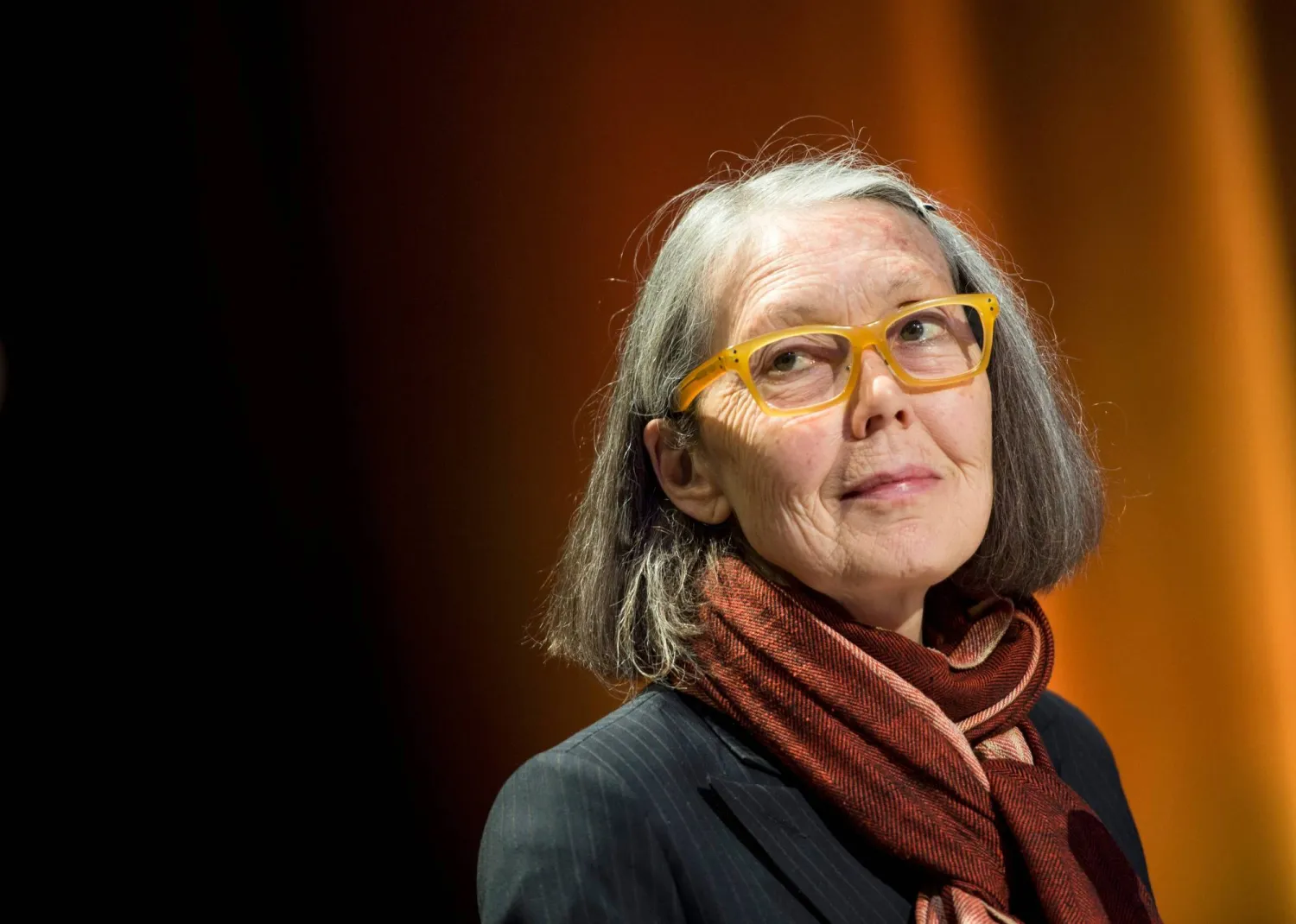
Canadian poet Anne Carson, winner of the 2026 Nobel Prize in Literature, performs her work "Antigonick" at the Moderna Museet art gallery in Stockholm, Sweden, May 8, 2015. (Pontus Lundahl/TT News Agency via AP)
TT

PM: Anne Carson's Nobel Literature Prize 'a Proud Moment for Canada'

Canadian poet Anne Carson, winner of the 2026 Nobel Prize in Literature, performs her work "Antigonick" at the Moderna Museet art gallery in Stockholm, Sweden, May 8, 2015. (Pontus Lundahl/TT News Agency via AP)

Canadian poet Anne Carson winning the Nobel prize for literature is a "proud moment" for the country, Prime Minister Mark Carney said Thursday.

The 76-year-old's works feature "wit, imagination, and a style entirely her own," Carney said on X.

"She has brought ancient stories to new audiences and transformed the way we think about literature," he said, calling the award "an extraordinary achievement and a proud moment for Canada."

In a statement to AFP, Canadian novelist Margaret Atwood said Carson's work "has long been admired among poets of many countries."

"For new readers I would recommend 'The Beauty of the Husband' -- direct and visceral, funny and angry and sad - or 'Men in the Off Hours.' Delights await!" added Atwood, a longtime Nobel contender who was passed over in 2013 in favor of fellow Canadian Alice Munro.

A renowned classicist, Carson has taught at several prestigious Canadian and American universities, including McGill in Montreal. She joined McGill's Department of Classics in 1988 and left the university in 2002.

"This is a wonderfully deserved honor for Anne Carson, whose work has captivated readers around the world by bringing ancient voices into conversation with the present," Lisa Shapiro, McGill's dean of arts, was quoted as saying by The McGill Reporter.

"Her extraordinary talent, originality and intellectual depth have had a profound influence on contemporary literature. We are proud that McGill was her academic home for many years and delighted to see her remarkable contributions recognized on the world stage."

Outside the university in Montreal, Vicky Huang, a 24-year-old political science student, expressed pride.

"My friends and I love 'Eros the Bittersweet,' so this is such exciting news," she told AFP.

"Yeah, I mean, the fact that she's a Canadian woman working in high literature makes all of us really proud."