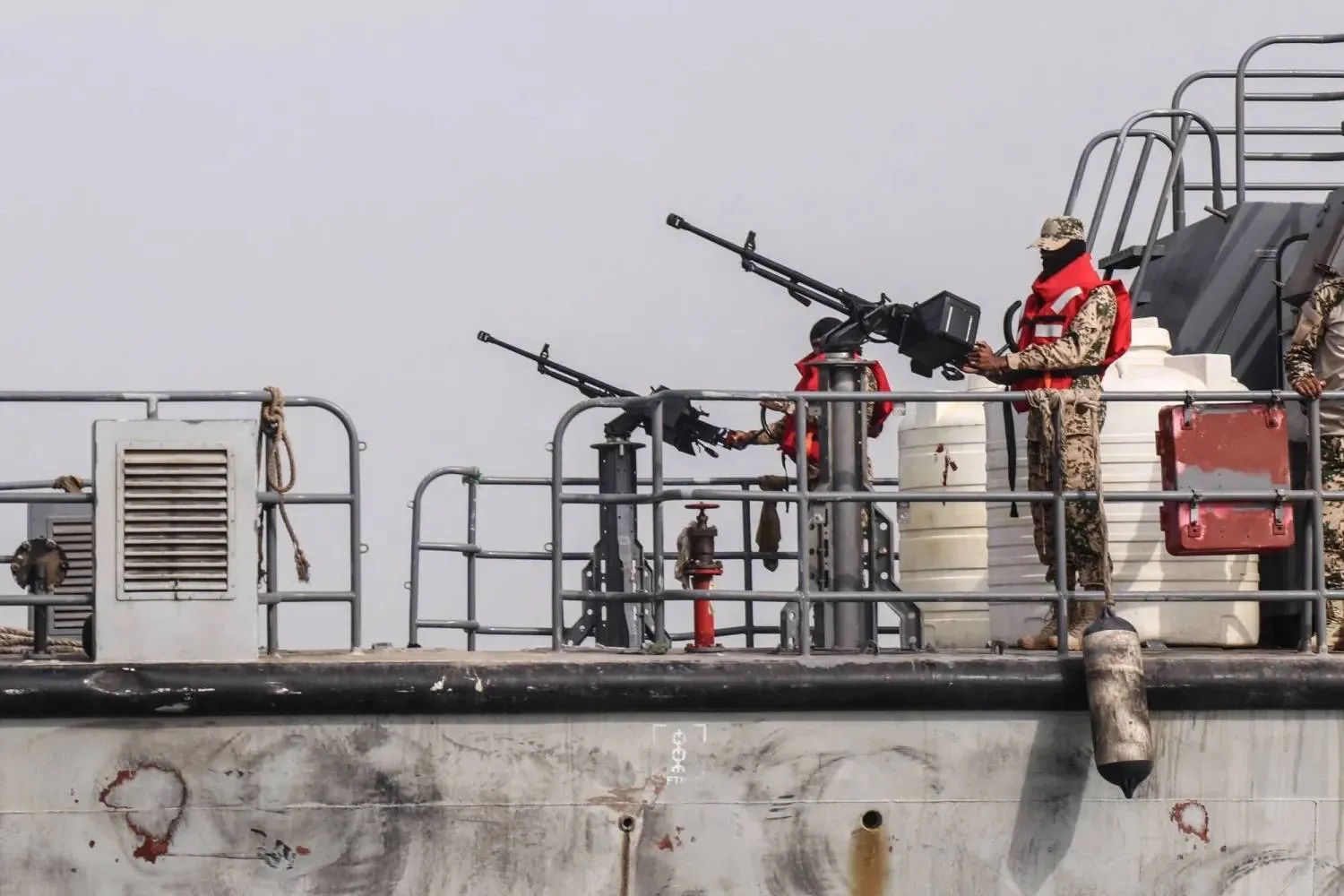
Yemen Navy Thwarts Houthi Attack in Red Sea

Yemeni naval forces on patrol in the Red Sea. (AFP)
TT

Yemen Navy Thwarts Houthi Attack in Red Sea

Yemeni naval forces on patrol in the Red Sea. (AFP)

The Yemeni navy thwarted an attack by the Iran-backed Houthi group in the southern Red Sea, hours after busting an attempt to smuggle equipment believed to be used in the manufacturing of drones.

The bust indicates that the Houthis are continuing their military and logistic activities on the Yemeni coasts and international marine passages.

Military media of the national resistance on the western Yemeni coast said naval patrols detected five Houthi vessels that had tried to approach the region overlooking international waterways. A clash ensued and the Houthis were forced to retreat north towards Hodeidah.

The forces also downed a drone that was on a surveillance mission.

Hours earlier, the navy busted the smuggling attempt. Drone material was being smuggled on a wooden boat from Iran to the Houthis.

The Houthis have escalated their ground and sea attacks in recent weeks, using drones and ballistic missiles against civilian and military installations along the west coast. The militants have also attacked commercial vessels in the Red Sea and Bab al-Mandeb Strait.

On Wednesday night, the Houthis fired four ballistic missiles at Mokha port west of Taiz city. Three hit the port, while the fourth landed inside Khokha city, a military source told the state news agency Saba.

The missiles were fired in regions held by the Houthis east of Taiz city.

The attack was the latest by the Houthis on Mokha that have left extensive damage to the port, which is vital to the west coast.

The Houthis also attacked central Taiz city on Wednesday using mortars, damaging a judicial building. No casualties were reported.

Yemeni authorities say that Houthi attacks on civilian facilities and residential areas in Taiz has become normal as the city and its surroundings are on the frontline between the government forces and Houthis.


US Ambassador: Hezbollah Ties to Iran Affect Lebanon and the Course of Talks

President Joseph Aoun presiding over a ceremony marking the 81st anniversary of General Security (Lebanese Presidency)
TT

US Ambassador: Hezbollah Ties to Iran Affect Lebanon and the Course of Talks

President Joseph Aoun presiding over a ceremony marking the 81st anniversary of General Security (Lebanese Presidency)

The stalled US-Iranian negotiations remain uncertain, and their direct or indirect impact on Lebanon continues to loom over efforts to achieve tangible results in talks with Israel, meanwhile President Joseph Aoun reaffirmed the state's commitment to its institutions and role.

US Ambassador to Lebanon Michel Issa made notable remarks, linking developments in southern Lebanon to events unfolding between Washington and Tehran. He also stressed that any engagement with Hezbollah would take place only through the Lebanese state.

Aoun: State moving forward

Aoun said the state was continuing to strengthen its presence and institutions, alongside the negotiations.

"We are engaged in an internal struggle between people who do not want state institutions, who are the antithesis of the state and live at its expense in its absence, and between us and you, who want the state and its institutions," Aoun said during a ceremony marking the 81st anniversary of the General Security.

He added: “We here tell them, whatever you do, we will continue. Not for your sake, but for the sake of citizens to whom we owe a duty."

Issa: Southern Lebanon talks tied to Washington-Tehran Tension

US Ambassador to Lebanon Michel Issa said negotiations over southern Lebanon cannot be separated from regional developments, particularly talks between Washington and Tehran.

He said Hezbollah must surrender its weapons to the state, adding that continued links between the group and Iranian decision-making are affecting Lebanon and the course of negotiations.

Ministerial sources said US-Lebanese-Israeli talks would continue, with a new round expected in Rome in September, but acknowledged that progress hinges partly on the outcome of US-Iranian negotiations and Tehran’s ties with Hezbollah.

Issa clarifies US position: Any Contact with Hezbollah to Go Through the State

US Ambassador Michel Issa clarified that any US engagement with Hezbollah would take place through the Lebanese state, saying Washington could help bridge differences through negotiations. He reiterated that Hezbollah must surrender its weapons and accused the group of taking orders from Iran.

Issa also said talks with Israel are between the Lebanese and Israeli states, with Washington seeking to narrow differences while pressing Israel to reduce strikes in southern Lebanon. He added that Hezbollah’s future would depend partly on whether Iran maintains its support for the group.


Arms Embargo: Can Washington Breach the Wall of Sudan’s War?

Massad Boulos, senior adviser to the US president for Arab and African affairs (AFP) 
TT

Arms Embargo: Can Washington Breach the Wall of Sudan’s War?

Massad Boulos, senior adviser to the US president for Arab and African affairs (AFP) 

The United States has stirred the stagnant waters of Sudan’s war by announcing plans to expand an arms embargo imposed on Darfur for more than two decades to cover the entire country.

The move appears aimed at shifting from limited sanctions to a direct attempt to reduce the warring parties’ ability to keep fighting and force them to reconsider the cost of seeking a military victory compared with returning to negotiations. It is a risky step, but one that also signals Washington’s determination to make a breakthrough in a war described as one of the world’s largest and most severe humanitarian crises.

Massad Boulos, senior advisor to the US president for Arab and African affairs, told the UN Security Council days ago that the US proposal would cover drones, related technologies and components, while strengthening the work of the sanctions panel of experts tasked with monitoring violations.

The current Darfur arms embargo expires Sept. 12, making the coming weeks a test of Washington’s ability to build consensus in the Security Council. Russia has voiced clear reservations, saying it would not accept measures affecting the Sudanese army’s capabilities, while China has taken a cautious position on expanding sanctions, leaving adoption of the proposal in its current form uncertain.

Washington views the proposed embargo as a pressure tool rather than merely a punitive measure. According to The Associated Press, the US administration believes restricting the flow of weapons to the belligerents could push them back to the negotiating table. UN political affairs chief Rosemary DiCarlo has meanwhile warned against the parties’ continued reliance on a military solution and the steady influx of sophisticated weapons.

Sudan’s Sovereignty Council chairman and army chief Gen. Abdel Fattah al-Burhan, however, has played down the possible impact of sanctions, saying they would neither affect Sudan nor weaken the armed forces’ resolve. He insisted the army would continue fighting until it retakes all areas controlled by the Rapid Support Forces.

The contrast shows the political struggle surrounding the US proposal. Washington wants to convince both sides that the flow of weapons cannot remain open-ended, while Sudan’s military leadership continues to speak in terms of retaking territory by force. The RSF is likewise reinforcing its positions and relying on supply networks, weapons and drones.

The US premise is that the ability to rearm prolongs the war: As long as each side believes it can replace its losses and obtain more drones, ammunition, fuel and financing, its incentive to compromise remains limited. If supplies become more difficult and costly, military calculations could gradually shift toward a settlement.

Drone use has expanded significantly in recent months, with attacks extending beyond front lines to cities, markets, electricity and water facilities and health infrastructure. Rosemary DiCarlo, the UN's under secretary-general for political and peacebuilding affairs, said sophisticated weapons, including drones, have become a major factor in increasing the war’s toll on civilians.

Restricting drones and their components, ammunition and heavy weapons could therefore yield an immediate humanitarian benefit by reducing long-range attacks, civilian casualties, displacement and disruption to hospitals and electricity and water networks, while improving humanitarian access.

But the plan’s success will depend on enforcement. The Darfur embargo, in place since 2005, failed to stop weapons from entering the region, exposing the limits of UN resolutions without effective monitoring and enforcement mechanisms.

Opposition Welcomes Proposal

Sudanese civilian opposition forces welcomed the US proposal while stressing that it should be linked to a comprehensive political process.

Khalid Omer Yousif, a leader in the Sumoud alliance, said pressure on both warring parties should be part of an “integrated package” to end the fighting and restore the civilian political process, rather than an isolated punitive measure.

Yasir Arman, head of the Sudan People’s Liberation Movement–Revolutionary Democratic Current, warned that piecemeal measures could lead to “managing the war rather than ending it,” calling for a joint African Union-UN roadmap to halt the fighting and preserve Sudan’s unity.

The real test of Washington’s seriousness will be whether it can move from a Security Council resolution to pursuing supply networks, including flights, land routes, brokers, companies and individuals facilitating the purchase and transfer of weapons to Sudan.

Washington does not appear to be relying on the embargo alone to end the war. Rather, the proposal is likely part of a broader effort to raise the cost of continued fighting while pushing for negotiations. US officials say the goal is not to hand victory to one side over the other, but to reduce both sides’ ability to wage an open-ended war.

Ultimately, the seriousness of the US effort will be measured by its willingness to pressure the parties’ backers, not only the Sudanese belligerents themselves. If weapons continue to flow, expanding the embargo will amount to little more than a legal framework with limited effect. But if combined with monitoring, sanctions and simultaneous diplomatic pressure to reopen negotiations, it could become one of the strongest international tools of pressure deployed since the war began.

At its core, the US proposal brings two opposing calculations into direct confrontation: Washington wants to make continuing the war harder and more costly, while both sides insist on fighting until they recover all territory. Between them, civilians stand to benefit most from any measure that genuinely reduces the flow of instruments of war, even before a comprehensive political settlement is reached.


Syria Sentences to Death Former Regime Informant as Moscow Says Took in Assad on Humanitarian Grounds

The fourth Criminal Court of the transitional justice in Damascus sentences former regime informant Abdel Nasser Buraqi to death. (SANA)
TT

Syria Sentences to Death Former Regime Informant as Moscow Says Took in Assad on Humanitarian Grounds

The fourth Criminal Court of the transitional justice in Damascus sentences former regime informant Abdel Nasser Buraqi to death. (SANA)

The fourth Criminal Court of the transitional justice in Damascus issued on Thursday a death sentence against former regime informant Abdel Nasser Buraqi after convicting him of grave crimes during the rule of ousted President Bashar al-Assad.

The accusations include forced disappearance, denial of freedom, participation in murder, torture leading to death, theft and criminal defamation.

Lawyer Radif Mustafa, Director of the Accountability and Justice Department at the National Commission for Transitional Justice, told the state news agency SANA that the court relied on international law to characterize the offenses as war crimes and crimes against humanity, in line with the Constitutional Declaration, to determine the nature, gravity, and causes of the crimes. Meanwhile, the court based its sentencing on the provisions of Syrian national law

Mustafa said the court decided to merge the sentences and apply the harshest penalty, which is execution.

It upheld the provisional seizure of the convict's assets, converting it into an executive seizure, and denied him any discretionary mitigating circumstances due to the massive scale and gravity of the committed crimes, he said in a post on Facebook.

He added that the ruling was a "the first judicial precedent in Syria's history."

"While informants were protected during the era of the ousted regime, they are now facing justice. This is the group that harmed people the most," he stressed.

Meanwhile, internal security forces in Latakia announced the arrest of Major Generals Haitham Barakat and Marwan Barakat, both officers from the ousted regime, during an operation in the city of Qardaha.

This operation follows several similar ones across various governorates. Security forces in Daraa announced on August 15 the arrest of Musab Abu Rukba, a former regime lieutenant colonel in the Raqqa Political Security branch.

The forces said the arrests are part of counter-terrorism efforts aimed at strengthening security and stability.

Separately, Russian Foreign Ministry spokeswoman Maria Zakharova said Russia granted Assad asylum on humanitarian grounds, not political ones.

Speaking at a press conference during which she was asked whether Moscow would turn him over to the new Syrian authorities, she replied: "There were and are no political grounds behind his stay in our country. The decision was made solely on humanitarian grounds: the dramatic circumstances of the change of power in Syria meant that he and his family faced death."

The authorities in Syria sentenced Assad to death in absentia earlier in August.