


Death Toll Rises in Nepal-China Border Disaster as a Lake Poses New Flood Threat

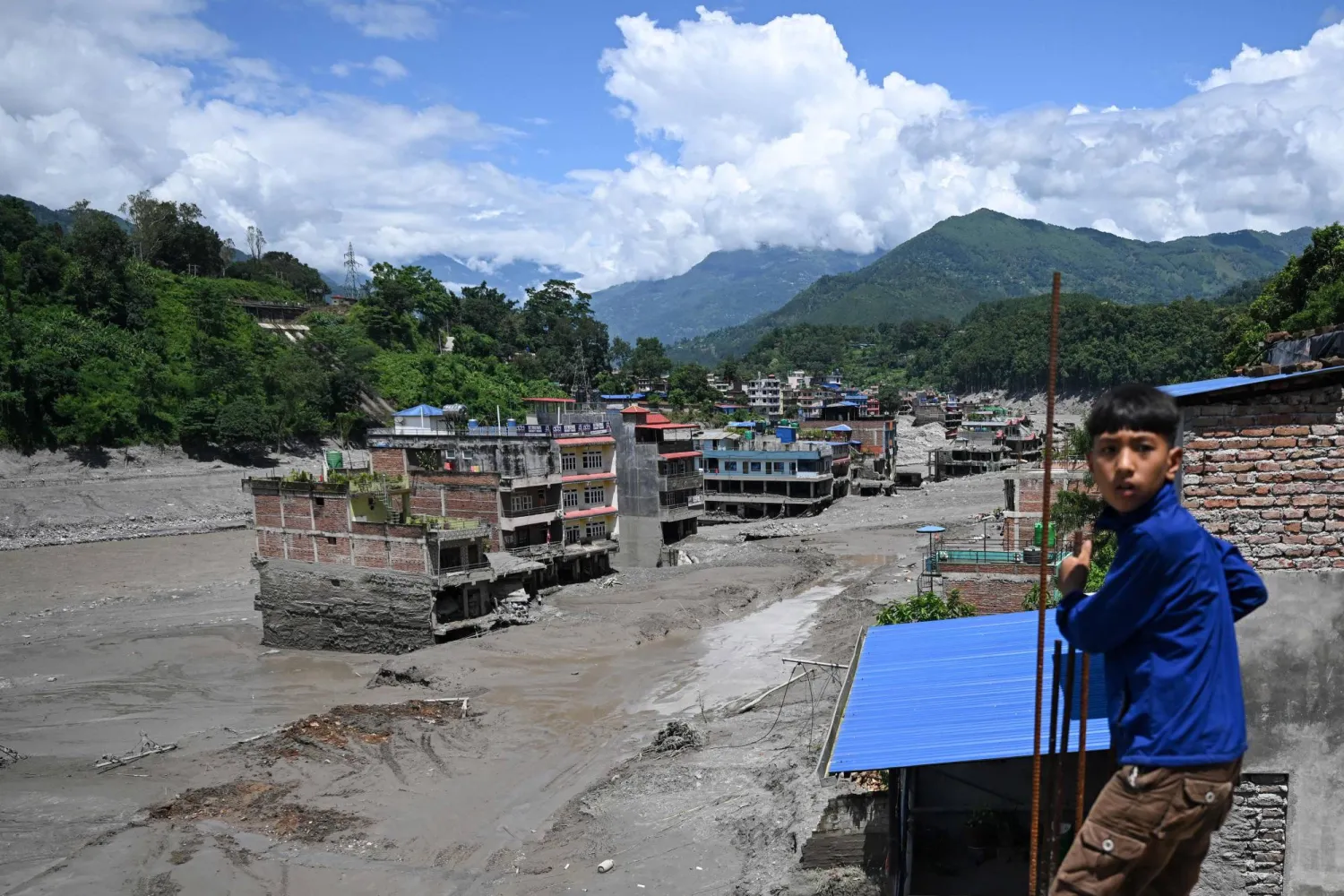
A general view shows houses lying deluged in sludge after flash floods at Trishuli in Nepal's Nuwakot district on August 27, 2026. (AFP)
TT

Death Toll Rises in Nepal-China Border Disaster as a Lake Poses New Flood Threat

A general view shows houses lying deluged in sludge after flash floods at Trishuli in Nepal's Nuwakot district on August 27, 2026. (AFP)

Rescuers pulled out survivors caked in dark brown mud and helicopters lifted stranded people to safety Friday as Nepal and China raced to respond to catastrophic flash floods that killed more than 500 people and left more than 1,500 missing.

Nepal's disaster management authority said the death toll there rose to 538, and that more than 3,700 people have been rescued. Nepali police later put the number of deaths higher at 547.

Meanwhile there was little information on survivors on the Chinese side, where the death toll rose to five Friday as state media showed evacuations of villages and leaders' efforts to direct the relief response.

China's state media previously said 558 people were missing. Across the border, Nepal’s disaster management authority said Friday that 977 people were still unaccounted for. Hundreds of them were foreigners in the area to work, trek or make a pilgrimage to a sacred peak.

Authorities warn of further flooding from a new lake Nepali police issued a fresh alert Friday after receiving information that a dam on the Tibet side has burst. Security personnel and rescue and relief workers were told to stay on high alert and immediately move to a safe location if necessary.

It is unclear if the dam bursting is related to flooding concerns over a barrier lake that formed after the initial flash floods, high up in the Chinese side of the Himalayan mountains. Chinese broadcaster CCTV said the lake was at an elevation of 2,950 meters (9,680 feet.)

Nepali and Chinese authorities earlier warned of further flooding from the barrier lake, which was already overflowing. They urged people in potentially affected areas to move to safer ground.

Nepal police spokesperson Abi Narayan Kafle told The Associated Press that the rescue operation was continuing but with high alert. “It hasn’t stopped," he said.

Although the new lake is located more than 10 kilometers (6 miles) from Gyirong Port, the hard-hit border crossing with Nepal, rescue workers heading to the disaster zone were ordered to stop temporarily Friday morning owing to concern the lake would overflow.
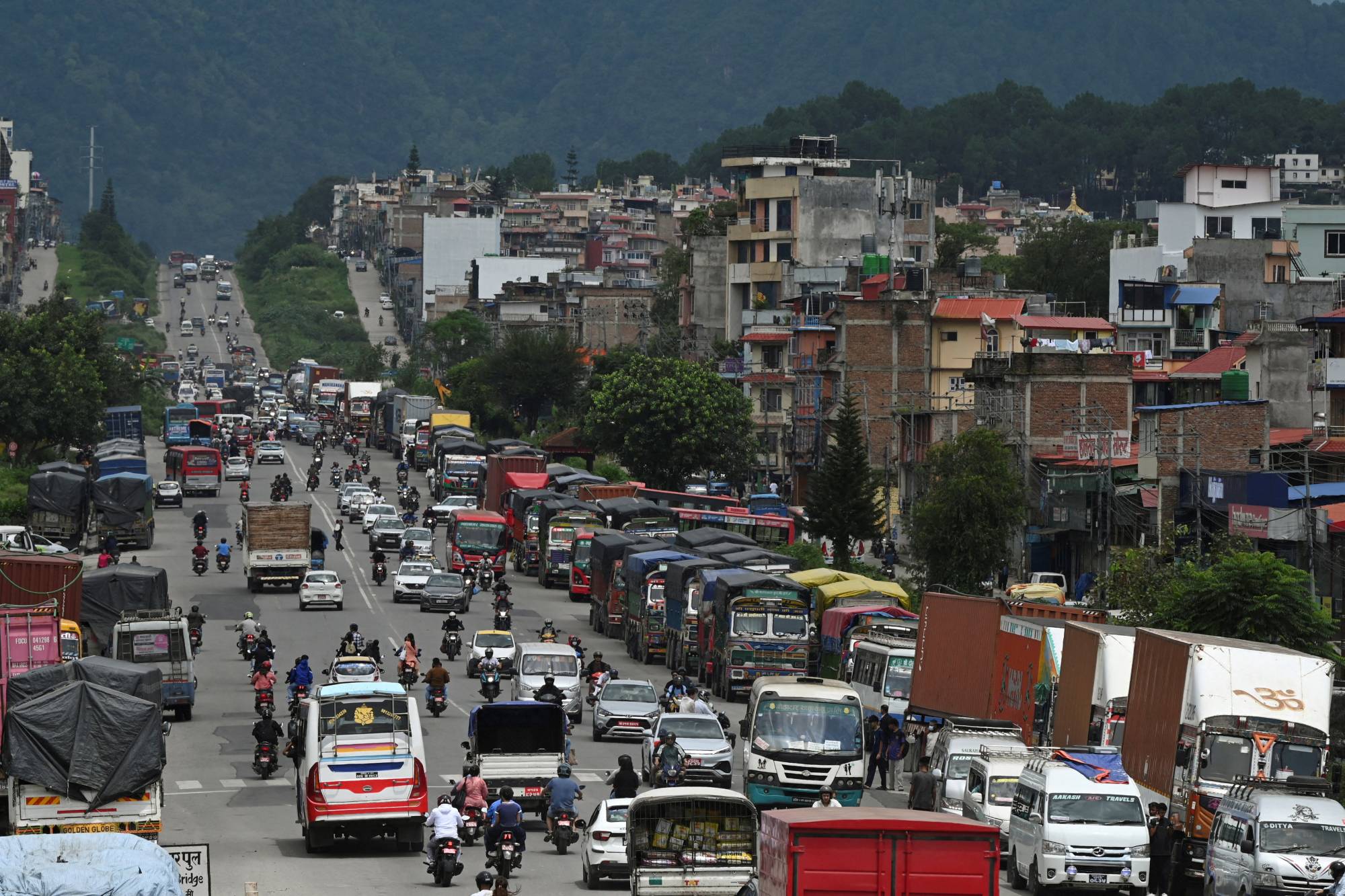
Stranded supply trucks wait at the Kalanki checkpoint for road clearance, following deadly flash floods and a mudslide in Nepal, in Kathmandu, Nepal, August 28, 2026. (Reuters)

Some 680 rescuers eventually reached the hardest-hit area at Gyirong by foot and via rafts after much effort. Some were dropped down from drones flown to the area, CCTV footage showed.

Thousands of people have been evacuated, others await rescue Nepali Army rescuers were working to help people trapped in a hydropower tunnel in Rasuwa, part of the Upper Trishuli-1 Hydropower Project.

Video from the scene show rescuers helping the man, covered in dark brown mud, out of the tunnel by pulling and pushing. He was one of likely dozens trapped in the tunnel.

Army spokesperson Brig. Gen. Raja Ram Basnet told the AP the focus was on survivors.

“It is complicated to find the entry and exit points of the tunnel because everything has been covered by mud,” Basnet said. “Our first priority is rescuing the stranded people.”

Nepal’s disaster management authority said 3,253 people had been airlifted by helicopter from the disaster area. Survivors, including injured people, were taken to Kathmandu and other locations.

Some felt the ground shake, then saw a ‘black storm’

Scientists who’ve studied satellite images said bedrock underneath a glacier high in the Himalayan region had collapsed, taking part of the glacier with it. The rockfall was so extreme that it reached a magnitude 5.2 seismic measurement.

The rocks and melted water then swelled the rivers in the valleys below, causing a torrent of water that swept buildings, bridges and earth downstream in Tibet and Nepal.

Customs officer Karbir Gaire was among some of the survivors in Timure, the closest Nepalese village to the border with China, where some 1,500 people had lived.

Gaire reached his office around 8 a.m. Wednesday and was working on his computer when he first felt the ground shake.

“Right after the shake, I noticed a black storm coming towards us," he recalled from Kathmandu, where he is back with family. "We all immediately started running out, and within a few seconds, we were climbing uphill on the opposite side of our office building. I think those 10 or so seconds saved some of us.”

Gaire doesn’t remember exactly how many people were in the office when the disaster struck, but 15 colleagues have gone missing. “It was like a Hollywood movie scene. I don’t call it a flood, it was a tsunami.”
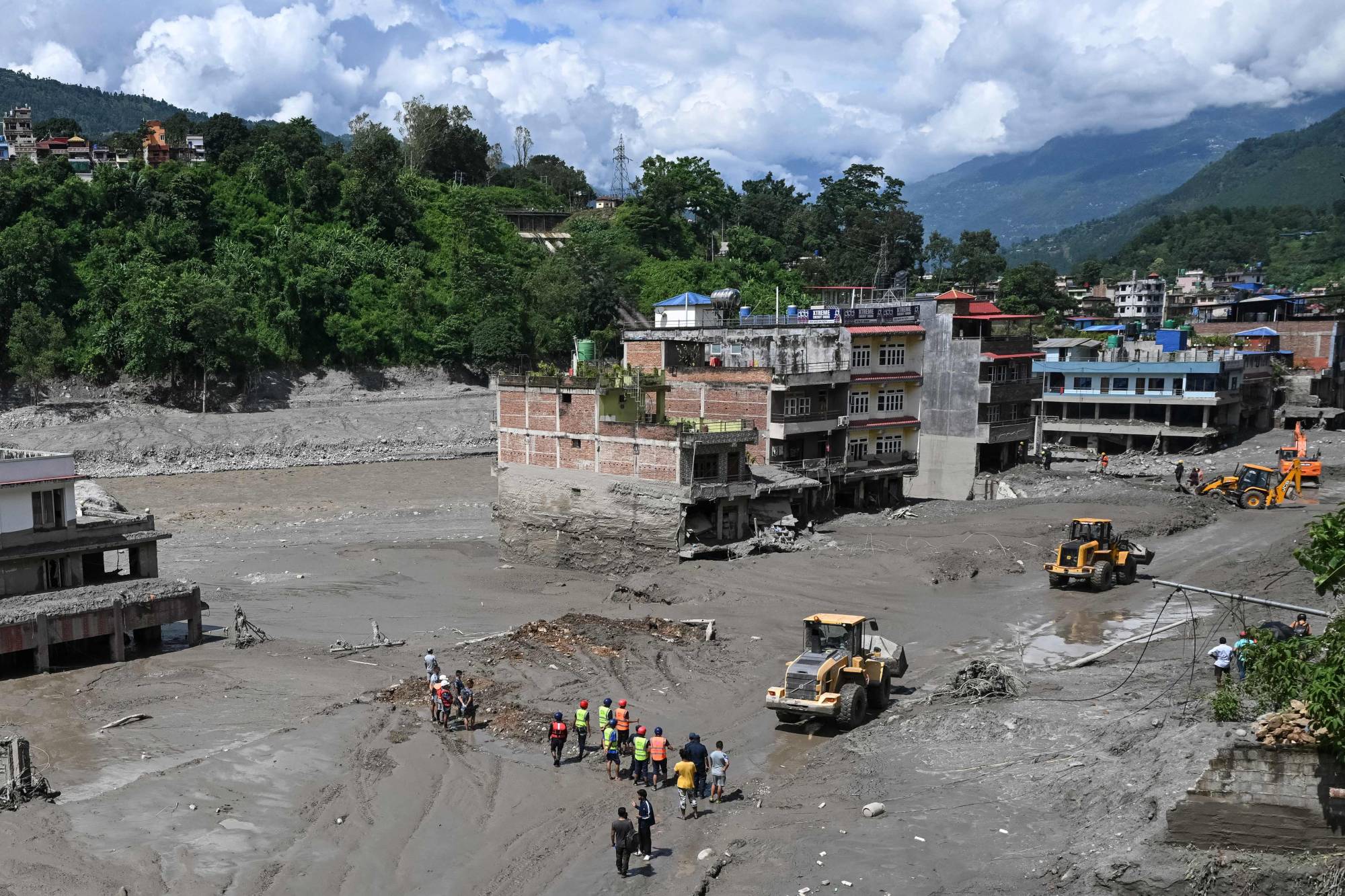
Volunteers use bulldozers to clear mud and debris along a road after flash floods at Trishuli in Nepal's Nuwakot district on August 27, 2026. (AFP)

Families around the world hope for news of loved ones

Nepal’s tourism board has said that among the missing are more than 500 foreigners.

About 90 Americans were unaccounted for. US President Donald Trump said the flooding was terrible to see, and he told reporters in the Oval Office he offered to provide Nepalese leaders “anything they want.”

Rajan Tamang, a restaurant owner in New York City, said he learned from family in Kathmandu that his mother and sister were among those who died, while many other relatives and friends remained missing.

“My family was just waking up, and they didn’t even get any information, and suddenly this flood came. Some of them are missing, some of them lost their life and only a few is alive,” he told the AP after a vigil in New York.

Some of the missing may have been on a pilgrimage to Mount Kailash in Tibet, a sacred site for Hindus, Buddhists and others.

Vishnuram Ramaswamy, who works at a private company in the southern Indian city of Puducherry, said that he last spoke to his mother and two sisters who were on that pilgrimage Wednesday morning. It was a highly anticipated trip, something his mother had always wanted to do, he said.

“My mother said they were on their way towards the border area and said they’ll reach their hotel and call us,” he said. While he's in touch with government officials, and the travel agency, there's been no news.

“This was the last we spoke to them. They have been unreachable since.”


Seoul Weighs Steps to Force North Korea Landmine Apology

A South Korean military guard post is seen through a military fence at Imjingak peace park near the Demilitarized Zone (DMZ) dividing the two Koreas, in Paju on September 30, 2026. Jung Yeon-je / AFP
TT

Seoul Weighs Steps to Force North Korea Landmine Apology

A South Korean military guard post is seen through a military fence at Imjingak peace park near the Demilitarized Zone (DMZ) dividing the two Koreas, in Paju on September 30, 2026. Jung Yeon-je / AFP

South Korea is considering measures to force an apology from North Korea over a recent landmine blast that injured three soldiers inside the Demilitarized Zone, its defense ministry said Tuesday.

A joint South Korean-UN investigation concluded that two landmines that exploded in the DMZ last month were planted by North Korean forces about a year ago, prompting Seoul to demand an official apology, reported AFP.

It has also called on the nuclear-armed North to remove any other mines planted on the southern side of the Military Demarcation Line (MDL) that runs through the DMZ, the heavily fortified frontier that has divided the Korean Peninsula since the 1953 armistice.

Pyongyang has denied responsibility, with Kim Yo Jong, the powerful sister of North Korea's leader, slamming the call for an apology as "despicable".

"We are not ruling out any options or prejudging anything when it comes to additional measures," defense ministry spokeswoman Chung Bin-na told reporters Tuesday when asked if steps were being planned to force an apology from Pyongyang.

Bin-na did not offer specifics about what actions might be employed.

Landmine incidents in the DMZ have previously heightened tensions between the two Koreas, which remain technically at war.

In 2015, two South Korean soldiers were seriously wounded in a landmine blast on the southern side of the DMZ, with one losing both legs.

Seoul concluded at the time that North Korean troops had crossed the MDL to plant the mines, an accusation Pyongyang denied.

Since 2024, Pyongyang's military has laid mines and built anti-tank barriers along the frontier as part of efforts to permanently seal it off.

During the operation, North Korea also blew up the northern sections of inter-Korean roads no longer in use.


Australian Soldier Dies, 5 Others Injured During Training Exercise

Australian army soldiers (Reuters file photo)
TT

Australian Soldier Dies, 5 Others Injured During Training Exercise

Australian army soldiers (Reuters file photo)

An Australian army soldier has died and five others have been injured during a training exercise in the Northern Territory ⁠of Australia, the Defense Department said on Tuesday.

The incident occurred at the Mount Bundey Training Area on October 5, the department said in a media statement ⁠on its website.

Five other Australian Army soldiers were injured, it added. No further details ⁠of the incident were available, according to Reuters.

“Next of kin has been notified. ⁠Defense will provide further updates when possible,” ⁠the statement said.


War-weary Northern Israelis Rethink Loyalty to Netanyahu before Election

Nahariya resident Maxim Zarbaylov says he is considering not backing Netanyahu for the first time. JACK GUEZ / AFP
TT

War-weary Northern Israelis Rethink Loyalty to Netanyahu before Election

Nahariya resident Maxim Zarbaylov says he is considering not backing Netanyahu for the first time. JACK GUEZ / AFP

On Israel's border with Lebanon where Hezbollah fired thousands of rockets and drones, previous backers of Prime Minister Benjamin Netanyahu say they are rethinking how they will vote in the first election since the war.

"Many I know were right-wing and were Bibi supporters, and today they're not," said plant nursery owner Sigal Malachi, using a nickname for Israel's longest-serving premier.

In traditional strongholds of Netanyahu support, many told AFP they could no longer back his right-wing government in the October 27 vote, accusing it of failing to secure a lasting quiet with the militants.

Hezbollah, an Iran-backed Lebanese militant group, began firing into Israel in October 2023 in support of Hamas following the deadliest-ever attack on the country.

The barrages altered life in northern communities, displacing tens of thousands of Israelis and forcing people like Malachi to close shop for several years.

Northern Israelis are accustomed to incoming fire from the Lebanese side of the border, but they say that round of conflict was more intense.

"We grew up with Katyushas (rockets) and bombs," said Malachi, whose plant nursery reopened in March.

"This war was different."

She described that "if you went outside, within a second you'd be running" for shelter.

The war was halted with a fragile ceasefire in November 2024, but evacuees were not allowed home until early 2025.

Life began slowly returning to normal, until the northern front reopened after the outbreak of the Iran war.

Maxim Zarbaylov, who was born in the former Soviet Union but has long lived in Nahariya, the northernmost Israeli town on the Mediterranean, is among those wavering.

"All my life I voted for (Likud), for Bibi Netanyahu... But this year I want to vote for (Gadi) Eisenkot," he said, referring to the former military chief who is Netanyahu's main election rival.

Hezbollah has repeatedly dragged Lebanon into conflicts with Israel, most recently in March with rocket fire at Israel in support of Iran.

Israel has in turn seized what it calls a "security zone" in Lebanon, where authorities say Israeli attacks have killed more than 4,300 people.

At least 48 Israeli civilians and 30 soldiers have died on the Lebanese front since 2023.

- 'Psychological catastrophe' -

The prolonged violence has left border residents in limbo.

"After October 7 we don't sleep well anymore," Malachi said.

"I've thought about leaving. But the roots are so deep that I'm staying."

In Shlomi, an Israeli border town, the enemy is a tangible presence behind a hill.

Shadi Tuma, who owns a supermarket there, prides himself on running the only one that remained open.

"This area is under a trauma we haven't seen before. There's anger. The government is unable to provide a comprehensive response," he said.

"It's a huge psychological catastrophe. Not everyone is able to cope with a war that lasts three years."

The war has cracked the local support base for Netanyahu, Tuma said.

In the last elections in 2022, the premier's Likud party won 43 percent of the vote in Shlomi, compared with 23 percent nationwide.

Residents who backed Netanyahu "now want change because they no longer trust this government," Tuma said.

He said the high cost of living was a major complaint.

"Many people I see are struggling to make it to the end of the month."

For Tuma, the conflict is also personal.

He was born in Lebanon, the son of a fighter with the South Lebanon Army, a militia that fought alongside Israel in the 1980s and that had many fighters granted Israeli citizenship.

- 'Feel protected' -

The war could have shifted longstanding political loyalties in towns like Nahariya, a sleepy resort of about 70,000 people.

In 2022, 38 percent of voters there chose Likud.

But Zarbaylov says there is anger over the failure to stop Hamas' unprecedented assault on the country.

"What happened on October 7, Bibi could have prevented it, but he didn't," he said.

"The army, the top commanders, the chief of staff, could have prevented it."

Others believe only the current hawkish coalition can protect them.

Patrice Haddad retired to Nahariya from Paris a year ago, drawn by the town's "charm".

Israel's "Law of Return" allows any Jew anywhere in the world to immigrate and automatically receive citizenship.

Adjusting to life under the rockets was not simple at first.

"We were told we had 30 seconds to find shelter" after sirens blared, he said. "In reality, sometimes we only had 15, sometimes less."

For his first election as an Israeli, he has made his choice.

"The left in Israel has done a lot of harm, it wanted to give up territories," he said.

"It's important to vote for the right, because for me, with a government like Netanyahu's, we will feel protected."
