


Qatar Expands Political, Economic Outreach in Libya, Engages Benghazi

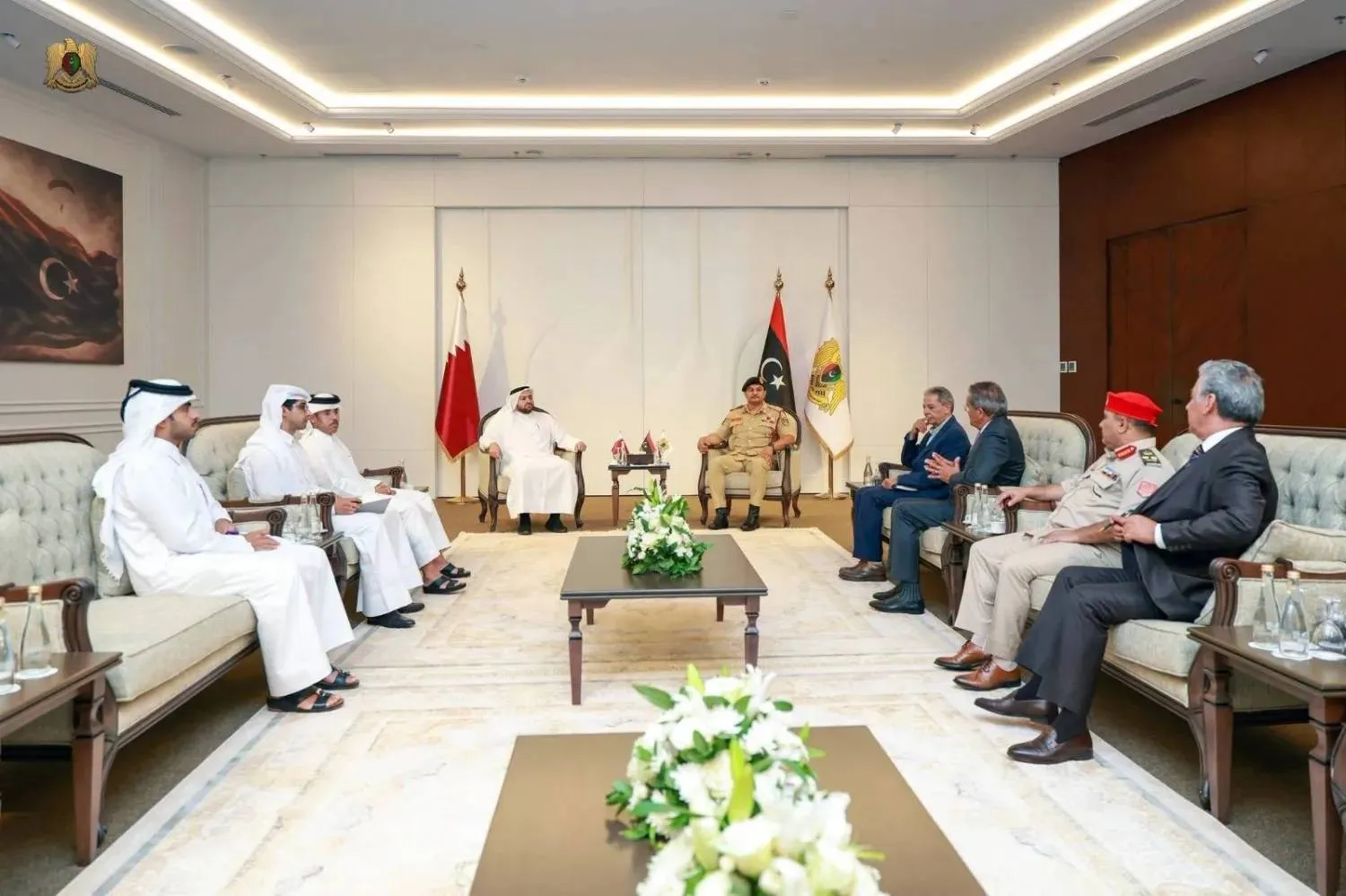
Saddam Haftar, acting commander-in-chief of the Libyan National Army, receives Qatari Minister of State for Foreign Affairs Mohammed bin Abdulaziz Al-Khulaifi. (General Command)
TT

Qatar Expands Political, Economic Outreach in Libya, Engages Benghazi

Saddam Haftar, acting commander-in-chief of the Libyan National Army, receives Qatari Minister of State for Foreign Affairs Mohammed bin Abdulaziz Al-Khulaifi. (General Command)

Qatar has significantly expanded its diplomatic and political presence in Libya, appearing poised to deepen cooperation and partnerships with political factions in both the east and west and forge future ties after years of strained relations, particularly with Benghazi.

During visits to the capital Tripoli and Benghazi, Qatari Minister of State for Foreign Affairs Mohammed bin Abdulaziz Al-Khulaifi held a series of meetings focused on political, economic and military cooperation. He also held talks with UN envoy to Libya Hanna Tetteh.

Al-Khulaifi concluded his two-day tour of Libya with a visit to Benghazi, where he met Lieutenant General Saddam Haftar, the acting commander-in-chief of the Libyan National Army, at the Libyan National Army's general command headquarters.

The two discussed the latest political developments in Libya and abroad, as well as ways to develop bilateral relations and strengthen cooperation across various fields in a manner that serves the two countries’ mutual interests.

Qatar has close ties and extensive cooperation with the authorities in Tripoli in western Libya, but this was the first visit by a senior Qatari official to Benghazi in the east since a political split engulfed the country 14 years ago.

Qatari Ambassador Khalid Al-Dosari has also conducted diplomatic outreach in Libya aimed at strengthening cooperation, advancing mutual interests and supporting stability in the country.

Saddam Haftar welcomed the Qatari delegation led by Al-Khulaifi, stressing the depth of the fraternal relations between the two countries and praising Qatar’s efforts to support Libya’s stability and unity.

The general command said on Thursday evening that Al-Khulaifi expressed his pleasure at visiting Benghazi and praised the stability and urban development the city was experiencing. He also formally invited Saddam Haftar to visit Qatar to continue consultations and coordination between the two sides.

Saddam Haftar visited Doha on July 16 to offer condolences to Qatar’s Emir Sheikh Tamim bin Hamad Al Thani over the death of his father, Sheikh Hamad bin Khalifa Al Thani.

Before meeting Saddam Haftar, Al-Khulaifi met his brother, Belqasim Haftar, director-general of the Libya Development and Reconstruction Fund, who was accompanied by Qatar’s ambassador to Libya, Khalid Al-Dosari.

Their talks focused on the importance of cooperation in development and reconstruction, economic partnerships and the participation of Qatari institutions and companies in development projects carried out by the fund.

The fund’s media office said on Thursday evening that the two sides discussed expanding cooperation in areas of mutual interest and maintaining communication and coordination in the coming period to translate bilateral relations into practical cooperation and partnerships in development and reconstruction.

Before traveling to Benghazi, Al-Khulaifi held several meetings at various levels in Tripoli late last week, beginning with talks with Abdulhamid al-Dbeibah, prime minister of the interim Government of National Unity, and his deputy Salem al-Zadma. He also met Salah al-Namroush, chief of the general staff in western Libya.

Talks between Dbeibah and Al-Khulaifi focused on developments in bilateral relations and ways to enhance Qatar’s role in supporting stability and Libya’s political and economic tracks.

Dbeibah welcomed the Qatari minister’s visits to Tripoli and Benghazi and stressed the importance of maintaining contact with Libya’s various factions.

He said his government hoped Qatar would play a greater role in the coming period to support stability and consensus and strengthen regional and international coordination on Libya.

The meeting also addressed the development of bilateral cooperation in several sectors, particularly energy and healthcare, and the expansion of economic cooperation between the two countries into broader programs and practical projects, according to Dbeibah’s office.

The two sides also discussed developments in a four-way cooperation mechanism involving Libya, Qatar, Türkiye, and Italy to address irregular migration.

They reviewed ways to build on the launch of a pilot operations room and to strengthen joint programs for capacity building, combating migration, and supporting voluntary returns.

Southern Libya also featured in Al-Khulaifi’s meeting with Dbeibah’s deputy, al-Zadma, who said he briefed the Qatari minister on conditions in the southern Fezzan region and the main challenges and obstacles it faced across various sectors.

They also discussed prospects for economic and development cooperation, developments related to irregular migration, and ways to strengthen coordination between the two countries.

Al-Zadma spoke of Qatar’s importance as an active partner in supporting cooperation with Libya, and the need to broaden communication and partnership to advance stability and development.

He also stressed the importance of continued communication and coordination to open wider prospects for cooperation on issues of mutual interest.

Al-Khulaifi and the Qatari delegation also met al-Namroush at the general staff headquarters in Tripoli to discuss strengthening and developing bilateral relations in various fields.

They also discussed support for efforts to unify Libya’s military establishment and ways to enhance cooperation that could bolster security and consolidate stability in the country.

Tetteh and Al-Khulaifi exchanged views on the latest political and security developments in Libya.

The UN mission said on Thursday evening that Tetteh briefed Al-Khulaifi on recommendations emerging from the “Structured Dialogue,” which the mission sponsored in an effort to break the political deadlock, and on ways to build on them.

She also briefed him on the outcome of a smaller meeting known as the “4+4 Committee” and the next steps, highlighting the role of regional and international actors in supporting UN efforts to pave the way for elections.

Al-Khulaifi expressed support for the efforts of the UN secretary-general’s special representative and the United Nations Support Mission in Libya. He stressed the need to integrate all initiatives aimed at resolving Libya’s political deadlock and leading the country toward elections.

The period following the overthrow of the late Libyan leader Muammar Gaddafi in 2011 was marked by political differences among regional states. Some chose to support Tripoli for ideological reasons, while others backed Field Marshal Khalifa Haftar, commander-in-chief of the Benghazi-based Libyan National Army.



Saudi Arabia Expresses Solidarity with Algeria Following Deadly Wildfires

Saudi Arabia Expresses Solidarity with Algeria Following Deadly Wildfires
TT

Saudi Arabia Expresses Solidarity with Algeria Following Deadly Wildfires

Saudi Arabia Expresses Solidarity with Algeria Following Deadly Wildfires

The Ministry of Foreign Affairs expressed the Kingdom of Saudi Arabia's solidarity with the People's Democratic Republic of Algeria following the deaths and injuries resulting from wildfires in the northeast of the country, SPA reported.

The Kingdom expressed its sincere condolences to Algeria and its people, extending deepest sympathies to the families of the deceased and wishing the injured a speedy recovery.


Saudi Crown Prince Receives Message from Prime Minister of Bangladesh

Saudi Crown Prince and Prime Minister Mohammed bin Salman. (SPA)
TT

Saudi Crown Prince Receives Message from Prime Minister of Bangladesh

Saudi Crown Prince and Prime Minister Mohammed bin Salman. (SPA)

Saudi Crown Prince and Prime Minister Mohammed bin Salman received a written message from the Prime Minister of Bangladesh Tarique Rahman on bilateral relations between their countries and ways to strengthen them.

The message was received by Saudi Foreign Minister Prince Faisal bin Farhan during a meeting with Bangladeshi State Minister for Foreign Affairs Humayun Kabir in Jeddah on Thursday.

The meeting came on the sidelines of the 23rd extraordinary session of the Council of Foreign Ministers of the Organization of Islamic Cooperation, attended by Saudi Vice Minister of Foreign Affairs Waleed Elkhereiji.

The two ministers discussed the bilateral ties between their countries and exchanged views on matters of mutual interest.


Saudi FM: Islamic Cooperation, Solidarity Now ‘Urgent Need’

Prince Faisal bin Farhan attends the extraordinary Council of Foreign Ministers meeting in Jeddah on Thursday (Organization of Islamic Cooperation)
TT

Saudi FM: Islamic Cooperation, Solidarity Now ‘Urgent Need’

Prince Faisal bin Farhan attends the extraordinary Council of Foreign Ministers meeting in Jeddah on Thursday (Organization of Islamic Cooperation)

Saudi Foreign Minister Prince Faisal bin Farhan said the region’s volatile conditions and multiple crises, coupled with the political, security, economic, social and humanitarian challenges facing the Islamic world, had made cooperation and solidarity an urgent necessity.

He spoke at an extraordinary meeting of the Council of Foreign Ministers of the Organization of Islamic Cooperation in Jeddah, western Saudi Arabia, on Thursday.

The meeting, focused on the Palestinian cause, elected Mauritanian diplomat Ismail Ould Cheikh Ahmed as secretary-general of the 57-member organization, succeeding Chad’s Hissein Brahim Taha.

Saudi Arabia renewed its strongest condemnation of a new plan by the Israeli occupation authorities to build settlement units under the E1 project.

It warned that the plan would not merely add new units but isolate East Jerusalem from its Palestinian surroundings, directly threatening the prospect of a viable, independent Palestinian state.

Prince Faisal said the E1 project formed part of a broader policy to impose settlement realities and carry out gradual annexation on the ground.

He reaffirmed the kingdom’s longstanding position on the Palestinian issue, its support for the Palestinian people’s right to establish an independent state under the two-state solution and their right to a just, comprehensive and lasting peace in the region.

Riyadh also condemned repeated incursions into Al-Aqsa Mosque by Israeli officials and settlers under the protection of Israeli forces.

It categorically rejected any attempt to impose a temporal or spatial division of the mosque or alter its Islamic character and identity, and stressed the need for humanitarian and food aid to reach the Gaza Strip without obstruction.

Serious Reform

Alongside Saudi Arabia’s position on Palestine, Prince Faisal set out the kingdom’s vision for the organization’s future as its leadership changes hands.

The kingdom believes the next phase requires serious reform of the organization to strengthen its ability to implement its resolutions, improve the efficiency of its institutions, and give joint Islamic action more effective tools, he said.

No country can confront these interconnected challenges alone. This makes it imperative to strengthen collective action and unify positions and efforts to safeguard the interests of states and peoples, the Saudi minister added.

According to him, the Islamic world, with its demographic, political, economic and civilizational weight, possesses the capabilities to become an effective participant in shaping international balances.

Prince Faisal said the OIC’s strength depended on solidarity among its member states, unity in their positions and their ability to turn shared principles and interests into “effective collective action”.

He reaffirmed Saudi Arabia’s continued support for every effort to strengthen the organization’s role and standing and advance the causes of the Islamic world and its peoples’ aspirations for security, stability, prosperity and peace.

The Saudi foreign minister said his country hoped Ould Cheikh Ahmed would succeed in “advancing the organization and enhancing its role”. He also praised the efforts of outgoing Secretary-General Hissein Brahim Taha and his staff.

Stronger Influence

In his first address after his election, Ould Cheikh Ahmed outlined his vision for the next phase, saying he accepted the mandate “with a profound awareness of the magnitude of the responsibility and the weight of the trust placed upon me”.

He invoked the hopes of nearly 2 billion Muslim men and women seeking an organization with a stronger presence, greater influence and a greater capacity to serve their causes.

The secretary-general-elect said the organization’s influence would depend on how effectively its member states harnessed their collective weight. They span four continents, possess vast human, natural and economic resources, and have predominantly young populations, he said.

Ould Cheikh Ahmed put the member states’ combined gross domestic product at nearly $30 trillion. He said those resources gave the organization both a major responsibility and a historic opportunity to strengthen its role and influence.

“The challenge lies in making effective use” of those assets, Ould Cheikh Ahmed said, as global power balances shift, technological change accelerates, artificial intelligence and the digital economy exert growing influence, and the multilateral system faces mounting challenges.

He said he approached the future “not with apprehension, but with hope and optimism”.

The new secretary-general placed Palestine at the top of the organization’s priorities, stressing that it would remain “the central cause” in its political, humanitarian and civilizational dimensions.

He said defending the legitimate rights of the Palestinian people — foremost among them establishing an independent state with East Jerusalem as its capital and protecting the sanctity of Al-Quds Al-Sharif — would remain an unwavering commitment.

Ould Cheikh Ahmed also pledged to strengthen the organization’s efforts to combat Islamophobia and hate speech, promote dialogue and mutual respect, and build broader partnerships with the international community.

Critical Juncture

Taha said the meeting was taking place at “an extremely delicate and sensitive juncture to elect a new secretary-general and discuss our central cause: Palestine and Al-Quds Al-Sharif”.

He said the past five years had brought achievements in political, economic, cultural and scientific cooperation.

Taha, whose term officially ends in November, thanked Saudi Arabia in particular for its unlimited support for the organization and its contributions to strengthening joint Islamic action. He also expressed his “full readiness to extend a helping hand” to his successor.

As the organization’s leadership passes from Taha to Ould Cheikh Ahmed, Palestine and Jerusalem remained at the center of the political messages from the Jeddah meeting. Speakers rejected Israeli policies and measures, reaffirmed their commitment to an independent Palestinian state and said the Palestinian issue would remain at the forefront of the organization’s work.

Ould Cheikh Ahmed will arrive in Jeddah, home to the OIC General Secretariat, with more than three decades of experience in United Nations work and crisis zones.

The OIC charter sets the secretary-general’s term at five years, renewable only once. The Council of Foreign Ministers elects the officeholder according to the principles of equitable geographical distribution, rotation and equal opportunity, while taking competence, integrity and experience into account.

The charter sets no fixed order for the transfer of the post among the Arab, African and Asian groups. Instead, it bases the selection on rotation and equitable geographical distribution.

In February, the African Union formally endorsed Ould Cheikh Ahmed’s candidacy for the 2027-2032 term, listing Mauritania as part of North Africa.

The charter does not limit the secretary-general’s role to diplomatic representation. It tasks the officeholder with following up on resolutions adopted by Islamic summits and the Council of Foreign Ministers, coordinating the work of the organization’s bodies and raising issues that could advance or obstruct its objectives.