

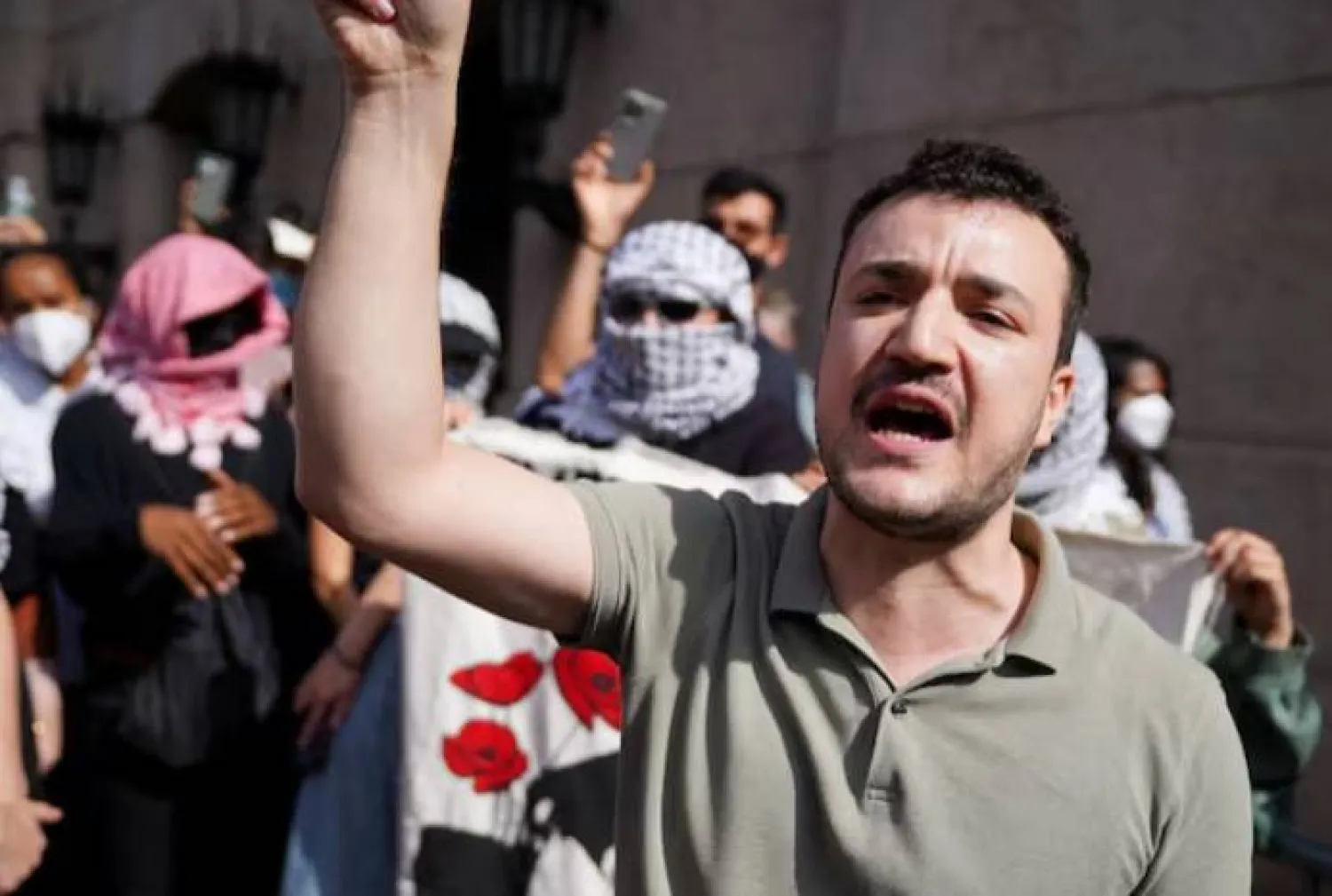

Judge Deals Blow to Trump Moves to Deport Pro-Palestinian Activists

Columbia University graduate Mahmoud Khalil attends a pro-Palestinian protest outside Columbia University, on the two-year anniversary of the deadly October 7, 2023 attack on Israel by Hamas from Gaza, in Manhattan in New York City, US, October 7, 2025. REUTERS/Ryan Murphy
TT

Judge Deals Blow to Trump Moves to Deport Pro-Palestinian Activists

Columbia University graduate Mahmoud Khalil attends a pro-Palestinian protest outside Columbia University, on the two-year anniversary of the deadly October 7, 2023 attack on Israel by Hamas from Gaza, in Manhattan in New York City, US, October 7, 2025. REUTERS/Ryan Murphy

A federal judge on Friday ruled that laws that President Donald Trump's administration used to cancel visas and initiate deportation proceedings against noncitizen college students based on their pro-Palestinian advocacy and criticism of Israel are unconstitutional.

US District Judge Noel Wise in San Jose, California in a blistering ruling chastised the US State Department and US Department of Homeland Security for how they had deployed provisions of federal immigration law to target non-citizens for deportation for expressing views they wanted to suppress.

The judge, an appointee of Democratic President Joe Biden, said that in the United States, free speech, including the freedom to criticize the government and its leaders, ‌was evidence of the ‌strength of the country's democracy.

"That strength is diminished when members ‌of ⁠our society – citizens and ⁠noncitizens alike – must self-censor and 'behave' or suffer the government’s retaliation," she said.

The State Department and DHS did not immediately respond to requests for comment.

Wise's ruling focused on how the Trump administration, from March 2025, began revoking visas and detaining non-citizens who engaged in pro-Palestinian advocacy on campus, starting with the arrest of Columbia University graduate Mahmoud Khalil, who is fighting separately to avoid being deported.

Those arrests formed the basis of a lawsuit that was filed in August 2025 by Stanford University’s student newspaper, ⁠The Stanford Daily, which alleged that some of its writers with student ‌visas had refrained from covering pro-Palestinian student protests and topics ‌related to the Middle East conflict as a result of the administration's policies.

The newspaper's lawyers argued that ‌two provisions of the Immigration and Nationality Act that the administration relied upon to cancel student ‌visas and initiate deportation proceedings violated the US Constitution's First and Fifth Amendments as applied to constitutionally protected speech.

Those laws allowed Secretary of State Marco Rubio to render noncitizens deportable if he personally determined someone's action “compromises a compelling foreign policy interest" and allowed him to revoke someone's visa at his discretion.

Wise agreed with ‌the newspaper, saying that when a noncitizen's speech is the reason behind a visa revocation and deportation determination, "the government is singling out that speech ⁠for disfavored treatment ⁠based on its viewpoint or content."

Conor Fitzpatrick, whose group Foundation for Individual Rights and Expression represented the student newspaper, in a statement said the ruling "proves that free speech isn’t a privilege, but the inalienable right of every man, woman, and child."

The ruling was similar to a decision last year by Boston-based US District Judge William Young, who similarly found the administration had acted unconstitutionally by adopting a policy of revoking visas, arresting, detaining and deporting foreign students and faculty engaged in pro-Palestinian advocacy.

Wise in her ruling expressed concern the administration had moved on to target people for expressing other types of views it disfavored, saying eventually the "targets may include anyone in the United States who exercises their freedom of speech to simply express opinions the government does not like."

"This downward spiral is antithetical to our Constitution that recognizes our right to speak freely," she wrote. "Here you can simultaneously hate the content of a person’s speech and love the country that cherishes the freedom to allow it."



US Supreme Court Lifts Limits on Third-country Deportations

The United States has deported thousands of migrants to so-called third-countries, including Liberia, as part of US President Donald Trump's immigration crackdown. Matthew Jacobs / AFP
TT

US Supreme Court Lifts Limits on Third-country Deportations

The United States has deported thousands of migrants to so-called third-countries, including Liberia, as part of US President Donald Trump's immigration crackdown. Matthew Jacobs / AFP

The US Supreme Court on Tuesday lifted restrictions on the deportations of immigrants to countries that are not their own, while agreeing to hear the issue on its merits in December.

The conservative-dominated high court granted an emergency request by the Trump administration to suspend a lower court ruling that restricted, but did not outright ban, so-called "third-country removals."

The lower court had said people targeted with deportation must be given effective notice ahead of time about where they are being sent to allow them to raise concerns about potential persecution, said AFP.

The three liberal justices on the nine-member bench said they would not have granted the administration's request.

President Donald Trump campaigned on promises to expel millions of undocumented migrants from the United States and has taken several actions aimed at speeding up deportations since returning to the White House in 2025.

The Trump administration has defended third-country deportations as necessary since the home nations of some of those who are targeted for removal sometimes refuse to accept them.

In a brief to the Supreme Court, opponents of lifting the restrictions argued that the lower court ruling did not fully block all third-country deportations, "it simply requires them to do so lawfully."

Trump's solicitor general, John Sauer, meanwhile told the court that the rapid deportation to third countries was "an essential tool to remove certain aliens, including some of the worst criminal aliens."

The lower court ruling "created substantial logistical problems" with removals, he said.

- 'Indefensible' -

An AFP investigation found that the US has offered multimillion-dollar deals and threatened visa restrictions in a bid to get "third countries," especially in Africa, to take such deportees.

Once in these countries -- and outside US jurisdiction -- deportees have been subject to abuse by local guards, indefinite detention, or quickly re-deported to their home countries.

According to an investigation published last week, the United States has deported more than 25,000 people under secretive agreements with 35 countries to take migrants with no ties to those nations.

The investigation by Forbidden Stories found the administration has earmarked $410 million to be paid directly to the receiving countries, or to United Nations agencies to facilitate the returns.

The vast majority of the deportees -- around 20,000 -- were sent to Mexico, but the rest were dispersed to 27 other countries across Latin America, Africa, and the Pacific, and agreements have been finalized with seven more.

Congress has made it US policy not to deport people to countries where their lives would be in danger or they could be subject to torture.

After the high court's ruling, some Democratic lawmakers were calling for more formalized steps to prevent such deportations and uphold due process.

"Congress must step in. No one should be shipped off to a country that is not their own without basic due process and a meaningful opportunity to raise legitimate fears for their safety," House Democrat Lois Frankel said on X.

Rob Menendez, another congressional Democrat, called the Supreme Court's decision "indefensible."

"Taxpayers shouldn't fund tearing people from the only home they've ever known, nor should our legal system fast-track these unilateral deportations."


US Withdraws from European Anti-Corruption Panel

FILE PHOTO: A general view of a US State Department sign outside the US State Department building in Washington, DC, US, July 11, 2025. REUTERS/Annabelle Gordon/File Photo
TT

US Withdraws from European Anti-Corruption Panel

FILE PHOTO: A general view of a US State Department sign outside the US State Department building in Washington, DC, US, July 11, 2025. REUTERS/Annabelle Gordon/File Photo

The Trump administration has withdrawn the United States from a top European anti-corruption watchdog as it forges ahead with plans to disengage from international and multilateral organizations that it accuses of exceeding their mandates, being inefficient or not adapting to US policies.

The Council of Europe said Tuesday that the US formally notified it a day earlier that it would leave the Group of States against Corruption, or GRECO. Only two other countries have left GRECO before — Russia and Belarus.

The State Department confirmed the move, saying that US participation, which requires an annual monetary contribution, “does not provide tangible benefits to US national security.”

“The era of writing blank checks to international bureaucracies is over,” it said. “The department is instead prioritizing higher-impact tools to combat corruption, such as visa restrictions, sanctions, and targeted foreign assistance to strengthen foreign criminal investigations into corruption directly threatening US security and prosperity.”

The Strasbourg-based Council of Europe said the US had been “a valuable contributor” to GRECO "and to the exchange of experience and good practice in preventing and combating corruption.”

“GRECO remains open to resuming cooperation with the United States in the future in support of shared efforts to prevent corruption, strengthen integrity and uphold the rule of law,” it said in a statement.

The decision was announced a week after the Organization for Security and Cooperation in Europe said the US had declined to invite its members to observe November’s congressional midterm elections, a sharp break from past practice.

The US has already withdrawn from a number of European-based UN and multilateral agencies, including the World Health Organization and the UN Human Rights Council, and is weighing further such steps.

The US withdrew in January from another Council of Europe panel — the Venice Commission, which is an advisory body on constitutional law.

GRECO was created in 1999 by the Council of Europe to monitor compliance with the organization’s anti-corruption standards. Membership is not limited to European Union members, and the United States joined a year after its founding.


Iran Hangs Two Anti-government Protesters

The Iranian flag waves in front of the International Atomic Energy Agency (IAEA) headquarters, amid the coronavirus disease (COVID-19) pandemic, in Vienna, Austria May 23, 2021. (Reuters)
TT

Iran Hangs Two Anti-government Protesters

The Iranian flag waves in front of the International Atomic Energy Agency (IAEA) headquarters, amid the coronavirus disease (COVID-19) pandemic, in Vienna, Austria May 23, 2021. (Reuters)

Iran's judiciary announced that two men were hanged on Wednesday over charges relating to anti-government protests that peaked in January, having begun a month earlier over economic grievances.

The two, Ali Hemmati and Majid Nik-Andish, were found guilty of involvement "in the riots of January that resulted in the martyrdom of four security personnel" in the northeastern city of Mashhad, said the judiciary's Mizan Online website.

It added that they also "inflicted extensive damage on public property by setting fire to shops, banks, buses, etc, and even torching trees".

They "were executed by hanging early Wednesday, following the Supreme Court's confirmation of their sentences".

In late December, a protest movement initially sparked by the high cost of living rapidly evolved into widespread anti-government demonstrations that peaked on January 8 and 9.

Iranian authorities reported more than 3,000 deaths, attributing the violence to "terrorist acts" orchestrated by the United States and Israel, while foreign-based NGOs maintain that security forces fired on protesters, said AFP.

US President Donald Trump had threatened at the time to intervene militarily in Iran, before the United States and Israel launched a joint attack on Iran on February 28, triggering the Middle East war.

Since then, arrests and executions have multiplied in the country, linked both to the conflict and to the protests that took place earlier in the year.

In 2025, Iran executed at least 1,639 people, the largest number for any year since 1989, according to the NGOs Iran Human Rights and Together Against the Death Penalty.

According to Amnesty International, Iran is responsible for the second most executions of any country, after China.