Rescuers Claw Through Mud as Missing Toll from Nepal, China Flood Nears 3,000

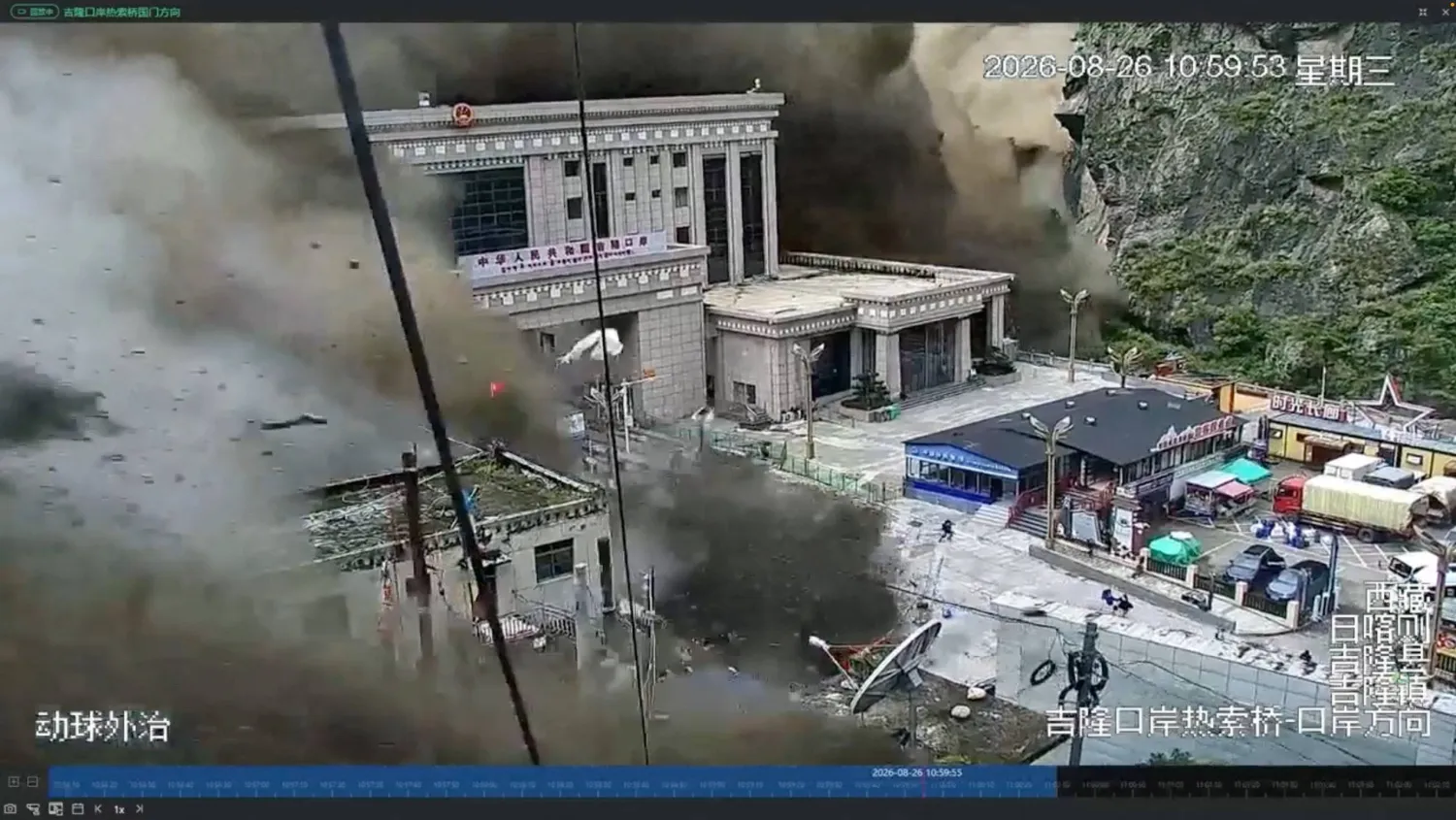
A CCTV footage shows people running away as wall of mud and water destroys buildings in a valley at Nepal-China border, in Gyirong, Tibet region, China August 26, 2026, in this screengrab obtained from a social media video. SOCIAL MEDIA/via REUTERS
TT

Rescuers Claw Through Mud as Missing Toll from Nepal, China Flood Nears 3,000

A CCTV footage shows people running away as wall of mud and water destroys buildings in a valley at Nepal-China border, in Gyirong, Tibet region, China August 26, 2026, in this screengrab obtained from a social media video. SOCIAL MEDIA/via REUTERS

Rescuers in Nepal and China were battling on Saturday to locate thousands of people missing days after a deadly, tsunami-like wall of water and debris swept through the Himalayan region, engulfing entire villages. 

Figures from both countries put the number of missing close to 3,000, with 682 bodies recovered -- and reports of some dead possibly swept downstream as far away as India. 

Rescue worker Kawan Koirala, from the Nepal Scout Disaster Response Team, said they were struggling in thick, leg-sucking mud. 

"People want their family member's body back, either dead or alive, but we cannot find them... you can see the mud," he told AFP, exhausted after an 18-hour shift. 

"It is very traumatic for me too. It is my first time seeing these types of things. Everywhere is mud. We faced flood in Nepal before, but not like this." 

The US Geological Survey said the disaster on the Tibet-Nepal border on Wednesday was caused by a glacial collapse that created a torrent of debris downstream. 

While the exact cause of the collapse is unclear, climate change is causing glaciers to melt worldwide, increasing the risks of such disasters. 

- 'Nothing left' - 

Survivors face an agonizing wait to learn the fate of missing relatives, and the prospect of rebuilding their lives from nothing. 

"All the settlements near the river were swept away," Buddhi Ram Dangol told AFP in Nepal's Nuwakot district. "There is nothing left." 

At Bidur's army base, a key rescue hub in the same district, relatives crowded around lists of rescued people pasted on a wall. 

"I have come here looking for my son," said Kalka Sharda, scanning the list in desperation. "He was a laborer at the hydropower plant, but I can't find his name, and the authorities are not saying anything." 

In an area home to vast energy infrastructure projects, Nepal's disaster authority listed 933 hydropower workers among the missing, along with 517 foreigners, including trekkers and Hindu pilgrims to Tibet's Mount Kailash. 

- 'Enormous' trauma - 

The trauma of Wednesday's catastrophe has been "enormous", and as many as 93,000 people may have been affected, the Red Cross said, with the death toll expected to rise. 

Nepal's reconstruction bill could run into "billions of dollars", Foreign Minister Shisir Khanal said Saturday. 

"The urgency is on rescue and saving lives as much as we can," he said, appealing for specialized assistance, including heavy-lift drones and technology to help locate people who are trapped. 

He also called for forensic testing kits to identify bodies and freezer units to store them, saying bodies that have been in water could decompose at a faster rate. 

"Our own healthcare capacity is very limited to put these bodies in a frozen state for a long time," he said. 

Emergency teams worked flat-out to find survivors as widespread devastation left communities short of food and water. 

Fears of further flooding have compounded the search for the missing. 

The deluge of ice and mud caused huge lakes, and one of these formations has become a risk of further floods. 

In Tibet, where Chinese authorities are the only source of information, Beijing had paused its rescue operation at the hardest-hit area of Gyirong over the risk of renewed flooding. 

On the Nepali side, soldiers were trying desperately to drill through to 100 people trapped in tunnels at multiple hydropower projects on Saturday. 

The prime minister's office said teams had begun "clearing mud and debris" to open the entrance, while a specialized Indian tunnel rescue unit had arrived to help, with a Chinese team on its way. 

Nepal's expert mountain rescue teams -- used to aiding climbers on the world's highest peaks, including Everest -- are also joining the search. 

"We do similar work on the mountains, with rescue operations for people trapped in risky places so I believe our skills will be useful," Tul Singh Gurung, president of Nepal National Mountain Guide Association, told AFP. 

Workers rescued from other dam projects along the Trishuli valley described a disaster that unfolded with terrifying speed. 

- 'I don't think there is any hope left' - 

Nepal reported a death toll of 675 people on Saturday. 

There are 2,426 people, including hundreds of foreigners, who are out of contact in the country. 

Across the border in Tibet, which is largely inaccessible to foreign journalists, seven people died and 554 remain missing, Xinhua state news agency said on Saturday. 

Authorities also said they had evacuated 555 stranded tourists and 499 Chinese residents from Tibet. 

In India, officials said they had recovered seven bodies from rivers flowing from Nepal, believed to be flood victims. 

Hope was fading for some still waiting desperately for news. 

Kalka Sharda, in Bidur, was searching lists of rescued for his 18-year-old son Vinod Sharda, a hydropower plant laborer. 

"I don't think there is any hope left," he said. 

"Because, if he was alive, he would have found a way to get in touch." 


Lavrov Says Russia Cannot Agree to Immediate Ukraine Ceasefire Without Knowing What Will Happen Next

30 October 2026, US, Atlanta: Russia's Foreign Minister Sergei Lavrov (C) attends the G20 foreign ministers' meeting chaired by US Secretary of State Marco Rubio in Atlanta. Photo: Michael Kappeler/dpa
TT

Lavrov Says Russia Cannot Agree to Immediate Ukraine Ceasefire Without Knowing What Will Happen Next

30 October 2026, US, Atlanta: Russia's Foreign Minister Sergei Lavrov (C) attends the G20 foreign ministers' meeting chaired by US Secretary of State Marco Rubio in Atlanta. Photo: Michael Kappeler/dpa

Russian Foreign Minister Sergei Lavrov said on Tuesday that Russia would not agree ‌to ‌an immediate ceasefire ‌in ⁠Ukraine without knowing ⁠what would happen next.

It would be wiser to ⁠discuss the ‌outlines ‌of the ‌future security architecture ‌in Europe first, and then a ‌ceasefire in Ukraine, Lavrov said, referring ⁠to ⁠the trilateral talks between Russia, Ukraine and the US in Abu Dhabi


Iran Calls on US to Meet Its Demands to End War

A drone view shows vessels in the Strait of Hormuz, as seen from Musandam, Oman, June 15, 2026. (Reuters)
TT

Iran Calls on US to Meet Its Demands to End War

A drone view shows vessels in the Strait of Hormuz, as seen from Musandam, Oman, June 15, 2026. (Reuters)

Iran on Tuesday urged the United States to meet its demands in a plan to reopen the Strait of Hormuz, after President Donald Trump spoke of "positive momentum" to end their eight-month war.

"The conflict with Iran will not be resolved through military means, nor by intensifying sanctions," Foreign Minister Abbas Araghchi told Iran's IRNA news agency.

"The only solution is to adopt a language of respect, engage in diplomacy, and address Iran's demands and conditions -- which were outlined in the two-day proposal and remain on the table."

Tehran has proposed reopening Hormuz, which it has blockaded since the start of the war, within two days in return for Washington meeting a raft of conditions.

These include ending the war on all fronts, unfreezing Iranian assets, lifting oil sanctions and ending the US counter-blockade of Iranian ports.

Trump, whose Republican party last week lost midterm elections in part due to the war, said on Monday that there was "positive momentum" towards ending the conflict after meeting Qatar's prime minister at the White House.

In a post on social media, Trump reiterated that the US was "locked and loaded" but said further strikes were "quite unlikely".

"We are seeing positive momentum toward an end to this conflict, and will ensure that America's interests are at all times protected," Trump said.

Diplomatic efforts, led by Qatar and Pakistan, are underway to find a resolution to the war, which broke out in late February when US-Israeli strikes killed Iran's supreme leader Ali Khamenei.

On Tuesday, Iran's security chief Mohsen Rezaei urged Washington to "surrender" to the Iranian demands.

"The war on Iran has already wrecked the US government. But Washington flails like a desperate gambler. FOLD YOUR HAND. STOP manufacturing FAKE NEWS about imaginary talks," said Rezaei, the head of Iran's Supreme National Security Council, in a post on X.


Six Held over Deadly Türkiye Steel Blast that Killed 17

The region's governor said the blast was caused by an overhead crane collapsing into a large industrial furnace. Demiroren News AAgency / AFP
TT

Six Held over Deadly Türkiye Steel Blast that Killed 17

The region's governor said the blast was caused by an overhead crane collapsing into a large industrial furnace. Demiroren News AAgency / AFP

Six people were arrested overnight after a huge blast at a steel plant near the western city of Izmir killed 17 workers, with grieving families waiting Tuesday to receive their loved ones' bodies for burial.

Onlookers said Monday's massive explosion felt like "an earthquake" when it ripped through the HABAS steel factory in Aliaga, a district 60 kilometers (37 miles) north of Izmir known for shipbreaking and heavy industry.

Police have so far detained six people in connection with the incident, with Energy Minister Alparslan Bayraktar warning "the number could rise".

The deadly blast at one of Türkiye's top steel producers also left around a dozen people injured, at least one in critical condition.

Outside the forensic institute in Aliaga, bereaved family members told AFP they had been waiting all night for confirmation that their loved ones had been identified so they could be laid to rest.

"We have been here since yesterday, we're waiting for the DNA results. Since the bodies are in a condition that makes visual identification impossible, the identification process is carried out through DNA analysis," said Turgut Dilek, saying his nephew Ozcan Efe was one of the dead.

Meanwhile, there was no word on the fate of a 40-year-old man who set himself alight outside the factory on Monday evening and was taken to hospital with severe injuries, IHA news agency said.

The man had worked for years as a truck driver at the factory, IHA said, without mention of earlier reports that his brother had died in the blast.

Workers' groups have accused HABAS of a chequered safety record, and President Recep Tayyip Erdogan on Monday vowed that investigators would get to the bottom of what happened.

Türkiye's pro-Kurdish DEM party -- which said late Monday "not a single party must go unpunished" at the factory -- sent a delegation to visit the families and the injured on Tuesday led by its co-chair Tulay Hatimogullari.

Jailed Istanbul mayor Ekrem Imamoglu, Erdogan's chief political rival, also demanded accountability.

"Workplace deaths are not fate. The causes of the accident must be fully established, and anyone who was negligent or at fault must be held accountable," he wrote on X.

Izmir governor Suleyman Elban said the explosion happened during "a boiler replacement operation".

Speaking to AFP, 52-year-old worker Yasin Cetiner said the crane had dropped a huge container of molten steel.

"The crane rope broke, and as a result, about 120 tons of liquid steel fell onto the furnace ... (which) caused a hydrogen explosion when it came into contact with the water beneath it," he said.

Contacted by AFP, HABAS declined to respond to any questions.

On Monday, police detained two representatives of a workers' collective outside Aliaga hospital while trying to make a statement about workplace safety issues, a spokesman told AFP.

Workers' groups have called a protest in Aliaga on Tuesday, saying: "STOP this hell of exploitation in which dozens of our comrades have died and hundreds were left disabled because of employers' greed!"