


Europe's Summer Drought Threatens Fish in Rivers, Lakes and Farms

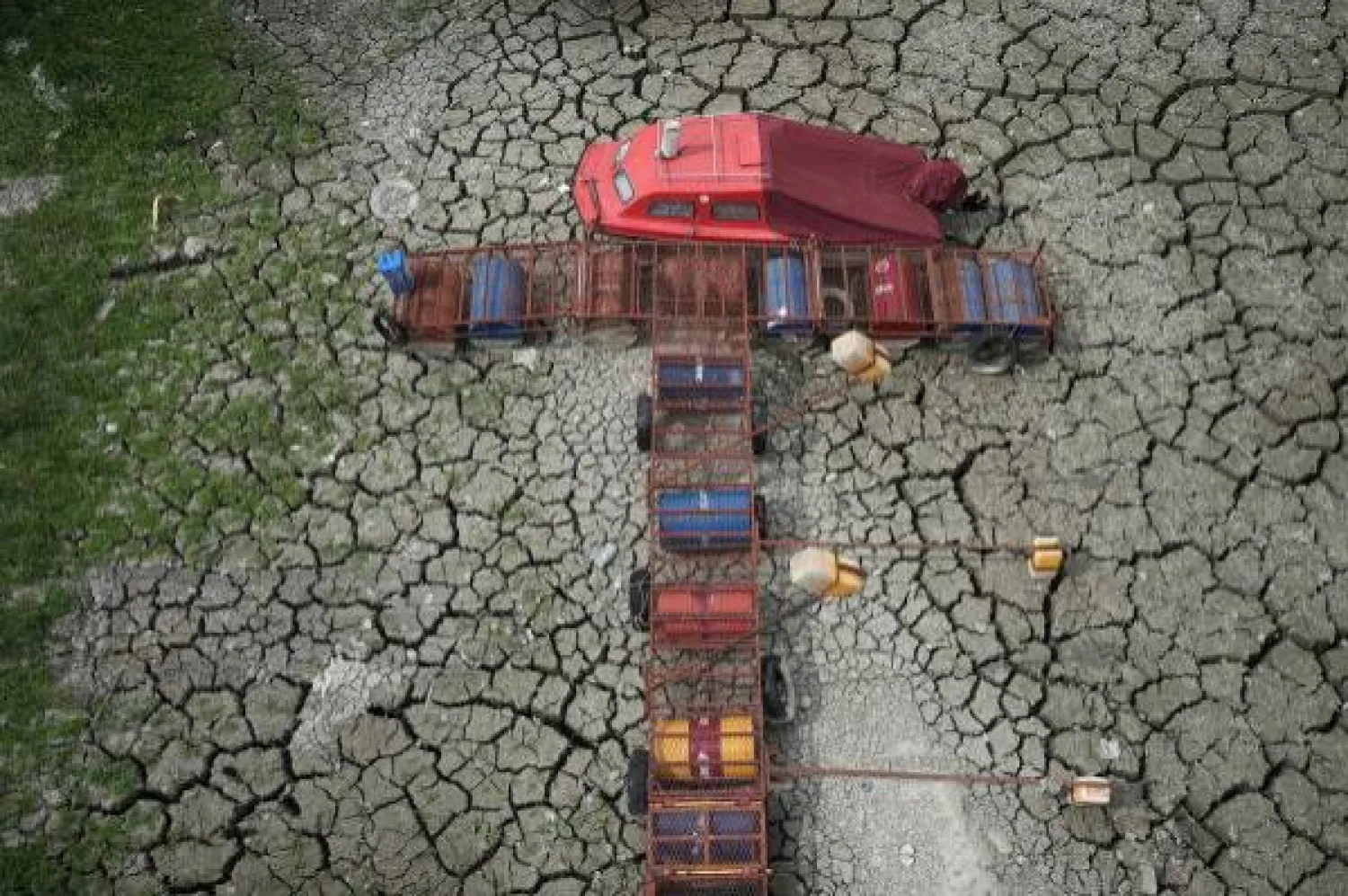
A boat sits on dry ground as water levels have dropped on the Danube in Petrovaradin, Serbia, Tuesday, August 25, 2026. (AP Photo/ Darko Vojinovic)
TT

Europe's Summer Drought Threatens Fish in Rivers, Lakes and Farms

A boat sits on dry ground as water levels have dropped on the Danube in Petrovaradin, Serbia, Tuesday, August 25, 2026. (AP Photo/ Darko Vojinovic)

Small boats stand idle on cracked ground in a shriveled side channel of the Danube River in northern Serbia, where the water has receded into a couple of shrinking ponds under pressure from extreme drought and heat. Fish circle in the shallow waters.

“This is all we have, these two little ponds that are full of juvenile fish,” fisherman Dusan Jovanovic said. He said the fish are in danger because there is too little water and its temperature is over 30 degrees Celsius (86 degrees Fahrenheit).

“If they start to die, they will all die at once,” Jovanovic said.

Persistent drought and scorching heat this summer have ravaged ecosystems and businesses across the region, from a lake in Slovenia and the side channel of the Danube in Serbia, to fish farms in Bosnia, the Czech Republic, Romania and Hungary.

The fish industry has been hit especially hard, with damage estimated in the millions of euros (dollars). This is adding to the already high toll caused by problems with energy and water supplies, devastated crops, losses in river traffic and trade, The Associated Press said.

Finding themselves unprepared for this year's crisis, countries and businesses are now pondering ways to minimize the effects of future extreme weather events that scientists have tied to human-induced climate change.

Hungary's fish die as entire country faces extreme drought

Around 99% of Hungary’s lands are currently under severe or extreme drought conditions, according to the national meteorological service. Desertification, a process where vegetation recedes because of high heat and low rainfall, threatens much of the Great Hungarian Plain.

Among the most affected are Hungary’s roughly 27,000 hectares (67,000 acres) of fish ponds. The country’s Agriculture and Food Economy Ministry said last week that “persistent heat and water shortages” had led to 1,588 hectares (3,924 acres) of those ponds drying out, causing the deaths of nearly 280 metric tons of fish at 20 farms.

The estimated revenue loss from the damage was 1.3 billion forints ($4.2 million), the ministry said. Producers say replacing lost fish could take years. Sometimes, operators were forced to drain one pond and divert its water to save fish in another, the Hungarian Aquaculture and Fisheries Inter-branch Organization said in early August.

Repeated drought over years hurts Romanian fish farmers

For fish farmers in Romania, especially those cultivating carp, this year’s blistering heatwave follows severe droughts in 2023 and 2024, the effects of which are still being felt, says Catalin Platon, president of ROMFISH National Association of Fish Producers.

In carp production, Platon said, the production cycle is three or four years.

“So what we lost in 2023 has (had an) impact every year since," he explained. Water-use policies that prioritized irrigation for agriculture during the previous droughts, “left us with no water for the fish,” Platon complained.

Czech fish farmers take emergency measures

Fish farmers across the Czech Republic have taken various emergency measures: reducing or suspending feeding to reduce oxygen use, aerating the ponds or draining them when necessary.

The Czech Fishing Association officials say sustained rainfall could ease the immediate crisis, but long-term measures are needed to retain more water in the landscape.

Jan Sokolik, a technician at the Rybarstvi Trebon fishery, explained that “some ponds that were actually low on water have already been fished, but they were all marginal ponds.”

“Now we’re just starting to plan what to do with the big ponds,” he said.

Bosnian trout breeders ‘looking to survive summer’

Veljko Budjen owns a trout farm near Trebinje in southeast Bosnia. He said hot and dry summers have brought serious problems in the mainly mountainous country famous for its trout restaurants.

“Trout is a cold water fish, which requires cold water with a lot of oxygen,” he said. “So during the summer you are forced to reduce trout production and feeding so the business can just barely survive.”

One option, he said, is to add liquid oxygen to the water during summer months. Otherwise, he said, “you wait for the first rain.”

Slovenians pump water into a lake in an attempt to save fish Emergency teams have been pumping water into Lake Pristava in eastern Slovenia, a favorite spot for fishermen, to try to prevent a mass suffocation of fish from lack of oxygen and water chestnut overgrowing to cover the lake surface.

Firefighters have pumped in 8 million liters (2 million gallons) of water but they still fear it's not enough.

"We are surprised that any fish has survived at all,” Danijel Fras, from the Pesnica Lenart Fishing Association, told public broadcaster RTV Slovenia.

In Serbia, fishermen said the only solution for the endangered fish in the Danube side channel in Novi Sad is to move them to another location.

“The temperatures this year are extreme,” Jovanovic, the Serbian fisherman, said. "No one can remember anything like this.”



China Zoo Stops Diet for Its Ageing Star, a Pudgy Leopard

This handout photo taken and released by Peng Runjie on November 28, 2026 shows Pan Baobao, an overweight spotted leopard, in his enclosure at the Panzhihua Park Zoo in Panzhihua in China's southwest Sichuan province. (Handout / Peng Runjie / AFP)
TT

China Zoo Stops Diet for Its Ageing Star, a Pudgy Leopard

This handout photo taken and released by Peng Runjie on November 28, 2026 shows Pan Baobao, an overweight spotted leopard, in his enclosure at the Panzhihua Park Zoo in Panzhihua in China's southwest Sichuan province. (Handout / Peng Runjie / AFP)

An ageing, overweight leopard that shot to social media stardom in China is no longer being kept on a diet due to its advanced years, the zoo where the animal is kept said.

The pot-bellied leopard Pan Baobao, which is estimated to be 18 or 19 years old, has become a star resident of the Panzhihua Park Zoo in China's southwestern Sichuan province.

Videos of the chubby feline went viral in early 2024 because of his striking resemblance to the character Officer Clawhauser, a chubby cheetah from the 2016 Disney animated film Zootopia.

His stardom boosted visitors to the zoo, which expanded the feline's enclosure and placed him on a diet.

Leopards in captivity can live more than 20 years.

But the beloved cat "is old now, and it is difficult for him to lose weight", a zoo employee told AFP by phone on Friday.

"Getting him to lose weight is no longer the primary goal," the employee said, adding that the zoo was now focused on ensuring his overall health and quality of life.

Loose skin, also due to age, had made the cat appear chubbier, too, said the employee, who asked not to be identified.

"Continuing to try to make him lose weight could actually harm his health."

Unlike Pan Baobao's Zootopia lookalike, who enjoys eating doughnuts, the cat in Sichuan sticks to a meal plan made by a veterinarian.

The leopard eats around a pound of beef daily, along with some chicken, the zoo employee said.

"He needs to eat enough to be satisfied, and it has to be nutritious," the employee said.

"We're no longer going to make him lose weight just for the sake of it."


Pakistani Leader and Army Chief Speak to First Astronaut Aboard Chinese Craft

People hold portraits of Pakistan's astronaut Muhammad Zeeshan Ali as they wait for a live telecast of the launch of China's Shenzhou 24 manned mission, during a ceremony at the Pakistan Space and Upper Atmosphere Research Commission (SUPARCO) headquarters in Islamabad, Pakistan, Wednesday, Nov. 25, 2026. (AP)
TT

Pakistani Leader and Army Chief Speak to First Astronaut Aboard Chinese Craft

People hold portraits of Pakistan's astronaut Muhammad Zeeshan Ali as they wait for a live telecast of the launch of China's Shenzhou 24 manned mission, during a ceremony at the Pakistan Space and Upper Atmosphere Research Commission (SUPARCO) headquarters in Islamabad, Pakistan, Wednesday, Nov. 25, 2026. (AP)

Pakistan’s prime minister and army chief spoke Saturday with the country’s first astronaut, who is aboard China’s space station, hailing his flight as a national achievement and a milestone in Islamabad’s close ties with longtime ally Beijing.

Prime Minister Shehbaz Sharif made his remarks days after Muhammad Zeeshan Ali flew alongside Chinese astronauts Tang Hongbo and Wu Yi on the craft that blasted off from the Jiuquan Satellite Launch Center in northwestern China.

Ali is the first foreign astronaut in the history of China’s crewed space program and his flight was part of an agreement signed between Pakistan and China in February 2025. The crew will conduct more than 90 scientific experiments and technology tests during the mission.

Shehbaz Sharif and army chief Field Marshal Asim Munir spoke with Ali by video link from the headquarters of Pakistan’s space agency.

"Zeeshan (Ali), it is a great day for all of us sitting here and 240 million people of Pakistan,” Sharif said in his televised remarks, as Ali stood aboard the station with a Pakistani flag on his chest.

“I extend my warmest felicitations to you on becoming the first Pakistani astronaut to orbit the Earth,” he said.

A Pakistani adventurer, Namira Salim, paid for a ticket to fly on Virgin Galactic's commercial flight in 2023, but was only in space for a matter of minutes.

Sharif said the Chinese mission opened opportunities for Pakistan’s young people in science and technology and expressed hope it would pave the way for more Pakistanis to travel to space.

He thanked Chinese President Xi Jinping for making Pakistan’s participation possible and noted that the mission coincided with the 75th anniversary of diplomatic relations between the countries.

Sharif said Ali’s journey demonstrated Pakistan’s belief that outer space should be used for peaceful purposes and the benefit of humanity.

“The experiments you are conducting alongside your talented Chinese brothers are not just for Pakistan; they will enrich the collective scientific knowledge of the international community,” he said.

Sharif told Ali that the entire Pakistani nation was eagerly awaiting his safe return home. The mission is due to last up to 10 days.

Munir also congratulated Ali, saying: “We are really proud of you and proud of the armed forces that one of us has gone into space and achieved this great accomplishment.”


France Faces Sole Fish Crisis as Channel Stocks Collapse

The hopper dredger ship Omvac Doce sails next to the entrance of the "chatiere", a new channel in the port of Le Havre, northwestern France, on November 26, 2026. (AFP)
TT

France Faces Sole Fish Crisis as Channel Stocks Collapse

The hopper dredger ship Omvac Doce sails next to the entrance of the "chatiere", a new channel in the port of Le Havre, northwestern France, on November 26, 2026. (AFP)

Huguette Germain's seafood restaurant is close to the Normandy D-Day beaches and a short walk to a monument to lost sailors, but Germain and the region's fisherman are increasingly worried about a new battle: disappearing sole.

Sole meunière, the emblematic flat fish cooked in lashings of butter, is a staple delicacy of any French fish restaurant worth its salt. But stocks in the eastern Channel separating France and Britain have mysteriously collapsed, sending shock waves through dining rooms and trawler fleets.

"It's become very difficult to find, and there's a good chance we'll have to take it off the menu next year," said Germain, who runs La Trinquette in the fishing village of Grandcamp-Maisy.

Sole meunière has been a staple at her establishment since the 1980s. "But there is no longer enough to be found in Normandy, so we're bringing it in from Brittany" -- at increasingly prohibitive prices.

"Even mackerel is becoming hard to come by," Germain added. "Moving forward, we'll inevitably have to cut back on these types of fish."

With the 2027 quotas on sole fishing slashed in a bid to save stocks, many French fishermen in the region fear they will be put out of business.

The International Council for the Exploration of the Sea (ICES) -- a senior scientific authority -- has recommended a catch limit of 163 tons in the eastern Channel, stretching from the Belgian border to the Gulf of Saint-Malo. This is 87 percent down on 2025.

"It's heartbreaking," said Dimitri Rogoff, president of the Normandy Fisheries Committee. "Sole is what has put food on my table for 30 years. I never thought I'd see this in my lifetime."

He called the crisis "a complete failure in resource management."

- Over-fished -

"It is going to be a catastrophe," predicted Quentin Yonnet, 45, who has a trawler in Port-en-Bessin.

"In the spring, the boats will be left tied up at the dock, and some will end up for sale. It's as simple as that."

Yonnet said some 150 boats in the Seine Bay on the Normandy coast depend on the sole that is shared with trawlers from Britain and Belgium.

Channel sole has long been over-fished. In the early 2000s, the trawlers caught up to 5,000 tons a year in the eastern Channel.

Since 2015 "we have seen a continuous reduction in fishing, yet the stock is not recovering," said Raphaël Girardin, a fisheries scientist at France's main sea institute IFREMER. The sole that survive are also getting smaller and the reasons are mainly unknown.

"We haven't identified a specific culprit," said Girardin, though he did pinpoint some "environmental factors."

In winter, sole spawn hundreds of thousands of eggs offshore. After hatching, the larvae drift for two months. As young sole, they spend the first two years in coastal mudflats that serve as nurseries. Even minor environmental changes can have a radical impact.

Over the past two centuries, Seine Bay has lost a third of the intertidal mudflats that were a vital habitat for juvenile sole. Much has been dredged away so bigger vessels can enter the key river Seine.

Olivier Le Pape, a researcher in fisheries ecology at L'Institut Agro, said that if the bay was in the same conditions as the 19th century there would already be 20 percent more fish.

But Le Pape, who has studied a similar phenomenon in the Bay of Biscay down the coast, said the decline appears to begin as early as the larvae stage though he cannot say why.

Plankton may be changing or there may be problems with the timing of the larvae hatching and the plankton blooms. Le Pape said that could be more fallout from global warming.