

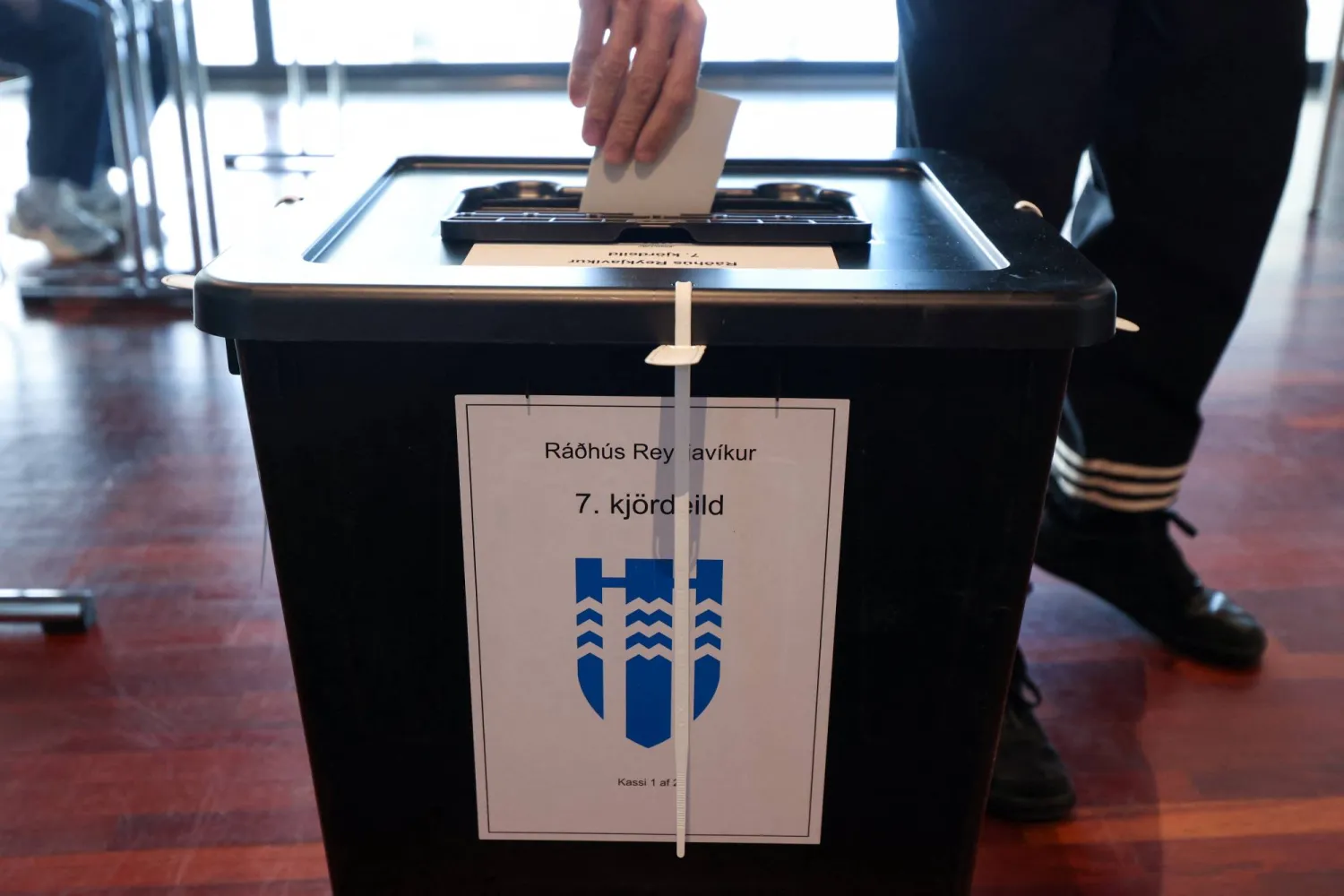

Iceland Votes on Whether to Resume EU Membership Talks

A person casts a vote for the national referendum on resuming EU membership talks, at the city hall in Reykjavik, Iceland, August 29, 2026. REUTERS/Leonhard Foeger
TT

Iceland Votes on Whether to Resume EU Membership Talks

A person casts a vote for the national referendum on resuming EU membership talks, at the city hall in Reykjavik, Iceland, August 29, 2026. REUTERS/Leonhard Foeger

Icelanders began voting Saturday in a referendum on whether to resume membership negotiations with the European Union, in a tight race that will be closely watched in Brussels.

The country of just under 400,000 people applied to join the EU in the wake of a 2009 financial crisis that devastated its economy, said AFP.

The membership talks were suspended in 2013 when a eurosceptic government came to power.

The referendum result is expected to go down to the wire, with the latest Gallup poll crediting the 'No' camp with 51.6 percent of voter support and the 'Yes' side with 48.4 percent, a gap within the statistical margin of error.

"It's pretty tight, but I'm always optimistic," Foreign Minister Thorgerdur Katrin Gunnarsdottir, a staunch europhile, told AFP ahead of the vote. "It's not done until it's done."

Voting began at 9:00 am (0900 GMT) and closes at 10:00 pm. With no exit polls and given the tight race, the first reliable results are only expected late Saturday at the earliest.

The around 273,000 voters are being asked to answer 'Yes' or 'No' to the question: "Should Iceland resume accession negotiations with the European Union?"

If the 'Yes' side wins, an accession agreement would be negotiated with Brussels and then put to a new referendum on actual membership.

The issue of fisheries -- a pillar of Iceland's economy and over which Reykjavik wants to retain exclusive control -- would have to be hammered out with Brussels, which this time around appears more willing to compromise.

"The fundaments (of the debate) are very domestic, but there is a significant impact that has come with the second term of (US President) Donald Trump and this sort of geopolitical upheaval," Bifrost University political scientist Eirikur Bergmann told AFP.

With Iceland's economy now flourishing, some voters see no reason to discuss EU membership, since the country already has access to the single market as a member of the European Economic Area.

"It's like if you are in a relationship with someone you don't live with, and if you lose something you have by getting married, then why get married?" said Hjordis Vilhjalmsdottir, a 60-year-old radio presenter wearing glasses in the red, blue and white of Iceland's flag.

"We don't need Brussels to rule us. We can do it ourselves," said Elias Theodorsson, a 65-year-old entrepreneur.

"We used to be one of the poorest countries in Europe only a hundred years ago. And now we are the most prominent country in Europe. We did it ourselves," he said.

- Money talks -

The flip side of Iceland's regained prosperity is soaring inflation and interest rates.

Some households are paying nine percent interest on their mortgages, making the prospect of joining the eurozone -- with its much lower rates -- very appealing.

"There's such a big gap, and it would mean so much for my household," said Alexandra Yr van Erven, a 32-year-old university administrator.

"I just think it's the responsible thing to do, to give this government the agency to negotiate a deal with the EU, so we can see what the possibilities are. And then we can evaluate the deal."

On the global stage, the return of war in Europe with Russia's invasion of Ukraine has shaken established security doctrines.

Trump's unpredictability and his threats to take over neighboring Greenland -- which he has mixed up with Iceland on several occasions -- have added to Icelanders' concerns.

Their island is strategically located in the sub-Arctic, has no military and depends on NATO and a 1951 bilateral agreement with the United States for its defense.

"People are now bringing into question the validity of that agreement," Bergmann said. "The geopolitical shifts are impacting the debate, but they're not driving it."

The referendum result will be followed closely by the EU, which has not welcomed a wealthy, net contributor to its budget since 1995.

Brussels would see Icelandic membership as an example of positive enlargement that could also make it more palatable for member states to agree to take in poorer countries like Montenegro -- or even help change some minds in ultra-wealthy non-EU member Norway, which could end up finding itself isolated.

"Iceland's decision would undoubtedly strengthen the case for the EU to welcome new members," EU Enlargement Commissioner Marta Kos noted.



Seoul: North Korean DMZ Landmine Blasts 'Violation of Armistice'

North Korean propaganda village "Gijungdong" is seen from a South Korea's observation post inside the JSA during a media tour at the Joint Security Area (JSA) on the Demilitarized Zone (DMZ) in the border village of Panmunjom in Paju, South Korea, 03 March 2023. (Reuters)
TT

Seoul: North Korean DMZ Landmine Blasts 'Violation of Armistice'

North Korean propaganda village "Gijungdong" is seen from a South Korea's observation post inside the JSA during a media tour at the Joint Security Area (JSA) on the Demilitarized Zone (DMZ) in the border village of Panmunjom in Paju, South Korea, 03 March 2023. (Reuters)

The blasts that wounded three South Korean soldiers last week were apparently caused by North Korean mines, Seoul said Tuesday, accusing Pyongyang of an armistice violation and warning of "corresponding measures".

One soldier lost a foot due to the explosions in the Demilitarized Zone (DMZ), the heavily mined buffer zone that has divided the two Koreas since their 1953 armistice.

The northern and southern boundaries of the zone are among the world's most heavily fortified frontiers and landmine incidents have previously heightened tensions between the two Koreas, which remain technically at war.

South Korean Defense Minister Kang Shin-chul spoke before a parliamentary hearing a day after his ministry said North Korean mines were "highly suspected" of causing the two explosions last week.

"This is a clear violation of the armistice agreement, and since North Korea bears responsibility, we will take corresponding measures," AFP quoted him as saying.

The military "has a range of necessary measures at our disposal, and we will implement them in stages", he added, without giving details.

The minister said that dense vegetation in the area had hampered the work of mine detectors, and that South Korean forces were in the DMZ to clear the area in advance of an operation with the UN Command.

That operation would assess terrain changes caused by North Korean forces south of the Military Demarcation Line, which marks the nations' effective border.

Hong Sung-pyo, senior researcher at the Seoul-based Korea Institute for Military Affairs, said it was reasonable to conclude that the mines were North Korean.

"In practical terms, the only forces operating in the DMZ area are the South Korean, US and North Korean militaries," he told AFP.

"Given the interoperability between South Korean and US forces, there would be little reason for the US military to have laid any mines there."

Yang Jin-hyeok of the Joint Chiefs of Staff told lawmakers that a site investigation on Tuesday discovered an unexploded North Korean plastic anti-personnel mine.

Seoul and Pyongyang remain technically at war since the Korean conflict ended in a truce, not a peace treaty.

Since 2024, after North Korean leader Kim Jong Un designated South Korea as his country's "principal enemy", Pyongyang's military has laid mines and built anti-tank barriers along the frontier as part of efforts to permanently seal it off.

During the operation, Pyongyang also blew up the northern parts of inter-Korean roads no longer in use.

Minister Kang said Tuesday that the North Korean mines linked to the September 21 incident were believed to have been laid as part of Pyongyang's border fortification work.

There was no mention of last week's blasts on North Korean state media.

In a 2015 incident, two South Korean soldiers were seriously wounded in a landmine blast on the southern side of the DMZ, with one losing both legs.

Seoul concluded that North Korean troops had crossed the Military Demarcation Line to plant the mines, an accusation Pyongyang denied.

The incident prompted South Korea to resume anti-Pyongyang loudspeaker broadcasts along the border.

But Yang Moo-jin, former president of the University of North Korean Studies in Seoul, said that there is "very little South Korea can realistically do" in retaliation for the latest blasts.

"Resuming loudspeaker broadcasts would do more harm than good, particularly because residents in border areas would bear much of the disruption," he told AFP.

"That effectively leaves Seoul with few options beyond demanding an apology from North Korea and seeking assurances that such an incident will not happen again" -- unless it is willing to risk heightened military tensions and further escalation, he added.


Trump Denies Offering Iran Sanctions Relief for Nuclear Concessions

US President Donald Trump takes questions at the Oval Office at the White House in Washington, D.C., US, September 28, 2026. REUTERS/Kevin Lamarque
TT

Trump Denies Offering Iran Sanctions Relief for Nuclear Concessions

US President Donald Trump takes questions at the Oval Office at the White House in Washington, D.C., US, September 28, 2026. REUTERS/Kevin Lamarque

US President Donald Trump on Monday denied offering Iran sanctions relief and the release of frozen funds in return for nuclear concessions from Tehran.

"This is untrue. I offered them NOTHING," Trump wrote on Truth Social, responding to an Axios report that cited US officials as saying that he was willing to give Iran sanctions relief and release Iranian frozen funds in ⁠return for "concrete" Iranian steps ⁠regarding the nuclear program.

CNN also reported, citing an unidentified US official, that Trump was willing to give Iran sanctions relief and release frozen funds as part of a final deal ⁠on the condition that Iran offered "concrete progress" on the nuclear issue.

Trump has offered shifting goals and timelines for the Iran war that began on February 28 when the US and Israel attacked Iran and Tehran responded with its own strikes on Israel and other states.

US and ⁠Iranian officials ⁠spoke separately with mediators on Monday as part of a renewed effort to end seven months of war, according to officials of both countries.

Iranian Foreign Minister Abbas Araghchi said he expected a formal answer on Tuesday from the US to Tehran's proposal to open the Strait of Hormuz, state media reported.

Qatari intermediaries "presented ideas, and we discussed them; they are set to raise the matter with the American side once more, after which the final US response will be conveyed to us," Araghchi said late Monday.

Iran's top diplomat, who is in New York for the UN General Assembly, said "the Qataris hope this will be done by tomorrow.”

"The current focus is solely on the Strait of Hormuz, and the reopening of the strait is contingent upon the fulfilment of certain conditions that we have communicated to the other side," he added.

The Strait of Hormuz lies at the heart of the conflict between the United States and Iran.


CNN, MS NOW, Politico Ask Judge to Extend Block on White House Ban

A CNN camera sets up before President Donald Trump, first lady Melania Trump, China's President Xi Jinping and his wife Peng Liyuan arrive at the National Archives Museum, Friday, Sept. 25, 2026, in Washington. (AP Photo/Julia Demaree Nikhinson)
TT

CNN, MS NOW, Politico Ask Judge to Extend Block on White House Ban

A CNN camera sets up before President Donald Trump, first lady Melania Trump, China's President Xi Jinping and his wife Peng Liyuan arrive at the National Archives Museum, Friday, Sept. 25, 2026, in Washington. (AP Photo/Julia Demaree Nikhinson)

CNN, MS NOW and Politico asked a federal judge late on Monday to issue a court order preserving their White House access while they fight US President Donald Trump's move to ban them over coverage he dislikes.

The news outlets asked a judge overseeing their case in Washington, DC, federal court to grant a preliminary injunction blocking Trump's bans ⁠until there is ⁠a final ruling in the case, Reuters reported.

US District Judge Timothy Kelly previously issued a 14-day temporary restraining order blocking the bans, finding they likely violated the news outlets' rights to fair ⁠legal treatment.

The outlets said in their September 21 lawsuit that Trump's bans were unlawful viewpoint discrimination under the First Amendment of the Constitution, which guarantees free speech and free press rights.

The Justice Department said Trump lawfully banned the outlets after determining their coverage threatened national security by revealing classified information.

Trump said ⁠in ⁠a September 18 social media post that he was banning the outlets for “reporting FAKE NEWS” and that they "shouldn't be able to constantly write or report FICTION and LIES.”

Trump has frequently clashed with the media in his second term and personally sued outlets including the New York Times, Wall Street Journal and BBC for defamation.