Nepal Resumes Bid to Reach Trapped Tunnel Workers

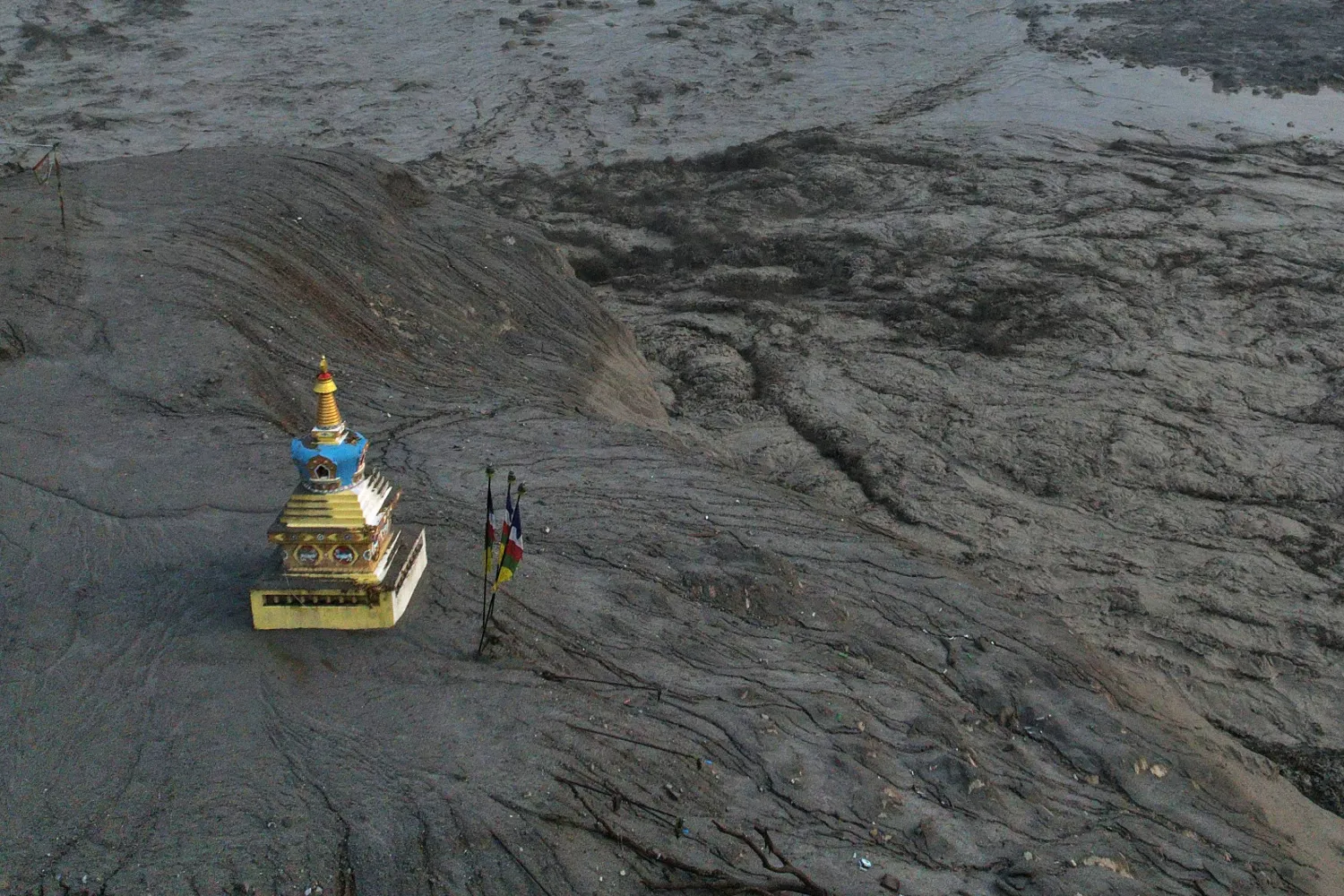
A drone view of the aftermath of flash flooding along the Trishuli river amidst fresh water surge warning in the Trishuli Bazaar area of Nuwakot district, Nepal, Sunday, Aug. 30, 2026. (AP)
TT

Nepal Resumes Bid to Reach Trapped Tunnel Workers

A drone view of the aftermath of flash flooding along the Trishuli river amidst fresh water surge warning in the Trishuli Bazaar area of Nuwakot district, Nepal, Sunday, Aug. 30, 2026. (AP)

Nepali rescuers seeking to reach hydropower workers believed trapped in tunnels swamped by flood debris resumed work Sunday after rain and rising river waters hampered efforts.

Rescue operations entered their fifth day since the floods, as teams battled difficult conditions at the disaster sites.

Nepal's government says more than 100 workers may still be alive and trapped inside multiple tunnels at hydropower projects, with key rescue efforts focused on the Trishuli 3A and 3B sites.

They are among 933 hydropower workers missing since a wall of mud and debris swept down on Wednesday morning, according to the National Disaster Risk Reduction and Management Authority.

At Trishuli 3A, army rescue teams using drills broke through Saturday evening into the upper part of a mud-swamped tunnel and began pumping air and sending in a camera.

But overnight rain and rising river waters hampered efforts early Sunday, filling the excavation area with water before conditions eased.

"As the floodwaters have receded, the team has resumed efforts to locate the tunnel entrance using drilling machines, excavators, hydraulic cutters, and other equipment," the Nepal Army said in a statement on Sunday.

Photographs shared by the disaster office showed workers wading through churned mud and navigating vast boulders left by the floods.

Nepal's prime minister's office said teams faced "difficult conditions" but were "making tireless efforts to search for and rescue those who may be trapped."

The rescue teams are using advanced search cameras and specialized monitors, it added.

The US Geological Survey said the disaster on the China-Nepal border was caused by a glacial collapse.

Specialized Indian and Chinese tunnel-rescue teams have also joined the efforts.

Nepal's expert mountain rescue teams -- who regularly aid climbers on the world's highest peaks, including Everest -- are also joining the search for missing people at another damaged hydropower site.

The Nepal Electricity Authority said 11 hydropower stations and one solar power station had stopped operating, with a combined capacity of 431.1 megawatts.

That represents about 10 percent of Nepal's installed electricity generation capacity, according to the authority.

Another 15 power projects under construction, with a combined planned capacity of 470 megawatts, have also been damaged.


Russia Says Preparing ‘Massive Strikes’ on Ukraine’s Energy Sector

A view of the destruction after a Russian attack struck a warehouse, followed by an explosion, in the village of Myla, Kyiv region, Ukraine, Saturday, Aug. 29, 2026. (AP)
TT

Russia Says Preparing ‘Massive Strikes’ on Ukraine’s Energy Sector

A view of the destruction after a Russian attack struck a warehouse, followed by an explosion, in the village of Myla, Kyiv region, Ukraine, Saturday, Aug. 29, 2026. (AP)

Russia's defense ministry on Sunday said it was gearing up for large-scale attacks on Ukraine's energy infrastructure in a tit-for-tat response to strikes by Kyiv.

"Russian forces have begun preparations for massive strikes against facilities in Ukraine's energy sector in response to the ongoing attacks by the Kyiv regime on civilian infrastructure and on Russia's oil and energy complex," it said on Telegram.

Last winter, Moscow repeatedly hit Ukrainian power plants, devastating the country's energy sector and plunging millions of people into cold and darkness in sub-zero temperatures.

Both sides have for several months escalated long-range strikes, targeting infrastructure such as warehouses, businesses, oil and port facilities, as well as ships, increasing civilian casualties.

On Sunday, the Russian army claimed to have struck a plant in Kyiv producing asbestos and cement whose warehouses, it said, were used to store explosives, as well as a manufacturer of drones and munitions.

On Saturday, a Russian strike on an ammunition depot in the suburbs of the Ukrainian capital triggered a huge explosion and killed at least 37 people.

Ukraine for its part attacked an oil refinery with drones in northwestern Russia, causing a fire, according to the local authorities.


Trump Cannot Deport Students for Criticizing Israel, Judge Rules

Students walk through the Stanford University campus, March 14, 2019, in Santa Clara, Calif. (AP)
TT

Trump Cannot Deport Students for Criticizing Israel, Judge Rules

Students walk through the Stanford University campus, March 14, 2019, in Santa Clara, Calif. (AP)

Citing the importance of the First Amendment, a federal judge in California says the US government is unconstitutionally silencing critics of Israel's war in Gaza and others as part of the Trump administration’s quest to deport noncitizens who it says disrupted college campuses while expressing their views.

Judge Noël Wise, in a ruling Friday, delivered a victory for The Stanford Daily, the student newspaper at Stanford University, which has said some international students were afraid to speak out because of the deportation threat.

“Freedom of speech is illusory if we are only ‘free’ to express complementary views about the government and its leaders,” the judge wrote.

The decision largely piggybacks on findings from nearly a year ago by a US district judge in Boston, who ruled that the Trump administration violated the Constitution when it targeted people who are not citizens for deportation solely for supporting Palestinians and criticizing Israel.

Wise wrote that the freedoms of speech and the press are “foundational to America’s enduring democracy.” The judge cited free-speech and vagueness flaws that violate the First Amendment and Fifth Amendment as she struck down portions of the provisions that the federal government follows regarding deportations.

Wise cited retaliation in March 2025 by US immigration authorities against people who engaged in speech supporting the Palestinians and against Israel's actions, which a growing number of experts, including those commissioned by a UN body, have said amount to genocide. The judge also cited retaliation against people who were critical of Charlie Kirk after the Turning Point USA co-founder was assassinated last September.

“Tomorrow, or perhaps even today, targets may include anyone in the United States who exercises their freedom of speech to simply express opinions the government does not like,” the judge in San Jose said.

“This downward spiral is antithetical to our Constitution that recognizes our right to speak freely,” she added. “Here you can simultaneously hate the content of a person’s speech and love the country that cherishes the freedom to allow it. Zealous protection of our Constitutional right to free speech is a provocative demonstration of our country’s powerful lack of fear.”

The Justice Department did not respond Saturday to a message seeking comment on the decision.

George Porteous, the editor-in-chief of The Stanford Daily, responded to the ruling by saying on X: “The reporters in our newsroom shouldn’t have to fear that writing a story will result in their deportation. Today’s victory means they won’t have to.”

Conor Fitzpatrick, an attorney with the Foundation for Individual Rights and Expression, which brought the lawsuit, praised the ruling.

“In America, free speech doesn’t just belong to the people who say things the government agrees with,” Fitzpatrick said in a release.

In her decision, Wise said it was clear that the government's tactics has had an effect on college campuses.

“The government has offered a chilling message regarding protected speech — speak out against Israel or in support of Palestinians and we will revoke your visa and deport you. Behave. Noncitizen students heard the warning and heeded. And, as the idiom goes, the silence is deafening,” the judge wrote.

At The Stanford Daily, lawfully present noncitizens at the paper have quit, withheld articles, refused assignments, requested articles be taken down, and asked for anonymity due to fear of adverse immigration consequences, Wise noted.

She said noncitizens have the same First Amendment rights as citizens and yet were left to guess what the US foreign policy was at any given moment and on any given subject.

“This is an incomprehensible standard,” she said. “While the Court understands that the government has been granted considerable discretion on foreign policy and immigration matters, that discretion must nevertheless still ensure that ordinary people can understand what the law permits and prohibits.”

Wise added: “Our Constitutional right to freedom of speech guarantees people the right to express — through their words, actions, or assembly — opinions that may be repugnant, views that run counter to prevailing political norms, or beliefs that otherwise challenge the country’s domestic or foreign policy, military engagement, or war.”


No Dutch Investigation into Mladic’s Death, Says Tribunal

The flag of Bosnia and Herzegovina among graves at the memorial cemetery where the victims of the Srebrenica genocide are buried, following the death of Bosnian Serb Ratko Mladic, former general convicted of Bosnia genocide, in Potocari, Bosnia and Herzegovina, August 28, 2026. (Reuters)
TT

No Dutch Investigation into Mladic’s Death, Says Tribunal

The flag of Bosnia and Herzegovina among graves at the memorial cemetery where the victims of the Srebrenica genocide are buried, following the death of Bosnian Serb Ratko Mladic, former general convicted of Bosnia genocide, in Potocari, Bosnia and Herzegovina, August 28, 2026. (Reuters)

A UN court said Saturday evening that Dutch authorities would not be conducting a criminal investigation into the death of Ratko Mladic, the convicted Bosnian Serb war criminal.

Mladic, serving life in prison in The Hague for genocide and war crimes committed during the 1992-1995 Bosnian war, died in hospital on Thursday, having suffered several strokes in recent months.

His age has always been a matter of dispute. He claimed to have been born in March 1943, but the tribunal listed his birth year as 1942 -- local media widely reported that he'd died at the age of 84.

The International Residual Mechanism for Criminal Tribunals Mechanism said the Dutch authorities had carried out the procedures required by national law.

On Friday, they had decided "that no criminal investigation would be opened and that they would not be conducting an autopsy", the statement added.

The Mechanism said it had also appointed a judge, Iain Bonomy, to conduct a separate investigation into Mladic's death. That inquiry was still ongoing and details, for the moment, were confidential, it added.

On Monday, days before Mladic's death, the Serbian authorities had called for his release on health grounds for treatment in Serbia.

In May, the Mechanism had already rejected a request from his family for Mladic's release.

Mladic, who was arrested in Serbia in 2011, had the verdict against him confirmed on appeal in 2021.

One of the crimes ascribed to him was the July 1995 massacre of approximately 8,000 Bosnian men and boys in the eastern Srebrenica region -- the worst such atrocity in Europe since WWII.

The Mechanism's role is to carry out the residual duties of the UN tribunals based in The Hague, including the International Criminal Tribunal for the former Yugoslavia, which convicted Mladic.