


NASA's Newest Space Telescope Launches on a Quest to Explore the Hidden Universe

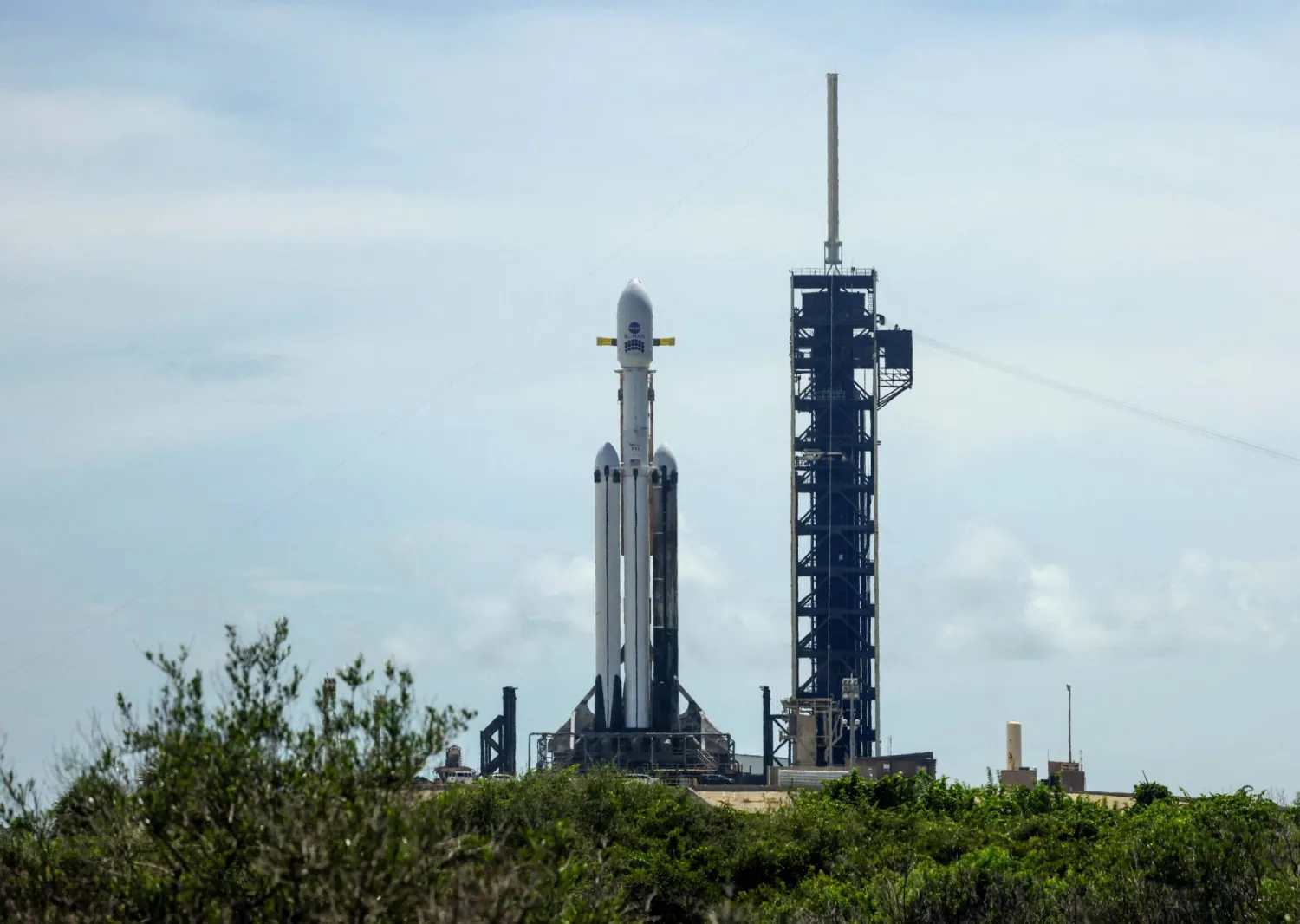
A SpaceX Falcon Heavy rocket is prepared for launch with NASA's Nancy Grace Roman Space Telescope aboard at the Kennedy Space Center in Cape Canaveral, Florida, US, August 29, 2026. (Reuters)
TT

NASA's Newest Space Telescope Launches on a Quest to Explore the Hidden Universe

A SpaceX Falcon Heavy rocket is prepared for launch with NASA's Nancy Grace Roman Space Telescope aboard at the Kennedy Space Center in Cape Canaveral, Florida, US, August 29, 2026. (Reuters)

NASA’s newest crown jewel blasted off Sunday to hunt for planets around other stars, explore secret dark energy and survey the cosmos like never before.

SpaceX launched the $4.3 billion Roman Space Telescope shortly after daybreak aboard a triple-the-fire-power Falcon Heavy rocket from Kennedy Space Center. Roman blazed toward an observation point 1 million miles (1.6 million kilometers) away that's home to the Webb Space Telescope, one of NASA's other big-ticket eyes in the sky.

The bus-sized telescope — named after the late Nancy Grace Roman, NASA’s first chief astronomer — will take more than three months to reach its destination. Once there, it will cast the widest gaze yet on the hidden parts of the universe from space, uncovering the unimaginable with unsurpassed speed.

“It’s going to find thousands of supernovae, tens of thousands of planets, billions of galaxies and tens of billions of stars,” said NASA science mission director Nicky Fox. “It’s going to be able to do things that we’ve never been able to do before with its massive field of view.”

Several minutes after the thunderous launch, the rocket's two reusable side boosters descended tail-first in a thrilling scene, producing sharp sonic booms as they landed back at Cape Canaveral. Soon afterward, the telescope separated successfully from the rocket's upper stage, drawing applause from ground controllers.

Fox was in tears watching the action unfold. “It's such a good day!” she said.

Roman’s field of view is more than 100 times wider than that of NASA’s Hubble Space Telescope, still churning out celestial glamour shots after 36 years in orbit. Webb joined the effort several years ago with an even narrower yet spot-on vision capable of zooming in on objects almost as old as the universe.

These three orbiting powerhouses will join forces — along with the European Space Agency’s Euclid spacecraft and the National Science Foundation’s Vera C. Rubin Observatory in Chile — to reveal some of the universe’s biggest secrets.

Inside the countless galaxies awaiting discovery are stars with planets. Once these new worlds are spotted by Roman, the more powerful and sensitive Webb will take aim to fill in the blanks.

“Roman’s vast reach will allow us to find the weird, the rare and the unusual,” senior project scientist Julie McEnery said on the eve of launch. “We’ll redefine what it means to find a needle in a haystack.”

Perhaps even more important, astronomers expect Roman to shed light on the dark matter and dark energy that make up most of the universe yet remain concealed. Roman's catalog of galaxies will help scientists ascertain how quickly the universe is expanding due to these puzzling, unseen forces.

Roman’s superpower is speed.

A month of Milky Way observations by Roman would take Hubble a century to complete, according to McEnery. Roman should make quick work of scanning the galactic bulge at dead center, she added, providing the deepest look yet into the heart of our galaxy.

Besides a wide-field infrared camera that matches Hubble’s sensitivity but is 1,000 times faster, Roman holds an instrument to block out starlight. This experimental, eclipse-creating coronagraph will allow Roman to directly image any planet, however faint, that might be orbiting the masked star.

The telescope is designed to be refueled, meaning if a robotic tanker becomes available in the coming decade, that could extend its life.

Launching nearly a year ahead of schedule and within budget, Roman is NASA's first space telescope to be named after a woman.

Retired NASA scientist Ed Weiler said the honor is long overdue. He coined the phrase “Mother of Hubble” for Roman, who hired him in 1978. Observatories above Earth’s obscuring atmosphere can see farther and better, she insisted after joining the brand new NASA in 1959. She died in 2018 at age 93.

“This is very, very fitting. I think Nancy would be very proud” that the namesake telescope will tackle some of the biggest, lingering questions about the universe such as dark energy, Weiler said.

Hubble launched in 1990 with a flawed mirror that required spacewalking astronauts’ dramatic intervention. Roman’s primary mirror is the same size as Hubble’s — nearly 8 feet (2.4 meters) in diameter — and is actually spy satellite surplus.

The National Reconnaissance Office donated two leftover mirrors to NASA more than a decade ago for repurposing. The second mirror is still in storage.


82-year-old Dies after Beach Fight in Greece over Sun Lounger

Tourists from a nearby hotel watch military helicopters fly overhead during Medusa 15, a joint military exercise led by Greece and Egypt, at Maleme on the Greek island of Crete, Friday, Sept. 18, 2026. (AP Photo/Thanassis Stavrakis)
TT

82-year-old Dies after Beach Fight in Greece over Sun Lounger

Tourists from a nearby hotel watch military helicopters fly overhead during Medusa 15, a joint military exercise led by Greece and Egypt, at Maleme on the Greek island of Crete, Friday, Sept. 18, 2026. (AP Photo/Thanassis Stavrakis)

An 82-year-old man died Sunday after he got into a fight over a sun lounger on a beach in Greece near Athens, local media reported.

The octogenarian had a dispute with a 76-year-old man and a 21-year-old woman over the sun lounger, with the argument degenerating into a scuffle between the two men, according to police, the ANA news agency and ERT state television channel reported.

The 82-year-old, badly hurt, was transported to hospital from the Vouliagmeni beach resort area where the argument broke out. He was later declared dead at the hospital, AFP said.

Both the 76-year-old man and the 21-year-old woman were arrested, ANA said, with police investigating what happened.


10 Lions Die in Suspected Poisoning at Tanzania Wildlife Reserve

Lions are seen in their counpound at the Artis Amsterdam Royal Zoo in Amsterdam, Netherlands in this handout photo released to media on January 28, 2021. Artis Amsterdam Royal Zoo/Handout via REUTERS
TT

10 Lions Die in Suspected Poisoning at Tanzania Wildlife Reserve

Lions are seen in their counpound at the Artis Amsterdam Royal Zoo in Amsterdam, Netherlands in this handout photo released to media on January 28, 2021. Artis Amsterdam Royal Zoo/Handout via REUTERS

Ten lions were found dead in Tanzania's Ngorongoro wildlife reserve this week and preliminary findings suggest they may have been poisoned, the area's management authority said.

The deaths raise concerns over the conservation of lions in one of Africa's most renowned wildlife ecosystems. Poisoning has been a recurring threat to large ⁠carnivores across parts ⁠of East Africa, often linked to conflicts between predators and livestock owners.

The lions were discovered on September 18 in the Ndutu area of Endulen Ward in Arusha ⁠region, Reuters quoted the Ngorongoro Conservation Area Authority as saying in a statement released late on Saturday.

"Preliminary findings suggest the animals may have died after ingesting poison," the authority said, adding that it had launched an investigation to determine the cause and identify those responsible.

The Ngorongoro Conservation Area, a UNESCO ⁠World ⁠Heritage Site in northern Tanzania, is one of the country's leading tourism attractions. It is home to a wide range of wildlife, including lions, elephants, buffaloes and endangered black rhinos.

Last month, police arrested four suspects in an investigation into the deaths of 18 elephants across the border in Kenya.


Diana's Brother Compares Media Treatment of Harry, Meghan to Late Princess' Ordeal

FILED - 13 February 2018, United Kingdom, Edinburgh: FILE PHOTO - Prince Harry and Meghan, Duke and Duchess of Sussex, attend a reception for young people at Holyroodhouse Palace in Edinburgh. Photo: Andrew Milligan/PA Wire/dpa
TT

Diana's Brother Compares Media Treatment of Harry, Meghan to Late Princess' Ordeal

FILED - 13 February 2018, United Kingdom, Edinburgh: FILE PHOTO - Prince Harry and Meghan, Duke and Duchess of Sussex, attend a reception for young people at Holyroodhouse Palace in Edinburgh. Photo: Andrew Milligan/PA Wire/dpa

The media's treatment of Prince Harry and his wife Meghan is on a par with that faced by his mother Diana, the late princess' brother said in an interview published on Sunday, warning that lessons needed to be learned from that period.

Diana died aged 36 in a 1997 Paris car crash as photographers pursued her on motorbikes, sparking an outpouring of grief and a reckoning over whether the media bore some responsibility for her death after splashing details of her life across front pages for years.

"If you look at an article in a tabloid about Diana or the couple that you were ⁠mentioning, Harry and ⁠Meghan, you know, they can be really, really unpleasant," Diana's brother, Earl Charles Spencer, told the BBC.

"And I think it would be really beholden on people to learn from Diana's example.

"I'm not here to speak for Harry and Meghan, but for anyone who's being destroyed in this way daily, it must be such ⁠a cancerous influence in their life,” Reuters quoted him as saying.

Harry, Diana's youngest son, and Meghan, cited the impact of what they called a toxic media on their lives before they quit royal duties and moved to the United States in 2020.

They also sued much of the British tabloid press - with varying degrees of success - before they moved back to Britain in August.

Spencer has made headlines around the world in the last week after his book, "Swan Song: Diana, My Sister", was serialized in the Daily Mail, accusing her former husband, the now ⁠King Charles, of ⁠sounding "giddily elated" in the hours after her death.

The palace hit back by saying the king "is mindful that the pain of fraternal grief can cloud reason, affect judgment and color memory in ways others do not recognize, even many years after such a loss".

The publication of the book and the return of Harry and Meghan to Britain are another challenge for the king, who is still undergoing treatment for cancer.

Diana's family accused the royals of showing a lack of support or care towards the late princess before her death, a charge that was repeated by Harry, who is now largely estranged from the rest of the royal family.
