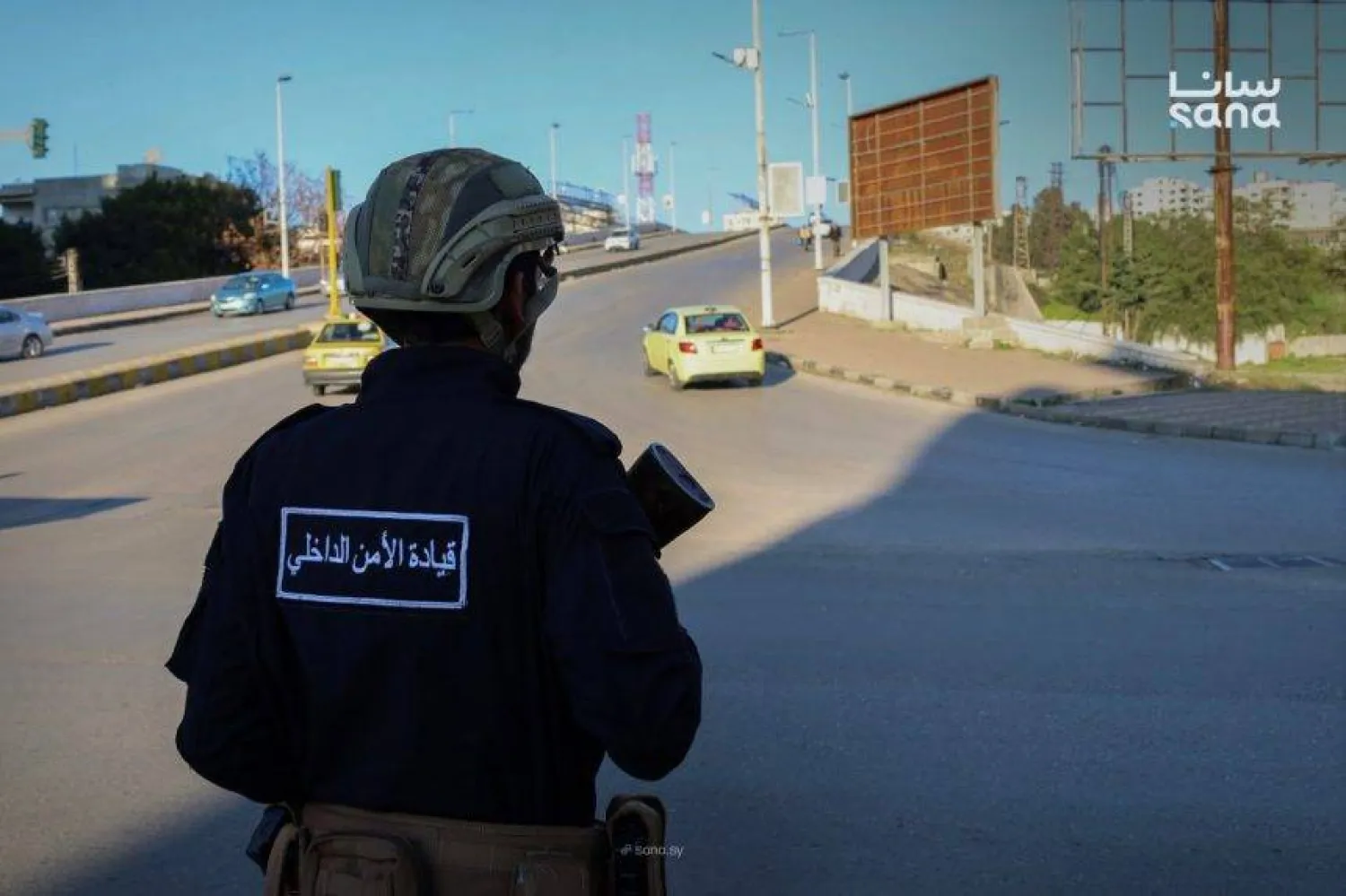
Syrian Authorities Say Killed Assad-Era Officer After Clash

A member of Syria's internal security forces in Tartus city. (SANA)
TT

Syrian Authorities Say Killed Assad-Era Officer After Clash

A member of Syria's internal security forces in Tartus city. (SANA)

Syrian security forces said on Sunday that they killed an army commander who served under ousted ruler Bashar al-Assad, after he opened fire on them as they tried to arrest him.

In a statement, the forces accused Firas Abdul Karim Hammoud of having taken part in anti-government insurrections that killed security personnel.

Since Assad's fall in December 2024, Syria's new authorities have arrested dozens of security officials from his rule, and trials began in April.

The security forces said they "neutralized Firas Abdul Karim Hammoud... following an armed clash and a raid on his hideout in the town of Safita" in Tartus province in the coastal Alawite heartland.

Hammoud had previously "opened fire on security personnel during an attempt to arrest him", they added.

"During the recent operation, he again opened fire and initiated a firefight with the security forces... necessitating their response."

They said Hammoud served as a commander of the special forces in the so-called "25th Division" under Assad's rule.

They accused him of working under Assad-era general Ghiath Dalla in leading pro-Assad groups on the coast after the former president's fall.

They added that he was involved in "armed insurrection operations" against state institutions that killed security personnel.

Dalla, a former officer in the much-feared Fourth Brigade, had announced on social media last year the formation of a "military council for the liberation of Syria".

The announcement came shortly before deadly violence targeting the Alawite minority, to which Assad's family belongs, erupted on the Syrian coast in March 2025.

Authorities accused armed Assad supporters of sparking the violence by attacking security forces in an ambush.


Hamas Executes Qassam Operative for ‘Collaborating’ with Israel

Supporters carry posters of Qassam Brigades commander Izz al-Din al-Haddad during his funeral in Gaza in May. (AFP)
TT

Hamas Executes Qassam Operative for ‘Collaborating’ with Israel

Supporters carry posters of Qassam Brigades commander Izz al-Din al-Haddad during his funeral in Gaza in May. (AFP)

Platforms affiliated with the Hamas movement in Gaza announced that gunmen from its armed wing, the Qassam Brigades, executed an operative from its ranks at dawn on Sunday after convicting him of "collaborating with Israel and causing the deaths of seven Qassam commanders and operatives, including his brother," in recent Israeli assassinations.

The execution was carried out by firing squad outside the Grand Mosque in central Khan Younis, in the southern Gaza Strip, more than a month after his arrest and interrogation.

Two field sources within Palestinian factions in Gaza told Asharq Al-Awsat that Al-Qassam circulated a briefing within its ranks stating that "a resistance member grew suspicious of the executed individual following movements near the site of an assassination operation in the Al-Aqqad Mosque area in Al-Mawasi, Khan Younis."

One of the sources said that "up until the moment of his arrest, the executed individual was an operative in Al-Qassam," noting that "he had served for a period as the commander of a military unit before being removed from that role."

The second source told Asharq Al-Awsat that the man "temporarily assumed command of the military unit for only a few months for security reasons, and was tasked with relaying messages to certain field commanders."

The source added that he was "not a senior commander, yet to many he was a trusted figure given that several members of his family are movement operatives."

Neither Hamas nor the two sources provided details about the circumstances under which the man defended himself, or the nature of the proceedings that led to imposing the maximum penalty one month after his detention.

Hamas and its operatives exercise the role of de facto authorities, to varying degrees, in the areas of the Gaza Strip under their control - estimated at 35 to 40 percent of the enclave, with Israel occupying the remainder.

One source explained that the executed man "was arrested last September after he was spotted at the site of a strike, subsequently tracked the targeted victim's body to identify him, and visited the hospital twice to confirm. At that point, an operative noticed him; he was interrogated, and a modern iPhone was found in his possession."

The details relayed by the two sources from Gaza mirror another incident that Hamas deemed collaboration and in which it executed the accused, after convicting him of causing the assassination of Qassam Brigades commander Izz al-Din al-Haddad last May following a prolonged pursuit.

Hamas has carried out several executions of individuals convicted of collaboration during the Israeli war on Gaza since 2023, while Israel encourages Gaza residents to collaborate with it and drops leaflets to locals containing phone numbers to contact Israeli officers.

According to one of the sources, the collaborator was found to have divulged extensive intelligence he held on Qassam commanders and operatives, in addition to providing security details regarding the operations and deployment of security apparatuses in Khan Younis.

The source noted that he had been recruited recently, roughly within a year of the day he was caught and exposed. The other source disclosed that similar executions of other collaborators, who were recently uncovered in Khan Younis, may follow.


Libya Suspects Drone Strike on Russian Ship Caused Blast in Benghazi

A satellite image of smoke rising from a fire after an explosion aboard a Russian ship docked at Benghazi port, Libya, November 22, 2026. (2026 Planet Labs PBC/Handout via Reuters)
TT

Libya Suspects Drone Strike on Russian Ship Caused Blast in Benghazi

A satellite image of smoke rising from a fire after an explosion aboard a Russian ship docked at Benghazi port, Libya, November 22, 2026. (2026 Planet Labs PBC/Handout via Reuters)

Authorities in divided Libya's east said a Russian ship docked at the Benghazi port was hit on Sunday in a suspected drone attack, causing a blast but no casualties.

There was no immediate claim of responsibility for the strike, but it comes as Ukrainian forces have stepped up their long-range barrages against Russia far beyond the front lines.

On Saturday, a drone hit a Russian cargo ship in the eastern Baltic Sea, close to the waters of Finland, whose border guard said the strike was Ukrainian.

Libya's eastern administration did not identify those behind Sunday's attack but said Libya was "not a party to the Russian-Ukrainian war".

The conflict, that began with Moscow's 2022 full-scale invasion of Ukraine, has killed hundreds of thousands of people and displaced millions.

Earlier reports said a fire broke out inside an ammunition depot at a naval base, but the authorities in Libya's east said "the explosion occurred on board a Russian ship docked in the port".

"It is suspected that the ship was attacked by drones," an official statement said.

"The ship was en route back to Russia and its stop was for refueling and resupply."

Libya's eastern authorities said they would launch a joint investigation with Russia.

The Government of National Unity in Tripoli said in a statement it was alarmed by "risks posed by involving civilian ports and facilities in activities linked to external conflicts".

- 'Shadow fleet' -

In March, a Russian liquefied natural gas carrier sank off the Libyan coast following an attack, which Russian President Vladimir Putin pinned on Ukraine.

The ship had been among Russia's so-called "shadow fleet" of tankers that carry its oil and gas around the world, skirting Western restrictions.

Ukraine has at times admitted to attacking Moscow's shadow fleet, including in the Mediterranean Sea last December.

The Tripoli government said it "rejects the transformation of Libya into an arena for international conflicts" and the use of Libyan territory "for any military or logistical activities that could jeopardize the security of Libyans or the sovereignty of the state".

Earlier on Sunday, Al-Masar TV channel cited local civil defense forces as saying response teams were deployed at a military facility to contain a blaze after the reported blast.

Libya Alhadath TV said the civil defense urged locals to avoid the area, later reporting that the fire had been put out.


Aoun: Lebanon Cannot Be Liberated Through Mini-States

Lebanese national flags line a highway ahead of the country's 83rd Independence Day celebrations in the Dbayeh coastal suburb, north of Beirut, Lebanon, 20 November 2026. (EPA)
TT

Aoun: Lebanon Cannot Be Liberated Through Mini-States

Lebanese national flags line a highway ahead of the country's 83rd Independence Day celebrations in the Dbayeh coastal suburb, north of Beirut, Lebanon, 20 November 2026. (EPA)

Lebanese President Joseph Aoun stressed on Sunday that "Lebanon will neither be liberated, nor stabilize, nor prosper except through sovereignty resting solely with the state, not through mini-state projects."

He made his remarks on 37th anniversary of the assassination of President Rene Moawad, building upon the position he declared on Independence Day on the state's exclusive control over arms and the need to establish a state with sole decision-making authority. His stance was met with support and praise from religious authorities and political forces, and backlash from Hezbollah and its allies.

Separately, Marking Independence Day, Parliament Speaker Nabih Berri said that "independence this year is incomplete and unfulfilled, and will only be realized by liberating the land and restoring unity across official and popular Lebanon."

Speaking on the anniversary of Moawad’s assassination, Aoun said: "They blew up President Rene Moawad because he refused to trade the presidency for sovereignty, refused to relinquish independence in exchange for stability, and confronted the equation of surrendering to the tutelage of a friend as a coercive price imposed to confront the occupier."

"He realized 37 years ago that Lebanon will neither be liberated, nor stabilize, nor prosper, nor remain a final homeland for all its citizens, except through sovereignty resting solely with the state, not through mini-state projects; through consensus anchored in balance, not illusions of hegemony; and through complete and responsible national freedom, with belonging and loyalty solely to Lebanon, not to the dreams of foreign powers of control, annexation, and encroachment,” he noted.

Lebanon’s Grand Mufti Sheikh Abdul Latif Derian said the speeches delivered by Aoun and Prime Minister Nawaf Salam on Independence Day fostered reassurance, describing their positions as "bold, courageous, and firm" at this critical juncture for the country.

Derian stressed that both addresses are rooted in the Taif Agreement, which mandates the state's monopoly on weapons and the extension of its authority across all Lebanese territory.

He also underscored support for the diplomacy pursued to end the Israeli occupation, calling it the best path for residents of the South to return to their villages and towns and launch the reconstruction process.

In his Independence Day address, Aoun declared: "Completing our independence today faces two main obstacles: the Israeli occupation of parts of our land, and foreign interference in our affairs, specifically by certain influential quarters within the Iranian regime, through weapons and decision-making outside the authority of the Lebanese state."

Salam stressed that the state alone holds the power over war and peace, and that its authority will extend across all territory under a single legitimate armed force.

Support for Aoun's speech

Lebanese Forces party leader Samir Geagea said Aoun's speech reflects "the voice of an overwhelming majority of Lebanese," urging that the address be translated into tangible steps on the ground as quickly as possible.

MP Ashraf Rifi declared his full backing for the president, describing his address as "the true Independence Day speech" because it clearly identified the obstacles to completing Lebanon's independence: Israeli occupation, Iranian interference, and weapons outside state authority.

Rifi questioned critics of the president’s remarks: "What has Lebanon gained from the 'support wars' and regional axes other than destruction, displacement, and losses? And who granted any faction the right to drag the nation into regional conflicts in service of foreign interests?"

Along the same lines, Maronite Patriarch Beshara al-Rahi stressed in his Sunday sermon that independence must not remain "merely written in history," but must be tangible on the ground and embodied in national will and decision-making.

He urged the necessity of protecting the South, reclaiming all Lebanese territory, and keeping the country neutral from conflicts and wars.

Qabalan attacks Aoun

Senior Jaafari Mufti Sheikh Ahmad Qabalan rejected Aoun’s characterization of Iranian involvement as foreign interference.

Qabalan said: "There is no party tied to Iranian interference; rather, there is a Lebanese resistance faction that fought Israel for decades, made the greatest sacrifices to defeat the occupying Zionist army, defeated it with God's help and Tehran's assistance, and liberated our country, Lebanon."

He added that the price paid by the "resistance duo" - comprising the Amal Movement, Hezbollah, and their popular base - was paid "so that Lebanon and the Middle East region remain, and so that Your Excellency remains in Baabda Palace."

Hezbollah

Hezbollah bloc MP Hassan Fadlallah said Lebanon's independence remains incomplete due to the ongoing Israeli occupation of parts of its land and foreign interference in state decisions and the shaping of its policies and stances.

Fadlallah accused the US administration and foreign embassies of inciting certain Lebanese parties to confront other Lebanese, aiming to undermine internal unity and push the country into a clash serving foreign interests.

By contrast, he expressed confidence in Iran, asserting that it is "shaping a new equation in the region from which Lebanon will be the primary beneficiary."